The development of artificial intelligence and edge computing gives rise to the edge intelligence, where the intelligent tasks such as deep neural network (DNN) based inference can be cooperatively performed by edge server and devices. Existing methods often treat DNN based tasks as indivisible units, optimizing computation offloading and resource allocation without exploiting the structural flexibility of DNN models. In this work, we investigate the joint optimization problem of resource allocation and computation offloading in the multi-access edge computing (MEC) network for DNN inference tasks. The objective is to maximize the inference accuracy while minimizing the task latency, through the joint design of DNN model partition, early exiting selection, device association, bandwidth and computation resource allocation. In addition, we consider the long-term optimization so the random generation of tasks and queue stability at devices and servers are also taken into account. Since the formulated problem is hard to solve, we opt to the deep reinforcement learning approach and leverage the transformer aided deep deterministic policy gradient algorithm to find the solution. Simulations confirm the promising performance of the proposed algorithm, which outperforms the other benchmark schemes.
In vehicular networks, various intelligent tasks, such as traffic flow prediction, object detection, and route planning, rely on vehicle collaboration for successful completion. Federated learning (FL), as a privacy-preserving collaborative distributed deep learning paradigm, has been increasing applications in vehicular networks. However, due to limited communication resources, frequent parameter transmissions between vehicles and remote base stations during the FL process result in the significant delays. Additionally, FL faces performance degradation challenges due to non-independent and identically distributed (non-IID) data. Moreover, the straggler effect in FL further prolongs the overall delay of FL. To address these issues, we propose a novel trust-based computation offloading assisted clustered federated learning framework for vehicular networks. In this framework, vehicles are grouped into different clusters and the straggling vehicles can offload partial computation tasks to their corresponding cluster heads. Specifically, we first analyze the impact of clustering strategy on learning loss and then design a multi-dimensional awareness clustering scheme that jointly considers vehicles’ physical domain, trust degree, and data distribution. Moreover, we formulate a total delay minimization problem for FL by optimizing computation offloading and bandwidth allocation decisions for each cluster. To solve this, we propose a dual actor-critic cross deep deterministic policy gradient (DC-DDPG) algorithm which determines the optimal offloading ratio and bandwidth allocation for each cluster. Extensive experiments demonstrate that our proposed scheme significantly outperforms baseline methods in reducing FL latency.
In low-altitude intelligent networks (LAINs), spectrum sensing is crucial to ensure efficient spectrum utilization especially for distributed unmanned aerial vehicle (UAV) users. However, the dynamic and complex electromagnetic environments in LAINs pose new challenges to spectrum sensing. To address specific challenges such as sparse data, low signal-to noise ratio (SNR), and dynamic spectrum conditions in LAINs, this paper proposes a novel spectrum sensing scheme, which integrates convolutional neural networks (CNNs) and Transformers in a meta-learning framework, namely Meta-CT scheme. The proposed Meta-CT scheme adopts a meta-learning architecture, in which CNNs and Transformers are jointly integrated as the base learner. By combining convolutional operations and self attention mechanisms, the weak features of low-SNR signals can be extracted. Furthermore, the proposed scheme can achieve spectrum sensing with sparse data by leveraging the inherent few-shot learning ability of meta-learning. The Meta-CT scheme can also optimize the initialization of model parameters, enabling rapid adaptation to new dynamic spectrum environments. Simulation results indicate that the proposed Meta-CT scheme significantly outperforms traditional spectrum sensing schemes, achieving superior accuracy and better robustness in sparse data and low-SNR scenarios. The proposed scheme provides a novel and efficient spectrum sensing paradigm for dynamic and heterogeneous electromagnetic environments in LAINs.
This work investigates a Field of View (FoV) prediction-based Adaptive Bitrate Streaming (ABS) strategy aimed at enhancing the Quality of Experience (QoE) for users watching 360-degree videos at wireless mobile devices. In doing so, there are two challenges: 1) how to achieve accurate FoV prediction, and 2) how to provide a flexible bitrate adaption service given the limited storage space of the video server. To address these issues, we propose a novel adaptive streaming strategy for 360-degree videos that integrates a Transformer-based FoV prediction model with on-demand video transcoding under dynamic wireless network conditions. To strike a balance between user QoE and transcoding overhead, we formulate a QoE-driven system utility maximization problem that jointly optimizes computing resource allocation and bitrate adaptation. Given the dynamic and multi-slot nature of the problem, it is inherently complex. To overcome this, we transform the original problem into a Markov decision process (MDP) and solve it using the residual learning and deep deterministic policy gradient (DDPG) method. Simulation results demonstrate that the proposed methods outperform the state-of-the-art baselines in terms of FoV prediction accuracy and utility improvement.
This paper focuses on the energy-efficient uncrewed aerial vehicles (UAVs) assisted vehicular networks, where multiple rotary-wing UAVs are deployed to provide uplink service to numerous ground vehicles. The objective is to maximize the long-term system energy efficiency (EE) over the entire service period, through jointly optimizing the vehicle-UAV association, the sub-carrier assignment, the power control of vehicles and the trajectory design of UAVs. The formulated problem involves the limitations on the transmit power of vehicles and the propulsion power of UAVs, the quality of service (QoS) requirements of vehicles, the UAV movement constraints, and co-channel interference among vehicles. This makes the problem a mixed integer non-convex fractional programming problem accompanied by a mass of variables and diverse constraints, which is difficult to be solved within the polynomial time through traditional optimization methods. To cope with the timely decision-making requirement and dynamic moving scenario, we opt to the deep reinforcement learning (DRL) approach. To do so, the formulated problem is first transformed to a Markov decision process (MDP). Then, an improved k-means proximal policy optimization (IKPP) algorithm is proposed to solve the MDP problem. The proposed algorithm involves action reconstruction, the improved k-means algorithm, and proximal policy optimization-clip algorithm, which can help obtain the solutions with low complexity. Simulation results demonstrate the convergence, scalability and real-time of the proposed algorithm, along with its performance advantage over other benchmark algorithms.
This paper investigates the Integrated Sensing and Communication (ISAC) empowered predictive beamforming design for Uncrewed Aerial Vehicle (UAV) assisted networks, where the ground Base Station (BS) explores the echoes of communication signal for real-time UAV tracking. To ensure practicality and generalizability, we establish a random UAV mobility model incorporating position fluctuations and attitude variations during flight, which poses challenges to accurate UAV tracking. To address this, we propose Historical Echoes-based Convolutional Time Attention Network (HECTA-Net), a novel deep learning framework for end-to-end beamforming prediction. The proposed HECTA-Net integrates Convolutional Neural Network (CNN) and Temporal Convolutional Network (TCN) to jointly extract the spatio-temporal features from historical ISAC echoes across multiple time slots, where the attention mechanism is also embedded to dynamically identify and weight the critical time slots. Thus it enables accurate prediction on the transmit and receive beamforming matrices. Extensive simulations are conducted to validate the robustness and performance of proposed scheme. Results demonstrate that the proposed HECTA-Net outperforms the other state-of-art baselines, with its performance closely approaching the theoretical upper bound even in the high randomized UAV motion patterns.
Caching 360 degrees videos at the network edge can reduce user content request latency and mitigate transmission congestion in backbone networks. Given the fact that user only views a part of content of 360 degrees scope at any time, caching the entire video is resource inefficient. To address this, we focus a multiaccess edge computing (MEC)-based 360 degrees video service system, where the edge server only caches a portion of each video, that is, most likely falling in the Field of View (FoV) of users. To minimize the average video request latency of all users in the system, we formulate a large-scale {0-1} knapsack problem, which is NP-hard. To tackle it, we proposed a heuristic algorithm where the user viewing patterns extracted from the historical request information are taken into account. Specifically, we first design a cascading cache space allocation method to assign the total cache space of edge server to each segment of videos. After that, the original problem is decomposed into several small-scale yet individual tile caching subproblems with compressed solution space. Then, they are solved by using the dynamic programming algorithm with moderate complexity. To further enhance the caching performance, the PSO-based algorithm is designed to fine tune the parameters involved in the proposed caching algorithm. In addition, we introduce a content-based method to calculate the request probability of the newly generated videos. The effectiveness of the proposed algorithm is evaluated through simulations based on a real world dataset, where the results demonstrate a substantial improvement in both video request latency and cache hit rate compared to the benchmark methods.
In this paper, a cache-enabled device-to-device (D2D) network is investigated, in which an optimization problem on minimizing the long-term energy consumption in content provision is formulated. To alleviate the single-point-of-failure in conventional federated learning (FL) that relies on a single central server, a novel decentralized federated deep reinforcement learning (DFDRL) framework is proposed to coordinate the collaborative content caching and provisioning among proximal devices. By aggregating the local models among distributed devices, higher robustness is achieved in making caching decisions and lower energy is consumed in provisioning contents. Compared to the state-of-the-art methods, the energy consumption is reduced by up to 8.78%.
Air-ground integrated sensing and communication (AG-ISAC) networks utilize unmanned aerial vehicles (UAVs) equipped with ISAC units as aerial platforms in next-generation wireless systems, which can sense ground status information to the base stations (BSs) for further decision-making. Given that effective decisions rely on timely sensed data, the Age of Information (AoI) serves as a metric that precisely reflects the timeliness and effectiveness of the sensing and communication (S&C) process. However, recent research has paid little attention to AoI minimization in AG-ISAC networks, particularly in the presence of malicious attackers attempting to interfere S&C operations. To address this research gap, this paper considers AG-ISAC networks with S&C jamming attacks, a mission ISAC UAV senses tasks and transmits the sensed data to the BS, while a mobile UAV attacker sends jamming signals to degrade S&C performance and increase AoI. To solve this, we jointly design the trajectory and S&C transmit power of the mission UAV to mitigate S&C performance degradation to minimize the AoI. Nonetheless, the NP-hard and dynamic long-term nature of the formulated problem poses significant challenges. To tackle this troublesome problem, we develop an efficient solution using the deep reinforcement learning (DRL) technique. Specifically, we propose a twin-delayed deep deterministic policy gradient (TD3)-based trajectory design and power control algorithm (TD3-TP). In addition to this, we incorporate a reward-shaping mechanism to speed up the convergence of the algorithm. Simulation results demonstrate our algorithm achieves the fastest training speed and minimum AoI under attacks relative to four benchmark methods.
The Lion Swarm Optimization (LSO) algorithm tends to become trapped in local optima due to its reliance on inter-group collaboration during population iteration updates, particularly between lionesses and cubs in their position update strategy. Moreover, the king primarily performs limited exploration in its vicinity, thereby inevitably compromising the search for the global optimum. Its randomness and locality also produce numerous ineffective solutions. To address this issue, we refine the king's behavior by incorporating strategies from the Whale Optimization Algorithm (WOA) and introduce the rogue lion to confront the king during iterations, facilitating escape from local optima. Additionally, we employ dynamic learning strategies to enhance the position update functions of lionesses and cubs, diminishing their excessive interdependence and preventing entrapment in local optima. Furthermore, comparative evaluations on unimodal and multimodal test functions demonstrate that the improved algorithm converges rapidly. Finally, due to the limited application scenarios of the original LSO algorithm, we effectively applied the Lion Swarm-Whale Hybrid Optimization (LSWO) algorithm to optimize airport ground handling (AGH) operations. In comparison to the original algorithm, the improved version better utilizes resources and enhances operational efficiency.
In order to address latency issues and enhance interactivity in live streaming, a communication-computing-caching (3C) enabled Artificial Intelligence Fog Radio Access Network (AI-FRAN) architecture is proposed in this paper. For a practical scenario featuring dynamic channel conditions and random user requests, a coordinated resource optimization problem is formulated to minimize the average download delay under 3C resource constraints. In order to solve this mixed integer nonlinear programming problem that is NP-hard in general, a hybrid 3C scheduling algorithm based on Twin Delayed Deep Deterministic Policy Gradient and Deep Q-Network (TD3-DQN) is then proposed. Specifically, TD3 is employed to jointly schedule communication and computing resources, while DQN is utilized to make intelligent caching decisions. Extensive simulation results demonstrate a substantial reduction in user download delays when compared to DDPG-DQN, highest-version caching (HVC), HVC without transcoding (HVCwt), and no caching (NC), where the average download delay is reduced by up to 12.0%, 36.4%, 53.3% and 63.0% respectively by the proposed TD3-DQN algorithm.
Wireless traffic prediction is indispensable for future intelligent cellular networks, as it can guide the resource allocation smartly to boost the usage efficiency. While the deep learning based methods have been reported to have promising performance, they encounter issues such as data privacy and data heterogeneity. To overcome these, in this letter we design a decentralized federated learning based network (DFLNet) for wireless traffic prediction, where a two layered federated learning framework is proposed. In the proposed algorithm, the base stations are divided into clusters, where the intra-cluster parameter aggregation is achieved through attention mechanism and that of inter-cluster is realized by reinforcement learning. The proposed approach enables the collaborative model updates to be carried out among the most spatial correlated clients, without involving the adversarial information provided by the geometrical remote clients. Simulations confirm the improved accuracy of the proposed algorithm compared to the benchmark schemes.
The advent of sixth-generation (6G) places intelligence at the core of wireless architecture, fusing perception, communication, and computation into a single closed-loop. This paper argues that large artificial intelligence models (LAMs) can endow base stations with perception, reasoning, and acting capabilities, thus transforming them into intelligent base station agents (IBSAs). We first review the historical evolution of BSs from single-functional analog infrastructure to distributed, software-defined, and finally LAM-empowered IBSA, highlighting the accompanying changes in architecture, hardware platforms, and deployment. We then present an IBSA architecture that couples a perception-cognition-execution pipeline with cloud-edge-end collaboration and parameter-efficient adaptation. Subsequently,we study two representative scenarios: (i) cooperative vehicle-road perception for autonomous driving, and (ii) ubiquitous base station support for low-altitude uncrewed aerial vehicle safety monitoring and response against unauthorized drones. On this basis, we analyze key enabling technologies spanning LAM design and training, efficient edge-cloud inference, multi-modal perception and actuation, as well as trustworthy security and governance. We further propose a holistic evaluation framework and benchmark considerations that jointly cover communication performance, perception accuracy, decision-making reliability, safety, and energy efficiency. Finally, we distill open challenges on benchmarks, continual adaptation, trustworthy decision-making, and standardization. Together, this work positions LAM-enabled IBSAs as a practical path toward integrated perception, communication, and computation native, safety-critical 6G systems.
In this paper, a cloud-edge-end integrated resource allocation and task scheduling architecture for industrial meta-verse is proposed. By leveraging the digital twins (DTs) technology, the proposed architecture enables factory operators to monitor, review historical data, and adjust equipment settings via a metaverse interface. In view of the dynamic generation, offloading and processing of compute-intensive tasks, an optimization problem on minimizing the system energy consumption is formulated by adhering to the resource constraints and soft task execution deadlines. In order to solve this non-convex nonlinear programming problem that is NP-hard in general, the process of task generation and execution is first modeled as a Markov Decision Process (MDP). Then a Soft Actor-Critic (SAC)-based ‘two-scale’ resource allocation and task scheduling algorithm is proposed to adapt to the varying network conditions while reducing the overhead of frequent decision makings. To be specific, the resource allocation is performed on a slot basis, whereas the task scheduling is performed as per the instantaneous requirements of tasks. Extensive simulations are conducted by comparing with Twin Delayed Deep Deterministic Policy Gradient (TD3), Deep Deterministic Policy Gradient (DDPG) and Proximal Policy Optimization (PPO) algorithms, where the average system energy consumption is reduced by up to 39.3%, 30.1%, and 17.9% respectively by the proposed SAC-based two-scale algorithm.
In order to meet the stringent requirements on the latency and energy consumption, a cloud-edge-terminal integrated architecture for IIoT is first proposed. In view of the dynamics in the generation of tasks and wireless environment, an optimization problem on maximizing the long-term latency satisfaction rate is formulated under energy constraint. To tackle this multi-stage stochastic problem, a joint resource allocation algorithm of communicating-computing-caching is proposed based on Lyapunov-guided parameterized DQN. Compared with DQN and DDPG based algorithms, the proposed algorithm improves the latency satisfaction rate by 16.9% and 27.7%, and reduces the energy consumption by 29.0% and 33.7%, respectively.
In this paper, a novel Double Dueling Deep Q-Network (D3QN) with noisy exploration is proposed for Dynamic Spectrum Access (DSA) in Cognitive Radio Networks (CRNs). Within the proposed dueling architecture, Double Deep Q-Network (DDQN) is deployed for bias reduction and NoisyLinear layers are inserted for the efficient exploration, which have the advantages of computational scalability, and stable convergence in dynamic environments. Real-world scenarios are modeled via the WINNER II path loss model, hybrid Rician-Rayleigh fading, Gauss-Markov for Primary Users (PUs) and Random Waypoint for Secondary Users (SUs). Important performance metrics including Spectral efficiency, interference avoidance, and energy conservation are jointly optimized by an energy-aware reward function. Simulation results show that the proposed D3QN-based DSA algorithm outperforms Q-learning, DDQN, DQN with Long Short-Term Memory (DQN+LSTM), and DQN with Reservoir Computing (DQN+RC) baselines, with 80% success rates and higher cumulative rewards. These findings validate D3QN as a scalable, robust, and adaptive solution to spectrum scarcity challenges in dynamic CRNs.
In this paper, we propose a rate splitting multiple access (RSMA) based integrated sensing and communication system (ISAC), where the sensing and communication are realized simultaneously with the RSMA signal. Further, reconfigurable holographic surface (RHS) is utilized to replace the traditional antennas for beam generation, expecting to combine the advantages of RSMA and RHS. To maximize the weighted summation of system rate and probing power, an optimization problem is formulated to jointly design the digital beamformer, the holographic beamformer and the message splitting vectors. To solve the non-convex problem, we first decompose it into two subproblems, where one jointly designs the digital beamformer and message splitting vectors, and the other deals with the holographic beamformer. An iterative algorithm, which leverages successive convex approximation and semi-definite relaxation, is proposed to achieve the sub-optimal solution through solving these two subproblems alternatively. Simulations confirm the effectiveness and efficiency of the proposed algorithm.
In the modern machine tool manufacturing scene, as the milling tool of CNC machine tool, the health of the tool directly affects the processing efficiency and product quality. Effective prognostic and health management of tool is critical. Precise monitoring of tool wear helps to avoid product quality problems caused by tool fault and improve production efficiency. Therefore, this paper constructs a tool fault diagnosis method based on deep learning. In order to effectively fuse the vibration signals features from different directions of machine tool spindle, we apply a variety of Channel Attention (CA) mechanisms to Multiscale Network (MSNet) to construct Multiscale-Channel Attention Network (MS-CA Net), and explore the performance gains of these modules in tool wear classification tasks. Among these modules, the CA blocks include Channel Attention Block (CAB), Squeeze and Excitation Block (SEB), and Efficient Channel Attention Block (ECAB). We use the three proposed networks to classify the tool wear status by identifying the vibration signal of the machine tool spindle. At the same time, in order to verify the performance of the proposed tool fault diagnosis method in the actual milling scene, this paper designs a tool wear test platform to collect sample data that meets actual industrial production scenarios, which uses a three-axis accelerometer to collect tool life cycle vibration signals, and a digital universal tool microscope to measure tool wear values. The experimental results show that, compared with the MSNet method, the tool fault diagnosis accuracy rate of the improved method is increased by 4.47%-7.38%.
In this paper, we consider a downlink wireless network assisted by single unmanned aerial vehicle (UAV) in an area with no-fly zones (NFZs), where there are multiple moving users with diverse quality of service (QoS) requirements to be served. In addition to the cylindrical NFZs, we also modeled and analyzed the polygonal NFZs that are common in reality but seldom investigated in research. We aim to maximize the sumrate of all user by jointly optimizing the power allocation and trajectory design of the UAV under the constraints on the limited power resource, the QoS requirements of users and the NFZs evasion for UAV. Since the formulated joint optimization problem is non-convex, to deal with it, we design a low-complex iterative scheme based on the proposed modified water-filling algorithm, the successive convex approximation (SCA) technology, disjunctive programming and penalty functions. The simulation results show that the proposed algorithm can significantly increase the system sum-rate while ensuring the QoS requirements of all users, reasonably evading the NFZs and adapting well to the real-time mobility of uses.
Addressing the limitations of the Lion Swarm Optimization (LSO) algorithm, such as its tendency to converge to local optima and its slow convergence rate, we propose an improved LSO algorithm that integrates Gaussian mapping and a somersault foraging strategy. Firstly, we advocate replacing the randomly generated initial population of the original algorithm with chaotic sequences generated via Gaussian mapping, thereby augmenting the diversity within the population. Secondly, the incorporation of the somersault foraging strategy is aimed at enhancing the diversity of optimization positions, thus bolstering the algorithm's resilience against local optima. Simulation experiments conducted on CEC2019 benchmark functions showcase notable enhancements in both convergence speed and solution accuracy with our proposed algorithm. Finally, the application of the improved LSO algorithm to multi-focus image fusion tasks reveals its superior performance in quantitative and visual assessments when compared against conventional techniques and genetic algorithm.
 Dongfeng Yuan (袁东风)合作论文数School of Information Science and Engineering, Shandong University49
 Haixia Zhang (张海霞)合作论文数Institute of Intelligent Communication Technologies, Shandong University48
 Yue Xiao (肖悦)合作论文数National Key Laboratory of Wireless Communications, University of Electronic Science and Technology of China10
 Cheng-Xiang Wang (王承祥)合作论文数School of Information Science and Engineering, Southeast University9
 Wensheng Zhang (张文胜)合作论文数Institute of Communication Technologies, School of Information Science and Engineering, Shandong University6
 Liuqing Yang (杨柳青)合作论文数Department of Civil and Environmental Engineering, School of Engineering, The Hong Kong University of Science and Technology;Department of Electronic & Computer Engineering, School of Engineering, The Hong Kong University of Science and Technology6
 Jing Wang (王静)合作论文数School of Control Science and Engineering, Shandong University5
 Xiaohu Ge (葛晓虎)合作论文数School of Electronic Information and Communications, Huazhong University of Science and Technology5
 Qiang Li (李强)合作论文数School of Electronic Information and Communications, Huazhong University of Science and Technology5
 Daojun Liang合作论文数Shandong Provincial Key Laboratory of Wireless Communication Technologies, Shandong University4
 Mingyan Jiang (江铭炎)合作论文数School of Information Science and Engineering, Shandong University4
 Shiwen Fan合作论文数3
 Yujie Wen合作论文数3
 Jie Tian合作论文数Shandong Normal Univ, Sch Informat Sci & Engn, Jinan 250014, Shandong, Peoples R China3
 Guannan Dong合作论文数Shandong Provincial Key Laboratory of Wireless Communication Technologies, Shandong University, Jinan, China3
 Tiantian Li合作论文数Shandong Provincial Key Laboratory of Wireless Communication Technologies, Shandong University, Jinan, China3
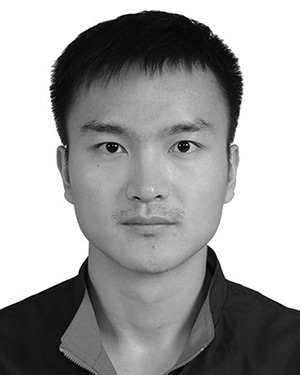 Dongyang Li合作论文数Tongji Univ, Coll Elect & Informat Engn, Shanghai 201804, Peoples R China3
 Anming Dong合作论文数Sch. of Inf. Sci. & Eng., Shandong Univ.;c;Sch. of Inf. Sci. & Eng., Shandong Univ.3
 Wenliang Lin (林文亮)合作论文数School of Electronic Engineering, Beijing University of Posts and Telecommunications3
 Xia Lei (雷霞)合作论文数National Key Laboratory of Science and Technology on Communications, University of Electronic Science and Technology of China3
 Jian Sun (孙健)合作论文数School of Information Science and Engineering, Shandong University3
 Yifei Philip Zhang (张翼飞)合作论文数School of Integrated Circuits, Shandong University3
 Zhongliang Deng (邓中亮)合作论文数School of Electronic Engineering, Beijing University of Posts and Telecommunications3
 Ke Wang (王珂)合作论文数School of Information and Communication Engineering, Beijing University of Posts and Telecommunications;MoE Key Laboratory of Universal Wireless Communications, Beijing University of Posts and Telecommunications3
 Xiang Cheng (程翔)合作论文数Institute of Information and Communication Technology, School of Electronics, Peking University3Guoxiao Yin合作论文数2
 Hong Niu合作论文数2
 Mingqiang Zhang合作论文数Shandong University(Shandong University),Jinan,China2
 Ruimeng Gan合作论文数Univ Elect Sci & Technol China, Natl Key Lab Sci & Technol Commun, Chengdu 611731, Sichuan, Peoples R China2
 Yu Han合作论文数National Mobile Communications Research Laboratory, Southeast University, Nanjing, China2
 Hongyan Zhang合作论文数Univ Elect Sci & Technol China, Chengdu, Peoples R China2
 Fangjun Li合作论文数Shandong Sanqi Energy Co Ltd, Jinan 250100, Shandong, Peoples R China2
 Yan Zhao合作论文数National Key Laboratory of Science and Technology on Communications, University of Electronic Science and Technology of China, Chengdu, China2
 Jingping Qiao合作论文数Sch. of Inf. Sci. & Eng., Shandong Univ.;c;Sch. of Inf. Sci. & Eng., Shandong Univ.2
 Shu Fang (方舒)合作论文数National Key Laboratory of Science and Technology on Communications, University of Electronic Science and Technology of China2
 Guoqiang Mao (毛国强)合作论文数School of Transportation, Southeast University2
 Ekram Hossain合作论文数Department of Electrical and Computer Engineering, University of Manitoba2
 Li You (尤力)合作论文数National Mobile Communications Research Laboratory, School of Information Science and Engineering, Southeast University2
 Jian Song (宋健)合作论文数Shenzhen International Graduate School, Tsinghua University2
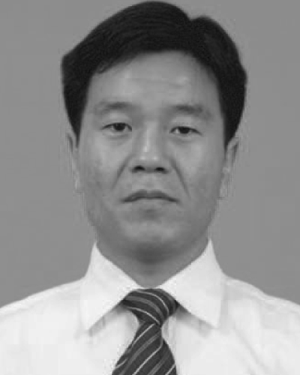 Peng Zhang合作论文数2Qingde Liu合作论文数1
 Zheng Wang (王正)合作论文数National Mobile Communications Research Laboratory, School of Information Science and Engineering, Southeast University1
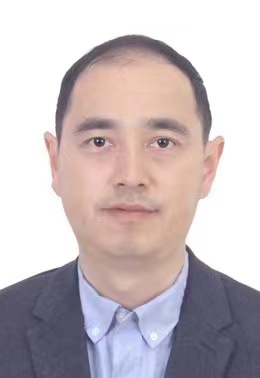 Yongming Huang (黄永明)合作论文数School of Information Science and Engineering, Southeast University;Purple Mountain Laboratories1Xg Li合作论文数1Keqin Jiang合作论文数1
 Xiangyun Deng合作论文数1
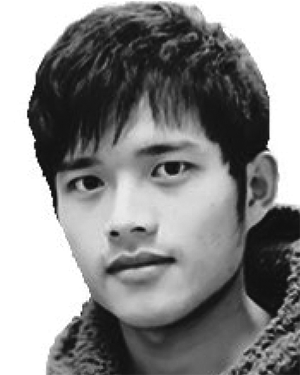 Zhaojie Sun合作论文数1Miaomiao Xin合作论文数1




