In this paper, we develop a characteristic set (CS)-based method for deriving full-rank equivalence conditions of symbolic matrices over the binary field. Such full-rank conditions are of fundamental importance for many linear coding problems in communication and information theory. Building on the developed CS-based method, we present an algorithm called Binary Characteristic Set for Full Rank (BCSFR), which efficiently derives the full-rank equivalence conditions as the zeros of a series of characteristic sets. In other words, the BCSFR algorithm can characterize all feasible linear coding schemes for certain linear coding problems (e.g., linear network coding and distributed storage coding), where full-rank constraints are imposed on several symbolic matrices to guarantee decodability or other properties of the codes. The derived equivalence conditions can be used to simplify the optimization of coding schemes, since the intractable full-rank constraints in the optimization problem are explicitly characterized by simple triangular-form equality constraints.
Distributed reinforcement learning is a key enabler for embodied intelligence, yet its scalability on HPC clusters is often constrained by communication overhead. Modern HPC platforms commonly rely on InfiniBand interconnects with RDMA support for ultra-low latency and high bandwidth, but widely used Ray-based RL stacks still depend on gRPC implementations optimized for TCP/IP, leading to underutilization of InfiniBand capabilities. We present an RDMA-adapted gRPC design that preserves the gRPC programming model while enabling RDMA-aware data movement. We redesign the transport and buffer management around completion events driven progress and pre-posted receives, and extend grpc’s slice to manage RDMA-registered buffers with reference-counted lifetimes, enabling safe sharing and practical zero-copy transfers. We integrate the proposed design into Ray’s RLlib and demonstrate its applicability to production-grade distributed RL pipelines on InfiniBand-equipped HPC systems.
Rip currents cause over 100 drowning deaths and more than 30,000 rescues annually in the United States, posing a severe threat to beach safety worldwide. However, most existing detection methods are reactive, identifying rip currents only after they form, leaving limited time for intervention. We propose RipAlert, a future-frame-aware framework that forecasts near-future coastal dynamics and proactively identifies rip current risks. We design a region-sensitive optical flow prediction method with a novel entropy-based object detector to capture early-stage reverse-flow anomalies. Unlike static-image approaches, RipAlert leverages temporal motion patterns to detect rip currents up to 5 seconds before they visibly form. To support real-world deployment, we design a lightweight mobile application and release a curated dataset with over 2,000 annotated images. Experiments on the RipVIS benchmark show that our approach achieves state-of-the-art performance. The system has been deployed at high-risk beaches in China, issuing successful early warnings over real-world events. Our work advances AI-driven coastal safety and contributes to SDG 3 (Good Health and Well-Being) and SDG 13 (Climate Action).
Sparse matrix-dense matrix multiplication (SpMM) is a core operation in scientific computing and deep learning. On multi-GPU platforms, its scalability is limited by communication bottlenecks. To address this, we propose DistSpMM, a co-design framework integrating data layout, pipelining, and communication strategies. DistSpMM introduces HSDMA, a lightweight algorithm that reduces communication by optimizing the dense matrix allocation. DistSpMM features a topology-aware two-stage pipeline that manages the IB/NVLink bandwidth disparity to maximize the overlap of computation and communication. Finally, DistSpMM employs an adaptive selector that uses a performance model to dynamically choose the optimal communication granularity (coarse vs. fine-grained) based on data sparsity and network tier. Experiments on diverse real-world datasets demonstrate the superior performance of our method. It achieves average speedups of 1.6 × to 2.6 × in single-node multi-GPU environments and 4.0 × to 5.1 × in multi-node multi-GPU environments over the baseline. Compared to the best state-of-the-art implementations, our method delivers up to 2.0 × speedup.
Large-scale language models (LLMs) based on the Transformer architecture exhibit robust representational power, yet their capability for complex coherent reasoning necessitates refinement through post-training processes. In Reinforcement Learning from Human Feedback (RLHF) post-training, the generation of reasoning chains exhibits significant length variability and a long-tailed distribution: excessively long sequences block the training pipeline, while overly short ones compromise reasoning integrity, which severely bottlenecks training efficiency. Traditional fixed-threshold truncation methods lack dynamic adaptability, resulting in either the loss of critical reasoning information or the waste of computational resources. To address this, we propose an innovative Integrated Intelligent Controller (IIC). At its core is a multi-objective fused dynamic threshold mechanism that, for the first time, synergistically integrates macro training progress scheduling, micro reward stability perception, and anomaly protection, enabling adaptive control of generation length based on real-time training feedback. We further achieve deep algorithm-system co-optimization by deeply integrating the IIC into a Verl-based distributed training framework, allowing dynamic policies to drive resource scheduling. Extensive experiments on dense models of varying scales (1.8B-7B parameters) across mathematical reasoning and commonsense reasoning tasks demonstrate that our method constrains the maximum accuracy degradation within 0.6% while improving the average training throughput by 12%. This work presents a general and efficient intelligent control solution to mitigate the “efficiency-effectiveness” trade-off bottleneck in large-model RLHF post-training.
With the rapid expansion of photovoltaic (PV) power generation worldwide, PV systems have become key to global energy construction. Accurate PV forecasting is essential for safe grid operation and renewable energy integration. However, most existing models rely heavily on site-specific historical data and perform poorly when deployed in cold-start scenarios of newly built power plants. We propose PhysTrans, a physics-aware transferable framework for cold-start PV forecasting. Firstly we design a physics-constrained residual network that utilizes a clear-sky module for better physical consistency. In further, we propose a dynamic cloud cropping method to obtain the cloud information of shaded PV stations by fitting the angle of the sun offsets. To fuse the asymmetric data, a query-based asymmetric fusion mechanism is introduced to achieve high-precision alignment of multi-modal data. We conduct experiments on global datasets, and the results show that the PhysTrans outperforms state-of-the-art models with a 13.2\% decrease in MAE in the single-site task, and also outperforms existing migration models with an average decrease in MAE of 12.7\% in the cross-sites task. Our work advances reliable and transferable PV forecasting for early-stage grid integration and contributes to SDG 7 (Affordable and Clean Energy) and SDG 13 (Climate Action), in line with the Leave No One Behind principle.
We analyze a coupled nonlinear parabolic--elliptic PDE system for thermally driven reactive transport. The incompressible velocity is reconstructed elliptically from a two-dimensional temperature--vorticity--stream-function subsystem and transports a reactive scalar governed by heterogeneous diffusion, degradation, source forcing, and Arrhenius kinetics. Exploiting the resulting block-triangular structure, we construct strong solutions by sequential approximation, establish finite-time well-posedness and continuous dependence in Sobolev energy spaces, and prove a uniform source-to-state Lipschitz estimate. Its constant is independent of the thermo--fluid trajectory, final time, activation energy, and Arrhenius frequency factor. Parameter-uniform energy estimates further yield exponential convergence to the Arrhenius-free transport equation as the activation energy tends to infinity. For the autonomous system, hierarchical dissipative estimates and elliptic regularity, under a vorticity spectral-gap condition, imply the existence of an absorbing set, asymptotic compactness of the solution semigroup, and a compact global attractor. These results provide a unified PDE foundation for pollutant source identification in coupled flows.
Graph neural networks (GNNs) have been proven to have increasingly widespread applications in the real world. In the mainstream mini-batch training mode, multiple cachebased GNN training acceleration systems have been proposed because of the possibility of selecting the same vertex multiple times during the sampling process. However, on ultra-large scale graphs, especially those exhibiting powerlaw characteristics, these systems are difficult to fully utilize the distribution characteristics of cached data, which limits training performance. To this end, we propose TAC, a GNN training acceleration system that fully exploits the distribution characteristics of cached data to optimize both data transmission and computational efficiency. Specifically, we have designed a data affinity optimization algorithm that significantly enhances the locality of cache access. Secondly, an adaptive sparse matrix operator for sparsity perception is proposed, which dynamically selects the optimal computing mode based on the location of data. Finally, we have constructed a fine-grained training pipeline that maximizes system parallelism by hiding the sampling and computation. The experimental results show that TAC significantly outperforms existing state-of-the-art cache acceleration systems on multiple benchmark datasets, demonstrating higher training efficiency.
Irregular workloads challenge GPUs with small tasks, unpredictable branching, and uneven load distribution. Quantum perturbation theory and Density Functional Theory (DFT) represent a prominent example, where such irregular patterns arise in large-scale simulations of materials and molecules. Despite recent efforts to accelerate these simulations on GPUs, State-of-the-Art (SOTA) methods still suffer from low GPU utilization and severe load imbalance, which hinder efficiency and scalability. In this paper, we redesign the expression of the data structure and propose an efficient implementation for quantum perturbation named HIP-DFPT. A series of general GPU optimizations are proposed, including micro-task composition strategy, GPU memory management, and multi-stream pipelines. We present a branch-dominant hybrid online performance model to predict quickly and accurately with only 5% sampled data. Furthermore, we introduce a multi-level load balancing strategy guided by performance models for both inter-GPU and intra-GPU task distribution. Our experimental results on a large-scale GPU cluster show significant improvements in computational efficiency and scalability. Using up to 8192 GPUs for simulations with up to 200,006 atoms with all-electron precision, we achieve an average load balancing efficiency of 1.06, a 55% increase in GPU occupation, and a 70% enhancement in throughput.
Modern artificial intelligence excels at prediction but cannot explain. From large language models to AI-for-science systems, today's machines answer what by recombining patterns already present in the human literature, yet they cannot reason out why a phenomenon must arise from underlying principles even though explanation, not prediction, lies at the heart of scientific discovery. Here we ask whether the structure of scientific explanation can be operationalized to guide how a machine generates hypotheses. We introduce DN-Hypo-Pipeline, a hypothesis-generation framework that adopts a layered, explanation-theoretic scaffold: Hempel's deductive-nomological (DN) model supplies the output form and deductive validity of a hypothesis, Salmon's causal-process account supplies an organizing constraint on where to search for the governing laws, and Armstrong's view of laws as relations between universals supplies the bridge from a phenomenon's constituent processes to the laws that may be associated with it. Rather than searching the space of what has been written, the framework searches the space of what principles govern a phenomenon: given an explanandum, it abstracts the universals instantiated in the phenomenon's formation process, retrieves the laws relating those universals, and deductively reconstructs a new, testable explanation. Evaluated in data-science modeling and judged by both LLMs and human experts, hypotheses generated through this principled reasoning significantly outperform those from direct prompting. Crucially, we translated the two highest-scoring hypotheses into novel algorithms one that reduces the Transformer's theoretical complexity with only minimal performance loss, and another that achieves competitive accuracy with substantially fewer parameters.
Photovoltaic (PV) power forecasting is essential for grid power dispatching but remains challenging due to the inherent intermittence and volatility of PV generation, especially under complex weather conditions. Additionally, existing deep learning models often lack interpretability, limiting their practical application in decision-making. To address these challenges, we propose an interpretable multi-level series decomposition model SEEDTrans for day-ahead PV power forecasting. The model integrates wavelet decomposition units and seasonal-trend decomposition units to extract frequency-specific features and isolate short-term fluctuations. A cross-fusion strategy further combines these components, while attention mechanisms capture long-term dependencies, enabling the model to handle complex temporal patterns. Experimental results on real-world datasets demonstrate that our model achieves state-of-the-art forecasting accuracy, significantly outperforming existing methods. Moreover, decomposition analysis reveals the contributions of distinct temporal components and variables, enhancing interpretability and providing actionable insights for grid management. This approach effectively balances predictive performance with model transparency, offering a robust solution for reliable PV power forecasting.
Spatio-temporal predictive learning plays a crucial role in self-supervised learning, with wide-ranging applications across a diverse range of fields. Previous approaches for temporal modeling fall into two categories: recurrent-based and recurrent-free methods. The former, while meticulously processing frames one by one, neglect short-term spatio-temporal information redundancies, leading to inefficiencies. The latter naively stack frames sequentially, overlooking the inherent temporal dependencies. In this paper, we re-examine the two dominant temporal modeling approaches within the realm of spatio-temporal predictive learning, offering a unified perspective. Building upon this analysis, we introduce USTEP (Unified Spatio-TEmporal Predictive learning), an innovative framework that reconciles the recurrent-based and recurrent-free methods by integrating both micro-temporal and macro-temporal scales. Extensive experiments on a wide range of spatio-temporal predictive learning demonstrate that USTEP achieves significant improvements over existing temporal modeling approaches, thereby establishing it as a robust solution for a wide range of spatio-temporal applications
The start of deep neural network training is characterized by a brief yet critical phase that lasts from the beginning of the training until the accuracy reaches approximately 50%. During this phase, disordered representations rapidly transition toward ordered structure, and we term this phase the Enlightenment Period. Through theoretical modeling based on phase transition theory and experimental validation, we reveal that applying Mixup data augmentation during this phase has a dual effect: it introduces a Gradient Interference Effect that hinders performance, while also providing a beneficial Activation Revival Effect to restore gradient updates for saturated neurons. We further demonstrate that this negative interference diminishes as the sample set size or the model parameter size increases, thereby shifting the balance between these two effects. Based on these findings, we propose three strategies that improve performance by solely adjusting the training data distribution within this brief period: the Mixup Pause Strategy for small-scale scenarios, the Alpha Boost Strategy for large-scale scenarios with underfitting, and the High-Loss Removal Strategy for tasks where Mixup is inapplicable (e.g., time series and large language models). Extensive experiments show that these strategies achieve superior performance across diverse architectures such as ViT and ResNet on datasets including CIFAR and ImageNet-1K. Ultimately, this work offers a novel perspective on enhancing model performance by strategically capitalizing on the dynamics of the brief and crucial early stages of training. Code is available at https://anonymous.4open.science/r/code-A5F1/.
Current Transformer models with channel independence (CI) have made tremendous achievements in time series data analysis. However, the CI methods suffer from short-term fluctuations with intra-channel noise and long-term trend extraction. The fixed receptive field of CI models struggles with capturing multi-scale temporal features within each channel. This paper proposes CSFformer, a cross-scale fusion Transformer for multivariate time series. We first present a Channel-Independent Masking (CIM) module to rectify the feature representation of anomalies and noise in each channel. Then we design a Multi-Scale Pyramid Fusion (MSPF) module, which extracts fluctuation and tread features across various scales. Furthermore, the Multi-Scale Attention Fusion (MSAF) module is introduced for in-depth analysis of interactions between different scales, which significantly contributes to capturing a broader spectrum of complex temporal patterns. We conduct experiments on 7 real-world public datasets. The results show that CSFformer achieves state-of-the-art performance on all datasets, especially in scenarios with obvious fluctuations and trends such as Traffic and Electricity. The source code is available at: https://github.com/damonwan1/CSIformer.
General-purpose Sparse Matrix-Matrix Multiplication (SpMM) is a fundamental kernel in scientific computing and deep learning. The emergence of new matrix computation units such as Tensor Cores (TCs) brings more opportunities for SpMM acceleration. However, in order to fully unleash the power of hardware performance, systematic optimization is required. In this paper, we propose Acc-SpMM, a high-performance SpMM library on TCs, with multiple optimizations, including data-affinity-based reordering, memory efficient compressed format, high-throughput pipeline, and adaptive sparsity-aware load balancing. In contrast to the state-of-the-art SpMM kernels on various NVIDIA GPU architectures with a diverse range of benchmark matrices, Acc-SpMM achieves significant performance improvements, on average 2.52x (up to 5.11x) speedup on RTX 4090, on average 1.91x (up to 4.68x) speedup on A800, and on average 1.58x (up to 3.60x) speedup on H100 over cuSPARSE.
 Ping Yan (严萍)合作论文数Institute of Electrical Engineering, Chinese Academy of Sciences;School of Electronic, Electrical and Communication Engineering, University of Chinese Academy of Sciences82
 Yangang Wang (王彦棡)合作论文数Computer Network Information Center, Chinese Academy of Sciences;University of Chinese Academy of Sciences53
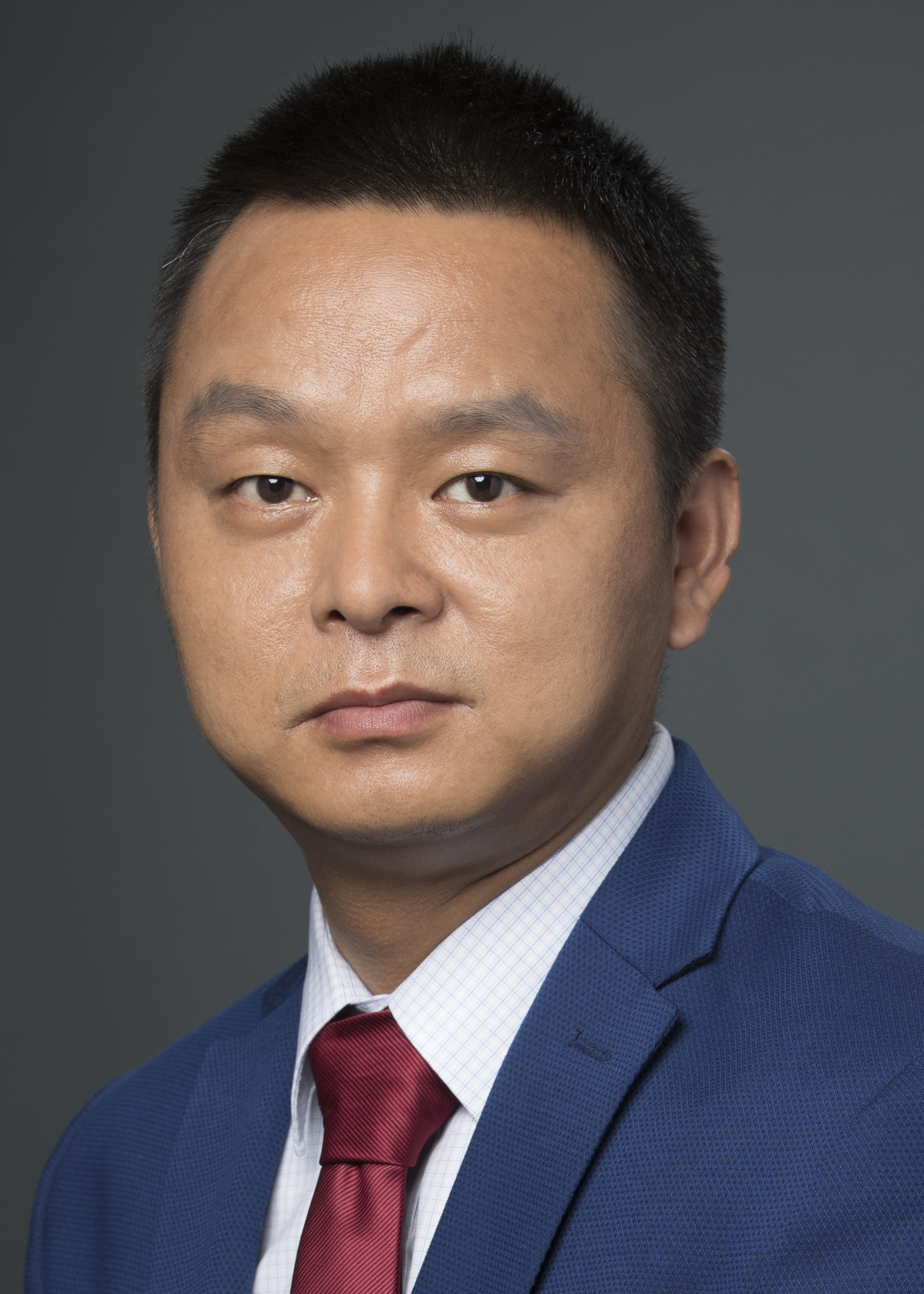 Tao Shao (邵涛)合作论文数Institute of Electrical Engineering, Chinese Academy of Sciences;University of Chinese Academy of Sciences27
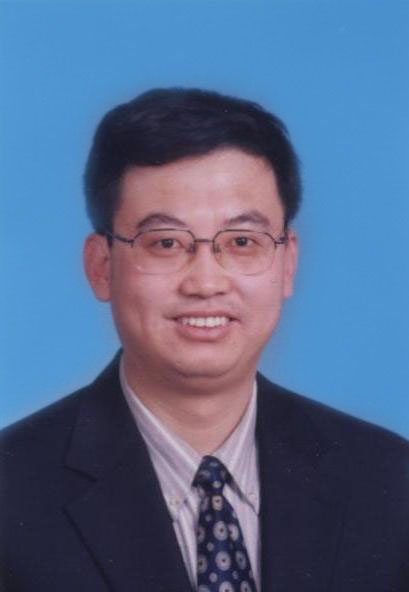 胡长军合作论文数北京科技大学计算机与通信工程学院26
 Guangsheng Sun (孙广生)合作论文数26
 Jilin Zhang (张纪林)合作论文数杭州电子科技大学23
 Meng Wan合作论文数Computer Network Information Center, Chinese Academy of Sciences22
 Shouyang Wang (汪寿阳)合作论文数Academy of Mathematics and Systems Sciences, Chinese Academy of Sciences;School of Economics and Management, University of Chinese Academy of Sciences22
 Rongqiang Cao (曹荣强)合作论文数University of Chinese Academy of Sciences;Computer Network Information Center, Chinese Academy of Sciences21
 ShiChang Zhang (张适昌)合作论文数21
 Jianjiang Li (李建江)合作论文数School of Computer & Communication Engineering, University of Science and Technology Beijing21
 Chengyan Ren (任成燕)合作论文数中国科学院大学中国科学院电工研究所.电子电气与通信工程学院19
 Xuebin Chi (迟学斌)合作论文数Computer Network Information Center, Chinese Academy of Sciences;University of Chinese Academy of Sciences19
 Tiechui Yao合作论文数University of Chinese Academy of Sciences18
 Weiqun Yuan (袁伟群)合作论文数Institute of Electrical Engineering, Chinese Academy of Sciences17
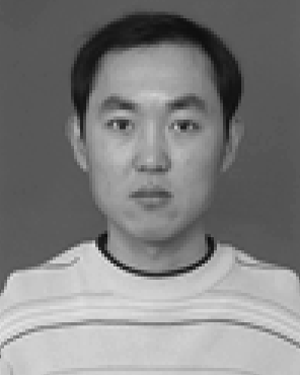 Ruzheng Pan合作论文数17
 Ningming Nie (聂宁明)合作论文数Computer Network Information Center, Chinese Academy of Sciences;University of Chinese Academy of Sciences13
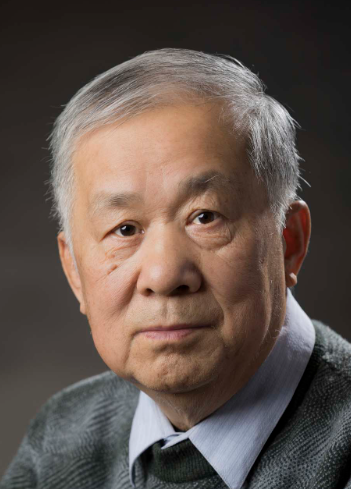 Yuan Zhou (周远)合作论文数Technical Institute of Physics and Chemistry, Chinese Academy of Sciences;University of Chinese Academy of Sciences13
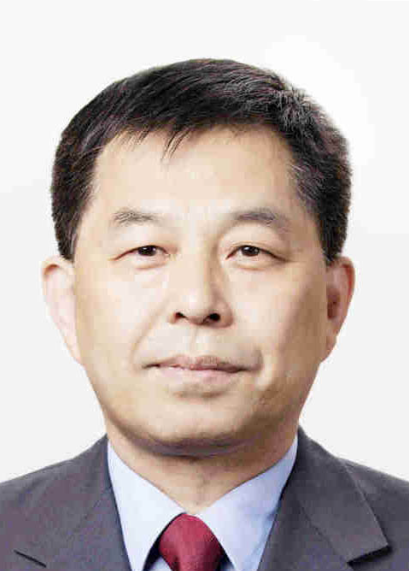 Wensheng Zhang (张文生)合作论文数Institute of Automation, Chinese Academy of Sciences;University of Chinese Academy of Sciences12Jian Wan合作论文数12
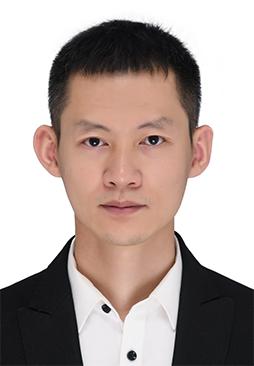 Shigang Li (李士刚)合作论文数Parallel Computing and Intelligent Systems Laboratory, School of Computer Science, Beijing University of Posts and Telecommunications12
 Cheng Zhang (章程)合作论文数Institute of Electrical Engineering, Chinese Academy of Sciences;University of Chinese Academy of Sciences12
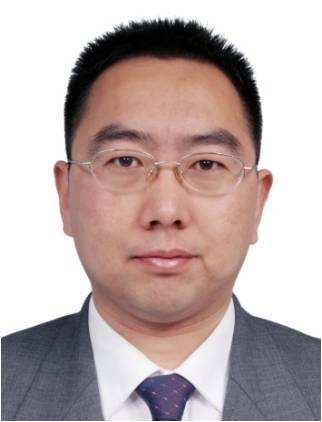 Peng Shi (时鹏)合作论文数National Center for Materials Service Safety, University of Science and Technology Beijing11
 Zhonghua Lu (陆忠华)合作论文数Computer Network Information Center, Chinese Academy of Sciences;University of Chinese Academy of Sciences10Chunbao Zhou (周纯葆)合作论文数10
 Yiyu Yao (姚一豫)合作论文数Department of Computer Science, University of Regina10
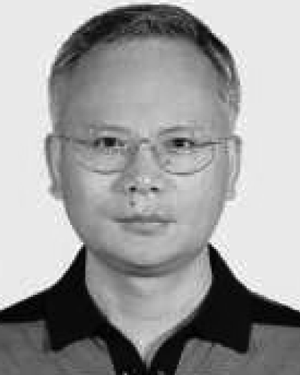 Qing Tao合作论文数The Key Laboratory of Complex Systems and Intelligence Science, Institute of Automation, Chinese Academy of Sciences, Beijing 100080, PR China9
 Fang Liu (刘芳)合作论文数School of Statistics and Mathematics, Central University of Finance and Economics9
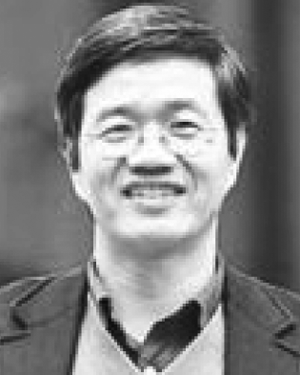 Yongjian Ren合作论文数9Xinfu He (贺新福)合作论文数8
 Zongguo Wang (王宗国)合作论文数Computer Network Information Center, Chinese Academy of Sciences;University of Chinese Academy of Sciences8Xiaoguang Wang合作论文数8
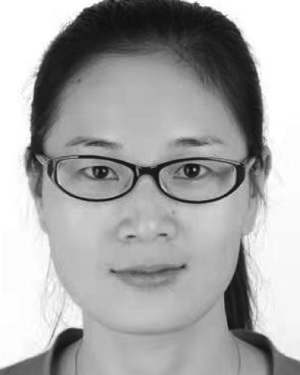 Li Zhou合作论文数Peking University Cancer Hospital and Institute, Beijing, China;8
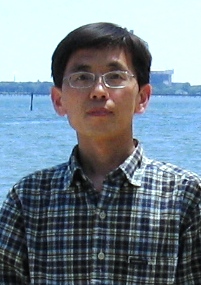 Yaohong Sun (孙鹞鸿)合作论文数中国科学院大学中国科学院电工研究所.电子电气与通信工程学院8
 Dongdong Zhang (张冬冬)合作论文数Shanghai Institute of Technical Physics, Chinese Academy of Sciences;University of Chinese Academy of Sciences8Gaowei Wu (吴高巍)合作论文数8
 Yangde Feng (冯仰德)合作论文数Computer Network Information Center, Chinese Academy of Sciences;University of Chinese Academy of Sciences8Z. Xin合作论文数7
 Liubiao Chen (陈六彪)合作论文数Technical Institute of Physics and Chemistry, Chinese Academy of Sciences;University of Chinese Academy of Sciences7
 Suqing Han合作论文数7
 Haizhou Cao合作论文数Computer Network Information Center, Chinese Academy of Sciences;University of Chinese Academy of Sciences6Boyao Zhang合作论文数6
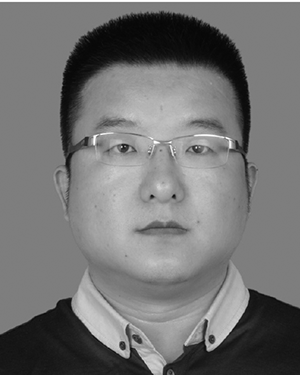 Min Shi (时珉)合作论文数6MinTang Li (李敏堂)合作论文数6
 Rong Xu (徐蓉)合作论文数中国科学院大学中国科学院电工研究所.电子电气与通信工程学院6
 Tao Wang合作论文数6
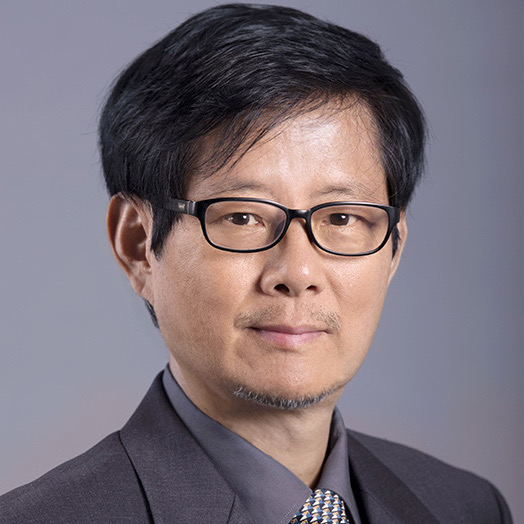 Stan Z. Li (李子青)合作论文数School of Engineering, Westlake University6




