To better understand the wheel-rail adhesion under actual operations, this study uses data collected from control systems of high-speed trains to assess the adhesion coefficient during traction at speeds up to 250km/h. Based on the data including train speed, temperature, wheel slip signals, sanding signals as well as required and actual traction forces, the correlation of wheel slip occurrence with weather conditions is first analyzed. Afterwards, an approach is further proposed to assess adhesion coefficients, in which actual traction coefficients during slip are used to approximate adhesion coefficients. Combining assessed adhesion coefficients at different speeds, the relationship between adhesion coefficient and speed is fitted from the lower limit of scattered adhesion coefficients. It is found that wheel slip events occurred the most in snowy weather, followed by rainy weather, then in hazy weather, and the least in sunny/overcast/cloudy weather. Wheel slip durations shortened gradually from the leading to trailing cars in hazy, rainy weather as well as after snowfall, confirming the adhesion recovery phenomenon induced by the cleaning effect of passing wheels, and assessed adhesion coefficients across different axles further showed such a trend quantitatively. However, the recovery was not figured out during snowfall, possibly due to ice formation from snow through the pressure-melting mechanism. The fitted adhesion coefficients of typical axle positions in rainy and snowing weather are compared to those from Shinkansen and a full-scale rig, suggesting that the presented approach may be employed to assess wheel-rail adhesion coefficient under complicated operating conditions.
Under wet conditions, the water film at the wheel/rail interface significantly degrades adhesion, leading to increased slip, unstable braking, and reduced brake safety for high-speed trains. Understanding adhesion-slip evolution and identifying critical brake parameters under such conditions are therefore essential for the design and optimization of brake control strategies. This study systematically investigates the wheel/rail adhesion-slip behavior and braking performance of high-speed trains under wet conditions using a full-scale integrated brake system test bench. Experiments were conducted over speeds of 60–400 km/h, axle loads of 9.0-17.0 t, and water flow rates of 0-1500 mL/min. The adhesion coefficient decreases with increasing speed and shows a non-monotonic dependence on axle load, whereas the maximum slip ratio rises sharply beyond a speed-dependent water-supply threshold. The brake pressure and wheel deceleration at 1% slip are used as common early-slip reference parameters. An empirical water-flow-to-speed index k is introduced to describe the observed onset conditions, and speed-dependent relationships are established for critical brake pressure and wheel deceleration. These findings provide experimental support for optimizing adhesion-based brake control under wet conditions.
In railway vehicles, wheel-rail adhesion utilization follows a static design with redundancy, yet its dynamic characteristics under realistic operating conditions remain poorly understood. This study quantifies adhesion utilization in the presence of track irregularities by developing a high-speed train-track coupled dynamics model and a wheel-rail transient contact finite element model. Mid/long-wave irregularities are simulated using power spectrum density, while short-wave irregularities are considered as the critical rail corrugation, rail weld and wheel flat. The analysis focuses on operations on the tangent track under dry and wet conditions, with speeds up to 400 km/h during full-acceleration traction or urgent braking. For single-type irregularities, adhesion utilization remains below 0.3 under dry conditions but can reach 1.0 under wet conditions, indicating occurrences of low adhesion (LA) or dynamic low adhesion (DLA). This is attributed to irregularity-induced normal unloading, axle load transfer, or the mismatch between high adhesion demands and low adhesion coefficients. The maximum allowable operating modes are further determined to avoid LA and DLA. Additionally, adhesion utilization is analyzed in scenarios involving the coexistence of mid/long-wave and short-wave irregularities, as well as on typical curved and sloped tracks, and with the use of adhesion design limits.
Due to the fact that trains operate in a complex environment with the presence of the third-body media (e.g., rain, leaves, oil, and antifreeze for track inspection in winter), low adhesion can occur at the wheel-rail interface, leading to a large slip ratio, which could cause severe wheel and/or rail damage. To help find a solution to this problem, wheel-rail dynamic adhesion characteristic tests were conducted under various third-body media conditions (dry, water, oil, leaves, and antifreeze) using wheel-rail rolling wear and contact fatigue testing machines. The results indicated that the adhesion curve exhibited a double peak in the loading stage under both dry and water conditions. However, under the other conditions (oil, leaves, and antifreeze), the adhesion characteristic curves were all single peak curves. Under the water conditions, the adhesion coefficient in the unloading stage was higher than in the loading stage, and the second peak point in the loading stage was higher than the first peak point. This phenomenon was related to the water volume at the wheel-rail interface, which affected the thickness of the water film. However, under dry conditions, the adhesion coefficient in the unloading stage was lower than in the loading stage, attributed to the formation and removal of oxides on the wheel-rail surface. Additionally, a wheel-rail adhesion model for the large slip ratio range was established, which provided the foundation for theoretical research on wheel-rail adhesion and for the design of locomotive adhesion control methods.
To study the effects of two-dimensional (2D) pillar shapes and the parameters of porous materials on flow field characteristics and aerodynamic noise, this study employs the Improved Delayed Detached Eddy Simulation (IDDES) method combined with the Ffowcs Williams-Hawkins (FW-H) equation to numerically simulate the flow field and aerodynamic noise of the pillars with variable cross-sections (cylindrical pillar, elliptical pillar, rounded square pillar and square pillar) and pillars covering with porous medium. The parameters of the porous medium under investigation include: porosity (phi), particle diameter (dp) and medium layer thickness (h). Proper Orthogonal Decomposition (POD) was utilized to perform reduced-order analysis of unsteady flow in the wake region, revealing the physical significance of POD modes of different pillars in wake evolution. The results indicate that the elliptical pillar exhibits the best performance in noise reduction, with its design allowing for a maximum reduction of 7 dBA in the far-field overall sound pressure level, among the four types of pillars with variable cross-sections. And the three types of porous medium parameters significantly affect the noise reduction performance of the pillar. Among them, the pillar with parameter combination of dp = 500 mu m, phi=0.97, and h = 0.25 D exhibit superior noise reduction effects, with a maximum reduction of 10.2 dBA in the far-field overall sound pressure level. Porous medium layer with reasonable parameters can significantly delay boundary layer separation, extend the stable region of the shear layer, and attenuate velocity and vorticity magnitudes in the wake region, thus suppressing turbulence fluctuations and aerodynamic noise.
Rail surface contaminations causing wheel-rail low adhesion problems may gradually be cleaned by passing wheelsets, leading to the phenomenon of adhesion recovery. This suggests an enhancement in available adhesion under low adhesion conditions for a train composed of multiple coaches. Using a four-coach Electric Multiple Unit (EMU) metro train equipped with a wheel slide protection system, field tests are conducted on a test line to measure the adhesion recovery rate of braking wheelsets under soapy water contamination. Initial braking speeds range from 100 km/h to 140 km/h, and tests under dry conditions are also conducted for reference and braking force calibration. Instantaneous creepages for different wheelsets are determined by recorded train speeds and rotational speeds of wheelsets, and the corresponding creep forces are calculated by measured vehicle speed, angular speeds of wheelsets, and brake cylinder pressures. Creep curves for different wheelsets are then obtained in consideration of the calculated axle load transfer. Adhesion coefficients corresponding to friction saturation are further derived for sliding wheelsets, typically located in the leading part of the train, with a maximum measured creepage of up to 11%. The number of passing wheelsets required to achieve adhesion recovery meeting braking requirements is also identified. The results indicate that the adhesion coefficient is as low as approximately 0.075 of the 1st axle at speeds between 93 and 132 km/h, with an adhesion recovery rate of 0.0040/axle among the first seven wheelsets. Such measurement technology holds potential application in operational trains, as it requires no significant modifications.
A type of resilient fastener called GJ-III has been used for several years to isolate wheel-rail vibrations in Chinese metro lines. It utilizes the compression deformation of the rail pad and the baseplate pad to achieve a low vertical stiffness of 12-18 MN/m and meets the medium vibration damping requirements of the track. The short-pitch rail corrugation with a wavelength of 30-50 mm has been widely observed on both curved and tangent tracks with GJ-III fasteners. The formation cause of the corrugation is investigated by field measurements and the finite element method. The dynamic properties of the track with GJ-III fasteners in different metro lines are measured by an impact test on site. The passing frequencies of corrugation in the range of 500 to 720 Hz differ from the frequencies of the first-order vertical rail bending resonance and the rail pinned-pinned resonance. A three-dimensional finite element model of transient wheel-rail rolling contact and the Archard wear model, which is implemented in the FE model, are established to simulate the wheel-rail transient contact forces and rail wear under excitation of a dip and a white noise roughness in the rail. The simulation results show that the main frequencies of the vertical fluctuations in the wheel-rail forces are between 544 and 700 Hz, regardless of whether the rail dip or the broadband noise roughness is used as excitation. The fluctuation forces between wheel and rail at 640-690 Hz are associated with the vertical bending mode of the rail coupled by the wheel at 664 Hz. The simulated corrugation wavelengths of 35-40 mm match the results from the field test. The characteristics of the wheel-rail dynamic response during transient wheel-rail rolling contact remain unchanged regardless of the excitation methods or the varying speeds of the vehicles.
Connected and automated vehicles (CAVs) are expected to improve traffic safety effectively at signalized intersections. Considerable studies have been conducted to investigate the benefits of CAVs in improving traffic mobility and efficiency. However, in most previous research, vehicle-to-vehicle (V2V) and vehicle-to-infrastructure (V2I) communication have been considered separately rather than concurrently, to study the characteristics of CAVs, resulting in the potential of CAVs not being fully exploited and inconsistency with reality. In this paper, an integrated communication system of CAVs (ICSC), which incorporates V2V and V2I communication, is proposed, to assess traffic safety at signalized intersections. In this study, the intelligent driver model (IDM) is used to approximate V2V communication between a subject CAV and preceding CAVs. A reinforcement learning algorithm is adopted to model V2I communication between a CAV and a traffic light. The traffic safety effect of ICSC, V2V-only, and V2I-only scenarios is evaluated for different market penetration rates (MPRs). The results show that the ICSC scenario significantly reduces traffic conflicts and outperforms V2V-only, V2I-only, and benchmark scenarios when the MPR is equal to or higher than 50% with different surrogate safety measures (SSMs), such as time-exposed deceleration (TED) to avoid crashing, time exposed time-to-collision (TET), and use of a spacing gap (SGAP). Moreover, the mobility effect of the ICSC scenario is studied, and appears to increase average speed and reduce delay time. Finally, the results suggest that the ICSC can improve traffic safety and mobility concurrently and exploit the potentials of CAVs at signalized intersections.
Quasi-steady and transient rolling contact of a driving wheelset over tangent and curved tracks at a speed up to 500 km/h is simulated using an explicit finite element approach to derive creep curves. Quasi-steady curves corresponding to smooth wheel and rail are compared to those from traditional theories implying the steady rolling assumption for validation. Transient curves in the presence of rail corrugation with a wavelength of 10 similar to 1000 mm are further analyzed to study the influence of middle/high-frequency vibrations. Cases where transient effects must be considered or traditional theories are inapplicable are identified.
Connected and automated vehicles (CAVs) can communicate with other CAVs through vehicle-to-vehicle (V2V) communication technology which can improve the stability and safety performance of the platoon. However, the V2V communication could be unreliable as some factors such as hardware damage, packet loss, and cyber-attack, may lead to communication delay or failure. Considering that the communication topology of the platoon can vary dynamically due to these factors, it may result in instability and collision risk on the platoon. To mitigate the impact of communication delay or failure, the study introduces a dynamic weights optimization-based CAV following model (DWOC). It adopts the multi-predecessor following (MPF) mode with which vehicles can obtain the dynamic information of three predecessors and the corresponding information weights can be adjusted adaptively. The study formulates the string stability conditions of the model and validates the stability and safety impact on the platoon through a series of numerical experiments. The results indicate that DWOC can effectively improve the stability and safety performance under different communication delays. The findings suggest that the CAV manufacturers should account for the possible changes of the communication topology of the platoon. The proposed DWOC can serve as a reference in designing the CAV controller to ensure stability and improve safety of the platoon in reality under different communication delays.
Purpose Dynamic low adhesion (DLA) has become an urgent problem for the high-speed wheel-rail system because of continuous decrease of adhesion redundancy in the past decades. This article aims to provide a simulation method to reveal the mechanism of DLA under high-frequency vibrations. Design/methodology/approach A transient wheel-rail rolling contact model is developed for a typical Chinese high-speed railway system using the explicit finite element (FE) method. Instantaneous adhesion exploitation levels are studied in the time domain, for which driving cases over corrugated rails are taken as an example. A speed up to 500 km/h is considered together with different traction coefficients and corrugation dimensions. DLA is expected when the instantaneous adhesion exploitation level reaches 1.0, that is adhesion saturates and full sliding contact occurs. Findings The instantaneous adhesion exploitation level can be very high in the presence of corrugation, even at low traction coefficients. DLA is found to occur as great vertical unloading takes place and causes a significant increase of creepage. An approach is further developed to determine the critical depth of corrugation over which DLA occurs. Originality/value This study employs the transient wheel-rail rolling contact model to predict the instantaneous adhesion exploitation level under high-frequency vibrations. The presented results reveal a mechanism of DLA being beneficial to guidelines for future railway practice.
The fatigue life assessment of railway wheels is a critical issue to establish an effective maintenance strategy. Presently, the traditional nominal stress method is commonly adopted, assuming the wheels are defect-free. However, the wheels are always subjected to railway ballast, corrosion, and more, rendering the traditional design method inadequate. To address this, our study introduces a stepwise fatigue assessment approach. Initially, the traditional nominal stress method is employed as the first level, followed by the application of advanced damage tolerance analysis as the second level, which takes into account the impact of defects. The safe-critical position of the wheels is identified using the finite element model. Three fatigue crack growth rate models are compared to assess the residual life of the wheels with defects. The numerical simulation results illustrate that the iLAPS model is proved to be effective, demonstrating the effectiveness of the developed assessment method. This work is expected to provide a scientific guidance for establishing and optimizing of maintenance strategy for railway wheels.
Wear and rolling contact fatigue (RCF) problems observed on metro wheel/rail systems in China in the last 15 years are summarized and explained from the aspects of phenomena, causes, and validated countermeasures. Presented wheel/rail wear in the lateral direction includes wheel flange wear, rail side wear, and abnormal wear of wheels such as differential, hollow, groove, and channel wear. As for irregular wear on wheel and rail running surfaces, the focus is on four and two important cases for wheel and rail, respectively, i.e., low-order wheel polygonal wear, high-order wheel polygonal wear, wheel stochastic out-of-roundness (OOR), wheel corrugation, short-pitch rail corrugation on the tracks with resilient and conventional fasteners, and rail corrugation on damping sleeper tracks. Finally, some unusual RCF problems occurring on wheel and rail surfaces are presented.
针对站间距短、研磨子频繁作用的城际铁路,建立了集车辆系统动力学、研磨子—车轮接触和车轮磨耗等模型于一体的动车组车轮磨耗预测模型,车轮磨耗采用Archard模型计算,实现了研磨子—车轮和轮轨接触对车轮磨耗贡献的定量预测.以中国南方某城际线路上运行的某型城际动车组为例,模拟了动车组车轮LM廓形在一个车轮镟修周期内的演化,通过对比跟踪测试结果,确定研磨子所致车轮磨耗的磨耗系数取1.45×10⁻⁴,并完成了模型验证.上述城际铁路的模拟结果显示,该模型的车轮磨耗预测误差仅为5.00%.以0.30 MPa工作气压下的高硬度研磨子为例,发现其最佳工作模式为"工作20 s—停止工作25 s"的间歇式工作模式.为动车组研磨子系统的优化设计提供有效模拟工具.
Gear pair is a key transmission part widely used in mechanical structures,the operating quality of which is directly affected by the meshing contact state.A 3D gear pair transient meshing contact model is developed based on explicit finite element method,where the complex factors such as the gears'3D geometry,elastic deformation and system vibration are taken into account.The transient meshing contact between the gear teeth is simulated in the time domain.The time-varying contact patch,normal/tangential contact stress,relative slippage and tooth surface wear are obtained.The meshing contact between tooth surfaces is solved by a surface-to-surface contact algorithm.Non-Newtonian EHL friction introduced,and the Archard model of partial-EHL is used to calculate surface wear.Taking a traction helical gear pair of a high-power electric locomotive in China as an example,the influence of speed and traction coefficient on meshing contact behavior of gear teeth under ideal profile is analyzed.It is found that the approximate steady-state meshing contact is basically established after dynamic relaxation of 0.008 s,0.011 5 s,0.012 s at running speeds of 65 km/h,100 km/h,120 km/h,respectively.As the gear teeth enter and exit meshing,the contact force of the gear pair fluctuates periodically around its theoretical solution.The contact force and stress increase with the traction coefficient.At a speed of 65 km/h,the maximum contact area and wear depth at a traction coefficient of 0.27 mm2 are 432.22 mm2 and 32.94×10⁻⁹ μm respectively,which are 1.2 and 1.6 times of the case with traction coefficient of 0.15.The increase in speed reduces the wear depth.With a traction coefficient of 0.15,the maximum wear depth per meshing at 120 km/h is 48%lower than that at 65 km/h.In the future,tooth wear and fatigue damage can be further introduced to provide a basic analysis tool for studying transient gear meshing behavior and its influence under non-ideal conditions.
The change of discharge circuit parameters will affect the reconnection electromagnetic emission efficiency. This paper simulates and analyzes the influence of capacitor voltage changes on efficiency when the capacitance is 400µF, 600µF, and 800µF. The results show that: first, keeping the capacitance unchanged, the efficiency will first increase and then decrease with the increase of the voltage, and there is an optimal voltage to make the efficiency the highest. Secondly, when the capacitance is 400µF, the efficiency is the highest when the voltage is 20kv; when the capacitance is 600µF, the efficiency is the highest when the voltage is 15kv; when the capacitance is 800µF, the efficiency is the highest when the voltage is 10kv. Finally, the overall efficiency at 400µF is greater, but there will be a large deceleration force in the later stage of the launch, which will reduce the exit speed, resulting in lower efficiency. In this paper, taking the case of 400µF and 10kv as an example, an improved pulse discharge circuit is used to reduce the influence of the deceleration force, which increases the efficiency by 2.79%, and recovers the energy of the original discharge capacitor 52%.
A 3D time-domain modelling approach is developed with the explicit finite element method to simulate transient meshing contact of gear pairs and the resulting wear. Taking a helical gear pair used in a locomotive as an example, the dynamic contact states of gear teeth are predicted for different speeds in consideration of actual geometries (including those of damaged teeth), time dependent torques, and structural and continuum vibrations of the gear system. The friction between mating teeth is taken into account by a non-Newtonian EHL friction model. A tiny time step of 4.5 x 10⁻⁸ s determined by conditional stability of the explicit time integration ensures the capture of transient effects. Based on detailed contact solutions during meshing, the dynamic wear on teeth is further calculated using an Archard wear model to predict tooth profile evolvement. Taking initial involute profiles and a speed of 120 km/h, the model is first validated for dynamic contact solutions. More results show that structural vibrations and worn profiles influence the dynamic meshing contact significantly, tooth wear increases as lubrication fails, and tooth pitting's influence is localized. This approach provides key load boundaries for detailed studies on mating gears, and may be employed for studies on tooth damages and as a reference for lumped parameter dynamic models of gear pairs.
A time-domain finite element model is developed to study the transient rolling contact of a driving wheelset over a curved track with Low Adhesion Zones (LAZs) shorter than 1.0 m. LAZs on one rail, i.e., unilateral LAZs occurring more likely, is treated for a speed up to 500 km/h. Structural vibrations of wheelset are analyzed to explain the transient contact forces, creepages and the resulting irregular wear. LAZs on high rails are found more detrimental than those on low rails. The results explain the occurrence of flats and rolling contact fatigue in bad weather, although significant wheel idling is absent.
A field investigation was conducted on a heavy haul railway line with axle load of 25 t. There was a significant difference in rail rolling contact fatigue (RCF) on the entering and leaving transition sections on curves with radius of 580−1000 m, and particularly, the RCF on the leaving transition section was severer. A dynamic model of heavy haul train including two locomotives and 108 wagons was established using Simpack on the basis of on-site wheel/rail observation and train parameter investigation, and a damage function model was applied to numerically analyze the mechanism of the rail RCF difference on the entering and leaving transition sections. Result shows that the RCF difference is dominated by the curving behavior of wagons, and the contribution of the leading wheelsets is the most significant, while the contribution of the trailing wheelsets and locomotives is relatively slight. More detailed analysis shows that the RCF is not significant under the condition of standard wheel/rail profile matching. However, after the wagon wheels wear, the wheel/rail creepage and creep force on the leaving transition section are higher than those on the entering transition section, which is the primary reason for the RCF. And the effect of rail worn profile is not significant for the RCF. The frequent interaction between the worn wagons leading wheelsets and the worn rail on the sharp radius curve is the main reason for the rail RCF difference on the entering and leaving transition sections.
 Zefeng Wen (温泽峰)合作论文数State Key Laboratory of Rail Transit Vehicle System, Southwest Jiaotong University62
 Xuesong Jin (金学松)合作论文数State Key Laboratory of Rail Transit Vehicle System, Southwest Jiaotong University34
 Shuangchao Huang合作论文数13
 Wenjian Wang (王文健)合作论文数School of Mechanical Engineering, Southwest Jiaotong University11
 Hengyu Wang (王衡禹)合作论文数State Key Laboratory of Rail Transit Vehicle System, Southwest Jiaotong University11
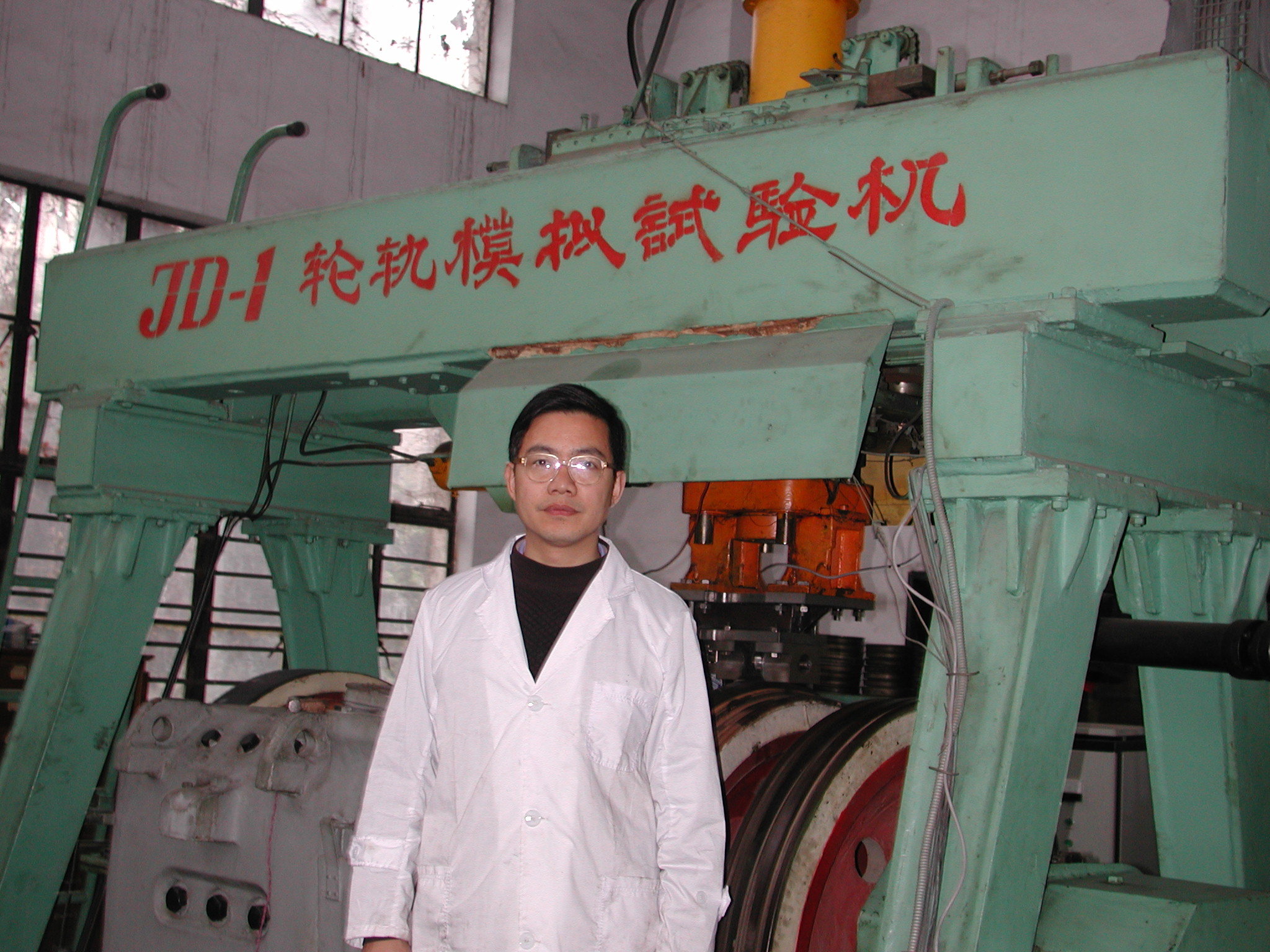 Qiyue Liu (刘启跃)合作论文数Tribology Research Institute, School of Mechanical Engineering, Southwest Jiaotong University10
 Gongquan Tao (陶功权)合作论文数State Key Laboratory of Rail Transit Vehicle System, Southwest Jiaotong University9
 Shengchuan Wu (吴圣川)合作论文数State Key Laboratory of Rail Transit Vehicle System, Southwest Jiaotong University9
 Zili Li合作论文数Group of Rail Systems & Monitoring, Department of Structural Engineering, Faculty of Civil Engineering and Geosciences, Technische Universiteit Delft9
 Jizhong Yang (杨吉忠)合作论文数6J. Guo合作论文数6
 Rolf Dollevoet合作论文数6Zhijun Zhou合作论文数5
 Boyang An (安博洋)合作论文数5Xiaogang Zhao (赵小罡)合作论文数5LIU Yongfeng (刘永锋)合作论文数5
 Li Wei合作论文数5
 Andrea Rindi合作论文数Department of Energetics, University of Florence5LUO Yifei (罗易飞)合作论文数4
 Ni Ao合作论文数4Chao Liu合作论文数4
 Shulin Liang (梁树林)合作论文数State Key Laboratory of Rail Transit Vehicle System, Southwest Jiaotong University4
 Molodova, M.合作论文数Sect. of Road & Railway Eng., Delft Univ. of Technol.;c;Sect. of Road & Railway Eng., Delft Univ. of Technol.4
 Bing Wu (吴兵)合作论文数School of Rail Transportation, Soochow University4E. Meli合作论文数3Shan Yin合作论文数3Junyu KOU (寇峻瑜)合作论文数3HongFeng Qi (齐洪峰)合作论文数3Peng Wang (王鹏)合作论文数3
 Qinghua Guan (关庆华)合作论文数State Key Laboratory of Rail Transit Vehicle System, Southwest Jiaotong University3
 Jun Guo (郭俊)合作论文数State Key Laboratory of Traction Power,Southwest Jiaotong University3
 Minhao Zhu (朱旻昊)合作论文数School of Materials Science and Engineering, Southwest Jiaotong University3
 Xinbiao Xiao合作论文数3
 Chenggang He合作论文数2E. Butini合作论文数2Haibo Li合作论文数2
 Martina Meacci合作论文数2Elisa Butini合作论文数2YIN Lijun (尹利钧)合作论文数2L. Marini合作论文数2
 Lorenzo Marini合作论文数2CAI Yutian (蔡宇天)合作论文数2ZHANG Duchao (张笃超)合作论文数2ZHAO Changyu (赵长雨)合作论文数2
 Hu Y.N. (胡雅楠)合作论文数2CAI Yuanwu (蔡园武)合作论文数2Xu Wang合作论文数2Peng ZHANG (张鹏)合作论文数2Tao Jiang合作论文数2




