为了提高脑控虚拟现实(VR)飞行模拟驾驶的准确率,提出一种基于桌面式虚拟现实技术的立体视觉刺激脑机接口(BCI)系统.该系统运用自主研发的桌面式虚拟现实视觉刺激子系统提供平面视觉刺激和立体视觉刺激2种刺激模式.结合Emotive EPOC+脑电设备采集用户的稳态视觉诱发电位(SSVEP)信号并传输至OpenVIBE脑电处理模块,利用OpenVIBE脑电处理模块对脑电信号进行滤波处理、特征提取和BCI分类器训练,然后运用训练好的BCI分类器在线对脑电信号进行采集和分类并实时转换为飞行控制指令,实现对虚拟现实(VR)飞行模拟器的在线操控.研究结果表明:在刺激频率为8.57,10,12和15 Hz及采集时间窗口为1.5 s的条件下,与平面视觉刺激相比,立体视觉刺激模式下的脑机接口分类器的平均准确率提升了6.5%,由此可见,立体视觉刺激能够诱发用户产生更具激励性的脑电响应,有利于提高脑控飞行模拟驾驶的性能.
碳纤维增强复合材料(CFRP)广泛应用在航空航天等领域中,其内部缺陷易引发灾难性的事故,X射线成像是CFRP缺陷检测的常用手段.为了有效减少图像背景对环状CFRP X射线图像缺陷检测性能的影响,提出了一种结合LeNet-5卷积神经网络和图像变换的环状CFRP图像缺陷检测新方法.首先对环状CFRP的X射线图像进行极坐标变换,然后提取变换图像中的感兴趣区域并对其进行分块构成LeNet-5网络训练和测试的数据集,最后根据图像块的二分类结果得到缺陷的局部区域,实现缺陷检测.实验结果表明,所提方法能显著提高缺陷检测性能,与利用原始图像对LeNet-5进行训练相比,该方法使得缺陷检测的召回率、查准率和F1值分别提高了11.02%、38.60%和25.02%.
为了缩短航天维修人员的培训时间,提高维修人员的操作熟练度,设计开发了一款基于桌面虚拟现实设备的航天器维修仿真系统,摆脱了头盔式虚拟现实设备笨重、与现实世界隔绝、易头晕目眩、难以分享等问题;提出了基于XMind思维导图及SqlServer数据库的装配管理方案,实现装配规则编辑的可视化,使得装配与拆解灵活便捷.
Spectral CT can separate basis materials, and thus it can provide information on material characterization and quantification. Such information can benefit various clinical applications. However, the presence of non-ideal effects in X-ray imaging systems limits the accuracy of basis images. To achieve high accuracy of material decomposition and high quality of basis images, a novel direct iterative basis material image reconstruction based on maximum a posteriori expectation–maximization algorithm (MAP-EM-DD) is proposed. Furthermore, by incorporating polar coordinate transformation into MAP-EM-DD, MAP-EM-PT-DD is proposed. The iterative formulas of MAP-EM-DD and MAP-EM-PT-DD are derived. To evaluate the proposed methods, a simulated cylinder phantom with inserts that contain polyethylene, hydroxyapatite, salt water, air, and aluminum is established. The methods are quantitatively evaluated for comparative studies. Results show that the proposed methods can remarkably reduce the noise of basis images and error of material decomposition and improve the contrast-to-noise ratios (CNRs) of each material-specific region. Compared with the image domain material decomposition based on FBP algorithm (FBP-IDD), MAP-EM-DD can reduce the noise levels of basis images ranging from 57.4 to 63.6% and the error levels of each material-specific region from 31.7 to 62.1%. Simultaneously, the CNRs of each material-specific region are improved ranging from 63.8 to 237.3%. Compared with MAP-EM-DD, MAP-EM-PT-DD can reduce the noise levels of basis images ranging from 21.4 to 23.6%, the error levels of each material-specific region ranging from 1.9 to 36.3%, and the reconstruction time of basis images by 14.1%.
为了解决经狭窄腔对内部目标进行多自由度大范围检测的难题,设计了一种新型线驱动连续型机器人.首先运用几何分析对该机器人进行建模,研究了单组关节的驱动空间、关节空间和操作空间之间的运动学映射定量关系,并对其工作空间进行了分析.针对2组关节协同运动时存在的耦合问题,提出了一种新的运动学解耦算法,并对线驱动连续型机器人单组关节和2组关节运动学特性进行了仿真研究.结果表明:所设计的连续型机器人能够经狭窄腔实施大范围空间的多自由度检测作业,具有良好的弯曲性能,其单组关节最大作业半径为99.33 mm;所提出的解耦算法简明有效,为经狭窄腔对内部目标进行多自由度大范围检测的线驱动连续型机器人系统的研制奠定了理论和技术基础.
为了提高基于Kinect相机的呼吸运动监测精度,提出了一种结合目标检测与目标跟踪算法的实时呼吸运动监测方法.该方法首先基于标记板形状特征利用霍夫圆检测算法进行目标检测,然后基于彩色图像结合Camshift目标跟踪算法实现单个或多个目标的跟踪,依据跟踪的结果获取目标位置的深度信息,并对获取的深度信息进行降噪处理.在此基础上,开发了一款基于Kinect相机的呼吸运动精准监测软件系统.实验结果表明,所提出的实时呼吸运动监测方法可有效提高呼吸运动监测的精度,与现有的基于深度图像获取呼吸运动数据方法相比,在体态偏移状态下数据采集准确度由47.9%提升至94.1%.同时,该方法具有良好的可视化效果.
为了提高双能CT基材料分解的精度,降低基材料图像的噪声,提出了基于MAP-EM算法的直接迭代基材料分解方法.结合MAP-EM算法,推导出基材料分解直接迭代求解公式,基于双能投影数据集直接重建基材料分解图像,并对该方法的性能进行了评价和分析.仿真结果表明,所提方法可显著降低分解误差和基材料图像噪声,提高对比噪声比.与基于FBP算法的图像域基材料分解方法相比,该方法可使基材料图像中各材料区域的噪声水平下降57.42% ~ 63.64%,分解误差水平降低31.72% ~62.14%,对比噪声比提高1.37% ~223.17%.
This paper presents a notch prefilter (NP) for phase locked loop (PLL). Similar to traditional notch filter (NF) and delayed signal cancellation (DSC) operator, the proposed NP can be easily tailored to completely eliminate harmonics. When the second order NF is used as in-loop filter, it may cause a delay time in the PLL control loop. The NP can overcome these drawbacks and achieve a better dynamic performance. For digital implementation, DSC operator may subject to delay time error. Moreover, the controller often needs to store many samples and may suffer from memory overflow. The NP does not cause such delay time error and the stored samples are greatly reduced. The proposed NP is analyzed and the effectiveness is verified by experiment in the paper.
The transportation sector is undergoing electrification to gain advantages such as lighter weight, improved reliability, and enhanced efficiency. As contributors to the safety of embedded critical functions in electrified systems, better sizing of electric machines in vehicles is required to reduce the cost, volume, and weight. Although the designs of machines are widely investigated, existing studies are mostly complicated and application-specific. To satisfy the multi-level design requirements of power systems, this study aims to develop an efficient modeling method of electric machines with a background of aircraft applications. A variable-speed variable-frequency (VSVF) electrically excited synchronous generator is selected as a case study to illustrate the modular multi-physics modeling process, in which weight and power loss are the major optimization goals. In addition, multi-disciplinary design optimization (MDO) methods are introduced to facilitate the optimal variable selection and simplified model establishment, which can be used for the system-level overall design. Several cases with industrial data are analyzed to demonstrate the effectiveness and superior performance of the modeling method. The results show that the proposed practices provide designers with accurate, fast, and systematic means to develop models for the efficient design of aircraft power systems.
Due to the skin and proximity effect, the conductive losses of rectangular conductor under high frequency working conditions increase. And the conventional one-dimensional model, which is currently used for calculating the conductive losses of rectangular conductor, leads to a considerable error due to the ignorance of edge effect. To eliminate the error, this paper proposes a simple technique for evaluating the AC losses of isolated rectangular conductor including edge effects based on two-dimensional simulation results. The proposed technique is based on introducing a set of 2-D skin factors formulas to account for the two-dimensional skin effect. The finite element simulation and experimental results suggest the proposed technique a more effective and simple method for the AC losses calculation of the isolated rectangular conductor.
能源危机和环境问题推动了绿色航空的发展,飞机电气化是绿色航空的主要实现手段,已经成为航空技术发展的重要方向.本文介绍了飞机电气化的发展历程,阐述了电气化飞机电力系统的关键技术及其研究现状,分析了先进飞机电力系统设计的关键技术,指出了飞机电力系统综合化、智能化的发展特点.在分析飞机电力系统设计存在的问题的基础上,文章初步提出了电气化飞机电力系统智能化设计平台的理论框架、功能和特点,分析了支撑电力系统智能化设计平台的关键技术,指出了航空智能化设计的研究方向.
Due to the skin and proximity effect, the winding losses of planar inductors under high frequency working conditions increase. The complex of rectangular conductor makes the calculation of AC resistance difficult. And the conventional Dowell's one-dimensional model, which is currently used for the calculation of rectangular conductor's conductive losses leads to a considerable error due to the ignorance of edge effect. To eliminate the error, this paper proposes a two-dimensional analytical calculation model based on the electromagnetic theory, which takes the edge effect into consideration, and establishes a new electromagnetic field model to determine the two-dimensional boundary values. At last, the theoretical calculation method of high frequency copper loss based on planar inductor's winding is derived from single rectangular conductor to multilayer planar windings. The finite element simulation verifies the correctness of the calculation results of the two-dimensional model and has high engineering precision.
In this paper, an optimal multi-degree open-circuit faults diagnostic algorithm, for improving condition monitoring ability of photovoltaics, has been proposed. This algorithm combines output parameters and characteristic impedance of PV-system under low frequency domain in simplified manner. The feasibility and accuracy of the method has been proven through simulation using Siemens-SM100-12.
Due to the skin and proximity effect, the conductive losses rectangular conductors under high frequency working conditions increase. And the conventional one-dimensional model, which is currently used for the calculation of rectangular conductor's conductive losses, leads to a considerable error due to the ignorance of edge effect. To eliminate the error, this paper proposes a two-dimensional analytical calculation model based on the electromagnetic theory, which takes the edge effect into consideration, and establishes a new electromagnetic field model to determine the two-dimensional boundary values for the isolated rectangular conductor, and provides a basis for the further improvement of the two-dimensional analytical calculation model. The Finite Element Method (FEM) simulation suggests the proposed model a more effective optimization design method for the isolated rectangular conductor carrying sinusoidal current.
With the application of high frequency power electronic devices, the planar transformer has been widely used in low voltage and high current module power supplies. Under high frequency working conditions, due to the existence of high frequency effects such as skin and proximity effect, the winding losses increase and take a huge part of the total power loss of the planar transformer. And the conventional one-dimensional model, which is currently used for the calculation of flat rectangular winding losses, leads to a considerable error due to the ignorance of the edge effect. Based on the mechanism and electromagnetic theory of high frequency AC winding losses, this paper analyzes the eddy effects in planar magnetic component, and proposes two-dimensional model, which takes the edge effect into consideration. The Finite Element Analysis (FEA) suggest the proposed model a more effective way to calculate the windings losses in planar magnetic component, which provide an effective calculation method for the optimization design and winding loss analysis of high frequency planar magnetic component and other rectangle conductors in high frequency conditions.
Distributed DC Power System is easy to integrate the renewable resources, and improve the efficiency of power generating and power supplying, it draws attentions from all over the world. However, the system structures and the bus voltage range of the Distributed DC Power System are lacking of the standards and specifications, and this makes it hard to design the power electronics devices. To accommodate the Distributed DC Power System with wide bus voltage (260~400V), a bidirectional AC-DC converter consisted of dual active bridge (DAB) converter cascaded with full bridge inverter is studied in this paper. For the DAB stage, the wide bus can be converted to rated 400V by phase shift control strategy to fulfill the requirement of the inverter stage which is controlled by SPWM strategy. The working principle is analyzed, and a 3kW prototype is designed. From the experiment result, this bidirectional AC-DC converter can fulfill the demands of the power system with wide bus to trade off power, bi-directionally, with the grid.
单独式供电结构的飞机外部交流供电方案存在静变电源数量多、管理和维护困难、成本高以及使用率低等缺点.本文提出了基于400 Hz电力系统的集中式飞机外部供电设计要求和设计方法,并对其中的关键技术进行分析,包括400 Hz电力系统的结构及功能分配、母线电压等级、配电结构和潮流分析等.以上海浦东国际机场1号航站楼的飞机外部供电为实例进行了400 Hz集中式供电系统的方案设计和参数分析.计算和仿真结果表明基于400 Hz电力系统的集中式飞机外部供电可保证供电可靠性和电能质量,同时可以降低成本,提高供电灵活性和设备利用率.结果证明了本文所提方案的合理性.
There are lots of issues existed with the Power Supply System in DC Building, and it is controversial as these issues have not been solved completely. In recent years, worldwide attention has been focused on proposing the standards of “HVDC power supply system” or “up to 400Vdc power feed system” following with the development of the power supply system in data center. Many attentions from the worldwide research organizations or institutions have pointed out that these standards can be applied with DC Building. In this paper, the standards of the main organizations and institutions on HVDC power supply system are introduced. Then some definitions of the issues among the standards of these organizations or institutions are analyzed and compared. The requirements for designing the power supply system in DC Building are discussed based on the above issues, including the system topology and the key power electronic converters interfaced to the system. The analysis can be referenced for designing the equipment of the Power Supply System in DC Building and helpful for popularizing the DC Power Supply Technology.
With two controllable switches, the efficiency of the two-switch buck-boost converters can be optimised by adopting appropriate control schemes. Among the control schemes, when only one switch works at high frequency, losses of the converter can be reduced effectively, but the complicated control logic and compensation technique are needed for step-up/down smooth transitions; when both switches operate at high frequency, the efficiency of these converters are low for high-voltage applications because of the serious switching losses. In this study, the coupled inductor is introduced to reduce the switching losses of these converters for high-voltage application and an asynchronous control scheme is proposed to reduce the losses much more. Based on the designed prototype, theoretical calculation, experiment results and loss analysis are provided to compare the traditional converter adopting single-winding inductor and the proposed circuit with the coupled inductor. And the comparisons of the converter adopting coupled-inductor with the tradition synchronous control scheme and that with the proposed asynchronous control scheme are also presented. The analysis and experimental results show that the efficiency of the converter adopting coupled inductor with the proposed asynchronous control scheme is the highest one. Moreover, the smooth transitions between step-up and step-down are also guaranteed by the proposed asynchronous control scheme.
In high voltage application, there are serious switch losses in the two-switch Buck- Boost converter when both switches are switching in high frequency; while sophisticated control logic and complex compensation technique are needed for step-up/down smooth transitions when single switch scheme is used. In this paper, based on synchronous control scheme, the two-switch Buck-Boost converter adopting coupling inductor for alleviating switch losses is discussed. An asynchronous control scheme is proposed to reduce the core loss of synchronous control method with no increase of diode reverse-recovery losses. With the same conditions, comparisons between the two control schemes including theoretical calculation and experiment are illustrated. It is proved that the asynchronous control scheme could not only alleviate the diode reverse recovery losses, reduce the equivalent current ripple of coupling inductor, but also guarantee the smooth transitions between step-up and step-down.
 Shisong Wei (魏士松)合作论文数7
 Li Wang (王莉)合作论文数College of Automation Engineering, Nanjing University of Aeronautics and Astronautics7Shaojun Xie (谢少军)合作论文数College of Automation Engineering, Nanjing University of Aeronautics and Astronautics7Xuling Zhang (章栩苓)合作论文数6
 Zhengdong Zhou (周正东)合作论文数College of Aerospace Engineering, Nanjing University of Aeronautics and Astronautics6Jia Junshan (贾峻山)合作论文数5Xiaohui Wang合作论文数4
 Shanshui Yang (杨善水)合作论文数College of Automation Engineering, Nanjing University of Aeronautics and Astronautics4Liu Chuanle (刘传乐)合作论文数3
 Yaojia Zhang合作论文数3
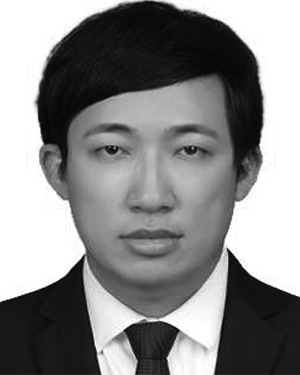 Zehua Dai合作论文数2ZHANG Ling-wei (张灵维)合作论文数2Runchao Xin (辛润超)合作论文数2Ling Qin (秦岭)合作论文数2Jinbo Li合作论文数1Jianhua Qin合作论文数1Li Juan合作论文数1
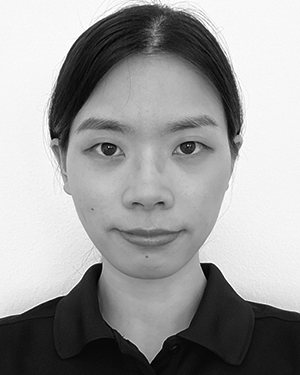 Lifang Yi合作论文数1Zhao Zhang合作论文数1
 Binbin Yang合作论文数1Peng He合作论文数1
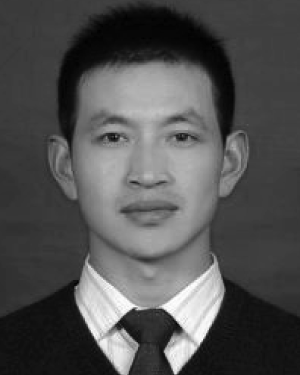 Wenming Chen合作论文数1
 Haichun Liu (刘海春)合作论文数College of Automation Engineering, Nanjing University of Aeronautics and Astronautics1
 Qin Wang (王勤)合作论文数College of Automation Engineering, Nanjing University of Aeronautics and Astronautics1
 Lexuan Meng合作论文数1
 Chen Yang合作论文数The State Key Lab of Chemical Engineering, Tsinghua University1
 Jiankun Cao合作论文数1
 Tao Sheng合作论文数National University of Defense Technology, National Univ of Defense Technology1Chunyang Han (韩春阳)合作论文数1




