With the increasing size of code and the increasing complexity of code files,code defect detection tools need to adopt parallel scheduling method for scheduling.In order to better use parallel method for scheduling and improve the efficiency of defect detection and utilization of hardware resources,we propose a method to predict the cost of the module tested in code defect detection.According to the characteristics of the defect testing system(DTS)defect detection process,the time cost feature and space cost feature were extracted.The semantic feature was extracted by deep memory network.The time cost feature and semantic feature were fused to get the fusion feature,and the regression model was used to predict the time cost of the fusion feature and the space cost of the space cost feature.Experimental results on 8 open source C projects show that the proposed method has a good performance in cost prediction.
Technological advancements in Deepfake enhance its quality and continuously reduce the application threshold. But the illicit utilization of Deepfake brings potential threats to individuals and the country. For safeguarding facial information security, it is crucial to detect the manipulated images and videos through deepfake detection models. It is an important topic of how to guarantee the accuracy, generalization, and significance of these models. Nevertheless, it is hard to obtain test predictions for deepfake detection models which present a notable testing challenge due to their extensive editing capabilities and uncertainties. In order to alleviate test oracle problem in this field, this paper general metamorphic relations based on the practice application scenario from three categories including image post-processing, image inpainting, and modifying the faces using textual prompts. This study founded the highest inconsistency percentage reaching up to 18.77% and the highest AUC percentage decreased by 12.9%. This paper assesses the effectiveness of these six metamorphic relations by employing five Deepfake detection models and evaluating the models' generalization based on result discrepancies. Experimental results show that metamorphic relations constructed can automatically generate high-quality follow-up test cases for identifying inconsistencies and assessing the models' generalization.
The design and development of the complex environment wind engineering simulation software CEWES was carried out, relying on the National Numerical Wind Tunnel Project (NNW). First, based on the characteristics of the physical problem that the software aims to solve, the requirements for the development of complex environment wind engineering simulation software are proposed, and three main modules of the software will be developed: structured grid flow field solver, unstructured grid flow field solvers modeling module of complex terrain and surface. Subsequently, the appropriate mathematical and physical model and numerical solution algorithm are selected for the flow field solver. The CEWES software uses the finite volume method for discretization with second-order accuracy, solves the RANS equations based on the SIMPLE algorithm, uses the k-ε turbulence model to solve the turbulence, and supports large-scale parallelism calculation. Third, the software design was carried out in accordance with the requirements of the CFD solution process and the modular program, focusing on the program architecture, data structure and subroutine interface design, and coding implementation based on the detailed design. Finally, the CEWES software was tested with typical examples. The test results of the calculation examples show that the software calculation results have good accuracy and large-scale parallel computing capabilities, and are suitable for wind engineering simulations in complex terrain environments.
在当前空气动力学研究中,各类求解计算程序缺乏与其配套的前后处理平台,容易降低研究人员的工作效率和软件的实用性.针对这一问题,NNW集成框架系统作为国家数值风洞项目(NNW)中数值模拟软件平台的重要组成部分,将前处理软件、求解计算程序、后处理软件集成于统一的集成环境,针对未来E级高性能计算的特点,以中间件为框架核心,按照一定的工作流模型集成多种功能模块,通过过程集成的方式,实现数据集成、计算集成、分析集成.同时,NNW集成框架系统支持对各类求解器的调度、作业管理、实时监控,为用户提供自动化多学科计算平台.通过在实际计算环境下运行计算案例,表明该集成框架系统能够为用户提供完整的计算工具链,快速定制一套或多套网格,并将与之配套的前处理和后处理计算结果可视化.
In high-performance computing job scheduling systems, to accurate predict the job runtime can effectively utilize the idle resource fragments generated during cluster computing as well as backfill them for improving scheduling performance. Because the runtime of high- performance computing jobs are affected by many factors thus are complicated non-linear problem. The ensemble machine learning method is used to predict the runtime of jobs in cluster computing. By comparing the prediction results of different models on the job log data sets from three real high-performance computing systems, it is found that the LightGBM algorithm has higher prediction accuracy, faster computation speed, shorter training time of the model and achieve better overall performance.
We accelerate a double precision Alternating direction implicit (ADI) solver for three-dimensional compressible Navier-Stokes equations from our in-house Computational fluid dynamics (CFD) software on the latest multi-core and many-core architectures (Intel Sandy Bridge CPUs, Intel Many integrated core (MIC) coprocessors and NVIDIA Kepler K20c GPUs). Some performance optimization techniques are detailed discussed. We provide an in-depth analysis on the performance difference between Sandy Bridge and MIC. Experimental results show that the proposed GPU-enabled ADI solver can achieve a speedup of 5.5 on a Kepler GPU in contrast to two Sandy Bridge CPUs and our optimization techniques can improve the performance of the ADI solver by 2.5-fold on two Sandy Bridge CPUs and 1.7-fold on an Intel MIC coprocessor. We perform a cross-platform performance analysis (between GPU and MIC), which serves as case studies for developers to select the right accelerators for their target applications.
In this paper, we accelerate a double-precision alternating direction implicit (ADI) solver for three-dimensional compressible Navier-Stokes equations from our in-house computational fluid dynamics (CFD) software on the latest multi-core and many-core architectures (Intel Ivy Bridge CPU, Intel Xeon Phi 7110P coprocessor and NVIDIA Kepler K20c GPU). For the GPU platform, both the OpenACC-based and the CUDA-based versions of the ADI solver are developed. To achieve high performance, we use a series of optimizatin techniques. For the Ivy Bridge CPU and Xeon Phi, we focus on three categories of optimization techniques: thread parallelism for multi-/many-core scaling, data parallelism to exploit the SIMD mechanism and improving on-chip data reuse, to maximize the performance. Also, we provide an in-depth analysis on the performance differences between Ivy Bridge and Xeon Phi. Our numerical experiments show that the proposed CUDA-based ADI solver can achieve a speedup of 9.7 on a Kepler GPU in contrast to a single naive serial version and our optimization techniques can improve the performance of the ADI solver by 2.5x on two Ivy Bridge CPUs and 1.7x on the Intel Xeon Phi coprocessor. We also notice that the OpenACC-based version runs around 29% slower than the CUDA-based one with careful manual optimizations. Besides, we systematically evaluate the programmability of the three platforms. Our insights facilitate the programmers to select a right platform with a suitable programming model according to their target applications.
This paper studies the implementation and optimization of a high-order weighted essentially non-oscillatory (WENO) solver to the solution of the Euler equations on the multi-core and many-core architectures (Intel Ivy Bridge CPU, Intel Xeon Phi 7110P coprocessor and NVIDIA Kepler K20c GPU). The implementation of up to ninth-order accurate WENO schemes is used in the solver. For the GPU platform, both the OpenACC-based and CUDA-based versions of different WENO schemes are developed. To achieve high performance, various optimizatin techniques are used. For Ivy Bridge CPU and MIC, we focus on three categories of optimization techniques: thread parallelism for multi-/many-core scaling, data parallelism to exploit the SIMD mechanism and improving on-chip data reuse, to maximize the performance. Also, we provide an in-depth analysis on the performance differences between Ivy Bridge and MIC. The numerical experiments show that the OpenACC performance can reach up to 84% in contrast to CUDA performance with careful manual optimizations, and the proposed CUDA-based version can achieve a speedup of 9.0 on a Kepler GPU in comparison with the sequential run. We also notice that the speedups of different WENO schemes roughly reach 15.9 and 192.2 on the two Ivy Bridge CPUs and the MIC, respectively. Besides, we conduct a systematic comparison of the three platforms in three aspects: performance, programmability, and power efficiency. Our insights facilitate the programmers to select the right platform with a suitable programming model according to their target applications.
CPU/GPU computing allows scientists to tremendously accelerate their numerical codes. In this paper, we port and optimize a double precision alternating direction implicit (ADI) solver for three-dimensional compressible Navier-Stokes equations from our in-house Computational Fluid Dynamics (CFD) software on heterogeneous platform. First, we implement a full GPU version of the ADI solver to remove a lot of redundant data transfers between CPU and GPU, and then design two fine-grain schemes, namely “one-thread-one-point” and “one-thread-one-line”, to maximize the performance. Second, we present a dual-level parallelization scheme using the CPU/GPU collaborative model to exploit the computational resources of both multi-core CPUs and many-core GPUs within the heterogeneous platform. Finally, considering the fact that memory on a single node becomes inadequate when the simulation size grows, we present a tri-level hybrid programming pattern MPI-OpenMP-CUDA that merges fine-grain parallelism using OpenMP and CUDA threads with coarse-grain parallelism using MPI for inter-node communication. We also propose a strategy to overlap the computation with communication using the advanced features of CUDA and MPI programming. We obtain speedups of 6.0 for the ADI solver on one Tesla M2050 GPU in contrast to two Xeon X5670 CPUs. Scalability tests show that our implementation can offer significant performance improvement on heterogeneous platform.
This paper focuses on the performance aspects of two types of many-core architectures, Tesla K20c GPU and Xeon Phi 31SP coprocessor, in solving complicated flow structures with a high-order weighted essentially non-oscillatory (WENO) scheme. Some performance optimization techniques are also detailed discussed. The results show that the K20c GPU can run several times faster than Xeon Phi 31SP due to the under-utilization of the Vector Processing Units (VPUs). When its VPUs are fully utilized, the Xeon Phi 31SP can achieve equivalent performance to that of the K20c GPU. The results could serve as a case study for users to select the right many-core architectures for their targeted application.
As a conservative, high-order accurate, shock-capturing method, weighted essentially non-oscillatory (WENO) scheme have been widely used to effectively resolve complicated flow structures in computational fluid dynamics (CFD) simulations. However, using a high-order WENO scheme can be highly time-consuming, which greatly limits the CFD application's performance efficiency. In this paper, we present various parallel strategies base on the latest many-core platform such as NVIDIA Fermi GPU, NVIDIA Kepler GPU and Intel MIC coprocessor to accelerate a high-order WENO scheme. Comparison analysis of the two generations GPUs between Fermi and Kepler, and cross-platform performance analysis (focusing on Kepler GPU and MIC) are also detailed discussed. The experiments show that the Kepler GPU offers a clear advantage in contrast to the previous Fermi GPU maintaining exactly the same source code. Furthermore, while Kepler GPU can be several times faster than MIC without utilizing the increasingly available SIMD computing power on Vector Processing Unit (VPU), MIC can provide the computing capability equivalent to Kepler GPU when VPU is utilized. Our implementations and optimization techniques can serve as case studies for paralleling high-order schemes on many-core architectures.
Based on the features of GPU architecture, this paper introduces CUDA into an existing Euler solver software for a 3-D Cartesian grid. Theories and Techniques used to solve the equations with finite volume methods using an explicit scheme are described. Two versions of GPU-based Cart Solver are implemented and optimized. For a real and complex model, the implementation on a NVIDIA GTX460se GPU by employing compute unified device architecture (CUDA) achieves up to an expected 8.5× speedup over a serial single-threaded Intel i7 CPU solver, and positively affects the practical applications with great engineering significance. The experimental results validate the correctness and accuracy of the solvers, and the great effect of optimization methods is also approved.
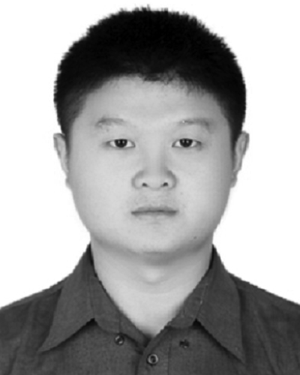 Liang Deng合作论文数College of Computer, National University of Defense Technology, Changsha, China6
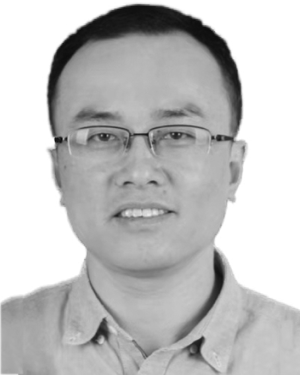 Fang Wang合作论文数6
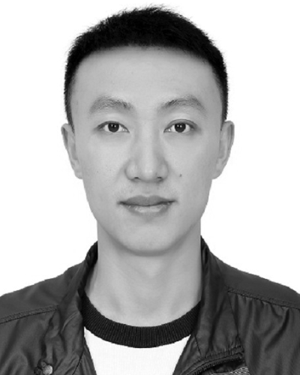 Dan Zhao合作论文数China Aerodynam Res & Dev Ctr, Computat Aerodynam Inst, Mianyang, Sichuan, Peoples R China3
 qingxin xu合作论文数2
 Bo Li合作论文数1
 Yang Liu合作论文数1
 Xujian Zhao合作论文数Southwest Univ Sci & Technol, Sch Comp Sci & Technol, Mianyang 621010, Sichuan, Peoples R China1Yufei Pang合作论文数China Aerodynamics Research and Development Center, Mianyang, China1Fan Zhao合作论文数1
 Hui Zhang合作论文数Southwest Univ Sci & Technol, Sch Comp Sci & Technol, Mianyang, Peoples R China1
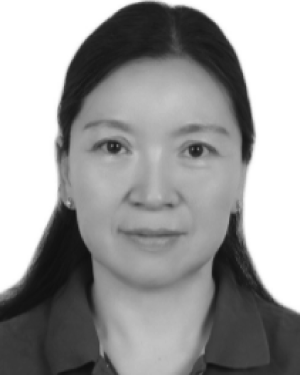 Ya Pan合作论文数Southwest University of Science and Technology(Southwest University of Science and Technology),Mianyang,China1HanShan Xiao (肖涵山)合作论文数1
 Yawen Wang (王雅文)合作论文数School of Computer Science, Beijing University of Posts and Telecommunications1
 Chunming Yang合作论文数1
 Jianbin Fang合作论文数National University of Defense Technology1
 Dahai Jin (金大海)合作论文数School of Computer Science, Beijing University of Posts and Telecommunications;State Key Laboratory of Networking and Switching Technology, Beijing University of Posts and Telecommunications1




