Conventional demodulation methods for fiberoptic Fabry-Perot (F-P) temperature sensors are limited either by the spectral resolution of wavelength-drift approaches or by spectral leakage in FFT-based phase demodulation. To address these issues, this study proposes a multitaper FFT full-spectrum phase demodulation (Multitaper FFT-FSPD) method for high-precision GaAs F-P temperature sensors. In the proposed dual-band cooperative scheme, the absorption-edge shift of GaAs in the 880-nm band is used for coarse temperature localization and free spectral range (FSR) counting, while high-precision phase demodulation is performed in the 1550-nm band using multitaper FFT for fine temperature compensation. By combining one Hamming window and two mutually orthogonal discrete prolate spheroidal sequence (DPSS) windows through coherent averaging in the complex spectrum domain, the proposed method effectively suppresses spectral leakage and improves dominant-frequency phase extraction. Experimental results show that the proposed sensor achieves a phase sensitivity of 0.235 rad/degrees C and a demodulation error of +/- 0.0984 degrees C. Compared with the traditional wavelength-drift method and the multipeak average wavelength-drift method, the proposed method improves demodulation accuracy by 63.6% and 38.8%, respectively. These results demonstrate the strong potential of the proposed method for high-precision real-time temperature monitoring.
Presents corrections to the paper, (Thermal Optical Fiber Sensor Based on GaAs Film for Fluid Velocity Measurement).
To measure contact forces between surgical instruments and tissues/organs in minimally invasive surgery (MIS), this paper proposes a miniature three-dimensional force sensor based on fiber Bragg grating (FBG). The sensor has an outer diameter of 1.5 mm and a length of 16 mm. Three FBGs inscribed on a single fiber are used to sense directional strains and realize three-dimensional force decoupling. Static calibration results show sensitivities of 224.6 pm/N, 584.9 pm/N, and 1457.7 pm/N in the Z, X, and Y directions, respectively. A phantom-based palpation experiment further verifies the feasibility of the proposed sensor for MIS applications.
The visualization and navigation of minimally invasive instruments within confined internal spaces are critical to the success of the surgery, but traditional navigation methods face challenges from electromagnetic interference and ionizing radiation. To address these limitations, we propose a fast fiber shape sensing approach with high accuracy based on a two-layer long short-term memory (LSTM) network. The model directly regresses the 3D coordinates along the fiber sensor from the Bragg wavelength shifts of fiber Bragg gratings (FBGs), bypassing explicit curvature estimation and numerical integration. In dynamic experiments, the method achieves real-time inference at 32 fps with an end-to-end latency of approximately 7.3 ms. The mean tip error is around 2.9 mm, accounting for 0.72% of the 400 mm sensing length. The results indicate that the proposed two-layer LSTM-based method enables high-speed, high-accuracy fiber shape reconstruction, offering potential for real-time fiber navigation applications.
Fiber-optic shape sensing is being actively developed for navigation in minimally invasive procedures, but reconstruction accuracy remains limited by both physical error sources and the reconstruction procedure itself. The four commonly used algorithms can achieve shape reconstruction including the Frenet-Serret frame (FS), the rotation minimizing frame (RMF), the helical extension method (HEM), and the transformation matrix method (TM). However, all four algorithms are based on the centerline by integrating local curvature and orientation along the fiber, in which small errors near the proximal end can accumulate and lead to larger deviations at the distal tip. In order to achieve high accuracy of the distal tip, we have theoretically compared the reconstruction accuracy and analyzed the noise robustness of the four reconstruction algorithms. In noise-free studies, TM algorithm can produce the smallest reconstruction errors compared with the FS, RMF, and HEM algorithms, showing great potential in the reliability of tip localization in clinical procedures. But when the strain noise and angular noise exist, the reconstruction accuracy of TM degrades, especially at high spatial resolution. To enhance the reconstruction accuracy, we have proposed Kabsch-algorithm-based pose correction that the principal axis direction of the shape reconstruction is corrected based on the minimum deviation of the proximal coordinate points. As a result, the relative accuracy enhancement of TM exceeds 35.7% under strain-spatial-resolution coupling noise and exceeds 37.8% and 42.7% under angular noises with 0.24° and 0.45° standard deviation, respectively. We have further investigated the reconstruction accuracy of complex path in minimally invasive procedures, e.g. brachial-artery-to-heart path. By utilization of TM algorithm with pose correction, the mathematical expectation of the mean shape reconstruction error in the presence of noise can be reduced from 1.25 mm to 0.90 mm, indicating the accuracy can be enhanced by 28%. Our obtained results provide a general guidance for selecting noise-robust reconstruction methods and show that Kabsch-algorithm-based pose correction offers a simple way to improve reconstruction accuracy for clinically relevant catheter paths.
Developing ultra-sensitive miniature fiber sensors capable of detecting ultrasonic signals in the kilohertz range is of fundamental importance for a wide range of applications. However, current Fabry-Perot interferometric (FPI) fiber sensors face the main challenge of the intrinsic trade-off between sensitivity and resonant frequency, which hinders broadband ultrasonic detection. To break the sensitivity-frequency trade-off, we have proposed and demonstrated an FPI sensing diaphragm based on a hollow-tympanic diaphragm (HTD) structure. The HTD design integrates a centrally thinned tympanic-inspired region to enhance sensitivity and a peripheral hollow support to maintain the resonant frequency, effectively overcoming the trade-off between sensitivity and bandwidth. It is fabricated on the fiber end face using two-photon 3D printing technology for constructing an FPI acoustic fiber sensor. The obtained mechanical sensitivity reaches 1435 nm/kPa at the center frequency of 198 kHz, demonstrating that the HTD design effectively maintains high sensitivity within the high-frequency range. This result verifies that the proposed structure successfully mitigates the trade-off between the sensitivity and frequency response. Furthermore, the device successfully captures continuous pulsed ultrasonic signals generated by a spark discharge source, with demodulated results showing excellent agreement with the source frequency, confirming its potential for high-resolution acoustic field detection and transient ultrasonic measurement. Such a high-sensitivity probe capable of operating effectively in the high-frequency detection range holds great potential for applications in industrial ultrasonic monitoring, biomedical sensing, and structural health diagnostics.(c) 2026 Chinese Laser Press
This paper proposes an optical fiber Fabry-Perot interferometer (FPI) temperature sensor enhanced by using virtual Vernier effect, which is achieved by superimposing the raw interference spectrum to a virtual one generated by frequency-shifting the initial one. Chirp-Z transform (CZT) is also used to improve the dominant frequency resolution and demodulation accuracy. Experimental results demonstrate impressively low temperature demodulation error of 0.06 °C and significantly enhanced sensitivity of 0.722 nm/°C.
To tackle the loss of tactile perception in minimally invasive surgery (MIS) and the challenge of simultaneously achieving miniaturization, high sensitivity, and lateral-force resistance in existing one-dimensional optical fiber force sensors, this paper presents a miniature contact force sensor. The sensor is based on a Fiber Bragg grating (FBG) integrated with a novel staggered parallelogram hollow-slot structure. The sensor features an ultra-compact design with an outer diameter of only 1.3 mm and a length of 10 mm, demonstrating significant miniaturization compared to the majority of existing sensors. The hollow-slot structure not only enhances the axial strain concentration effect, thereby elevating the axial sensitivity to 415.9 pm/N, but also endows the sensor with robust resistance to lateral forces. Meanwhile, the reduced-diameter structure effectively improves the overall structural stiffness. A force-temperature decoupling mechanism is established through a dual-FBG configuration, effectively eliminating the impact of environmental temperature fluctuations on the accuracy of the measurement. Finite element simulations and comprehensive experimental validations—including static calibration, dynamic response evaluation, temperature calibration, lateral force resistance comparison, and simulated palpation experiments—demonstrate that the proposed sensor offers high sensitivity, excellent linearity, and real-time responsiveness, thereby meeting the requirements for precise low-magnitude force sensing in MIS.
A data-driven method based on fiber Bragg grating (FBG) wavelength shifts is proposed to estimate force and location along a flexible instrument. A multilayer perceptron (MLP) is used to directly map the wavelength shifts of three FBGs to the force components and loading location. Experiments on an FBG-integrated flexible instrument show mean absolute error (MAE) values are 4.05 mN (3.10%), 10.20 mN (1.41%), and 0.41 mm (1.36%) for the Y-direction force component, Z-direction force component, and loading location, respectively.
This paper presents a high-precision miniature force sensor based on fiber Bragg grating (FBG) for measuring axial contact force (CF) between a medical instrument tip and tissue during minimally invasive surgery (MIS) palpation. The newly designed FBG force sensor, with a reduced diameter of 1.5 mm and a total length of 12 mm, is easier to integrate into miniature medical instruments compared to existing 3 mm diameter sensors. The sensor consists of a tubular elastomer structure and two optical fibers. A unique staggered inclined notch design on the elastomer surface enhances sensitivity to axial forces and mitigates lateral force-induced strains. The central axial optical fiber has FBG1 inscribed to detect strains from axial forces and temperature changes, while the adjacent fiber has FBG2 to measure only temperature-induced strains. Calibration and temperature compensation experiments confirmed the sensor's accuracy in measuring CF and decoupling temperature effects. The sensor has an axial force sensitivity range of 0 to 1.4 N with a sensitivity of 270.809 pm/N and a dynamic measurement error of less than 0.2 g. The post-temperature compensation error is less than 0.08 N. Simulation palpation experiments, using silicone embedded with hard blocks to mimic pathological tissues, validated the sensor's effectiveness in detecting tissue abnormalities and distinguishing the hardness of different blocks during MIS palpation. A comparative experiment was conducted with a traditional helical-structured sensor to assess lateral force resistance, confirming that the designed sensor exhibits excellent lateral force resistance.
When dealing with the reflected signals from an array of optical fiber Bragg gratings (FBGs) in fiber optic sensing, the conventional multi-peak detection algorithm often faces challenges due to the presence of noise interference, potentially resulting in demodulation failures. In this study, we propose a robust self-adaptive multi-peak detection algorithm. First, the reflected signals from the optical fiber Bragg grating array are normalized to enhance the stability of the algorithm. Next, an improved thresholding function in a wavelet transform denoising method is introduced to process the normalized FBG signals, effectively reducing high-frequency noise within the signals. Following this, the spectrum is segmented using the Hilbert transform and a self-adaptive threshold mathematical model, and then achieve stable 3 dB bandwidth spectrum segmentation by using spectrum expansion techniques. Lastly, the traditional peak detection algorithm is applied to extract the Bragg wavelengths from the segmented sub-spectral signals. Theoretical analysis and experimental results provide comprehensive evidence that employing a self-adaptive threshold for spectral segmentation significantly enhances the algorithm's portability across diverse scenarios, thereby improving the demodulation speed and stability of the algorithm. The proposed algorithm provides a precise and noise-resistant demodulation method for handling multi-peak signals in quasi-distributed sensing networks.
The sensing fiber plays a critical role in distributed acoustic sensing (DAS) as it functions as a transducer, converting external acoustic signals into optical signals that can be detected and measured. However, temperature variations significantly impact the accuracy and reliability of acoustic measurements, posing a notable challenge to DAS performance. Previous solutions have employed additional spectral-domain demodulation using ultra-weak fiber Bragg gratings or a Raman-based system, which considerably hinder real-time distributed demodulation and increase system complexity. Here, we have proposed an air-ring microstructured optical fiber (AR-MOF) to replace standard single-mode fiber in DAS system, by leveraging the air-hole microstructure to enhance elastic-optic, strain-optic, thermo-optic, and thermal expansion properties. Simultaneously distributed acoustic and temperature sensing has been achieved with an acoustic sensitivity of −126.38 dB re rad/μPa at 3 kHz and a temperature sensitivity of 263.02 rad/°C within 32.0°C–42.0°C. The results highlight its potential for advanced applications, such as early-stage acoustic and thermal anomalies in oil and gas pipelines leakage.
This work introduces a novel fiber Bragg grating (FBG)-based tactile sensor specifically developed for real-time force monitoring at the tips of flexible ureteroscopes. With a diameter of only 1.5 mm, the sensor features a dual-FBG configuration that effectively separates temperature effects from force signals, integrated with an innovative elastomer structure based on staggered parallelogram elements. Finite element analyses comparing traditional spiral and parallel groove designs indicate that the new configuration not only enhances axial sensitivity through optimized deformation characteristics but also significantly improves resistance to transverse forces via superior stress distribution and structural stability. In the sensor, a suspended lateral FBG is employed for thermal compensation, while an axially constrained FBG is dedicated to force detection. Calibration using a segmented approach yielded dual-range sensitivities of approximately 283.85 pm/N for the 0–0.5 N range and 258.57 pm/N for the 0.5–1 N range, with a maximum error of 0.07 N. Ex vivo ureteroscopy simulations further demonstrated the sensor’s capability to detect tissue–instrument interactions and to discriminate contact events effectively. This miniaturized solution offers a promising approach to achieving precise force feedback in endoscopic procedures while conforming to the dimensional constraints of standard ureteroscopes.
To address the optimization problem of expensive multi-modal multi-objective black-box functions, this paper proposes a systematic optimization method based on a back propagation neural network as a proxy model, combined with clustering algorithm to cluster and differentiate multiple modes within the model. The method utilizes normalization and weighted summation of numerical experimental data to optimize the hyperparameters of the optimization algorithm's decision-making process. This approach resolves the multiple constraints of traditional optimization methods. Finally, applied to the hollow-core anti-resonant fiber with gap angle constraints to ensure its topological properties remain unchanged, the model optimizes three categories totaling six modes, optimizing the objectives of birefringence and loss. The top five optimal models achieve a minimum loss of 3.54x10(-3) dB/m, maximum birefringence of 1.25x10(-4), higher order modulation enhanced receiver of 50, and bandwidth of 1.425 mu m.
A multi-taper FFT-based full-spectrum phase demodulation (FSPD) method is proposed for high-precision Fabry-Perot fiber-optic temperature sensing. The method introduces a Hamming window and two orthogonal DPSS windows to perform coherent averaging of complex spectra, effectively suppressing spectral leakage and noise. This approach enables accurate phase extraction across the entire interference spectrum, improving both precision and robustness. Experimental validation over 20-45 degrees C using a GaAs F-P fiber probe and a dry-well calibrator achieved a phase sensitivity of 0.2147 rad/degrees C and an average demodulation error of +/- 0.174 degrees C, demonstrating significantly higher accuracy than conventional wavelength-drift methods. The proposed technique offers a compact and efficient solution for real-time, high-precision fiber-optic temperature sensing.
Abstract In order to evaluate the passing performance of the wire mesh screen wheel designed for the lunar mobile platform, a beam element co-node method was proposed to build the finite element model of the wheel net according to its special wheel net structure. The wheel net model built by the beam element co-node method not only ensures the mesh quality and wire cross-section characteristics, but also greatly reduces the number of meshes compared with the direct meshing of the model. The lunar soil discrete element particle model and the screen wheel finite element model were set up in LS-DYNA for the joint working conditions. The screen wheel designed according to the lunar platform has a sinking amount of less than 10% of the wheel diameter and a driving torque of less than 10.2N•m under various working conditions, which proves that the wheel has good passing performance.
This study presents a miniature insulated acceleration sensor based on Fiber Bragg Grating (FBG) technology, specifically designed for monitoring abnormal vibrations at the end windings of stator coils in turbo-generators. The proposed FBG sensor comprises a single optical fiber with an inscribed FBG element, an elastomeric structure, and an encapsulated base. The novel elastomer structure enhances sensitivity to axial acceleration while effectively mitigating cross-axis interference. Unlike conventional FBG acceleration sensors that typically employ non-dielectric materials, this design utilizes zirconia, offering superior electromagnetic compatibility in the high-voltage, high-magnetic-field environment typical of turbo-generators. The compact form factor of approximately 48 mm × 15 mm × 15 mm ensures ease of integration into constrained installation spaces within generator stator ends, addressing limitations of bulky traditional sensors. Calibration experiments reveal an average acceleration sensitivity of 14 pm/g over the 50–500 Hz frequency range.
Fiber optic Fabry-Perot sensor technology offers numerous advantages for ultrasonic detection.However,demodulating the ultrasonic frequency band of the Fabry-Perot sensor is challenging,owing to complex external environments and existing technical limitations.Thus,the fast and stable demodulation of ultrasonic sensor information a key issue.First,this study introduces the development and principles of the Fabry-Perot ultrasonic sensor.Second,this study deeply analyzes the method principles,research progress,and existing problems in the demodulation process of the fiber optic Fabry-Perot ultrasonic sensor,and proposes application limitations for various demodulation methods.Finally,this study provides a prospective summary of demodulation methods for Fabry-Perot ultrasonic fibers.
 Yang Tianyu合作论文数50
 Huanhuan Liu合作论文数30
 Jianwei wu合作论文数17
 Guohua Jiao (焦国华)合作论文数Faculty of Computer Science and Artificial Intelligence, Shenzhen University of Advanced Technology;Shenzhen Institutes of Advanced Technology, Chinese Academy of Sciences;University of Chinese Academy of Sciences16
 Yuanfu Lu (鲁远甫)合作论文数Shenzhen Institute of Advanced Technology, Chinese Academy of Sciences;University of Chinese Academy of Sciences15dong luo合作论文数11Yunjie Shi合作论文数9
 Liang Zhang (张亮)合作论文数School of Communication and Information Engineering, Shanghai University7Jialin Wen合作论文数6
 Shidi Liu合作论文数Chinese Acad Sci, Shenzhen Inst Adv Technol6Ronghui XU (徐荣辉)合作论文数6Zhengyong Zhou合作论文数Shanxi Normal Univ, Sch Math & Comp Sci, Linfen 041004, Shanxi, Peoples R China6Zhisheng Zhou合作论文数6
 Tianyu Yang (楊田雨)合作论文数Alibaba DAMO Academy6
 Guangyuan Li (李光元)合作论文数Shenzhen Institutes of Advanced Technology, Chinese Academy of Sciences;University of Chinese Academy of Sciences5Yuyang Lou合作论文数5
 Xinyong Dong (董新永)合作论文数School of Information Engineering, Guangdong University of Technology5
 Yan Liang (梁岩)合作论文数School of Resources and Environment, University of Electronic Science and Technology of China5
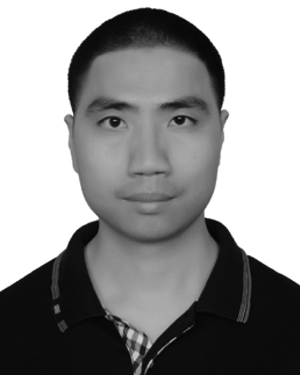 Wenquan Liu合作论文数5Chen Si-Hai合作论文数4
 Wei Liu合作论文数School of Electronic and Optical Engineering, Nanjing University of Science and Technology4Degui Sun合作论文数University of Ottawa4
 Jiancheng Lv (吕建成)合作论文数College of Computer Science, Sichuan University4
 Zhenyu Lu (陆振宇)合作论文数School of Artificial Intelligence, Nanjing University of Information Science & Technology4
 Zhengshuai Cao合作论文数3Zijue Zhu合作论文数3
 Chunlei Yang (杨春雷)合作论文数Center for Photovoltaic Solar Cells, Shen Zhen Institute of Advanced Technology, Chinese Academy of Sciences;University of Chinese Academy of Sciences3Qiran Li (李其然)合作论文数Center for Optoelectronic Technology & Engineering, Shenzhen Insititues of Advanced Technology, Chinese Academy of Sciences;University of Chinese Academy of Sciences3Qi Zhang合作论文数3Jianxiong Zou合作论文数3
 Rongbin She合作论文数Chinese Univ Hong Kong3Ming Tian合作论文数3Xingxing LUO (罗星星)合作论文数3
 Linfeng Lan (兰林锋)合作论文数School of Materials Science and Engineering, South China University of Technology3
 Bo Liu (刘波)合作论文数School of Physics Science and Engineering, Tongji University3
 Haitao Luo (骆海涛)合作论文数Shenyang Institute of Automation, Chinese Academy of Sciences;University of Chinese Academy of Sciences3
 Perry Ping Shum (沈平)合作论文数Department of Electronic and Electrical Engineering, College of Engineering, Southern University of Science and Technology3Liangpei Chen (陈良培)合作论文数2
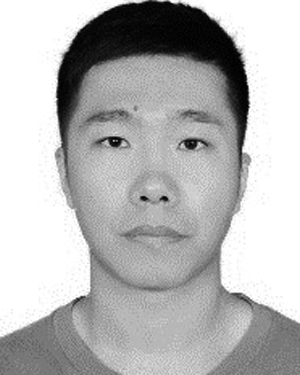 Peng Liu (刘鹏 liu peng)合作论文数2Lin Liwei合作论文数2Li Jin-Ying合作论文数2Yuxin Li合作论文数2
 Lei Xiong合作论文数2Kun HU (胡昆)合作论文数2
 Wei Chen (陈伟)合作论文数Institute of Semiconductors, Chinese Academy of Sciences2
 Xingyu Zhang (张行愚)合作论文数School of Information Science and Engineering, Shandong University2
 Zhiyuan Liu (刘志远)合作论文数Shenzhen Institute of Advanced Technology, Chinese Academy of Sciences;University of Chinese Academy of Sciences2




