Two fungi, wich produced an acid and an alkaline-stable xylanase, were isolated from soil and identified as strains of Aspergillus niger. The basic characteristics of both xylanases were studied and the conditions of pretreating wheat straw pulps with xylanases were also optimized. The results showed that enzyme-pretreated pulps can obtain higher brightness, or 20%-30% of hypochlorine can be reduced at the same final brightness level. It can be predicted that xylanase has a great potential economic and environmental benefits in non-wood pulp bleaching in the near future.
The cellobiohydrolase II gene, cbh2 was amplified by polymerasechain reaction(PCR) from an enhanced cellulase-producing strain, Trichoderma k?ningii K, and then was cloned to T-easy vector. Sequence comparisons show that cbh2 of T. k?ningii is identical to that of T. reesei with the exception of 2 bp in the coding region, which cause an amino acid substituted in the mature CBHII protein. The similarity values between CBHII gene of T. k?ningii and reported cbh2 gene of Trichoderma reesei is 99.89%. The cbh2 gene of T. k?ningii is 1611bp long, and the coding region is interrupted by three short introns. The derived CBHII protein sequence is 471 amino acids long and three putative N-glycosylation sites is found.
Zymograms of the cultural supernatant of Aspergillus niger 149 showed xylanase^s two bands tentatively named X-I and X-II. X-I and X-II were purified to PAGE homogenity by (NH_(4))_(2)SO_(4) fractionation and DEAE-Sephadex A50 column chromatography. The molecular mass of X-I and X-II estimated by SDS-PAGE and concentration gradient PAGE and 37kDa, 76kDa, 24kDa and 23kDa, respectively. X-I and X-II contained 27.6% and 7.3% carbohybrate residues, respectively.
 zizheng yan (严自正)合作论文数3Zhu Jing (朱静)合作论文数2XinCheng Jia (贾新成)合作论文数2
 Shuzheng Zhang (张树政)合作论文数中国科学院生物学部常委2Hongge Chen合作论文数2Zhenyan Li合作论文数1qingrong chang (常清荣)合作论文数1ZHU Ling-xiang (祝令香)合作论文数1YU Wei (于巍)合作论文数1WenYing Feng (冯文英)合作论文数1
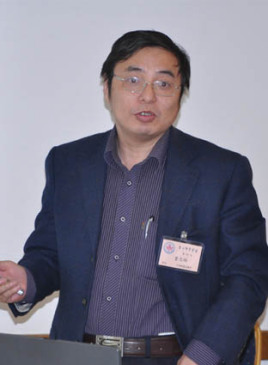 Zhiyang Dong (董志扬)合作论文数State Key Laboratory of Microbial Resources, Institute of Microbiology, Chinese Academy of Sciences1




