This work reports and thoroughly discusses the results of an onsite trilateral comparison between a dual Josephson impedance bridge developed by METHS and the electronic fully digital impedance bridges developed by CMI and INRIMPOLITO. The target accuracies of the bridges are at the level of 10(-9) to 10(-8) for the former and at the level of parts in 10(7) for the latter. The bridges were tested with R : R and R : C standards, with nominal magnitudes of 12.9 k Omega, and with a quantum Hall resistance standard, in conditions suitable for the primary direct realization of the impedance units ohm and farad from ac quantum Hall resistance standards or from ac/dc calculable transfer resistance standards calibrated against dc quantum Hall resistance standards. The results were fully compatible at the expected level of uncertainty for what concerns the magnitude ratio, but phase measurements with R : C standards showed some incompatibilities.
Nowadays, precision electrical measurements in AC voltage are mainly based on the use of Josephson arbitrary waveform synthesizers. Optimising the performance of such a system requires careful adjustment of the pulse train shape sent through the array. In this paper, we present a new method for tuning the various parameters of the pulse pattern generator when the Josephson array is operated in the zero-compensation mode. This method is based on the use of a two-terminalpair impedance bridge and can be fully automated. Preliminary results of this ongoing project show that the plateau width of the quantum-accurate output voltage increases by more than 2.5 times after optimisation provided by the described method.
This paper addresses the challenges associated with accurately measuring longitudinal impedance in a quantum Hall device. A novel bridge design capable of measuring both real and imaginary components of longitudinal impedance is introduced and applied for the first time. The measured inductance appears to be independent of both carrier density and mobility. Additionally, the inductance remains constant over the frequency range from 600 Hz to 50 kHz.
In this work, we present the results of an onsite trilateral comparison between a dual Josephson impedance bridge developed by METAS and the electronic fully-digital impedance bridges developed by CMI and INRIM-POLITO. The target accuracies of the bridges are at the 10(-8) level for the former and at the 10(-7) for the latter. Here we report the results of the calibration of a 10nF capacitance standard against a 12.9k Omega calculable resistance standard at 1233Hz, conditions suitable for the primary direct realization of the impedance units ohm and farad from AC quantum Hall resistance standards or from AC/DC calculable transfer resistance standards calibrated against DC quantum Hall resistance standards.
Main text This report describes the second CCM key comparison of realizations of the kilogram definition based on the fixed numerical value of the Planck constant, which came into force on 20 May 2019. The objectives were to determine the level of agreement between realizations of the kilogram using Kibble and joule balances and the x-ray crystal density (XRCD) method and to provide input for the calculation of the second "consensus value" of the kilogram. The consensus value serves as the basis for an internationally coordinated dissemination of the kilogram and is updated after each new key comparison. Its use will continue until satisfactory agreement between realization experiments has been achieved. Another objective was the determination of the reproducibility of the realization experiments by comparing the new results with those of the first key comparison of kilogram realizations, CCM.M-K8.2019. The comparison was organized by the BIPM and had nine participants. The BIPM, LNE, METAS, NIST, NRC and UME operated Kibble balances, the NIM used a joule balance and the NMIJ and the PTB participated using 28Si spheres, the masses of which were determined with the XRCD method. These realization methods were used to calibrate 1 kg mass standards under vacuum or in air. The standards were sent to the BIPM where they were compared with each other and with BIPM Pt-Ir working standards. The latter were calibrated traceable to the International Prototype of the Kilogram (IPK), the mass of which served as the definition of the kilogram until 20 May 2019. The results of the weighings at the BIPM together with the measurement results communicated by the participants allowed comparison of the values attributed to 1 kg mass standards using the realization experiments of the participants. The level of agreement between mass determinations with the realization experiments and the BIPM as-maintained mass unit, traceable to the Planck constant through the mass of the International Prototype of the Kilogram, could also be deduced. To reach the main text of this paper, click on Final Report. Note that this text is that which appears in Appendix B of the BIPM key comparison database https://www.bipm.org/kcdb/. The final report has been peer-reviewed and approved for publication by the CCM, according to the provisions of the CIPM Mutual Recognition Arrangement (CIPM MRA).
After several years of development and continuous improvement, the Kibble balance at the Federal Institute of Metrology (METAS) is now operational. Its stability and reliability allows high precision measurements to be performed under vacuum. Two measurement campaigns were conducted in 2021 with 1 kg stainless steel test masses. The result differs from the value deduced from the calibration following the dissemination process after the redefinition of the kilogram by 6 μg with a total standard uncertainty of 43 μg ( k = 1). This paper presents the details of this first result with its associated uncertainty budget.
A new watt balance experiment is under development at the Federal Institute of Metrology (METAS, Switzerland). Its scope is to link the mass unit to the Plank constant in order to set a new definition of the kilogram, which is no longer based on the international prototype. The experiment is performed in two steps with the same setup and requires that the magnetic field produced in the two steps by the magnet fitted in the setup remains stable within few parts per 108. This paper describes the design, manufacture, and characterization of this magnet, which is performed through a collaboration between METAS and CERN.
Precision absolute gravity measurements are growing in importance, especially in the context of the new definition of the kilogram. For the case of free fall absolute gravimeters with a Michelson-type interferometer tracking the position of a free falling body, one of the effects that needs to be taken into account is the 'speed of light perturbation' due to the finite speed of propagation of light. This effect has been extensively discussed in the past, and there is at present a disagreement between different studies. In this work, we present the analysis of new data and confirm the result expected from the theoretical analysis applied nowadays in free-fall gravimeters. We also review the standard derivations of this effect (by using phase shift or Doppler effect arguments) and show their equivalence.
The METAS Mark II experiment (BWM II) [1-3] is close to be fully assembled and the first characterization tests have started. In the dynamic phase, the field profile shows a curvature below 1 ppm/mm over a region larger than 15 mm. The field profile is measured at a velocity of 1.3 mm/s to produce an induced voltage of 1 V across the coil. This motion is measured with a Michelson interferometer where the moving optical element is placed at the geometrical center of the coil. The development of the mass handler is finished and the last parts are ready to be mounted. After a set of tests, the determination of the Planck constant will be performed in the second half of 2015.
There is a firm will in the metrology community to redefine the kilogram in the International System of units by linking it to a fundamental physical constant. The watt balance is a promising way to link the mass unit to the Planck constant h. At the Federal Institute of Metrology METAS a second watt balance experiment is under development. A decisive part of the METAS Mark II watt balance is the mechanical linear guiding system. The present paper discusses the development and the metrological characteristics of two guiding systems that were conceived by the Laboratoire de Systemes Robotiques of EPFL and built using flexure mechanical elements. Integration in the new setup is also described.
In the early eighties, the development of ballistic absolute gravimeters based on laser interferometer opened the doors to new research areas in various scientific domains such as geodesy, geophysics or metrology. After a brief overview of the most used technique for gravity measurements, the implication of gravity in the context of an improved SI, especially for a new definition of the mass unit kg, will be presented.
We propose a microelectromechanical systems-based tunable asymmetric Fabry-Perot cavity for the high-precision weighing of macro samples. The device is based on an in-plane design and is structured in a silicon-on-insulator substrate. The cavity length of the optical resonator is tuned under the action of an external force. The force can be determined from the resulting spectral shift of the optical resonance. Measurements can be done under static conditions and are immune to electromagnetic interferences. Various designs have been simulated, fabricated and characterized. We report the experimental performances of four devices that have been tested under loads up to 98 mN (10 g). Sensitivities ranging from 0.51 to 67.69 nm/mN and absolute resolution ranging from 0.15 to 19.61 μN are reported. The maximum relative resolution of the sensor is below 100 ppm.
The kilogram is the last unit of the international system of units (SI) still based on a material artefact, the international prototype of the kilogram (IPK). The comparisons made in the last hundred years have clearly revealed a long-term relative drift between the IPK and the official copies kept under similar conditions at the Bureau International des Poids et Mesures. A promising route towards a new definition of the kilogram based on a fundamental constant is represented by the watt balance experiment which links the mass unit to the Planck constant h. For more than ten years, the Federal Institute of Metrology METAS has been actively working in the conception and development of a watt balance experiment. This paper describes the new design of the Mark II METAS watt balance. The metrological characteristics of the different components of the experiment are described and discussed.
The kilogram is the last unit of the international system (SI) still based on a material artifact, the international prototype of the kilogram (IPK). The comparisons made in the last hundred years have clearly revealed a long term relative drift between the IPK and a set of copies kept under similar conditions. Since the long term stability is one of the major conditions set on the SI base units, this situation is no longer satisfactory and a new definition of the mass unit becomes a priority for the metrology community. A promising route towards a new definition based on fundamental constants is given by the watt balance experiment which links the mass unit to the Plank constant h. Today, the kilogram is the last unit of the International System of Units (SI) still based on an artifact, the international prototype of the kilogram (IPK), kept at the Bureau International des Poids et Mesures (BIPM). The IPK prototype that has been machined in 1878, is a cylinder of platinum-iridium alloy (Pt 90% - Ir 10% in mass) whose height (39 mm) is equal to its diameter. Six copies were designated as official copies and are kept in the same conditions as the international prototype. At that time, about seventeen other copies were given to the member states of the meter convention to materialize their national prototype. Since then, other countries have joined the meter convention and new national prototypes have been machined and added to the existing set of international prototype copies. To survey the evolution of the different copies relative to IPK three comparisons have been organized since 1880. The results of these comparisons have clearly put in evidence, a relative drift of this set of masses with respect to IPK. The mean drift of the official copies has been evaluated to 0.5 µg/year. Nevertheless, it is clear that the actual definition of mass does not allow attributing the drift to IPK or to the copies. Moreover, variations of the mass unit directly reflect on the ampere definition and therefore on the whole set of electri- cal units. Since it is now possible to compare two mass standards made out of the same material with an uncertainty of about 1 µg, the instability among the international mass prototypes - including IPK - is a major contribution to the final uncertainty. Clearly, such a situation is no longer satisfactory for one of the base units of the SI. There is now a general consensus in the metrology community that the time for a redefinition of the kilogram has come. To get a better stability, the new definition should be linked to a physical fundamental constant with a relative uncertainty in the order of 10 -8 . During the last decades, several
The European Metrology Research Programme (EMRP) funds research to address the discrepancy between the values of the Planck and Avogadro constants measured via the watt balance experiments and by the counting of 28 Si atoms. The strategy will be to strain the procedures, models, and apparatuses up to their limit by repeating the measurements with accuracies stricter than those achievable by today's technologies.
The Swiss Watt Balance is a new type of moving-coil experiment with a very compact design. The aim of the experiment is to link the unit of mass to fundamental constants with a view to a future redefinition of the kilogram. That means to express the kilogram in terms of the meter, the second and the Planck's constant, by equating electrical and mechanical power, with a relative uncertainty of 10 –8 . The main features of the Swiss design are a very compact construction and a strict separation between the moving and weighing parts of the experiment. In order to optimize all the key components of the set-up, they were separately tested and accurately characterized. An update on the optical velocity measurement and regulation system, on the permanent magnet and coil assembly assessment, and on the automation of the programmable Josephson voltage standard is given first. In addition, the mass comparator, the characterization of the 100 g gold mass standards, and the absolute gravity measurements are presented. In a second part, the description of a complete sequence of data acquisition is explained in details.
The METAS watt balance project was initiated slightly more than a decade ago. Over this time, the apparatus has been through an uninterrupted series of upgrades that have improved its reliability to a point where continuous series of measurements can be taken fully automatically over periods of several months. A comprehensive analysis of possible systematic errors has now been completed and a large set of data has been analysed to calculate a value for the Planck constant h. This paper describes the watt balance in detail, explains the data acquisition and analysis thoroughly and presents the uncertainty budget. The value of the Planck constant determined with our apparatus is h = 6.626 069 1(20) x 10(-34) J s with a relative standard uncertainty of 0.29 x 10(-6). This value differs from the 2006 CODATA adjustment by 0.024 mu W W-1.
The kilogram is the last unit of the international system (SI) still based on a material artefact, the international prototype of the kilogram (IPK). The comparisons made in the last hundred years have clearly revealed a long term relative drift between the IPK and a set of copies kept under similar conditions. Since the long term stability is one of the major conditions set on the SI base units, this situation is no longer satisfactory and a new definition of the mass unit becomes a priority for the metrology community. A promising route towards a new definition based on fundamental constants is given by the watt balance experiment which links the mass unit to the Plank constant.
In watt balance experiments, the determination of the position and the velocity of a moving coil have a crucial contribution in the overall uncertainty. In this paper, we present optical devices that will be set up to measure the two above mentioned parameters.
The alignment of optical devices such as interferometers and laser position detectors is needed for the different adjustments of watt balances. This paper describes the optical apparatus and the numerical simulations developed to tune the alignment of experimental setup. A telescope coupled with a CCD camera and data processing are presented in detail.
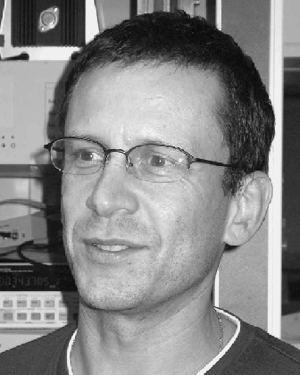 Henri Baumann合作论文数Fed Off Metrol METAS, CH-3003 Bern, Switzerland11
 Beat Jeckelmann合作论文数Swiss Federal Office of Metrology10
 Frederic Overney合作论文数Institute for Micro- and Optoelectronics, Swiss Federal Institute of Technology7
 Blaise Jeanneret合作论文数Swiss Federal Office of Metrology OFMET6
 Franck Bielsa合作论文数5
 Davide Tommasini合作论文数European Organization for Nuclear Research4Gerard Geneves合作论文数4
 Mark W. Keller合作论文数National Institute of Standards and Technology4d reber合作论文数3Gilbert, O.合作论文数3
 Cosandier, F.合作论文数3
 Patrick P. Juncar合作论文数3
 Massimo Ortolano合作论文数Istituto Nazionale di Ricerca Metrologica Strada delle Cacce3Neil M. Zimmerman合作论文数National Institute of Standards and Technology3
 Reymond Clavel合作论文数3
 Martina Marzano合作论文数Institute of Metrology, Electronics and Computer Science, University of Zielona Góra (UZG),2
 Philippe Richard合作论文数2
 Jan Kucera合作论文数2
 Alessandro Mortara合作论文数2
 Vincenzo D'Elia合作论文数Politecnico di Torino2
 Luca Callegaro合作论文数Istituto Nazionale di Ricerca Metrologica2A. Kiss合作论文数1S. Mizushima合作论文数1D'AGOSTINO G合作论文数1F Beaudoux合作论文数1R G Green合作论文数1P Conceição合作论文数1E.E. Klingele合作论文数1D Ziane合作论文数1
 Stephan Bauer合作论文数1
 Koji Fujita合作论文数1
 Yefei Yin合作论文数1
 Hajime Inaba合作论文数1
 Felix Luond合作论文数1
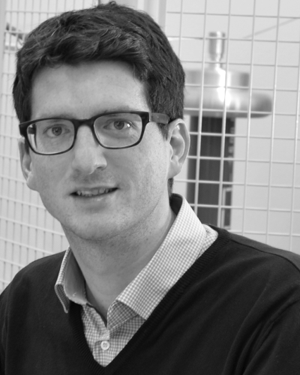 Marco Agustoni合作论文数1D. Knopf合作论文数1Edward Mulhern合作论文数National Institute of Standards and Technology (NIST),1K Marti合作论文数1
 Diego Blas Temiño合作论文数Institució Catalana de Recerca i Estudis Avançats;The Barcelona Institute of Science and Technology;Department of Theoretical Physics, CERN1
 Alexandre Poulin合作论文数1
 Michael Wollensack合作论文数1
 St-Gelais, R.合作论文数Dept. of Eng. Phys., Ecole Polytech. de Montreal;al;c;Dept. of Eng. Phys., Ecole Polytech. de Montreal1Müller Matthias合作论文数1Jacques Liard合作论文数1Yang Bai合作论文数1
 Sho Okubo合作论文数1
 Kruskopf Mattias合作论文数Physikalisch-Technische Bundesanstalt1
 Naoki Kuramoto合作论文数1
 Stephan Schlamminger合作论文数Physical Measurement Laboratory, National Institute of Standards and Technology1




