Within the European project UFTIR (Time series of Upper Free Troposphere observations from an European ground-based FTIR network), six ground-based stations in Western Europe, from 79 degrees N to 28 degrees N, all equipped with Fourier Transform infrared (FTIR) instruments and part of the Network for the Detection of Atmospheric Composition Change (NDACC), have joined their efforts to evaluate the trends of several direct and indirect greenhouse gases over the period 1995-2004. The retrievals of CO, CH4, C2H6, N2O, CHClF2, and O-3 have been optimized. Using the optimal estimation method, some vertical information can be obtained in addition to total column amounts. A bootstrap resampling method has been implemented to determine annual partial and total column trends for the target gases. The present work focuses on the ozone results. The retrieved time series of partial and total ozone columns are validated with ground-based correlative data (Brewer, Dobson, UV-Vis, ozonesondes, and Lidar). The observed total column ozone trends are in agreement with previous studies: 1) no total column ozone trend is seen at the lowest latitude station Izana (28 degrees N); 2) slightly positive total column trends are seen at the two mid-latitude stations Zugspitze and Jungfraujoch (47 degrees N), only one of them being significant; 3) the highest latitude stations Harestua (60 degrees N), Kiruna (68 degrees N) and Ny-Alesund (79 degrees N) show significant positive total column trends. Following the vertical information contained in the ozone FTIR retrievals, we provide partial columns trends for the layers: ground-10 km, 10-18 km, 18-27 km, and 27-42 km, which helps to distinguish the contributions from dynamical and chemical changes on the total column ozone trends. We obtain no statistically significant trends in the ground-10 km layer for five out of the six ground-based stations. We find significant positive trends for the lower-most stratosphere at the two mid-latitude stations, and at Ny-Alesund. We find smaller, but significant trends for the 18 27 km layer at Kiruna, Harestua, Jungfraujoch, and Izana. The results for the upper layer are quite contrasted: we find significant positive trends at Kiruna, Harestua, and Jungfraujoch, and significant negative trends at Zugspitze and Izana. These ozone partial columns trends are discussed and compared with previous studies.
(1) Belgian Institute for Space Aeronomy, Brussels, Belgium, (2) Forschungszentrum Karlsruhe, IMK-ASF, Karlsruhe, Germany, (3) University of Liege, Institute of Astrophysics and Geophysics, Liege, Belgium, (4) Chalmers University of Technology, Goteborg, Sweden, (5) University of Bremen, Department of Physics, Institute of Environmental Physics, Bremen, Germany, (6) Forschungszentrum Karlsruhe, IMK-IFU, Garmisch-Partenkirchen, Germany, (7) National Physical Laboratory, Teddington, UK, (8) University of Oslo, Oslo, Norway, (9) Laboratoire de Physique Moleculaire et Applications, Paris, France (martine@oma.be / Fax: +32-2-3748423 / Phone: +32-2-3730363).
Abstract Solar absorption measurements using Fourier transform infrared (FTIR) spectrometry carry information about the atmospheric abundances of many constituents, including non-CO2 greenhouse gases. Such observations have regularly been made for many years as a contribution to the Network for the Detection of Stratospheric Change (NDSC). They are the only ground-based remote sensing observations available nowadays that carry information about a number of greenhouse gases in the free troposphere. This work focuses on the discussion of the information content of FTIR long-term monitoring data of some direct and indirect greenhouse gases (CH4, N2O, O3 and CO and C2H6, respectively), at six NDSC stations in Western Europe. This European FTIR network covers the polar to subtropical regions. At several stations of the network, the observations span more than a decade. Existing spectral time series have been reanalyzed according to a common optimized retrieval strategy, in order to derive distinct tropospheric and stratospheric abundances for the above-mentioned target gases. A bootstrap resampling method has been implemented to evaluate trends of the tropospheric burdens of the target gases, including their uncertainties. In parallel, simulations of the target time series are being made with the Oslo CTM2 model: comparisons between the model results and the observations provide valuable information to improve the model and, in particular, to optimize emission estimates that are used as inputs to the model simulations. The work is being performed within the EC project UFTIR. The paper focuses on N2O for which the first trend results have been obtained.
Carbon monoxide total column amounts in the atmosphere have been measured in the High Northern Hemisphere (30°-90° N, HNH) between January 2002 and December 2003 using infrared spectrometers of high and moderate resolution and the Sun as a light source. They were compared to ground-level CO mixing ratios and to total column amounts measured from space by the Terra/MOPITT instrument. All these data reveal increased CO abundances in 2002-2003 in comparison to the unperturbed 2000-2001 period. Maximum anomalies were observed in September 2002 and August 2003. Using a simple two-box model, the corresponding annual CO emission anomalies (referenced to 2000-2001 period) have been found equal to 95Tg in 2002 and 130Tg in 2003, thus close to those for 1996 and 1998. A good correlation with hot spots detected by a satellite radiometer allows one to assume strong boreal forest fires, occurred mainly in Russia, as a source of the increased CO burdens.
A scientific NO2 retrieval developed at the University of Bremen was applied to all available SCIAMACHY nadir spectra from August 2002 to May 2004. The NO2 columns show the expected seasonal, latitudinal and regional variations and a good internal consistency. The precision of the individual measurements was assessed by analyzing the scatter of the results within certain areas and an excellent standard deviation of below 3x10 14 molec cm -2 was found. Comparison of the SCIAMACHY columns with measurements from the German DOAS and FTS validation network shows very good agreement with the exception of high latitudes in summer, where a systematic under- estimation is apparent and polluted sites, where the different sensitivity of the measurement systems to tropospheric absorptions plays a role.
A scientific NO2 retrieval developed at the University of Bremen was applied to all available SCIAMACHY nadir spectra from August 2002 to May 2004. The NO2 columns show the expected seasonal, latitudinal and regional variations and a good internal consistency. The precision of the individual measurements was assessed by analyzing the scatter of the results within certain areas and an excellent standard deviation of below 3x10 14 molec cm -2 was found. Comparison of the SCIAMACHY columns with measurements from the German DOAS and FTS validation network shows very good agreement with the exception of high latitudes in summer, where a systematic under- estimation is apparent and polluted sites, where the different sensitivity of the measurement systems to tropospheric absorptions plays a role.
In the frame of the EC project UFTIR (Time series of Upper Free Troposphere observations from a European ground-based FTIR network), a common strategy for an optimal determination of the chemical composition in the free troposphere and lower stratosphere with ground-based Fourier-transform infrared (FTIR) spectrometers is being developed. The project focuses on 6 target species that are O3, CO, CH4, N2O, C2H6 and CHClF2 (HCFC-22). The strategy consists in selecting the most appropriate parameters to retrieve vertical concentration profiles from solar FTIR spectra. Among the important parameters are the spectral microwindows: they have been optimised to maximise the information content and to minimize the influence of poorly known spectroscopic data and interfering species.
 Ralf Sussmann合作论文数11
 Johan Mellqvist合作论文数Chalmers University of Technology8
 V. Velazco合作论文数Institute of Environmental Physics, University of Bremen8
 Justus Notholt合作论文数Department of Physics, University of Bremen8Thomas Blumenstock合作论文数Institute of Meteorology and Climate Research, Karlsruhe Institute of Technology7Pierre Duchatelet合作论文数7Emmanuel Mahieu合作论文数7F. Hase合作论文数6I. Kramer合作论文数6Wolfgang Stremme合作论文数Forschungszentrum Karlsruhe6a strandberg合作论文数5
 Michael Gauss合作论文数Department of Research and Development, Norwegian Meteorological Institute4
 C. Camy-Peyret合作论文数Sorbonne University4A. Schulz合作论文数3
 Matthias Schneider合作论文数3Martine De Mazière合作论文数3Paul C. Novelli合作论文数3
 David Edwards合作论文数Atmospheric Chemistry Observations & Modeling Lab, National Center for Atmospheric Research3A. V. Dzhola合作论文数3Marc D. Coleman合作论文数3H. E. Scheel合作论文数3I. Isaksen合作论文数2Philippe Demoulin合作论文数2P. Chelin合作论文数2Tom Gardiner合作论文数2P. Woods合作论文数2
 James Drummond合作论文数Department of Physics & Atmospheric Science, Faculty of Science, Dalhousie University2
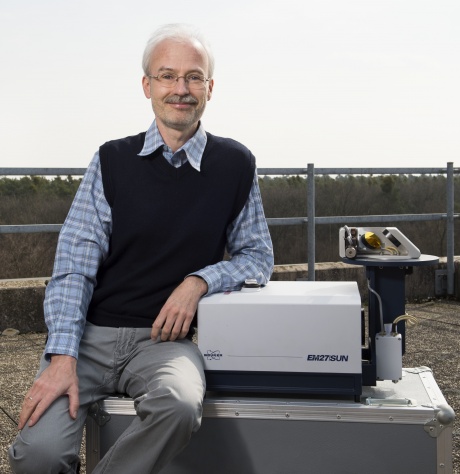 Frank Hase合作论文数Forschungszentrum Karlsruhe2Peter Woods合作论文数2
 Hiroshi Tanimoto合作论文数Natl Inst Environm Studies2Leonid Yurganov合作论文数2John C Gille合作论文数2Kjerstin Ellingsen合作论文数2
 Udo Frieß合作论文数University of Heidelberg2T. Gardiner合作论文数2Astrid Schulz合作论文数2
 Folkard Wittrock合作论文数Institute of Environmental Physics;University of Bremen;Institute of Environmental Physics, University of Bremen2Thomas Wagner合作论文数Max Planck Institute For Chemistry2t d gardiner合作论文数1s fietkau合作论文数1T. Medeke合作论文数1isabell kramer合作论文数1He Scheel合作论文数1H. Giehl合作论文数1Corinne Vigouroux合作论文数1
 Mark Coleman合作论文数Department of Forest, Rangeland and Fire Sciences, College of Natural Resources, University of Idaho1Markus Rettinger合作论文数1




