The key features and performances of a compact, lightweight, high power Er(3+):Yb(3+) glass laser transmitter are reported on. The theory employed to get an optimal design of the device is also described.In free running regime high energies of about 15mJ in 3ms long pulses were obtained, with an optical efficiency close to 85%. When q-switched by a Co: MALO crystal of carefully selected initial transmittivity, a high peak power in excess of 500 kW was obtained in about 9ns pulse duration, with an optical efficiency of 60%.The laser was successfully run with no significant power losses at repetition rates up to 5Hz due to a carefully designed heat sink which allowed an efficient conduction cooling of both the diode bars and the phosphate glass.The transmitter emits at a wavelength of 1535nm in the so-called "eyesafe" region of the light spectrum thus being highly attractive for any application involving the risk of human injury as is typically the case in remote sensing activities. Moreover, the spectral band around 1,5 m m corresponds to a peak in the athmospheric transmittance thus being more effective in adverse weather conditions with respect to other wavelengths.Actually, the device has been successfully integrated into a rangefinder system allowing a reliable and precise detection of small targets at distances up to 20Km. Moreover, the transmitter capabilities were used into a state of the art infrared laser illuminator for night vision allowing even the recognition of a human being at distances in excess of 5Km.
In the Northern Apennines there are many historical villages and castles, which are of great value and represent a cultural heritage of great importance. Their presence within a territory greatly affected by landslide hazards creates, in many circumstances, the need to solve problems of land management and to act for the preservation of historical monuments.This paper describe an interesting landslide, failed during the night of 28 February 2004, that involved the village of Rossena: the failure damaged the village (Fig. 1), the road and the fields down to the stream but, fortunately, the castle just upslope the village was not involved at all.The 10th century massive castle of Rossena stands on the top of a cliff at about 500 m a.s.l., on the border between the provinces of Parma and Reggio Emilia, and it is surrounded by a small ancient village. The castle of Rossena is the best preserved stronghold of the Longobard times, enlarged and reinforced in the tenth century and partially rebuilt by Bonifacio, the father of Matilda of Canossa (the Vice-Queen of Italy and probably the most important woman in the Middle Ages) as a defensive structure guarding the Enza Valley. In addition, at Conossa, very close to Rossena, there was the meeting between Pope Gregory VII and the Emperor of Germany Henry IV, during the historical event known as "fight for the investitures". For these reasons, the area of Rossena is one of the most relevant from a historical point of view in the entire western part of the Emilia Romagna Region and it also has a high value as a geosite (Coratza et al., 2004).
Optical phase locking of a diode laser to a mode of a femtosecond optical comb has been achieved with a system that combines the advantages of analog and digital phase detectors. Low noise and fast response are combined with a broad phase range and lock reliability. Details of the circuit are illustrated, and properties of different phase detectors in view of optical frequency measurements are discussed.
An heterodyne technique employing ultra-wide band Schottky diodes and a femtosecond pulsed laser was tested to perform frequency measurements in the far infrared range. Preliminary experiments demonstrate an efficient frequency down-conversion in Schottky diodes by mixing the microwave radiation with the output of a femtosecond laser used as a reference local oscillator.
In the number of the atomic frequency standards, or atomic clocks, the devices working by optical pumping of alkali vapor in cell (usually known as Rubidium frequency standard, because the rubidium atom is traditionally used) are by far the most common. They are used as a reference for a quartz oscillator in the applications where its long-term stability is no more adequate. The best commercial device presents a short-term stability only slightly better than 10 -11 at 1 s, which is, however, almost three order of magnitude larger than the theoretical limit, when a spectrally narrowed laser diode is used as pumping source. An accurate analysis of the pumping process and a carefully project of the pumping laser system and of the microwave interrogation circuits may closer approach the theoretical limit. In this paper we present an analysis of the interrogation process and the development of a new device, based on Cs transition at 9192.631 MHz. In this apparatus we control carefully both the spectral purity of the pumping diode laser, and of the microwave interrogation chain, which are the principal source of losses for the clock stability. For this purpose, we tested new schemes for locking the diode laser radiation on the resonance Cs line, new scheme for microwave locking circuit, and a new microwave resonance cell, where the Cs is directly filled in the metallic cavity for a more direct control of the cavity mode.
Coherent four-wave mixing (FWM) of laser pulses in gas-filled hollow fibers is studied. The experimental data and the expressions derived for the amplitude of the FWM signal indicate that the excitation of higher order waveguide modes is an important physical factor having a considerable influence on nonlinear optical processes in hollow fibers.
The influence of higher order waveguide modes on the process of coherent four-wave-mixing (FWM) in a gas-filled hollow fiber is studied for fibers with different inner diameters and different gas pressures. Higher order waveguide modes play an especially important role in FWM within the ranges of gas pressures where FWM processes involving such modes are phase matched due to the compensation of the gas dispersion by the dispersion of waveguide modes.
The possibilities of using four-wave mixing enhanced in hollow fibers for improving the sensitivity of gas-phase analysis are explored by studying third-harmonic, difference-frequency, and sum-frequency generation processes. The use of 30-ps pulses with an energy of several millijoules in these experiments allowed pump power densities up to 10(12) W/cm(2) to be coupled into a hollow fiber, thus increasing the intensity of signals generated through four-wave mixing as compared with the nanosecond regime. Hollow fibers are shown to expand the possibilities of nonlinear-optical analysis of gases by allowing the generation of third-harmonic and sum-frequency signals, which vanish in the regime of tight focusing in a medium with normal dispersion.
Third-harmonic, difference-frequency, and sum-frequency generation processes in hollow fibers are experimentally studied with 30-ps pulses having an energy of several millijoules. The experimental dependence of the difference-frequency signal on the pressure of the gas filling the fiber agrees well with the results of calculations when the contribution of higher order waveguide modes is taken into consideration, thus indicating the importance of nonlinear-optical processes involving higher order waveguide modes of a hollow fiber. Hollow fibers are also shown to expand the possibilities of nonlinear-optical analysis of gases by allowing the generation of third-harmonic and sum-frequency signals, which vanish in the regime of tight focusing in a medium with normal dispersion.
. Hyperfine optical pumping of a Cs-vapor cell through a diode laser in frequency standards requires a high purity of the laser emission spectrum, and a high stability of the emission frequency. We present here a frequency-locking scheme that is able to produce a discrimination signal without any modulation, by using the dichroism induced by a magnetic field on the atomic vapor. The larger line-width of the reference signal (Doppler-broadened) is compensated by its larger amplitude, when compared with the saturated absorption signal. As a final result, the slope is similar, and the large line-width warrants a large locking range, making robust the lock against external perturbations. This error signal is used to lock the frequency of an external cavity diode laser, with a grating reflector in Littman configuration. A fast correction band is obtained by changing the cavity length through an intra-cavity electro-optic modulator. The possible sources of instabilities of the locking point are discussed and estimated through a simulation computer program.
We present a technique for generating short far-infrared (FIR) laser pulses, with a linewidth close to the Fourier transform limit, changing the reflectivity of an InSb crystal by the photoelectric effect. The crystal is irradiated with an optically pumped CW FIR laser and its reflectivity at an FIR frequency is changed by the ionizing radiation of a pulsed Nd-YAG laser. A reflectivity change, from 18 to 90%, has been obtained. Shorter FIR pulses can be obtained using shorter ionizing laser pulses. Finally, double pulses separated by an arbitrary time interval and of chosen amplitude are obtained.
The excitation of metastable states in an atomic beam apparatus by means of electron collision is a widespread technique. We have observed a large bistable behaviour in our apparatus designed to provide an intense and collimated beam of metastable helium by excitation with orthogonally impinging electrons. This bistable behaviour largely affects the efficiency of the apparatus and is therefore worth of being carefully investigated. The apparatus has an electrode configuration equivalent to that of a tetrode valve with large intergrid distances. The bistability consists in a hysteresis cycle in the curve of the anode current vs. grid voltage. Experimental measurements, supported by a simple theoretical model and by numerical simulation, stress out the crucial role played by space charge effects for the onset of bistability. A comparison with previous observation of this phenomenon is given. Spontaneous current oscillations with various shapes have been recorded in one of the two curves of the hysteresis cycle.
The competition effects between two-photon ionization and XUV photon emission induced by a pulsed laser radiation resonant with the 2 1S3 1P and 2 1S4 1P transitions in He(2 1S0) are investigated experimentally. The ion scanning profile around the 2 1S3 1P resonance shows a dip very similar to the one reported in a previous experiment, whereas the dip is absent in the case of the 2 1S4 1P resonance. A theoretical model for the time evolution of the atomic system and the relative numerical solution allow a quantitative reproduction of the experimental results, demonstrating the influence of the lifetime of the intermediate nP level and of the distribution of the laser power changing in space and time. The difference between the widths of ion and photon scanning profiles is also reproduced with a good agreement by the model.
Stimulated Anti‐Stokes Raman scattering at 537 and 584 Å has been achieved in a singlet metastable supersonic helium beam. About 107 photons/pulse have been observed for 537 Å emission, the maximum amplification is for a detuning of about 10 GHz with an estimated exponential gain value of 1.8. For 584 Å emission the measurements are in progress.
 Paolo Marsili合作论文数7
 F. Giammanco合作论文数Laboratorio di Fisica Atomica e Molecolare, del C.N.R.6An Naumov合作论文数5
 Ab Fedotov合作论文数5
 Aleksei Zheltikov合作论文数Department of Physics and Astronomy, College of Arts & Sciences, Texas A & M University;Institute for Quantum Science & Engineering, Texas A & M University5
 Nicolò Beverini合作论文数Department of Physics "E.Fermi", Università di Pisa;Istituto Nazionale di Fisica Nucleare5Franco Strumia合作论文数4DA Sidorov-Biryukov合作论文数3E. Maccioni合作论文数INFN Sezione Pisa and Dipartimento di Fisica, Università di Pisa3O. Tommasi合作论文数3
 F. Sorrentino合作论文数INFN, Sezione di Genova, I-16146 Genova, Italy.2
 Yibing Cheng (程一兵)合作论文数Department of Materials Science and Engineering, Faculty of Engineering, Monash University;State Key Laboratory of Advanced Technology for Materials Synthesis and Processing, Wuhan University of Technology2Boris Nyushkov合作论文数2Giorgio Carelli合作论文数Departimento di Fisica;Universita di Pisa;Departimento di Fisica, Universita di Pisa2Augusto Moretti合作论文数2D. A. Sidorov‐Biryukov合作论文数1f periale合作论文数1v barychev合作论文数1G. Truffelli合作论文数1V. Baraulia合作论文数1O. A. Kolevatova合作论文数1marco vitiello合作论文数1
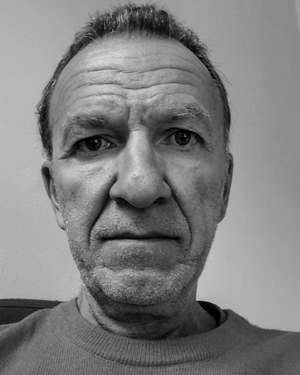 Giovanni Antonio Costanzo合作论文数1Kenneth A. Strain合作论文数Institute for Gravitational Research, University of Glasgow1
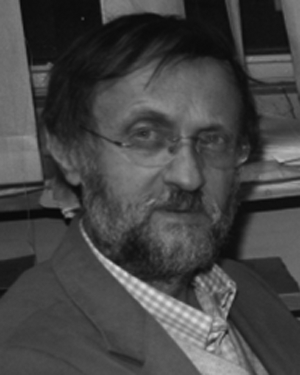 A. De Marchi合作论文数1
 Alessandro Bertolini合作论文数Faculty of Science and Engineering, Maastricht University1
 Giuseppe Mandrone合作论文数1Carlo Andrea Massa合作论文数1
 Dmitry Sidorov合作论文数M.V. Lomonosov Moscow State University;Institut für Photonik, Technische Universität Wien1
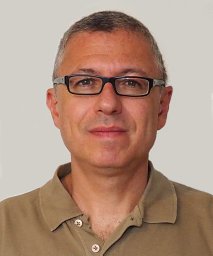 Massimo Ortolano合作论文数Istituto Nazionale di Ricerca Metrologica Strada delle Cacce1N. Ioli合作论文数1Alessandro Chelli合作论文数Laboratoire d'Astrophysique1Marco Prevedelli合作论文数Sezione di Firenze, Università di Firenze INFN1
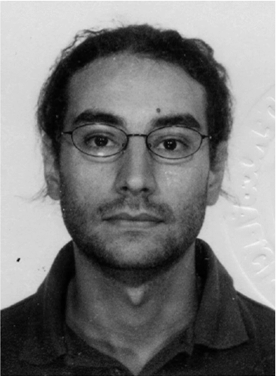 A. De Michele合作论文数1




