The measurement of the actual shape of a sail during navigation is an important issue both for skippers and sail makers. Besides sophisticated optical approaches based on artificial vision or based on the use of fiber optics glued within a sail, we propose to directly measure the mainsail's draft by means of a full bridge strain gauge (specifically designed for this application on PCB) applied on the two sides of a fiber glass batten into an horizontal section of the sail. The proposed approach reveals to be accurate enough and has the benefits of a cheap implementation so that it can be used not only by racing yachts and sail makers but also by leisure yachts owners. Moreover, thanks to the wireless data transmission, the proposed system can be easily integrated in a network of multiple sensors completing in this way the set of navigation data.
This paper presents the design and validation of a low-power, ring-worn PPG acquisition system for continuous monitoring of heart rate (HR) and blood oxygen saturation of drivers in automotive applications. The device utilizes a MAX30102 sensor and an STM32 microcontroller to capture Red and Infrared signals, which are transmitted via Wi-Fi to a dedicated GUI. To ensure real-time performance on constrained hardware, we implemented a light algorithm able to obtain a robust peak identification, even in case of strong motion artifacts. The sensor’s mechanical housing was 3D-printed using flexible TPU to optimize fit and signal quality. Experimental results from six volunteers using a dynamic driving simulator demonstrate good accuracy, with mean HR differences typically below 1 BPM compared to reference ECG data. The study identifies mechanical fit as the primary critical factor; even if a ring provides good signal quality, a loose fit significantly increases motion artifacts during driving maneuvers. These results confirm the system’s potential for enhancing road safety through real-time driver physiological assessment.
This paper investigates the correlation between vehicle control inputs and driver physiological states to enhance non-invasive monitoring in intelligent automotive environments. While traditional physiological sensors (ECG, EDA) provide high-fidelity data regarding stress and cognitive load, their physical discomfort often limits practical application in naturalistic driving. To address this, we propose the use of vehicle mechanical signals—steering wheel angle, throttle, and brake pedal demand—as "virtual sensors" for driver well-being. Using a high-fidelity driving simulator with a moving platform, we collected synchronized physiological and mechanical data from four subjects driving on a simulated circuit. Our analysis employs Spearman correlation to identify relationships between heart rate (HR), heart rate variability (HRV) metrics, and electrodermal activity (EDA) against driving maneuvers. Experimental results demonstrate a significant and consistent correlation between throttle pedal demand and mean heart rate (85%), suggesting that longitudinal control patterns could be good indicators for driver engagement and physiological arousal. These findings provide a foundation for developing unobtrusive ADAS that can infer driver mental state directly from vehicle bus data.
Detecting anomalies in PPG signals is crucial for the early identification of cardiovascular conditions, such as arrhythmias, poor perfusion, or stress induced by daily activities, thereby enabling timely interventions. This approach supports continuous, non-invasive monitoring and promotes advancements in data-driven healthcare. In this paper, we summarize the design and implementation of a wearable necklace sensor developed for monitoring the well-being of individuals during daily activities, such as driving, by acquiring PPG signals. Furthermore, we introduce an anomaly detection method for PPG signals based on a Convolutional Autoencoder (CAE). CAE architectures are particularly well-suited for tasks involving data compression and reconstruction, as they effectively capture local data relationships and preserve spatial structures. They are especially advantageous for processing PPG signals. Moreover, their reduced number of parameters compared to traditional Autoencoders (AE) makes them computationally more efficient compared to dense AE. The proposed approach is validated using a dataset of normal PPG signals, acquired through our innovative necklace sensor, for training, along with various anomalous PPG datasets sourced from public databases for testing. Experimental results demonstrate that the CAE successfully generalizes well from the training data and achieves highly effective discrimination between normal and anomalous signals, with AUC scores approaching one across all analyzed cases.
Accurate estimation of the State of Charge (SoC) in electric vehicle batteries is crucial for performance optimization, safety, and reliability—especially in high-demand applications such as electric racing. This work focuses on a battery SoC estimation scheme developed at the University of Udine as part of a student competition, where real-time energy management plays a key role. Traditional SoC estimation methods often suffer from noise and drift in voltage and current measurements, particularly under the rapid load changes typical of race conditions. To address these limitations, we propose a data-driven approach using deep learning, specifically a Recurrent Neural Network (RNN) with Long Short-Term Memory (LSTM) units. The proposed method utilizes instantaneous measurements of voltage, current, and charge to estimate consumption and compensate for signal inaccuracies. Multiple network architectures are evaluated, comparing single-layer LSTM models with cascaded configurations to identify the optimal balance between model complexity and performance. The results show that a two-layer cascaded LSTM architecture significantly improves estimation accuracy, achieving errors as low as 0.5% in most test scenarios. Given the constrained scope of the application—a specific battery pack during a race session—the model maintains a low computational footprint and requires only a simple training procedure. In conclusion, this study demonstrates that LSTM-based models offer a viable and efficient solution for real-time SoC estimation in electric vehicles, especially when applied to short-duration, high-performance use cases such as competitive racing.
The energy efficiency of ferroelectric-based devices makes them interesting for many applications. However, their optimization requires a dependable characterization of the ferroelectric (FE) material. In this work, we show and investigate how the series resistance (R S ) can strongly impact the current-voltage (I-V) characteristics of Metal-Ferroelectric-Metal (MFM) stacks and distorts the hysteresis curves, which can lead to an inaccurate extraction of the FE parameters and a misleading interpretation of FE switching dynamics. The complex R S effect on the I-V curves cannot be easily compensated, so here we propose, for the first time to our knowledge, a procedure for an improved extraction of the FE parameters even in the presence of a non-negligible series resistance.
This paper presents the design and implementation of a wearable sensor necklace for monitoring the well-being of drivers, focusing on heart rate (HR) and blood oxygen saturation (SpO(2)) measurements. The proposed necklace allows HR and SpO(2) monitoring into a compact and ergonomic design, enabling unobtrusive and continuous data collection during driving activities. The necklace's design prioritizes user comfort and ease of wearing to facilitate prolonged usage without interfering with driving tasks. Collected physiological data can be wirelessly transmitted to a mobile application for real-time analysis and visualization. The HR and SpO(2) data may provide information of the driver's physiological state and potential stress levels. Particular attention has been dedicated to the firmware development in order to extract HR and SpO(2) removing the motion artifacts that arise when the user moves the head. The design is validated by an experiment conducted in a simulated driving scenario, demonstrating the reliability of the wearable sensor necklace in capturing dynamic changes in HR and SpO(2) levels associated with driving-induced stress.
The transition of healthcare towards digitalization is closely related to the advancement of health-related technologies, including wearable sensors and edge computing. In this paper, we present VersaSens, a versatile and customizable platform concept and its real implementation as a tool to boost research in wearable sensors. The platform embodies the core attributes of the VersaSens concept: versatility, flexibility, and extendability across multiple aspects of hardware, software, and processing components. It features a modular design, consisting of sensor, processor, and co-processor modules, allowing for various configurations. To evaluate the efficiency of the platform, we tested three use cases: cough monitoring, heartbeat classification and epileptic seizure detection. In all cases, the results indicate that the platform effectively executes the applications, achieving low energy consumption. In particular, our findings indicates that the integration of a domain-specific edge-AI co-processor (i.e., HEEPocrates [1]) equipped with several hardware accelerators further improved the overall execution time and energy consumption of the system. These results demonstrate the potential of VersaSens to effectively support a diverse range of edge-AI applications and configurations, thereby providing a robust foundation for the research and development of novel smart wearable sensor systems.
Monitoring heart rate (HR) through photoplethysmography (PPG) signals is a challenging task due to the complexities involved, even during routine daily activities. These signals can indeed be heavily contaminated by significant motion artifacts resulting from the subjects’ movements, which can lead to inaccurate heart rate estimations. In this paper, our objective is to present an innovative necklace sensor that employs low-computational-cost algorithms for heart rate estimation in individuals performing non-abrupt movements, specifically drivers. Our solution facilitates the acquisition of signals with limited motion artifacts and provides acceptable heart rate estimations at a low computational cost. More specifically, we propose a wearable sensor necklace for assessing a driver’s well-being by providing information about the driver’s physiological condition and potential stress indicators through HR data. This innovative necklace enables real-time HR monitoring within a sleek and ergonomic design, facilitating seamless and continuous data gathering while driving. Prioritizing user comfort, the necklace’s design ensures ease of wear, allowing for extended use without disrupting driving activities. The collected physiological data can be transmitted wirelessly to a mobile application for instant analysis and visualization. To evaluate the sensor’s performance, two algorithms for estimating the HR from PPG signals are implemented in a microcontroller: a modified version of the mountaineer’s algorithm and a sliding discrete Fourier transform. The goal of these algorithms is to detect meaningful peaks corresponding to each heartbeat by using signal processing techniques to remove noise and motion artifacts. The developed design is validated through experiments conducted in a simulated driving environment in our lab, during which drivers wore the sensor necklace. These experiments demonstrate the reliability of the wearable sensor necklace in capturing dynamic changes in HR levels associated with driving-induced stress. The algorithms integrated into the sensor are optimized for low computational cost and effectively remove motion artifacts that occur when users move their heads.
Ferroelectric Tunnel Junctions (FTJs) are promising electron devices which can be operated as memristors able to realize artificial synapses for neuromorphic computing. In this work, after a thorough validation of the in-house-developed experimental setup, novel methodologies are devised and employed to investigate the large- and small-signal responses of FTJs, whose discrepancies have proven difficult to interpret in previous literature. Our findings convey a significant insight into the contribution of the irreversible polarization switching to the bias-dependent differential capacitance of the ferroelectric–dielectric stack.
In this paper we present a system which allows the detection of stress in drivers by analyzing a two-dimensional representation of their electrodermal activity Skin Potential Response (SPR) signal, and their electrocardiogram signal. Signals were logged during a simulated drive, in an experiment carried out in a company using a professional car driving simulator. Subjects had to overcome some stress-inducing events located at specific positions during the drive. The acquired SPR and heart rate signals are analyzed with scalogram plots, in order to obtain a time-frequency representation of the signals. The 2D scalogram representation is segmented into images, associated to short time segments, which are classified using a Convolutional Neural Network architecture. We show that the use of scalograms can allow the system to perform well in distinguishing among stress and non-stress situations, achieving a 91.78% accuracy. The same system was tested on real driving data available from a public dataset, achieving a 99.24% accuracy.
In this paper, we consider the evaluation of the mental attention state of individuals driving in a simulated environment. We tested a pool of subjects while driving on a highway and trying to overcome various obstacles placed along the course in both manual and autonomous driving scenarios. Most systems described in the literature use cameras to evaluate features such as blink rate and gaze direction. In this study, we instead analyse the subjects’ Electrodermal activity (EDA) Skin Potential Response (SPR), their Electrocardiogram (ECG), and their Electroencephalogram (EEG). From these signals we extract a number of physiological measures, including eye blink rate and beta frequency band power from EEG, heart rate from ECG, and SPR features, then investigate their capability to assess the mental state and engagement level of the test subjects. In particular, and as confirmed by statistical tests, the signals reveal that in the manual scenario the subjects experienced a more challenged mental state and paid higher attention to driving tasks compared to the autonomous scenario. A different experiment in which subjects drove in three different setups, i.e., a manual driving scenario and two autonomous driving scenarios characterized by different vehicle settings, confirmed that manual driving is more mentally demanding than autonomous driving. Therefore, we can conclude that the proposed approach is an appropriate way to monitor driver attention.
In this paper, we integrated within a specifically developed acquisition system, denoted as Oceanus, the measurements from a differential pressure sensor between the two sides of a sail (windward and leeward sides); experiments have been performed using a light jib sail of a 35 feet cruising-racing yacht. We analyzed the correlation between such a signal and other standard signals usually present on board such as boat speed, intensity and direction of apparent or real wind; moreover, data from Inertial Measurement Units are handled. We also considered the Target Data, which depend on the actual point of sail, and the discrepancy between measured data and the predicted Targets is monitored as an error in terms of the true wind angle and boat velocity. In this way, the trimmer/helmsman can monitor the differential sail pressure together with Target data and decide to reduce the error with a correction in how sails are trimmed, rather than in how the boat is steered to achieve an improvement of boat performances. The resulting telemetry system represents an effective low cost solution, which is affordable even for amateur yachtsmen.
Human Activity Recognition (HAR) is a research area that is receiving increasing attention in recent years. In this paper we propose the application of different supervised learning algorithms to recognize distinct human activities. In particular, we use a dataset that includes inertial measurements recorded from sensors placed in various positions on the subjects' body, while performing sports and daily activities. Considering possible real-life applications of the system, we analyze only the acceleration signal coming from a single and low-complexity sensor placed on the torso of the subjects. We derive different statistical features from the three axial accelerations. These features are the input of Machine Learning algorithms with the purpose of recognizing the particular activity carried out by the subjects. The unprocessed acceleration signals are instead sent to Deep Learning algorithms, giving us the opportunity to compare the performance of the classifiers. In the end, we achieve accuracy values of 73.3% and 86.6% in classifying 19 types of different human activities, using a Random Forest (RF) classifier and a 1D Convolutional Neural Network (CNN) network, respectively.
Measuring punch force is crucial for assessing the performance and progress of boxers during training and matches. In this paper, we present a novel wearable sensor designed specifically to measure punch force in boxers. The sensor is a unique example of a measuring wearable device that can be easily integrated into commercial boxing gloves, making it suitable for both training and matches. The module is lightweight, compact, and fits into commercial gloves without compromising comfort or mobility. Moreover, the sensor incorporates wireless communication capabilities, enabling real-time monitoring of punch force data on a companion mobile application or a dedicated display unit, facilitating immediate feedback and analysis. We conducted tests with four amateur boxers, and we chose the boxers trying to cover a wide range of standard categories. The results demonstrate that the sensor reliably measures punch force across different boxing techniques such as straights and hooks, with accuracy in the order of 6 % of full scale. The presented wearable sensor represents a significant advancement in wearable sensor technology for boxing; its integration into commercial gloves allows for seamless adoption by boxers of all skill levels, enhancing training efficiency and promoting better performance during matches.
In this paper, we present a comprehensive assessment of individuals' mental engagement states during manual and autonomous driving scenarios using a driving simulator. Our study employed two sensor fusion approaches, combining the data and features of multimodal signals. Participants in our experiment were equipped with Electroencephalogram (EEG), Skin Potential Response (SPR), and Electrocardiogram (ECG) sensors, allowing us to collect their corresponding physiological signals. To facilitate the real-time recording and synchronization of these signals, we developed a custom-designed Graphical User Interface (GUI). The recorded signals were pre-processed to eliminate noise and artifacts. Subsequently, the cleaned data were segmented into 3 s windows and labeled according to the drivers' high or low mental engagement states during manual and autonomous driving. To implement sensor fusion approaches, we utilized two different architectures based on deep Convolutional Neural Networks (ConvNets), specifically utilizing the Braindecode Deep4 ConvNet model. The first architecture consisted of four convolutional layers followed by a dense layer. This model processed the synchronized experimental data as a 2D array input. We also proposed a novel second architecture comprising three branches of the same ConvNet model, each with four convolutional layers, followed by a concatenation layer for integrating the ConvNet branches, and finally, two dense layers. This model received the experimental data from each sensor as a separate 2D array input for each ConvNet branch. Both architectures were evaluated using a Leave-One-Subject-Out (LOSO) cross-validation approach. For both cases, we compared the results obtained when using only EEG signals with the results obtained by adding SPR and ECG signals. In particular, the second fusion approach, using all sensor signals, achieved the highest accuracy score, reaching 82.0%. This outcome demonstrates that our proposed architecture, particularly when integrating EEG, SPR, and ECG signals at the feature level, can effectively discern the mental engagement of drivers.
Ferroelectric Tunnel Junctions (FTJs) operating as memristors are promising electron devices to realize artificial synapses for neuromorphic computing. But the understanding of their operation requires an in-depth electrical characterization. In this work, an inhouse experimental setup is employed along with novel experimental methodologies to investigate the largesignal (LS) and small-signal (AC) responses of FTJs. For the first time, our experiments and physics-based simulations help to explain the discrepancies between LS and AC experiments reported in previous literature.
Fetal heart rate (FHR) monitoring, typically using Doppler ultrasound (DUS) signals, is an important technique for assessing fetal health. In this work, we develop a robust DUS-based FHR estimation approach complemented by DUS signal quality assessment (SQA) based on unsupervised representation learning in response to the drawbacks of previous DUS-based FHR estimation and DUS SQA methods. We improve the existing FHR estimation algorithm based on the autocorrelation function (ACF), which is the most widely used method for estimating FHR from DUS signals. Short-time Fourier transform (STFT) serves as a signal pre-processing technique that allows the extraction of both temporal and spectral information. In addition, we utilize double ACF calculations, employing the first one to determine an appropriate window size and the second one to estimate the FHR within changing windows. This approach enhances the robustness and adaptability of the algorithm. Furthermore, we tackle the challenge of low-quality signals impacting FHR estimation by introducing a DUS SQA method based on unsupervised representation learning. We employ a variational autoencoder (VAE) to train representations of pre-processed fetal DUS data and aggregate them into a signal quality index (SQI) using a self-organizing map (SOM). By incorporating the SQI and Kalman filter (KF), we refine the estimated FHRs, minimizing errors in the estimation process. Experimental results demonstrate that our proposed approach outperforms conventional methods in terms of accuracy and robustness.
The paper presents the assessment of drivers’ attention by means of blink rate extraction from EEG signals. Ten volunteers wore an EEG headband and drove on a driving simulator in three different setups: manual driving, autonomous vehicle with prudent behavior and autonomous vehicle with aggressive behavior. Data processing and statistical tests indicate that manual driving is more mentally demanding than autonomous driving, no matters what the aggressiveness of the algorithm is. This result is confirmed also by evaluating the power of EEG beta waves, usually related to discomfort and stress.
Nowadays in modern societies, a sedentary lifestyle is almost inevitable for a majority of the population. Long hours of sitting, especially in wrong postures, may result in health complications. A smart chair with the capability to identify sitting postures can help reduce health risks induced by a modern lifestyle. This paper presents the design, realization and evaluation of a new smart chair sensors system capable of sitting postures identification. The system consists of eight pressure sensors placed on the chair's sitting cushion and the backrest. A signal acquisition board was designed from scratch to acquire data generated by the pressure sensors and transmit them via a Wi-Fi network to a purposely developed graphical user interface which monitors and stores the acquired sensors' data on a computer. The designed system was tested by means of an extensive sitting experiment involving 40 subjects, and from the acquired data, the classification of the respective sitting postures out of eight possible postures was performed. Hereby, the performance of seven deep-learning algorithms was assessed. The best accuracy of 91.68% was achieved by an echo memory network model. The designed smart chair sensors system is simple and versatile, low cost and accurate, and it can easily be deployed in several smart chair environments, both for public and private contexts.
 Pamela Zontone合作论文数University of Trento21
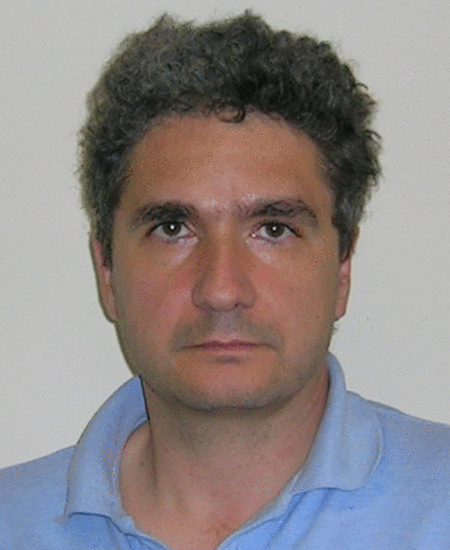 Roberto Rinaldo合作论文数Dipartimento Politecnico di Ingegneria e Architettura, University of Udine17
 Francesco Trevisan合作论文数16
 Ruben Specogna合作论文数Polytech Dept Engn & Architecture, Univ Udine14
 Alessandro Piras合作论文数Department of Human and General Physiology, University of Bologna13
 Riccardo Bernardini合作论文数DIEGM, University of Udine9
 Giovanni Chiorboli合作论文数Dipartimento di Ingegneria dell' Informazione, Università di Parma9Taraneh Aminosharieh Najafi合作论文数7
 Marco Massarotto合作论文数5
 Suzanne Lancaster合作论文数NaMLab gGmbH, D-01187 Dresden, Germany5
 Stefan Slesazeck合作论文数NaMLab gGmbH, Dresden, Germany5
 David Esseni合作论文数Dipartimento Politecnico di Ingegneria e Architettura, Universita degli Studi di Udine5
 Thomas Mikolajick合作论文数Center for Advancing Electronics Dresden, Dresden University of Technology5
 Francesco Driussi合作论文数DIEGM, University of Udine – IU.NET5Leonida Del Linz合作论文数4D. Minen合作论文数3M. Minen合作论文数3C. Savorgnan合作论文数3D Brisinda合作论文数3
 Elisabetta Lombardi合作论文数Fac Psychol, eCampus Univ3Mario Mazzucato合作论文数3De Zanet Denise合作论文数3
 Monica Battiston合作论文数3
 Riccardo Fenici合作论文数Clinical Physiology-Biomagnetism Research Center, Catholic University of Sacred Heart3
 Luigi De Marco合作论文数3Sonia Guerci合作论文数2Mattia Segatto合作论文数DPIA, Univ Udine2
 Gennaro Esposito合作论文数Science and Mathematics Division, New York University Abu Dhabi2
 Giovanni Franceschini合作论文数2
 Alberto Bellini合作论文数Department of Electrical, Electronic, and Information Engineering "Guglielmo Marconi", Universita Di Bologna2
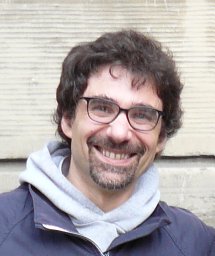 Federico Fogolari合作论文数Dipartimento di Scienze e Tecnologie Biomediche, Università di Udine2
 Alessandra Corazza合作论文数2Maurizio Polano合作论文数2Carla Tassoni合作论文数2Stefano Albini合作论文数1Yutaka Matsui合作论文数1Tomoaki Ohtsuki合作论文数1Natsuho Niida合作论文数1Fabio Formaggia合作论文数1Michela Minen合作论文数1Quang T. Duong合作论文数1
 Xintong Shi合作论文数Graduate School of Science and Technology, Keio University1
 Alireza Amirshahi合作论文数Institute of Electrical and Micro Engineering, École Polytechnique Fédérale de Lausanne (EPFL),1Kazunari Owada合作论文数1
 Riccardo Fontanini合作论文数DPIA, Univ Udine1
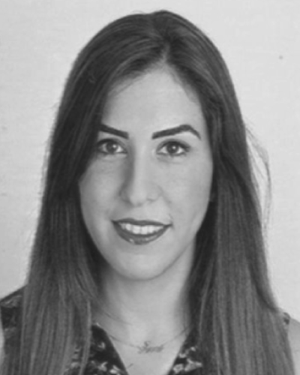 Anna Lo Grasso合作论文数Univ Pisa1Diego Minen合作论文数1
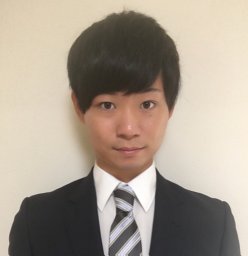 Kohei Yamamoto合作论文数Keio Univ, Grad Sch Sci & Technol, Yokohama, Kanagawa 2238522, Japan1Alessandro Da Ponte合作论文数1




