Asynchronous automata are a model of distributed finite state processes synchronising on shared actions. A celebrated result by Zielonka shows how a deterministic asynchronous automaton (AA) can be synthesised, starting from two inputs: a global specification given as a deterministic finite-state automaton (DFA) and a distribution of the alphabet into local alphabets for each process. The DFA to AA translation is particularly complex and has been revisited several times, with no complete prototype tool provided for the full construction. In this work, we revisit this construction on a restricted class of “fair” specifications: a DFA describes a fair specification if in every loop, all processes participate in at least one action — so, no process is starved. For fair specifications, we present a new construction to synthesise an AA. Our construction results in an AA where every process has a number of local states that is linear in the number of states of the DFA, and where the only exponential explosion is related to a fairness parameter: the length of the longest word that can be read in the DFA in which not every process participates. We have implemented a prototype tool showing how it can be applied to some examples, in particular a concrete one: the dining philosophers problem. Finally, we show how this construction can be combined with an existing construction for hierarchical process architectures, in order to relax the fairness assumption.
•Corrigendum to the paper “Revisiting reachability in polynomial interrupt timed automata”.•The lower bound is corrected from PSPACE to NP.
Polynomial Interrupt Timed Automata (PolITA) are finite automata with clocks organized along hierarchical levels. These clocks are equipped with an interruption mechanism, well suited to the modeling of real-time operating systems. Moreover, transitions between states contain polynomial guards and updates. The reachability problem in this class is known to be in 2EXPTIME with a decision procedure based on the cylindrical algebraic decomposition. We improve this complexity to EXPSPACE mainly using a combinatorial argument and we include a reduction leading to a PSPACE lower bound.
We study the synthesis problem for systems with a parameterized number of processes. As in the classical case due to Church, the system selects actions depending on the program run so far, with the aim of fulfilling a given specification. The difficulty is that, at the same time, the environment executes actions that the system cannot control. In contrast to the case of fixed, finite alphabets, here we consider the case of parameterized alphabets. An alphabet reflects the number of processes, which is static but unknown. The synthesis problem then asks whether there is a finite number of processes for which the system can satisfy the specification. This variant is already undecidable for very limited logics. Therefore, we consider a first-order logic without the order on word positions. We show that even in this restricted case synthesis is undecidable if both the system and the environment have access to all processes. On the other hand, we prove that the problem is decidable if the environment only has access to a bounded number of processes. In that case, there is even a cutoff meaning that it is enough to examine a bounded number of process architectures to solve the synthesis problem.
The problem of distributed synthesis is to automatically generate a distributed algorithm, given a target communication network and a specification of the algorithm's correct behavior. Previous work has focused on static networks with an a priori fixed message size. This approach has two shortcomings: Recent work in distributed computing is shifting towards dynamically changing communication networks rather than static ones, and an important class of distributed algorithms are so-called full-information protocols, where nodes piggy-pack previously received messages onto current messages. In this work, we consider the synthesis problem for a system of two nodes communicating in rounds over a dynamic link whose message size is not bounded. Given a network model, i.e., a set of link directions, in each round of the execution, the adversary choses a link from the network model, restricted only by the specification, and delivers messages according to the current link's directions. Motivated by communication buses with direct acknowledge mechanisms, we further assume that nodes are aware of which messages have been delivered. We show that the synthesis problem is decidable for a network model if and only if it does not contain the empty link that dismisses both nodes' messages.
Interrupt Timed Automata (ITA ) form a subclass of stopwatch automata where reachability and some variants of timed model checking are decidable even in presence of parameters. They are well suited to model and analyze real-time operating systems. Here we extend ITA with polynomial guards and updates, leading to the class of polynomial ITA (PolITA ). We prove that reachability is decidable in 2EXPTIME on PolITA, using an adaptation of the cylindrical algebraic decomposition algorithm for the first-order theory of reals. We also obtain decidability for the model checking of a timed version of CTL and for reachability in several extensions of PolITA. In particular, compared to previous approaches, our procedure handles parameters and clocks in a unified way. We also study expressiveness questions for PolITA and show that PolITA are incomparable with stopwatch automata.
On a partially observed system, a secret φ is opaque if an observer cannot ascertain that its trace belongs to φ. We consider specifications given as Constraint Markov Chains (CMC), which are underspecified Markov chains where probabilities on edges are required to belong to some set. The nondeterminism is resolved by a scheduler, and opacity on this model is defined as a worst case measure over all implementations obtained by scheduling. This measures the information obtained by a passive observer when the system is controlled by the smartest scheduler in coalition with the observer. When restricting to the subclass of Linear CMC, we compute (or approximate) this measure and prove that refinement of a specification can only improve opacity.
We present an application of statistical model-checking to the verification of an autonomous vehicle controller. Our goal is to check safety properties in various traffic situations. More specifically, we focus on a traffic jam situation. The controller is specified by a C++ program. Using sensors, it registers positions and velocities of nearby vehicles and modifies the position and velocity of the controlled vehicle to avoid collisions. We model the environment using a stochastic high level Petri net, where random behaviors of other vehicles can be described. We use HASL, a quantitative variant of linear temporal logic, to express the desired properties. A large family of performance indicators can be specified in HASL and we target in particular the expectation of travelled distance or the collision probability. We evaluate the properties of this model using COSMOS 1. This simulation tool implements numerous statistical techniques such as sequential hypothesis testing and most confidence range computation methods. Its efficiency allowed us to conduct several experiments with success.
De nombreux projets industriels, notamment dans la construction automobile, font appel a la suite d'outils Simulink pour la conception et la validation de composants critiques representant des systemes hybrides c'est-a-dire combinant des aspects discrets et continus. Cependant les formalismes associes ne disposent pas d'une semantique formelle ce qui peut diminuer la confiance des ingenieurs vis-a-vis des resultats produits. Nous proposons ici une telle semantique en procedant en deux etapes. Nous developpons d'abord une semantique exacte mais non executable. Puis nous l'enrichissons d'une semantique operationnelle approchee avec pour objectif une quantification de l'erreur issue de cette approximation.
Web services has become the most mature implementation of the service oriented computing (SOC) paradigm. The verification of behavioural compatibility is then necessary to ensure correct composition of services, which depends not only on qualitative properties such as absence of deadlock but also on some quantitative properties related to performance. Most of the proposed approaches verify the composition in service orchestration modelling. However, service choreography is more collaborative in nature and describes direct interactions between services. Although many existing approaches use Petri nets (PNs) and Colored PNs (CPNs) to analyse behavioural compatibility, few of them explore time constraints. We propose to model service interactions in a choreography with timed CPNs and perform automatic verification and simulation using CPN tools. We evaluate our approach with a case study from the Algerian e-Government, where we show how to verify global time constraints for the renewal of biometric passports.
Given a probabilistic transition system (PTS) A partially observed by an attacker, and an ω-regular predicate φ over the traces of A, measuring the disclosure of the secret φ in A means computing the probability that an attacker who observes a run of A can ascertain that its trace belongs to φ. We consider specifications given as Interval Markov Chains (IMCs), which are underspecified Markov chains where probabilities on edges are only required to belong to intervals. Scheduling an IMC S produces a concrete implementation as a PTS and we define the worst case disclosure of secret φ in S as the maximal disclosure of φ over all PTSs thus produced. We compute this value for a subclass of IMCs and we prove that simulation between specifications can only improve the opacity of implementations.
Mobile robot networks emerged in the past few years as a promising distributed computing model. Existing work in the literature typically ensures the correctness of mobile robot protocols via ad hoc handwritten proofs, which, in the case of asynchronous execution models, are both cumbersome and error-prone. Our contribution is twofold. We first propose a formal model to describe mobile robot protocols operating in a discrete space i.e., with a finite set of possible robot positions, under synchrony and asynchrony assumptions. We translate this formal model into the DVE language, which is the input format of the model-checkers DiVinE and ITS tools, and formally prove the equivalence of the two models. We then verify several instances of two existing protocols for variants of the ring exploration in an asynchronous setting: exploration with stop and perpetual exclusive exploration. For the first protocol we refine the correctness bounds and for the second one, we exhibit a counter-example. This protocol is then modified and we establish the correctness of the new version with an inductive proof.
Interrupt Timed Automata (ITA) are an expressive timed model, introduced to take into account interruptions according to levels. Due to this feature, this formalism is incomparable with Timed Automata. However several decidability results related to reachability and model checking have been obtaine d. We add auxiliary clocks to ITA, thereby extending its expressive power while preserving decidability of reachability. Moreover, we define a parametrized version of ITA, with polynomials of parameters appearing in guards and updates. While parametric reasoning is particularly relevant for timed models, it very often leads to undecidability results. We prove that various reachability problems, including robust reachability, are decidable for this model, and we give complexity upper bounds for a fixed or variable number of clocks, levels and parameters.
Covert channels represent a security problem for information systems, since they permit illegal flows and sometimes leaks of classified data. Although numerous descriptions have been given at a concrete level, relatively few work has been carried out at a more abstract level. In this paper, we propose a definition for covert channels based on encoding and decoding binary messages with transducers, in a finite transition system, and we explain why this definition is different from a similar notion of so called iterated interference. We also show that covert channels can be detected using a restricted class of transducers.
Interrupt Timed Automata (ITA) form a subclass of stopwatch automata where reachability and some variants of timed model checking are decidable even in presence of parameters. They are well suited to model and analyze real-time operating systems. Here we extend ITA with polynomial guards and updates, leading to the class of polynomial ITA (PolITA). We prove the decidability of the reachability and model checking of a timed version of CTL by an adaptation of the cylindrical decomposition method for the first-order theory of reals. Compared to previous approaches, our procedure handles parameters and clocks in a unified way. Moreover, we show that PolITA are incomparable with stopwatch automata. Finally additional features are introduced while preserving decidability.
Non-interference (NI) is a property of systems stating that confidential actions should not cause effects observable by unauthorized users. Several variants of NI have been studied for many types of models, but rarely for true concurrency or unbounded models. This work investigates NI for High-level Message Sequence Charts (HMSC), a scenario language for the description of distributed systems, based on composition of partial orders. We first propose a general definition of security properties in terms of equivalence among observations, and show that these properties, and in particular NI are undecidable for HMSCs. We hence consider weaker local properties, describing situations where a system is attacked by a single agent, and show that local NI is decidable. We then refine local NI to a finer notion of causal NI that emphasizes causal dependencies between confidential actions and observations, and extend it to causal NI with (selective) declassification of confidential events. Checking whether a system satisfies local and causal NI and their declassified variants are PSPACE-complete problems.
Mobile robot networks emerged in the past few years as a promising distributed computing model. Existing work in the literature typically ensures the correctness of mobile robot protocols via ad hoc handwritten proofs, which are both cumbersome and error-prone. This paper surveys state-of-the-art results about applying formal methods approaches (namely, model-checking, program synthesis, and proof assistants) to the context of mobile robot networks. Those methods already proved useful for bug-hunting in published literature, designing correct-bydesign optimal protocols, and certifying impossibility results. We also present related open questions to further develop this path of research.
Given a probabilistic transition system (PTS) A partially observed by an attacker, and an ω-regular predicate ϕ over the traces of A, measuring the disclosure of the secret ϕ in A means computing the probability that an attacker who observes a run of A can ascertain that its trace belongs to ϕ. In the context of refinement, we consider specifications given as Interval-valued Discrete Time Markov Chains (IDTMCs), which are underspecified Markov chains where probabilities on edges are only required to belong to intervals. Scheduling an IDTMC S produces a concrete implementation as a PTS and we define the worst case disclosure of secret ϕ in S as the maximal disclosure of ϕ over all PTSs thus produced. We compute this value for a subclass of IDTMCs and we prove that refinement can only improve the opacity of implementations.
Mobile robot networks emerged in the past few years as a promising distributed computing model. Existing work in the literature typically ensures the correctness of mobile robot protocols via ad hoc handwritten proofs, which are both cumbersome and error-prone. This paper surveys state-of-the-art results about applying formal methods approaches (namely, model-checking, program synthesis, and proof assistants) to the context of mobile robot networks. Those methods already proved useful for bug-hunting in published literature, designing correct-by-design optimal protocols, and certifying impossibility results. We also present related open questions to further develop this path of research.
Opacity is a generic security property, that has been defined on (non probabilistic) transition systems and later on Markov chains with labels. For a secret predicate, given as a subset of runs, and a function describing the view of an external observer, the value of interest for opacity is a measure of the set of runs disclosing the secret. We extend this definition to the richer framework of Markov decision processes, where non deterministic choice is combined with probabilistic transitions, and we study related decidability problems with partial or complete observation hypotheses for the schedulers. We prove that all questions are decidable with complete observation and $\omega$-regular secrets. With partial observation, we prove that all quantitative questions are undecidable but the question whether a system is almost surely non opaque becomes decidable for a restricted class of $\omega$-regular secrets, as well as for all $\omega$-regular secrets under finite-memory schedulers.
 Serge Haddad合作论文数Inria, Université Paris-Saclay23
 François Laroussinie合作论文数CNRS;Laboratoire Sp??cification & V??rification20
 Antoine Petit合作论文数LSV, ENS de Cachan & CNRS19
 Laure Petrucci合作论文数Institut Galilée, Université Paris 13;LIPN, CNRS UMR 703018
 A. Finkel合作论文数Laboratoire Sp??cification et V??rification16
 Michel Bidoit合作论文数Laboratoire Spécification et Vérification, École Normale Supérieure de Cachan15Mathieu Sassolas合作论文数15
 Ph. Schnoebelen合作论文数LSV, CNRS & ENS de Cachan14
 Didier Lime合作论文数Real-Time Systems Group, École Centrale de Nantes13Pierre Mckenzie合作论文数Departement d’Informatique et de recherche operationnelle, Universite de Montreal11
 John Mullins合作论文数10Y. Thierry-Mieg合作论文数Universite Pierre & Marie Curie, 4 place Jussieu, 75252 Paris cedex 05, France9
 Olivier H. Roux合作论文数Doctoral School MaSTIC 641, École Centrale de Nantes9
 F. Cassez合作论文数CNRS6Nathalie Sznajder合作论文数5
 O. De Smet合作论文数5
 Laure Millet合作论文数4
 Paul Gastin合作论文数ENS Cachan, CNRS & INRIA4Philippe Schnoebelen合作论文数4Gilles Benattar合作论文数4
 Laurent Fribourg合作论文数CNRS4
 Joffroy Beauquier合作论文数Laboratoire De Recherche Informatique4Claudine Picaronny合作论文数LSV, CNRS & ENS4
 Sebastien Tixeuil合作论文数Laboratoire D'Informatique de Paris 6, Sorbonne University;Institut Universitaire de France4
 Patricia Bouyer Decitre合作论文数CNRS3Yan Zhang合作论文数3
 Houda Bel Mokadem合作论文数3
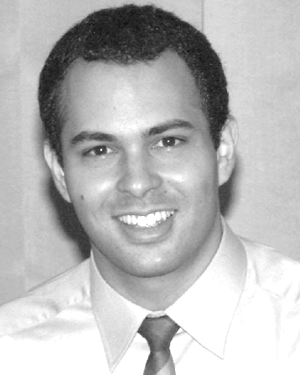 Mongi Ben Gaid合作论文数Institut Francais du Petrole;Control Systems Department;Control Systems Department, Institut Francais du Petrole|3
 Nicolas Markey合作论文数Institut De Recherche En Informatique Et Systèmes Aléatoires, CNRS3
 Lom-Messan Hillah合作论文数CNRS UMR 7606, Université Paris Ouest Nanterre La Défense3
 Olga Kouchnarenko合作论文数Institut Femto-Sciences & Technologies, University of Franche-Comté;Inria Lille-Nord Europe;Département d'Informatique, University of Franche-Comté3Maria Gradinariu Potop-Butucaru合作论文数University Paris 63Fabrice Kordon合作论文数Universite P. & M. Curie3Yann Duplouy合作论文数2
 Aleksandra Jovanovic合作论文数2
 Maya Souilah Benabdelhafid合作论文数LIRE Laboratory, Constantine 2 University, Constantine 25000, Algeria2
 Kim Guldstrand Larsen合作论文数Department of Computer Science, Aalborg University2Claude Jard合作论文数Distribcom research group;Bretagne;ENS-Cachan2Pierre Courtieu合作论文数Conservatoire national des arts et métiers2
 Jean-Marc Roussel合作论文数Laboratoire d’Ecologie Aquatique Rennes, Institut National de la Recherche Agronomique2Lionel Rieg合作论文数2
 Benedikt Bollig合作论文数Laboratoire Méthodes Formelles, Université Paris-Saclay;Centre National de La Recherche Scientifique2Mahmoud Boufaïda合作论文数LIRE Laboratory, Mentouri University of Constantine2
 Vincent Gourcuff合作论文数2
 Mohab Safey El Din合作论文数Laboratoire d'Informatique, Sorbonne Université;Institut Universitaire de France2
 Ocan Sankur合作论文数IRISA, Univ Rennes2
 S Akshay合作论文数Department of Computer Science and Engineering, Indian Institute of Technology Bombay1




