The reduction of atmospheric greenhouse gas emissions is a major challenge. In this context, each natural or industrial release such as methane (CH4), carbon dioxide (CO2) has to be monitored, localized and quantified. IFP Energies nouvelles (IFPEN) is developing a mobile measurement system called Flair car whose purpose is the detection of different abnormal gas emissions. Flair car system incorporates various gas sensors, including a weather station and GPS (Global Positioning System) module, mounted on a plugin hybrid electric vehicle. This enables the real-time monitoring and the recording of geo-time-stamped gas concentration measurements. Flair map corresponds to the on board real-time visualization software.Flair map development required two important challenges: a quick and agile software modification capability together with a real-time display of measurements on maps. In order to meet these two challenges, we adopted a software rapid-prototyping approach based on the xDash tool. In this paper, our proposed real-time data visualisation approach is first introduced. Then, the rapid-prototyping development methodology which resulted in the Flair map software is described. Finally, two main operational usages of Flair map are illustrated. The first involves real-time visualization aboard the car of the maps representing data acquisition from gas concentration sensors. The second shows the a-posteriori analysis of measurement campaigns for the purpose of methane anomalies study.
The growing complexity of cyber-physical systems, together with increasingly available parallelism provided by multi-core chips, fosters the parallelization of simulation. Simulation speed-ups are expected from co-simulation and parallelization based on model splitting into weakly coupled submodels, such as in the framework of a functional mockup interface. However, slackened synchronization between submodels and their associated solvers running in parallel introduces integration errors, which must be kept inside acceptable bounds. CHOPtrey denotes a forecasting framework enhancing the performance of complex system co-simulation, with a trivalent articulation. First, we consider the framework of a computationally hasty online prediction system. It allows to improve the tradeoff between integration speed-ups, needing large communication steps, and simulation precision, needing frequent updates for model inputs. Second, smoothed adaptive forward prediction improves co-simulation accuracy. It is obtained by past-weighted extrapolation based on causal hopping oblivious polynomials. Third, signal behavior is segmented to handle the discontinuities of the exchanged signals: the segmentation is performed in a contextual and hierarchical ontology of patterns. Implementation strategies and simulation results demonstrate the framework ability to adaptively relax data communication constraints beyond synchronization points which sensibly accelerate the simulation. The CHOPtrey framework extends the range of applications of standard Waring-Lagrange polynomial extrapolation, often deemed unstable. The embedding of predictions in lag-dependent smoothing and discontinuity handling demonstrates its practical efficiency.
The growing complexity of cyber-physical systems, together with increasingly available parallelism provided by multi-core chips, fosters the parallelization of simulation. Simulation speed-ups are expected from co-simulation and parallelization based on model splitting into weakly coupled submodels, such as in the framework of a functional mockup interface. However, slackened synchronization between submodels and their associated solvers running in parallel introduces integration errors, which must be kept inside acceptable bounds. CHOPtrey denotes a forecasting framework enhancing the performance of complex system co-simulation, with a trivalent articulation. First, we consider the framework of a computationally hasty online prediction system. It allows to improve the tradeoff between integration speed-ups, needing large communication steps, and simulation precision, needing frequent updates for model inputs. Second, smoothed adaptive forward prediction improves co-simulation accuracy. It is obtained by past-weighted extrapolation based on causal hopping oblivious polynomials. Third, signal behavior is segmented to handle the discontinuities of the exchanged signals: the segmentation is performed in a contextual and hierarchical ontology of patterns. Implementation strategies and simulation results demonstrate the framework ability to adaptively relax data communication constraints beyond synchronization points which sensibly accelerate the simulation. The CHOPtrey framework extends the range of applications of standard Waring–Lagrange polynomial extrapolation, often deemed unstable. The embedding of predictions in lag-dependent smoothing and discontinuity handling demonstrates its practical efficiency.
Building high-fidelity system-level models of Cyber-Physical Systems (CPS) is a challenging duty. A first problem is the diversity of modeling and simulation environments used by the various involved multi-disciplinary teams. Particular environments are preferred for a specific use, due to distinctive strengths (modeling language, libraries, solvers, cost, etc.). The Functional Mock-up Interface (FMI) specification has been proposed to improve this issue [1]. A second problem is the growing complexity of such high-fidelity models and their induced prohibitive CPU execution time. Indeed, major system-level simulation softwares are relying on sequential ODE/DAE solvers. They are currently unable to efficiently exploit the available parallelism provided by multi-core chips. In addition, CPS are commonly modeled as hybrid models where the major challenge resides in their numerous discontinuities. Indeed, discontinuities usually prevent high integration speeds with variable-step solvers. We propose a modular co-simulation [2] of a split model, where each sub-model is integrated with its own solver. Thanks to splitting, high integration speeds can be reached when using LSODAR,a variable step solver with a root-finding capability. Nevertheless, partitioning a complex model into several lesser complex sub-models also brings some difficulties that need to be managed. First, partitioning may add virtual algebraic loops, therefore involving delayed outputs, even with an efficient execution order. To avoid the latter, we propose in [3] a new co-simulation method based on a refined scheduling approach. This technique, denoted “RCosim”, retains the speed-up advantage of modular co-simulation thanks to the parallel execution of the sub-models. Furthermore, it improves the accuracy of simulation results through an offline scheduling of operations that takes care of model input/output dynamics. Second, partitioning and even co-simulation require synchronization between coupled models to exchange updated data to reduce numerical error propagation in simulation results. Thus, tight synchronization, using small communication steps, is required between blocks. This greatly limits the possibilities to accelerate the simulation. Adaptive communication steps may better handle changes in model dynamics [4]. Meanwhile, stability of multi-rate simulators needs to be carefully assessed. Data extrapolation over steps is expected to enhance the precision over large communication steps. However, complex models usually present non-linearities and discontinuities, entangling forecasts from past observations only [5]. We propose a Computationally Hasty Online Prediction framework (CHOPred) to stretch out synchronization steps with negligible precision changes in the simulation, at low-complexity. It allows to improve the trade-off between speed-ups, needing large communication steps, and precision, needing frequent updates for model inputs. It is based on a Contextual & Hierarchical Ontology of Patterns (CHOPatt) that handles the discontinuities of exchanged signals by selecting appropriate 1Ordinary Differential Equation/Differential Algebraic Equation. 2Livermore Solver for Ordinary Differential equations, with Automatic method switching for stiff and nonstiff problems, and with Root-finding.
In Chaps. 10 and 11, we addressed the stability and dynamic performance of distributed control and embedded systems (DCESs) under the periodic scheduling or hyper-sampling mode. We have considered the stability of DCESs under the hyper-sampling mode as well as the scheduling design in order to enhance the performance. The stability analysis of this class of systems is motivated by their increasing practical importance and the necessity to handle faulty and overload situations. The results obtained prove the usefulness of their stability analysis by reducing the conservatism and so increasing their stability domain as well as pointing out some contradiction with the generally accepted intuition. It is worth noting that reducing the system communication and calculation resources does not necessarily mean the reduction of the dynamic performance.In this chapter, we will follow the same line by further focusing our study "inside" the sampling period. The rationale behind it is the system stability together with the system performance enhancement. We will propose an easily-implemented switched sampled-data (SD) control strategy which may enhance the stability as well as dynamic properties. Regarding the stability issue, we will show that the use of the switched SD control strategy allows to enlarge the stability bound on the sampling period. As a consequence, a controlled task can be stabilized with less system resources by using the switched SD controller. We will also study the dynamic performance of a DCES with the switched SD control. An optimization method is proposed to optimally set the switching parameter of the switched SD controller. Thus, given a sampling period, we may obtain the optimal performance index through an appropriate setting of the switching parameter. We will show that the switched SD control may lead to a much better performance index than the standard single-sampling control. In other words, with the same utilization of computation and communication resources, the dynamic performance of a controlled task may be considerably enhanced by using the switched SD control.
The growing complexity of systems, together with increasing available parallelism provided by multi-core chips, calls for the parallelization of simulation.Simulation speed-ups are expected from co-simulation and parallelization based on models splitting into loosely coupled sub-systems in the framework of Functional Mockup Interface (FMI).However, slackened synchronization between the sub-models and associated solvers running in parallel introduces integration errors, which must be kept inside predefined bounds.In this paper, context-based extrapolation is investigated to improve the trade-off between integration speedups, needing large communication steps, and simulation precision, needing frequent updates for the models inputs.An internal combustion engine, based on FMI for model exchange, is used to assess the parallelization methodology.
The main objective of this chapter is to understand the way in which periodic scheduling or hyper-sampling period and DCES-induced delays affect the stability of the controlled plant. Several scenarios are considered, leading to three stability problems. First, a delay-sweeping method is given in the case of constant parameters (hyper-sampling periods and DCES-induced delays). Next, two problems concerning the case when time-varying uncertain parameters are considered. For a system with time-varying uncertain parameters, a sufficient stability condition is given in terms of the existence of an appropriate Lyapunov matrix. The second problem concerns the stability of a real-time system including a constant hyper-sampling period and time-varying uncertain DCES-induced delays. In this case, sufficient conditions expressed in terms of feasibility of some appropriate linear matrix inequalities (LMIs) are proposed. Finally, the third problem concerns the case without DCES-induced delays but subject to time-varying uncertain hyper-sampling periods. The problem is handled by establishing an appropriate connection between the single-sampling and hyper-sampling cases. In this way, the hyper-sampling case appears as a direct application of the results derived in the single-sampling case. Next, a parameter-sweeping method is employed to detect the whole stability region in the corresponding parameter-space. Different examples (including also the case of two inverted pendulums) are given to illustrate the proposed results. It is worth mentioning that each system can be viewed as a switched system composed of “n” sub-systems if the hyper-sampling period has “n” sub-sampling periods. The derived stability regions include, in some cases, sub-regions where some sub-systems are not necessarily stable. This fact helps us to enlarge the stability ranges of the parameters by taking more advantage of the effect induced by the hyper-sampling period on the stability of the overall system. To the best of the authors’ knowledge, such an angle was not sufficiently addressed and exploited for real-time applications.
The design process of complex Cyber-Physical Systems often relies on co-simulations of the system, involving the interaction of several simulated models of sub-systems. However, reaching real-time simulations is currently prevented by prohibitive CPU times using the single-threaded existing simulation tools. This paper investigates the problem of the efficient parallel co-simulation of hybrid dynamical systems. It introduces,a finely-grained co-simulation method enabling numerical integration speed-ups. It is obtained using a partition across the model into loosely coupled sub-systems with sparse communication between modules. The proposed scheme leads to schedule a large number of Operations with a wide range of execution times. A suitable off-line scheduling algorithm, based on the input/output dynamics of the models, is proposed to minimize the simulation errors induced by the parallel execution. This scheme is finally tested using the phenomenological model of a combustion engine issued from the Functional Mockup Interface framework. Compared with the sequential case, it shows significant speed-ups while keeping the numerical integration accuracy under control. (C) 2014 Elsevier B.V. All rights reserved.
Numerical results of the optimal integrated control and scheduling problem show that the optimal scheduling is closely dependent on the dynamical state of the controlled systems. This dependence confirms the intuition that the most disturbed plants have always more important "needs" in terms of communication resources than the plants that are near to the equilibrium. By using on-line scheduling algorithms, it is possible to exploit this dependency to achieve a better control performance, thanks to a more efficient use of the available resources.In this chapter, we consider a resource-constrained system S where the full state vector x(k) is available to the controller at each sampling period. We first propose the use of the model predictive control approach as an algorithmic solution allowing to compute on-line, at the same time, the optimal values of the control signals and the communication scheduling of resource-constrained systems. In opposition to [191], control signals that could not be updated are held constant (and not set to zero). Furthermore, a quadratic cost function (and not linear function) is used in order to evaluate the control performance as well as the ability of the adaptive scheduling to improve the performance of sampled-data systems (instead of discrete-time systems) is demonstrated. However, the on-line solving of the optimization algorithm, which is required by the MPC approach, is very costly. For that reason, an on-line scheduling algorithm, called optimal pointer placement (OPP) is proposed. While being based on a pre-computed optimal off-line schedule, OPP makes possible to allocate on-line the communication resources, based on the state of the controlled dynamical systems. It is shown that, under mild conditions, OPP ensures the asymptotic stability of the controlled systems and enables in all the situations to improve the control performance compared to the basic static scheduling. Furthermore, under these conditions, the determination of OPP control and scheduling amounts by comparing a limited number of quadratic functions of the state. Finally, OPP is applied to two typical examples of distributed control and embedded systems: the active suspension of car and the attitude control of a quadrotor.
In the Part II of this document, the object of our study is the DCES analysis and design with a special emphasis on the scheduling of control signals and their real time update depending on the system state. This simply means that the systems resources are allocated with respect to the system's performance enhancement and robustness. Such a state dependent scheduling may be classified in the set of event driven scheduling algorithms which have attracted recently the attention of many researchers in control domain.Another characteristic of the class of applications treated there, which is more related to the technology of communication, concerns the communication and calculation model. The network was supposed to posses real-time characteristics and the transfer time of messages packets from a node processor to another node processor of the Hardware/Software application architecture was considered as being negligible. The calculation as well as the communication models were supposed to be synchronous. Thus, such an assumption simply means that the delay induced model is uniquely given by the static scheduling hyperperiod. Meanwhile, for the class of this type of applications, in our opinion, it is impossible to neglect the delay induced by scheduling of messages on the network as well as of control and other tasks (actuation, sampling, ...) running on the node processors.The object of our study in Chap. 10 will be the influence of the induced delay on the stability and on the performance of some special class of DCESs corresponding to those studied and discussed in Chap. 7. The stability analysis will allow us defining appropriate stability domain for task period variation and for DCES-induced delay. Such a study, done generally off-line, will help us to better understand their influence on the system's stability and performance as well as to propose new control switching algorithms in order to handle network or processor over-load state and control messages packets dropping. As it will be seen in the Chaps. 12 and 13, the knowledge of the induced delay influence will also allow slowing down the system's performance deterioration by switching from a given control law to the zero-control one.In our opinion, it is important to operate this analysis for the case where the induced delay is inferior to a sampling period as well when it is composed by a sequence of sampling period. The objective is double. First, it concerns the choice of sampling periods. We will see that we can increase it without degrading the system's performances. This means that, for the same level of service or performances, we use less communication and calculation resources. During this analysis, we observe that the generally accepted intuition consisting in the fact that more communication and calculation resources allow to better control a given system is not always verified. Second, it is helpful for proposing new control and/or recovery strategies in the case of messages dropouts and control task preemption. Based on this analysis, in Chap. 11, we also propose scheduling algorithms able to handle resources and/or performance optimization of DCESs.Our main objective is to be as realistic as possible with respect to the representation of communication and calculation model in the presence of induced delays. We will see that this representation is sufficiently informative to address stability analysis as well as the performance optimization of DCESs.In the sequel, we briefly introduce the existing delay models of DCESs, the corresponding technical background, different related problems, as well as appropriate methodologies and approaches adopted in handling them. We absolutely do not have the pretentiousness to cover the whole field of DCESs or to provide all the solutions proposed so far in the literature. Meanwhile, in Sect. 9.6, we give a very brief presentation of some of them which seems to be in close relation or complementary the ones proposed in the book.
In this chapter, we refine the model of resource-constrained systems to take into account quantization aspects and mainly focus on performance considerations in presence of information limitations. The communication constrains are modeled at the bit level, in bits per second. By using this modeling, we have to determine the control inputs that have to be updated as well as their quantization precision. In order to limit the inherent complexity of the proposed protocol, we suppose that the quantization precision choices of the input control signals belong to a reduced finite set. At each sampling period, quantization possibilities may be chosen from this set. In the case of allocation of communication resources based on the "per symbol" paradigm, the information exchange is modeled at the symbol level. The quantization of measurements and control commands is thus implicitly taken into account. The general model is given in Fig. 7.1.In this model, the communication channel can transmit at most R bits per time unit. Because of these resource limitations, measurements and control commands must be encoded (as a flow of symbols) before their transmission and decoded at their reception. Various coding techniques may be employed. A fundamental question is to determine the necessary and/or sufficient data-rate allowing the existence of a coder, a decoder and a controller that achieve the stabilization of the system.In general, increasing the sampling frequency improves the disturbance rejection abilities whereas increasing the quantization precision improves the steady state precision. However, when the bandwidth is limited, increasing the sampling frequency necessitates the reduction of the quantization precision. In the opposite, augmenting the quantization precision requires the lowering of the sampling frequency.Motivated by these observations, an approach for the dynamical on-line assignment of sampling frequencies and control inputs quantization is proposed. This approach, which is based on the model predictive control (MPC) philosophy, enables to choose the sampling frequency and the quantization levels of control signals from a predefined set, in order to optimize the control performance. Naturally, handling dynamically the quantization precision requires some communication resources and some extra computational resources. Consequently, we have to jointly handle the computational complexity, the protocol bandwidth consumption and performance[GRAPHICS]improvements. In order to limit the inherent complexity of the proposed protocol, we suppose that the quantization choices of the input control signals belong to a reduced finite set, which may be chosen by the designer in order to ensure the stability and to comply with the computational requirements. At each sampling period, quantization possibilities may be chosen from this set. This contrasts with the approach of [99], where the quantization precision of control signals is fixed. The proposed approach aims to capture the intuitive notion that high sampling rates improve the disturbance rejection and the transient behavior whereas the fine quantization improves the static precision near the origin [80]. The proposed method allows to dynamically choosing the pertinent control information to send, knowing the plant state and subject to the communication constraints.
Traditionally, control design problems are decoupled from software design and implementation considerations. Such a separation allowed the control and computer science communities to focus on specific problems independently, and led to the development that we are familiar with nowadays. However, as explained in Arzen et al. [13], this separation relies on the fact that these two fields use very simplified models of their interface with each other. In fact, control designers disregard the characteristics of the implementation and the available computational and communication resources. On the other hand, real-time designers see the control loop as a periodic task with a hard deadline, that have sometimes to fulfill data dependency constraints (especially when the sensing and actuation are distant). Recently, researchers from these two communities have shown that if more elaborate models are used, significant improvements in terms of implementation efficiency and quality of control may be achieved. This integrative co-design approach is central to this book.This chapter is organized into two parts. The first part presents the state of the art of the real-time scheduling theory, focusing on the most used results in distributed control and embedded system (DCES) applications. We start by presenting real-time single-processor scheduling problems. Next, we focus on the problem of ensuring real-time networked communications. We emphasize different methods for managing the access concurrency having a determinant impact on the guarantee of deterministic real-time communications. Finally, an overview of the problem of guaranteeing end-to-end real-time constraints in distributed systems is given. In the second part, we present a state of the art of the new approaches, that are based on more elaborate models, and that take into account both the dynamic nature of the controlled systems as well as some characteristics of their implementation. Various problems and models were discussed in the literature. We propose a classification of these different approaches and illustrate the different problems and models that were addressed.
In this chapter, we present our abstract view of a distributed control and embedded systems (DCES) operating under communication constraints. This abstract view is described by the class of computer-controlled systems, which was introduced by Hristu in [122]. This class allows modeling, in a finely-grained and abstract way, the impact of the resource limitations on the behavior of the controlled system. In this book, we will rather use the term of resource-constrained systems to refer to this class of systems. After the introduction of the notation we are using, we present the framework of the mixed logical dynamical (MLD) systems, which represents a modeling framework for hybrid systems. Such a framework was introduced by Bemporad and Morari in [21]. We show that resource-constrained systems may be modeled in the MLD framework. Furthermore, we propose a systematic approach allowing establishing the MLD model of a resource-constrained system. Finally, we review the main theoretical results that are related to resource-constrained systems, and encountered in the literature. These results include the problems of stabilization, tracking, reachability and observability.
In Chap. 10 , we considered the stability conditions of distributed control and embedded systems (DCESs) under periodic scheduling or hyper-sampling period. Even if the stability is the most important property for a controlled system, we always require dynamic performance enhancement through the optimal calculation of periodic scheduling of control signals or tasks given by the hyper-sampling periods or sequence. More precisely, we will derive the analytical relation between the hyper-sampling sequence and a consistently chosen performance index. Using such a relation, we may optimally design the hyper-sampling period for different scheduling periodicity and DCESs dynamic characteristics and possibly use this hyper-sampling period as a base for optimal on-line handling of DCESs with constrained resources.
In computer systems, the scheduler is the entity that is responsible of the allocation of the computational resources. Consequently, using efficiently these resources amounts to design appropriate scheduling algorithms. The need for an efficient use of the computational resources comes from cost pressure, which requires the realization of system functionalities with minimum resources. Traditionally, control design and real-time scheduling design have been decoupled in the design processes of embedded control applications. This separation of concerns allowed each community to focus on specific problems, and led to the spectacular development we are familiar with today [12]. However, this separation of concerns relies on the fact that these two domains use very simplified models of their interface with each other. In fact, as pointed out in [53], control designers assume that the implementation is able to provide an equidistant sampling and actuation, and to ensure a fixed input output latency as well as an infinite quantization precision. Real-time designers on the other hand see the control loop as a periodic task with a hard deadline.In both control and real-time scheduling theories, the notion of "instantaneous computational needs" of a control application is not defined. Computation and communication resources are consequently allocated according to the "worst case needs" of these applications. This corresponds to the use of periodic sampling, which on one hand simplifies the control design problem, but on the other hand leads to an unnecessary usage of some computational resources. In fact, a control task that is close to the equilibrium needs less computing resources than another one which is severely disturbed [23, 26, 167]. Similarly, the real-time scheduling design of control tasks is based on their worst-case execution time. As illustrated in [55], a resource saving may be obtained if these hard real-time constraints are "conveniently" relaxed, since control systems may be situated in between hard and soft real-time systems. Our opinion is that a significant saving in computing resources may be performed if more elaborate models are used by the two communities, which amounts to the co-design and the scheduling [12, 55, 212, 255].In this chapter, a new approach for the co-design of control and real-time scheduling is proposed. In the first part, we motivate the use of the H-2 performance index for the problem of the optimal integrated control and non-preemptive off-line scheduling of control tasks. A new approach for solving this problem is proposed. This approach decomposes the problem into two sub-problems, which may be solved separately. The first sub-problem amounts in finding the optimal non-preemptive off-line schedule, and may be solved by using the branch and bound method. The second sub-problem resolution uses the lifting technique to determine the optimal control gains, based on the solution of the first sub-problem. We illustrate how the existing knowledge from the considered control systems models may be used to considerably reduce the time needed to find the optimal solution, taking full advantage of the use of the branch and bound method. In the second part, a plant state feedback scheduling algorithm, called reactive pointer placement (RPP) scheduling algorithm is proposed. Its objective is to improve the control performance by reacting as fast as possible to unexpected disturbances. Performance improvements as well as stability guarantees using the RPP algorithm are formally proven and then illustrated on a comprehensive implementation model, which was simulated using the tool TRUETIME [5]. Finally, the RPP algorithm is implemented on an embedded processor in order to achieve the concurrent real-time speed regulation of two DC motors.The rest of this chapter is organized as follows. After a brief overview of the related work in the second section, the formulation and solving of the optimal control and non-preemptive off-line scheduling according to the H-2 performance criterion is addressed in the third section. The RPP scheduling algorithm is introduced, described and evaluated using simulation in the fourth section. Finally, some remarks on the experimental evaluation of the proposed approach are presented in the fifth section. Some notes and comments end the chapter.
As studied in the previous chapters, a DCES may be subject to some undesired factors like DCES-induced delays and sampling period jitters. These factors, in general, deteriorate the dynamic performance, but it is well known that a controlled system has inherent stability robustness. Thus, a DCES with a proper sampled-data controller may tolerate induced delays and sampling jitters to a certain degree, without losing its stability.However, some factors like data dropout, overload of calculation nodes and control tasks preemptions may cause standard sample-and-control execution failures at some sampling instants. Such a phenomenon of controller failure is called the control input missing which has recently attracted a special attention. With the generalization of DCESs Hardware/Software control input missings are likely to happen more frequently implying thus the necessity to use an appropriate adapted controller design methodology.In the literature, there are two commonly used compensation strategies called the zero-control strategy and the hold-control strategy. If a control input missing occurs, the zero-control strategy sets the control input to zero as given in Zhang and Yu [265]. In the case of hold-control strategy, if a control input missing occurs, the previous control input is held as given in Schenato [207]. In Zhang and Yu [265], the stability of sampled-data control systems under the zero-control strategy is studied and the admissible control input missing rate (ACIMR)(1) is computed.In this chapter, we will propose a novel compensation strategy: a switched hold-zero (HZ) control approach. The idea is to combine the benefits of hold-control law with the zero-control law. If a control input missing occurs, the actuator node of a DCES has two optional natural strategies: the hold-control and the zero-control ones. In this context, a natural question may arise: what are the appropriate control strategies guaranteeing larger ACIMRs? To the best of our knowledge, no answer has been given to this question. This motivates our study on the control input missing phenomenon and consequently, we propose to use both of them in an ordered and precise temporal switched manner defined according to the structural properties of the DCES under study.This chapter starts with the study of system dynamics under the zero-control and the hold-control strategies, respectively. The system dynamics under the two strategies present different characteristics. The variation rate of the Lyapunov function(2) under the zero control is independent of the distribution of the control input missings. While, under the hold control, such a quantity varies with respect to the distribution of the control input missings. From the delay-system point of view, the input delay is proportional to the number of consecutive control input missings. Thus, when a small number of consecutive control input missings happen, the hold control may lead to a smaller variation rate of the Lyapunov function than the zero control. As the number of consecutive control input missings increases, the variation rate of Lyapunov function of the hold control tends to increase.The above observation inspires us to present the switched hold-zero control: first, we apply the hold control, and then, we switch to the zero control. The switching instant will be considered as a design parameter and it will be computed based on the system structural properties.
Optimal Design of Distributed Control and Embedded Systems focuses on the design of special control and scheduling algorithms based on system structural properties as well as on analysis of the influence of induced time-delay on systems performances. It treats the optimal design of distributed and embedded control systems (DCESs) with respect to communication and calculation-resource constraints, quantization aspects, and potential time-delays induced by the associated communication and calculation model. Particular emphasis is put on optimal control signal scheduling based on the system state. In order to render this complex optimization problem feasible in real time, a time decomposition is based on periodicity induced by the static scheduling is operated. The authors present a co-design approach which subsumes the synthesis of the optimal control laws and the generation of an optimal schedule of control signals on real-time networks as well as the execution of control tasks on a single processor. The authors also operate a control structure modification or a control switching based on a thorough analysis of the influence of the induced time-delay system influence on stability and system performance in order to optimize DCES performance in case of calculation and communication resource limitations. Although the richness and variety of classes of DCES preclude a completely comprehensive treatment or a single best method of approaching them all, this co-design approach has the best chance of rendering this problem feasible and finding the optimal or some sub-optimal solution. The text is rounded out with references to such applications as car suspension and unmanned vehicles. Optimal Design of Distributed Control and Embedded Systems will be of most interest to academic researchers working on the mathematical theory of DCES but the wide range of environments in which they are used also promotes the relevance of the text for control practitioners working in the avionics, automotive, energy-production, space exploration and many other industries.
With the new prospects that are offered by the diffusion of the communication means on the one hand, and the abilities of the control engineering and science to model and handle different categories of systems belonging to a broad range of application fields on the other hand, it is easy to envisions the development of new applications in the future, where the dynamics and the information will be strongly dependent. For that reason, the study of the integration of control, communication and computation was considered, in a recent report on the future of control (Murray et al. in IEEE Control Syst. Mag. 23(2):20–33, 2003), as a major challenge research direction. The integrated study of control communication, and computation (Årzén et al. in 39th IEEE conference on decision and control, Sydney, Australia, 2000) becomes more important when the communication bandwidth or the processing power is limited. Communication and computing resource limitations are generally presented as being a common characteristic to an important range of embedded systems. The term embedded system refers to an electronic system, which is in close relationship to a physical system. Embedded systems are reactive systems: they must correctly respond to the stimuli of their physical environment. They are characterized by a given degree of autonomy, which often appears in the autonomy of the computational resources, and less frequently in the autonomy of the energy supply.
 Arben Cela合作论文数Department of Embeded Systems, Paris East University23
 Xuguang Li (李旭光)合作论文数College of Information Science and Engineering, Northeastern University13
 Silviu-Iulian Niculescu合作论文数Laboratory of Signals and Systems, CNRS13
 Daniel I. Simon合作论文数The Department of Physiology and Biophysics, School of Medicine, Case Western Reserve University;Division of Cardiovascular Medicine, University Hospitals Case Medical Center;Heart & Vascular Institute, University Hospitals Cleveland11
 Olivier Sename合作论文数GIPSA-lab, Department of Control Systems, Grenoble Institute of Technology8Abir Ben Khaled合作论文数6Rémy Kocik合作论文数4
 Laurent Duval合作论文数IFP Energies Nouvelles4A Cela合作论文数3C. Ionete合作论文数3
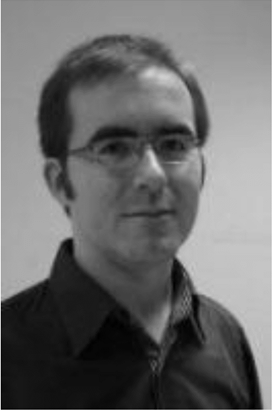 Nicolas Pernet合作论文数3Cyril Faure合作论文数3
 Abdellatif Reama合作论文数3
 David Robert合作论文数Institute of Computational Chemistry Campus Montilivi, University of Girona3
 O. De Smet合作论文数3
 Rédha Hamouche合作论文数3
 Béatrice Bérard合作论文数University Pierre et Marie Curie3Gregory Font合作论文数2
 Antonio Camacho合作论文数2Alexandre Seuret合作论文数CNRS2
 Manel Velasco合作论文数Automatic Control Department;Technical University of Catalonia;Automatic Control Department, Technical University of Catalonia2Yskandar Hamam合作论文数Laboratoire A2SI;Algorithmique et Architecture des Systemes Informatiques2
 Cosmin Ionete合作论文数Department of Automatic Control, University of Craiova2
 Pau Martí合作论文数Department of Engineering Automatic Control and Industrial Informatics, Universitat Politècnica de Catalunya2
 Gilles Corde合作论文数2Mohamed El Mongi合作论文数2M Donkers合作论文数1
 Julien Bohbot合作论文数1zakia benjellountouimi合作论文数1Wei Zhang合作论文数1Tingli Su合作论文数Beijing Technol & Business Univ, Sch Comp & Informat Engn, Beijing 100048, Peoples R China1
 Guido Herrmann合作论文数Department of Electrical and Electronic Engineering, School of Engineering, Faculty of Science and Engineering, The University of Manchester1
 Stefano Longo合作论文数Ctr Automot Engn & Technol, Cranfield Univ1
 Alexandre Chasse合作论文数1Izak, M.合作论文数1Goktas, F.合作论文数1
 Björn Wittenmark合作论文数Department of Automatic Control, Lunds Universitet1
 Houssem Saafi合作论文数1
 Antonis Papachristodoulou合作论文数Department of Engineering Science, University of Oxford;Worcester College, University of Oxford1Daniel Simon合作论文数1
 Corentin Briat合作论文数Department of Biosystems Science and Engineering, Eidgenossische Technische Hochschule Zurich1
 Jamal Daafouz合作论文数Universite de Lorraine1
 Jean Pierre Richard合作论文数Centrale Lille1
 Patrizio Colaneri合作论文数Dipartimento di Elettronica, Informazione e Bioingegneria, Politecnico di Milano1
 Lui Sha合作论文数Department of Computer Science, The Grainger College of Engineering, University of Illinois Urbana-Champaign;Cyber Physical Systems Integration Laboratory, University of Illinois Urbana-Champaign1
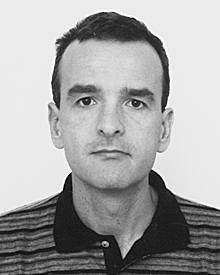 Pedro Luis Dias Peres合作论文数1
 Alberto Bemporad合作论文数IMT School for Advanced Studies Lucca;ODYS S.r.l.1
 Joao Pedro Hespanha合作论文数Department of Electrical and Computer Engineering, College of Engineering, University of California, Santa Barbara;Department of Mechanical Engineering, University of California, Santa Barbara;Center for Control, Dynamical Systems and Computation, University of California, Santa Barbara1




