Accurate environmental information is required for obtaining confident sonar performance predictions. This environmental information is, however, often unreliable or unavailable. To support antisubmarine warfare (ASW) operations, a through-the-sensor approach has been developed in which relevant acoustic seabed properties are derived from reverberation data, and a demonstrator system has been installed on a Royal Norwegian Navy frigate. It determines relevant acoustic seabed parameters from the reverberation data near real time. This demonstrator system has been validated in several sea trials conducted off the coast of Bergen, Norway. The acoustic seabed parameters derived in these trials have a good correspondence with the available prior information. Furthermore, the results show that acoustic seabed parameters derived from reverberation data in previous trials can be used to improve reverberation prediction for subsequent trials, even when environmental conditions, i.e., sound-speed profiles, are different. Because the demonstrator makes information on acoustic seabed properties directly available for in situ sonar performance prediction, it can be used as a tactical decision aid.
The European Defence Agency project RUMBLE-2 (ref.[1]) offered the opportunity for investigating experimentally acoustic reverberation at about 1.kHz, under grazing incidence (less than about 20°), from very porous clayey seafloors of a continental shelf (mean grain size spanning from about 7 to 10 in units); the instrument was an operational, carefully calibrated LF towed triplet-array sonar. Assuming Lambert law, observed values for the normal backscattering strength μ0 spanned between –20 dB to –12 dB, i.e. 10-15 dB higher than usually recommended values for soft seabeds. The objective of this article is to understand such high values of inverted μ0’s during the RUMBLE2 experiments, which appear at first glance considerably high, particularly when considering the nature of the sedimentary cover. As displayed by the map on the left of Figure 1, the inverted μ0’s are ranging from about –20 to –12 dB, for a seabed covered by very thin clays with Mean Grain Sizes of 8 to 10 units (porosities more than 85%), as shown by the chart on the right of Figure 1. Usually recommended values for μ0 are 10 to 15 dB lower, or even more; we have to explain such a disturbing discrepancy.
An operational low-frequency active sonar system has been used in the European Defence Agency (EDA) project Rumble-2 to collect reverberation data in the North Sea. Using a fast ray model for forward computations, the reverberation data are inverted to determine bottom parameters: Lambert back-scattering parameter μ and sound speed c, density ρ, absorption α, and thickness h of the sediment. Hamilton-Bachman regression relations for c, ρ, and α, are hereby incorporated with uncertainties and with the mean grain size Mz as a common descriptive parameter. This fits nicely into a Bayesian inversion framework, but with a non-uniform a priori probability density function. Markov-chain Monte-Carlo techniques are applied to produce an ensemble of models distributed in model space according to the a posteriori probability density function, which is thereby assessed. Laplace distributions are chosen to model non-stationary data errors, and particular attention is given to corresponding covariance matrix estimation. Application to actual reverberation data pings shows that the mean grain size Mz and the Lambert parameter μ are reasonably well determined, whereas there are uncertainties concerning the sediment thickness. The pings involve bottom areas mainly covered by sand and silt, and the inversion results reflect this difference in the anticipated way.
Within the European Defence Agency (EDA) project Rumble-2, an operational low-frequency active sonar system has been used to collect reverberation data at several sea trials in the North Sea. A global optimization method is used to determine the bottom parameters that provide the best match between measured and modeled time traces. A fast ray model is used for the forward computations. The bottom parameters are the Lambert back-scattering parameter and the sound speed c, density ρ, absorption α, and thickness of the sediment. The reverberation data do not constrain all these parameters to unique values, however, and different approaches have been tried in the project to reduce the ambiguity problems. The approach reported here is to use the mean grain size Mz as a common descriptive parameter. From regression relations by Hamilton and Bachman, c, ρ, and α can be set as functions of Mz. More ambitiously, the regression relations could be applied as a priori constraints, with uncertainties, in a Bayesian framework. The obtained inversion results are consistent with ground truth for the grain size, as measured from bottom samples. Moreover, similar results are obtained for trials in the same area with quite different environmental conditions.
This paper presents the European Defence Agency project called “RUMBLE 2” carried out with contribution of several European organizations: TUS in France, TNO in the Netherlands, KDS and FFI in Norway, FOI in Sweden. The objective was to assess the capability of an operational Low Frequency Active Sonar (LFAS) to estimate bottom parameters in shallow water necessary to predict LFAS performance. An inversion method based on the observation of broadside beam reverberation power decay received on a towed array was developed by TNO and applied to experimental results obtained in the North Sea. The result of the inversion is a real time mapping of sea bed parameters, used for improving the prediction of the sonar performance. A demonstrator has been realized, mounted onboard a new Norwegian frigate, using a CAPTAS triplet array sonar and tested at sea. Satisfying agreement with ground truth has been obtained over the set of investigated data. Experimental results lead to a good description of the sea bed reverberation parameters in real time resulting in improved sonar performance predictions. During sea trials, the demonstrator has shown its capability to be used during standard missions of the frigate.
This work focuses on acoustic passive localisation ( n depth and in range) of Ultra-Low Frequency sources (ULF) in shallow water (50-400m). In this environment acoustic signal can be described by propagation mod es with amplitudes depending on the source depth. The range information is carried by m ode phases. For recordings of the acoustic field generated by an impulsive ULF (1-100 Hz) source we use a horizontal array of hydrophones at monitored depth. Our approach is ba ed on the combination of Matched Field Processing (MFP) and Matched Mode Pro cessing (MMP). The dispersive modes are separable in the frequency wavenumber p lane (f-k plane) which is the representation space of the signal. MFP requires th e simulated acoustic field to be compared with the real acoustic field. For the refe nce data we use realistic simulations generated with Moctesuma underwater acoustic propag ation simulator. Modes extracted from the f-k plane by adapted masks are analysed fo r localisation purposes. The estimated source depth is found for the best matching between r al and reference modes amplitudes. The access to the mode phases allows estimation of source range and mode signs (which improves significantly the localisation performance ). We validated the feasibility of the method in shallow water for different operational c onfigurations with known and unknown sources. The performance and robustness of the loca lisation is very satisfactory even for low Signal to Noise Ratio.
 b juhel合作论文数9j dybedal合作论文数9
 Robbert Van Vossen合作论文数Delft University of Technology9
 Xavier Cristol合作论文数9
 j pihl合作论文数8Eidem, E.J.合作论文数8
 Mathieu E Colin合作论文数TNO;c;TNO8
 sven ivansson合作论文数7
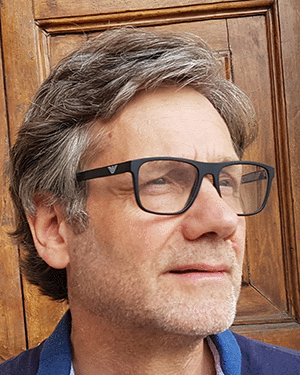 Michael A. Ainslie合作论文数Sonar Department, TNO7g k olsen合作论文数6b l andersson合作论文数6
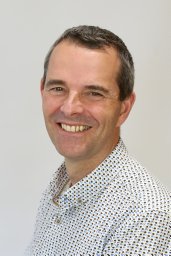 Frank Benders合作论文数Netherlands, Integrated Vehicle Safety Grp5lars abrahamsson合作论文数2Sven Ivansson合作论文数2
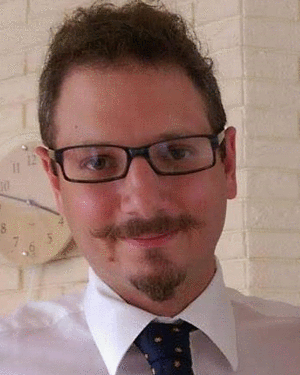 Mathieu Colin合作论文数1Fattaccioli, D.合作论文数1
 Cornel Ioana合作论文数University of Montenegro1Maciej Lopatka合作论文数1Grégoire Le Touzé合作论文数1
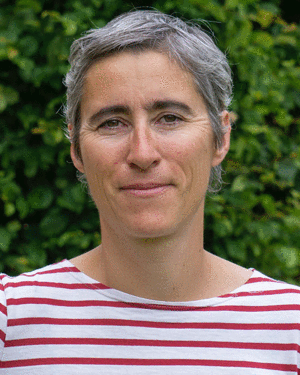 Barbara Nicolas合作论文数GIPSA-Lab/DIS, CNRS1




