This paper presents a Bayesian framework for inferring the posterior of the augmented state of a target, incorporating its underlying goal or intent, such as any intermediate waypoints and/or the final destination. Thus, it is for joint object tracking and intent recognition. Several latent intent models are proposed here within a virtual leader formulation. They capture the influence of the target's hidden goal on its instantaneous behaviour. In this context, various motion models, including for highly maneuvering objects, are also considered. The a priori unknown target intent (e.g. destination) can dynamically change over time and take any value within the state space (e.g. a location or spatial region). A sequential Monte Carlo ( particle filtering) approach is introduced for the simultaneous estimation of the target's (kinematic) state and its intent. Rao-Blackwellisation is employed to enhance the statistical performance of the inference routine. Simulated data and real radar measurements are used to demonstrate the efficacy of the proposed techniques.
In applications such as tracking and localisation, a dynamical model is typically specified for the modelling of an object's motion. An appealing alternative to the traditional parametric Markovian dynamical models is the Gaussian Process (GP). GPs can offer additional flexibility and represent non-Markovian, long-term, dependencies in the target's kinematics. However, a standard GP with constant or zero mean is prone to oscillating around its mean and not sufficiently exploring the state space. In this paper, we consider extensions of the common GP framework such that a GP acts as the driving disturbance term that is integrated over time to produce a new Integrated GP (iGP) dynamical model. It potentially provides a more realistic modelling of agile objects' behaviour. We prove here that the introduced iGP model is, itself, a GP with a non-stationary kernel, which we derive fully in the case of the squared exponential GP kernel. Thus, the iGP is straightforward to implement, with the usual growth over time of the computational burden. We further show how to implement the model with fixed time complexity in a standard sequential Bayesian updating framework using Kalman filter-based computations, employing a sliding window Markovian approximation. Example results from real radar measurements and synthetic data are presented to demonstrate the ability of the proposed iGP modelling to facilitate more accurate tracking compared to conventional GP.
This paper presents a computationally efficient multi-object tracking approach that can minimise track breaks (e.g., in challenging environments and against agile targets), learn the measurement model parameters on-line (e.g., in dynamically changing scenes) and infer the class of the tracked objects, if joint tracking and kinematic behaviour classification is sought. It capitalises on the flexibilities offered by the integrated Gaussian process as a motion model and the convenient statistical properties of non-homogeneous Poisson processes as a suitable observation model. This can be combined with the proposed effective track revival / stitching mechanism. We accordingly introduce the two robust and adaptive trackers, Gaussian and Poisson Process with Classification (GaPP-Class) and GaPP with Revival and Classification (GaPP-ReaCtion). They employ an appropriate particle filtering inference scheme that efficiently integrates track management and hyperparameter learning (including the object class, if relevant). GaPP-ReaCtion extends GaPP-Class with the addition of a Markov Chain Monte Carlo kernel applied to each particle permitting track revival and stitching (e.g., within a few time steps after deleting a trajectory). Performance evaluation and benchmarking using synthetic and real data show that GaPP-Class and GaPP-ReaCtion outperform other state-of-the-art tracking algorithms. For example, GaPP-ReaCtion significantly reduces track breaks (e.g., by around 30
In this article, a simple, yet effective, Bayesian scheme for tracks maintenance, promotion, and deletion in drone surveillance radar is presented. It enables the simultaneous tracking of the target body and micro-Doppler components that originate from the motion of rotors (if any) onboard an unmanned air system. This not only delivers more accurate multi-target tracking, but also substantially improves the radar automatic target classification capability (e.g. discriminating between drone and non-drone targets). Challenging and diverse real staring radar datasets are used here to demonstrate the efficacy and benefits of the proposed track management approach.
This paper proposes a reversible jump Markov chain Monte Carlo method that provides efficient inference for the general problem of pulse fitting. In particular, it minimises the potential of an adopted parametric model overfitting to the (noisy) data via the inclusion of a peak proximity parameter. This facilitates learning a more representative underlying model and significantly reduces the computational cost. Synthetic and real data are used to demonstrate the efficacy of the introduced Bayesian technique.
Automatic target classification or recognition is a critical capability in non-cooperative surveillance with radar in several defence and civilian applications. It is a well-established research field and numerous techniques exist for recognising targets, including miniature unmanned air systems or drones (i.e., small, mini, micro and nano platforms), from their radar signatures. These algorithms have notably benefited from advances in machine learning (e.g., deep neural networks) and are increasingly able to achieve remarkably high accuracy. Such classification results are often captured by standard, generic, object recognition metrics and originate from testing on simulated or real radar measurements of drones under high signal to noise ratios. Hence, it is difficult to assess and benchmark the performance of different classifiers under realistic operational conditions. In this paper, we first review the key challenges and considerations associated with the automatic classification of miniature drones from radar data. We then present a set of important performance measures, from an end-user perspective. These are relevant to typical drone surveillance system requirements and constraints. Selected examples from real radar observations are shown for illustration. We also outline here various emerging approaches and future directions that can produce more robust drone classifiers for radar.
Monitoring drivers' mental workload facilitates initiating and maintaining safe interactions with in-vehicle information systems, and thus crucial for delivering adaptive human machine interaction solutions with reduced impact on the primary task of driving. In this article, we tackle the problem of workload estimation from driving performance data. First, we present a novel on-road study for collecting subjective workload data via a modified peripheral detection task in naturalistic settings. Key environmental factors that induce a high mental workload are identified via video analysis, e.g. junctions and behaviour of vehicle in front. Second, a supervised learning framework using state-of-the-art time series classifiers (e.g. convolutional neural network and transform techniques) is introduced to profile drivers based on the average workload they experience during a journey. A Bayesian filtering approach is then proposed for sequentially estimating, in (near) real-time, the driver's instantaneous workload. This computationally efficient and flexible method can be easily personalised to a driver (e.g. incorporate their inferred average workload profile), adapted to driving/environmental contexts (e.g. road type) and extended with data streams from new sources. The efficacy of the presented profiling and instantaneous workload estimation approaches are demonstrated using the on-road study data, showing F-1 scores of up to 92% and 81%, respectively.
This paper presents a Bayesian framework for inferring the posterior of the extended state of a target, incorporating its underlying goal or intent, such as any intermediate waypoints and/or final destination. The methodology is thus for joint tracking and intent recognition. Several novel latent intent models are proposed here within a virtual leader formulation. They capture the influence of the target's hidden goal on its instantaneous behaviour. In this context, various motion models, including for highly maneuvering objects, are also considered. The a priori unknown target intent (e.g. destination) can dynamically change over time and take any value within the state space (e.g. a location or spatial region). A sequential Monte Carlo (particle filtering) approach is introduced for the simultaneous estimation of the target's (kinematic) state and its intent. Rao-Blackwellisation is employed to enhance the statistical performance of the inference routine. Simulated data and real radar measurements are used to demonstrate the efficacy of the proposed techniques.
This paper presents an experimental study on tracking a small drone target with a high resolution camera and a staring radar. The objective is to assess the benefits of fusing the outputs of both sensors using real data collected during live drone trials. We examine the impact of losing the signal from one sensor, which often occurs in practice for various reasons such as occlusions, high background noise-clutter, target sharp maneuvers, etc. We demonstrate that fusion with filtering, namely employing interacting multiple models with unscented Kalman filter in modified spherical coordinates or a simple extended Kalman filter, can deliver improved overall target tracking performance under such degraded sensing conditions.
Multi-target tracking of agile targets can be limited by choice of dynamical models. This is typically overcome by using sophisticated non-Gaussian and/or nonlinear motion models, and complex data association schemes. Here we aim to tackle scenarios when tracking (semi-)autonomous systems, such as drones, which often follow smooth optimised trajectories and undertake rapid manoeuvres when needed. This paper introduces a novel, flexible, multi-target tracking approach based upon a Gaussian process as a dynamical model, coupled with a non-homogeneous Poisson process for the observation model. It applies a particle filtering inference method for state estimation (including data association) and online parameter learning. The promising performance of the proposed technique is demonstrated on both synthetic data and real drone surveillance radar measurements, compared with a selection of more standard approaches.
A key challenge for multi-target trackers is being able to track both agile and simply moving targets effectively. This is only furthered by the standard difficulties of automated track initiation and deletion. This paper proposes a solution to this, where unknown associations and track management are handled by a Dirichlet process prior, and Gaussian processes model the dynamics of the targets. The promising performance of the proposed tracker is demonstrated on both synthetic and real radar data against a selection of other methods.
In this paper, we present a study on adapting a radar multi-target tracker using neural networks to enhance its performance against agile, maneuvering, targets such as drones. In particular, a network dynamically adjusts the process noise of the target motion model based on the normalised filtering innovations. Different neural networks are evaluated for this task, namely fully connected, recurrent and convolutional networks. They are trained on representative simulated data, including waypoint-driven trajectories which are common with (semi-) autonomous systems, e.g. small unmanned air systems. Results from synthetic radar data demonstrate the potential benefits of adapting a multi-target tracker with a low-complexity recurrent neural network, albeit the modest improvements it achieves.
In order to be effective, radar drone surveillance systems need to be able to discriminate between birds and drones. In this work, convolutional neural networks (CNNs) are used to distinguish between bird and drone spectrograms, where the classifier is tested on real, low signal to background ratio (SBR) data obtained using an L-band staring radar. This allows for a better understanding of the classifier's ability to generalise against new models of drone and new clutter environments. This work highlights the importance of SBR for drone surveillance, placing limits on the size of drone that can be reliably classified, as well as range from the radar.
In this paper, we apply an efficient Convolutional Neural Network (CNN) to radar data to estimate physical parameters of a drone target, specifically, its rotor flash rate. It uses Doppler spectra from a short dwell on the target, supporting high update rates with minimal latency. To avoid the risk of overfitting, the regression CNN is trained exclusively on synthetic data from a simple radar signal generator. Measurements from multiple drone types, captured with a Thales Aveillant Gamekeeper radar, are used to demonstrate useful performance, showing an ability to generalise to previously unseen drone types.
In non-cooperative radar surveillance, identifying moving parts, such as rotors or propellers, on a target can not only provide strong cues for automatic classification (e.g. drone versus bird), but also improve the quality of its tracking results (e.g. by appropriately processing detections originating from propellers). In this paper, we present a simple Bayesian approach, termed Probability of Tracking (PoT), that facilitates the simultaneous tracking of a target body and micro-Doppler components arising from the motion of any on-board rotors. It is based on a Markov chain model and utilises the concept of Doppler component recognition. PoT is an additional mechanism applied in conjunction with an existing (legacy) radar multi-target tracker. It postulates the problem of sequentially inferring the track type (i.e. a target body or micro-Doppler component) and status (including promotion and maintenance or deletion) as a multiple hypothesis testing task. This leads to a low-complexity recursive filtering routine. Challenging real measurements from Aveillant Gamekeeper radar are used to demonstrate the benefits of the introduced PoT in the context of counter drone applications, for example it reduces track breaks and false alarms by over 30%.
In this paper, we present an efficient Convolutional Neural Network (CNN) classifier for discriminating between drone and non-drone targets from L-band staring radar data. It supports a high recognition update rate from short-dwells on the target, with minimal latency. Evaluation using real measurements from the Aveillant Gamekeeper radar demonstrates that the introduced classifier delivers high recognition accuracy when trained on real data. It also shows that the short-dwell CNN achieves reasonable classification performance when exclusively trained on synthetic data from a simple radar signal simulator, and so offers capability against previously unseen drone types.
This paper focuses on the need for good target recognition in order to provide effective tracking and on good tracking to provide effective recognition in the application of radar to drone surveillance. The joint function, merging drone tracking and recognition, referred to as Simultaneous Tracking and Recognition (STaR) of drones is discussed and the benefits are presented through examples. This includes real measurements from Aveillant's Gamekeeper Radar.
In this paper, a Bayesian approach is proposed for the early detection of a drone threatening or anomalous behaviour in a surveyed region. This is in relation to revealing, as early as possible, the drone intent to either leave a geographical area where it is authorised to fly (e.g. to conduct inspection work) or reach a prohibited zone (e.g. runway protection zones at airports or a critical infrastructure site). The inference here is based on the noisy sensory observations of the target state from a non-cooperative surveillance system such as a radar. Data from Aveillant’s Gamekeeper radar from a live drone trial is used to illustrate the efficacy of the introduced approach.
The nine papers in this special section focus on meta-level and adversarial tracking. A plethora of well-established tracking algorithms aim to estimate, over time, the latent kinematic state (e.g., position, velocity, higher order kinematics, or any other spatiotemporal characteristic) of a single or multiple targets based on the available sensory observations, including from several sources. Here, we refer to such techniques as sensor-level trackers. Meta-level and adversarial tracking presents a shift away from the traditional viewpoint of a scene where objects move independently of one another in an unpremeditated manner and without regard to possible competition or group structures, toward an integrated viewpoint where intents, anomalies, group interactions, and characteristics of competitors/adversaries can be automatically learned. This also enables more accurate state estimation by capitalizing on inferred meta-level information. The papers included here showcase a diverse set of recent relevant technical developments and applications. It comprises of nine selected articles, drawing on recent advances in stochastic modeling, computational methods, statistical filtering, sensing systems, and others.
In this paper, several performance metrics are proposed for staring radar to provide figures of merit that effectively capture the overall capability of a non-cooperative drone surveillance system. Such figures of merit can offer more meaningful system performance measures to the end user by combining aspects such as track quality combined with target classification. This is contrary to relying only on standard classifier performance metrics such as a confusion matrix. Example results are presented here using real radar data.
 Simon Godsill合作论文数Information Engineering Division, Department of Engineering, University of Cambridge43
 Patrick Langdon合作论文数23
 Andrzej Tarczynski合作论文数Department of Electronics, Communications and Software Engineering, University of Westminster19
 Lee Skrypchuk合作论文数11
 Robert Hardy合作论文数9
 Jiaming Liang合作论文数8
 Mustafa Al-Ani合作论文数8
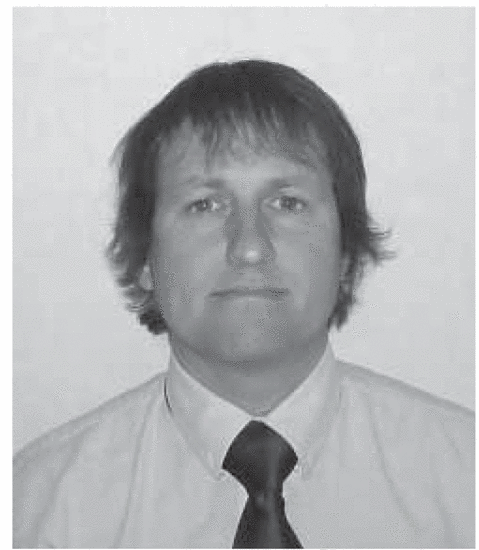 Stephen Harman合作论文数6
 Jahangir, M.合作论文数6James K. Murphy合作论文数4
 Runze Gan合作论文数4
 Pat Langdon合作论文数Transport Research Institute, School of Computing Engineering and the Built Environment, Edinburgh Napier University4Fred Goodyer合作论文数3
 James Murphy合作论文数3
 Thomas Popham合作论文数School of Engineering, Faculty of Science, Engineering and Medicine, The University of Warwick3
 Chris Baker合作论文数Department of Electronic, Electrical and Systems Engineering, School of Engineering, University of Birmingham3
 Cong Ling (凌聪)合作论文数Communications and Signal Processing Group, Department of Electrical and Electronic Engineering, Faculty of Engineering, Imperial College London3Holly Dale合作论文数2
 Richard Arhin-Donkor合作论文数2Mike Newman合作论文数2Briana Lindsay合作论文数2Arber Shabani合作论文数2
 Chrisminder Hare合作论文数2
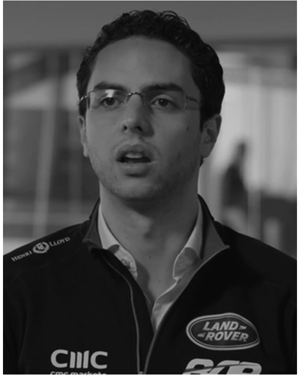 Mauricio Delgado合作论文数2
 Tohid Ardeshiri合作论文数Linköpings Universitet2
 Michail Antoniou合作论文数Microwave Integrated Systems Laboratory, Department of Electronic, Electrical and Systems Engineering, School of Engineering, University of Birmingham2Wei Dai合作论文数2
 Francesco Fioranelli合作论文数Department of Microelectronics, Faculty of Electrical Engineering, Mathematics and Computer Science, Delft University of Technology2
 A. Eduardo Dias合作论文数bViva International, Universidade Nova de Lisboa2Cameron Bennett合作论文数1
 Alexandra Bremers合作论文数1
 Nermin Caber合作论文数1Maxence de Rochechouart合作论文数1Hongjian Sun合作论文数1
 David Oxtoby合作论文数Jaguar Land Rover Ltd, Coventry CV3 4LF, W Midlands, England1
 Vikram Krishnamurthy合作论文数Department of Electrical and Computer Engineering, College of Engineering, Cornell University1
 J. Chris Baker合作论文数School of Engineering, University of Birmingham1
 Peter Willett合作论文数Department of Electrical and Computer Engineering, School of Engineering, University of Connecticut1
 Muralidhar Rangaswamy合作论文数Air Force Research Laboratory Sensors Directorate1Amal Fallah Seghrouchni合作论文数LIP6 laboratory;University Paris VI1
 Jacqueline Christmas合作论文数School of Engineering, Computing and Mathematics, University of Exeter1
 Pete Bunch合作论文数Signal Processing and Communications Laboratory, University of Cambridge1
 Frédéric Barbaresco合作论文数Thales Group1
 Arumugam Nallanathan合作论文数Centre for Networks, Communications and Systems, School of Electronic Engineering and Computer Science, Faculty of Science and Engineering, Queen Mary University of London1
 Karim Helwani合作论文数Telekom Innovation Laboratories, Technische Universität Berlin1
 Julien Le Kernec合作论文数1Marc Ihle合作论文数1
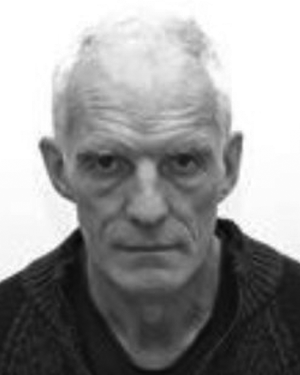 Michael R. Belmont合作论文数1
 Raed Abu Zitar合作论文数College of Information Technology, Philadelphia University1




