Many signal estimation problems allow for a delay in producing the estimates. Such smoothed estimates offer improved accuracy, though their solutions are less established than those of filtering. This paper introduces new simulation-based methods for fixed-lag and fixed-point smoothing in general state space models. The methods are broadly applicable and can be implemented when forward simulation of the model is feasible. Most of the computations can be performed offline, which makes the approach suitable for real-time applications, while a univariate treatment of the state vector enables its use in high-dimensional problems. The proposed methods are illustrated through simulation examples in linear, nonlinear, and non-Gaussian models.
In this paper, we introduce dynamical models based on Stochastic Differential Equations (SDE)s driven by additive processes. Additive processes are intuitively obtained as time-varying versions of Lévy processes, and we adopt this formalism to model properties that may change over time, for example the skewness of the process. While the framework is quite general, we take an $\alpha$-stable process with time-varying skew as a concrete example, demonstrating the effect of time-varying skew on the expected direction of motion of an object. The framework is constructed based on a generalised shot-noise representation of an additive process. We show how to perform joint inference about states and skew of the model, based on a marginalised particle filter framework. Finally, performance is demonstrated on both simulated and real data and improved performance is observed compared with competitor models.
Lévy processes, known for their ability to model complex dynamics with skewness, heavy tails, and discontinuities, play a critical role in stochastic modeling across various domains. However, inference for most Lévy processes, whether in parametric or non-parametric settings, remains a significant challenge. In this work, we present a novel Bayesian non-parametric inference framework for inferring the Lévy measures of subordinators and normal variance-mean (NVM) processes within a linear state space model. A flexible random measure, the Independent Gamma-scaled Dirichlet Process (IGSDP), is introduced, for which the well-known Gamma process is a special case, leading to tractable conditional distributions for inference about both Lévy measures. We further show that in the Gamma process special case, conjugacy can be achieved for hyper-parameter inference. An explicit characterization of the parameter contour for NVM processes is provided, enabling an identifiable parameterization of the model for effective Markov Chain Monte Carlo algorithms in posterior inference. The method is demonstrated on both synthetic and tick-level (high-frequency) financial datasets.
In applications such as tracking and localisation, a dynamical model is typically specified for the modelling of an object's motion. An appealing alternative to the traditional parametric Markovian dynamical models is the Gaussian Process (GP). GPs can offer additional flexibility and represent non-Markovian, long-term, dependencies in the target's kinematics. However, a standard GP with constant or zero mean is prone to oscillating around its mean and not sufficiently exploring the state space. In this paper, we consider extensions of the common GP framework such that a GP acts as the driving disturbance term that is integrated over time to produce a new Integrated GP (iGP) dynamical model. It potentially provides a more realistic modelling of agile objects' behaviour. We prove here that the introduced iGP model is, itself, a GP with a non-stationary kernel, which we derive fully in the case of the squared exponential GP kernel. Thus, the iGP is straightforward to implement, with the usual growth over time of the computational burden. We further show how to implement the model with fixed time complexity in a standard sequential Bayesian updating framework using Kalman filter-based computations, employing a sliding window Markovian approximation. Example results from real radar measurements and synthetic data are presented to demonstrate the ability of the proposed iGP modelling to facilitate more accurate tracking compared to conventional GP.
Kalman filtering is widely used for object tracking applications but often relies on predefined motion models, which limits its adaptability to nonlinear or uncertain trajectories. Formulating a Gaussian Process (GP) as a linear Gaussian state-space model provides a data-driven alternative for efficient sequential inference within a Kalman filtering framework. This paper extends the Integrated GP (iGP) model to introduce three novel variants: the Twice-Integrated GP (iiGP), the Dynamics-Informed Integrated GP (iDGP), and the Dynamics-Informed Twice-Integrated GP (iiDGP). The dynamics-informed models incorporate system dynamics alongside data-driven modelling, enabling more accurate tracking of motion under uncertain environments. The twice-integrated models enforce smoother motion patterns while maintaining the flexibility of GPs as driving noise. These models are implemented in the Stone Soup tracking framework. We discuss the software design, implementation challenges, and present evaluation results on synthetic and insect motion trajectory data. Results highlight the benefits of incorpo-rating dynamical information in GP-based tracking models, as well as the trade-offs between adaptability and robustness.
Levy state-space models (SSMs) are a class of Bayesian models exhibiting heavy-tailed dynamics, particularly suited to systems with extreme values and abrupt changes. A broad family of Levy SSMs that admit a linear-Gaussian conditional sub-model can be filtered using the Rao-Blackwellized particle filter (RBPF). In this work, we implement an efficient form of particle MCMC, taking advantage of end-to-end GPU acceleration and the special structure of the Levy SSM, to permit inference in a practical time frame. We benchmark the performance of our implementation against a comparable CPU implementation, as well as existing comparable software packages, before showcasing our inference methods on a financial time series example, performing efficient joint inference on the SSM parameters alongside a novel Bayesian nonparametric estimate of the driving Levy measure.
Existing trackers based on Poisson measurement process often struggle with efficiency and accuracy in large-scale tracking under heavy clutter. To overcome this, we introduce PiVoT, a scalable, robust multi-object tracker capable of efficiently detecting and tracking a large, varying number of objects, along with their shapes, existence probabilities, and measurement rates, even in heavy clutter. PiVoT employs a novel two-stage variational inference routine to achieve inference tractability and closed-form, parallelisable updates. Efficiency is further enhanced by early identification and removal of ineffective birth objects and designing highly simplified, much faster, yet equivalent variational updates. Additionally, PiVoT inherently offers efficient clutter-robust clustering, an innovation that can also enhance existing trackers that depend on supplementary clustering techniques. Experiments demonstrate PiVoT's clear accuracy and efficiency gains over existing methods, while also highlighting its ability to track a thousand closely spaced objects in under a second on a standard laptop without gating.
This paper tackles the challenge of multi-sensor multi-object tracking by proposing various decentralised Variational Inference (VI) schemes that match the tracking performance of centralised sensor fusion with only local message exchanges among neighboring sensors. We first establish a centralised VI sensor fusion scheme as a benchmark and analyse the limitations of its decentralised counterpart, which requires sensors to await consensus at each VI iteration. Therefore, we propose a decentralised gradient-based VI framework that optimises the Locally Maximised Evidence Lower Bound (LM-ELBO) instead of the standard ELBO, which reduces the parameter search space and enables faster convergence, making it particularly beneficial for decentralised tracking. This proposed framework is inherently self-evolving, improving with advances in decentralised optimisation techniques for convergence guarantees and efficiency. Further, we enhance the convergence speed of proposed decentralised schemes using natural gradients and gradient tracking strategies. Results verify that our decentralised VI schemes are empirically equivalent to centralised fusion in tracking performance. Notably, the decentralised natural gradient VI method is the most communication-efficient, with communication costs comparable to suboptimal decentralised strategies while delivering notably higher tracking accuracy.
This paper presents a computationally efficient multi-object tracking approach that can minimise track breaks (e.g., in challenging environments and against agile targets), learn the measurement model parameters on-line (e.g., in dynamically changing scenes) and infer the class of the tracked objects, if joint tracking and kinematic behaviour classification is sought. It capitalises on the flexibilities offered by the integrated Gaussian process as a motion model and the convenient statistical properties of non-homogeneous Poisson processes as a suitable observation model. This can be combined with the proposed effective track revival / stitching mechanism. We accordingly introduce the two robust and adaptive trackers, Gaussian and Poisson Process with Classification (GaPP-Class) and GaPP with Revival and Classification (GaPP-ReaCtion). They employ an appropriate particle filtering inference scheme that efficiently integrates track management and hyperparameter learning (including the object class, if relevant). GaPP-ReaCtion extends GaPP-Class with the addition of a Markov Chain Monte Carlo kernel applied to each particle permitting track revival and stitching (e.g., within a few time steps after deleting a trajectory). Performance evaluation and benchmarking using synthetic and real data show that GaPP-Class and GaPP-ReaCtion outperform other state-of-the-art tracking algorithms. For example, GaPP-ReaCtion significantly reduces track breaks (e.g., by around 30
Probabilistic dynamical models used in applications in tracking and prediction are typically assumed to be Gaussian noise driven motions since well-known inference algorithms can be applied to these models. However, in many real world examples deviations from Gaussianity are expected to appear, e.g., rapid changes in speed or direction, which cannot be reflected using processes with a smooth mean response. In this work, we introduce the non-Gaussian process (NGP) dynamical model which allow for straightforward modelling of heavy-tailed, non-Gaussian behaviours while retaining a tractable conditional Gaussian process (GP) structure through an infinite mixture of non-homogeneous GPs representation. We present two novel inference methodologies for these new models based on the conditionally Gaussian formulation of NGPs which are suitable for both MCMC and marginalised particle filtering algorithms. The results are demonstrated on synthetically generated data sets.
This paper investigates the task of tracking multiple objects in clutter under a distributed multi-sensor network with time-varying connectivity. Designed with the same objective as the centralised variational multi-object tracker, the proposed method achieves optimal decentralised fusion in performance with local processing and communication with only neighboring sensors. A key innovation is the decentralised construction of a locally maximised evidence lower bound, which greatly reduces the information required for communication. Our decentralised natural gradient descent variational multi-object tracker, enhanced with the gradient tracking strategy and natural gradients that adjusts the direction of traditional gradients to the steepest, shows rapid convergence. Our results verify that the proposed method is empirically equivalent to the centralised fusion in tracking accuracy, surpasses suboptimal fusion techniques with comparable costs, and achieves much lower communication overhead than the consensus-based variational multi-object tracker.
The non-homogeneous Poisson process (NHPP) is a widely used measurement model that allows for an object to generate multiple measurements over time. However, it can be difficult to efficiently and reliably track multiple objects under this NHPP model in scenarios with a high density of closely-spaced objects and heavy clutter. Therefore, based on the general coordinate ascent variational filtering framework, this paper presents a variational Bayes association-based NHPP tracker (VB-AbNHPP) that can efficiently perform tracking, data association, and learning of target and clutter rates with a parallelisable implementation. In addition, a variational localisation strategy is proposed, which enables rapid rediscovery of missed targets from a large surveillance area under extremely heavy clutter. This strategy is integrated into the VB-AbNHPP tracker, resulting in a robust methodology that can automatically detect and recover from track loss. This tracker demonstrates improved tracking performance compared with existing trackers in challenging scenarios, in terms of both accuracy and efficiency.
This paper presents an adaptive approach to real-time multi-object localisation in addition to Siteswap inference, and performance evaluation metrics for juggling routines, employing a proposed bimodal machine learning-enhanced state-space model implementation. Considering the complex multi-modal characteristics exhibited by objects during performances, the paper introduces a bespoke Interacting Multiple Model (IMM) component for increased Siteswap beat detection accuracy and gravitational acceleration inference, and a scheme for causal Siteswap inference derived through machine learning-enhanced IMM mode outputs. The algorithm effectively models the transitory behaviour of the system, enabling rapid and smooth transitions between the two discrete tracking cases (airborne, and caught) and accurate Siteswap inference under a variety of camera and environmental conditions. The employment of beat tracking algorithms that exploit optimal compromises in time domain onset detection functions and Tempograms, enables effective error correction of Siteswap detections, in addition to providing performance analysis and visualisation utilities. Experimentally, the algorithm is capable of object tracking and Siteswap inference with up to 11 objects for a variety of challenging Siteswaps and conditions, serving as a versatile performance analysis, evaluation, and visualisation utility.
In this paper we introduce tracking models based on non-Gaussian continuous time stochastic processes with time-varying skewness. The idea behind this is that the skewness of the dynamical model may be able to model a propensity for an object to undergo manoeuvres of a particular type, for example velocities tending in a particular direction, but that these may change over time. This process is constructed based on a random series representation of conditionally Gaussian Levy processes, which enables straightforward simulation of the models. We demonstrate the specific example of alpha-stable processes and find that such processes can capture abrupt changes owing to their heavy-tailed behaviour, and demonstrate the random changes in direction caused by the time-changing skewness of the distribution. We propose methods for joint tracking of both states and skewness for such processes, based on a marginalised particle filter, which are demonstrated to perform well even with limited numbers of particles.
In recent years, state-space models for highly manoeuvrable objects have been proposed based on non-Gaussian, continuous time, jump-based Levy processes, the so-called Levy state-space model [1]-[4]. In these models, the standard Brownian motion driving process for continuous time processes is replaced with a heavy-tailed non-Gaussian alternative. This retains all the flexibility of its Gaussian counterpart in terms of possible dynamical model structures and operations with irregular time stamps or heterogeneous data sources. These models aim to operate in areas such as surveillance of irregularly moving drones or people, and tracking wildlife or biological data. Implementation is relatively straightforward since the Kalman filters of the Brownian motion case can be replaced in the non-Gaussian case by mixtures of Kalman filters within a marginalised particle filtering framework [5]. While the Stone Soup tracking software environment includes both Kalman filtering and generic particle filtering, it does not currently allow the combination of these tasks within a marginalised particle filtering framework. We discuss the significant challenges involved in incorporating these models and algorithms into Stone Soup, and present initial simulation results for the new software.
This paper proposes a reversible jump Markov chain Monte Carlo method that provides efficient inference for the general problem of pulse fitting. In particular, it minimises the potential of an adopted parametric model overfitting to the (noisy) data via the inclusion of a peak proximity parameter. This facilitates learning a more representative underlying model and significantly reduces the computational cost. Synthetic and real data are used to demonstrate the efficacy of the introduced Bayesian technique.
In this article, a simple, yet effective, Bayesian scheme for tracks maintenance, promotion, and deletion in drone surveillance radar is presented. It enables the simultaneous tracking of the target body and micro-Doppler components that originate from the motion of rotors (if any) onboard an unmanned air system. This not only delivers more accurate multi-target tracking, but also substantially improves the radar automatic target classification capability (e.g. discriminating between drone and non-drone targets). Challenging and diverse real staring radar datasets are used here to demonstrate the efficacy and benefits of the proposed track management approach.
We consider the problem of obtaining effective representations for the solutions of linear, vector-valued stochastic differential equations (SDEs) driven by non-Gaussian pure-jump Lévy processes, and we show how such representations lead to efficient simulation methods. The processes considered constitute a broad class of models that find application across the physical and biological sciences, mathematics, finance, and engineering. Motivated by important relevant problems in statistical inference, we derive new, generalised shot-noise simulation methods whenever a normal variance-mean (NVM) mixture representation exists for the driving Lévy process, including the generalised hyperbolic, normal-gamma, and normal tempered stable cases. Simple, explicit conditions are identified for the convergence of the residual of a truncated shot-noise representation to a Brownian motion in the case of the pure Lévy process, and to a Brownian-driven SDE in the case of the Lévy-driven SDE. These results provide Gaussian approximations to the small jumps of the process under the NVM representation. The resulting representations are of particular importance in state inference and parameter estimation for Lévy-driven SDE models, since the resulting conditionally Gaussian structures can be readily incorporated into latent variable inference methods such as Markov chain Monte Carlo, expectation-maximisation, and sequential Monte Carlo.
In this work we study linear vector stochastic differential equation (SDE) models driven by the generalised hyperbolic (GH) Lévy process for inference in continuous-time non-Gaussian filtering problems. The GH family of stochastic processes offers a flexible framework for modelling of non-Gaussian, heavy-tailed characteristics and includes the normal inverse-Gaussian, variance-gamma and Student-t processes as special cases. We present continuous-time simulation methods for the solution of vector SDE models driven by GH processes and novel inference methodologies using a variant of sequential Markov chain Monte Carlo (MCMC). As an example a particular formulation of Langevin dynamics is studied within this framework. The model is applied to both a synthetically generated data set and a real-world financial series to demonstrate its capabilities.
Monitoring drivers' mental workload facilitates initiating and maintaining safe interactions with in-vehicle information systems, and thus crucial for delivering adaptive human machine interaction solutions with reduced impact on the primary task of driving. In this article, we tackle the problem of workload estimation from driving performance data. First, we present a novel on-road study for collecting subjective workload data via a modified peripheral detection task in naturalistic settings. Key environmental factors that induce a high mental workload are identified via video analysis, e.g. junctions and behaviour of vehicle in front. Second, a supervised learning framework using state-of-the-art time series classifiers (e.g. convolutional neural network and transform techniques) is introduced to profile drivers based on the average workload they experience during a journey. A Bayesian filtering approach is then proposed for sequentially estimating, in (near) real-time, the driver's instantaneous workload. This computationally efficient and flexible method can be easily personalised to a driver (e.g. incorporate their inferred average workload profile), adapted to driving/environmental contexts (e.g. road type) and extended with data streams from new sources. The efficacy of the presented profiling and instantaneous workload estimation approaches are demonstrated using the on-road study data, showing F-1 scores of up to 92% and 81%, respectively.
 Bashar I. Ahmad合作论文数Department of Engineering, University of Cambridge43
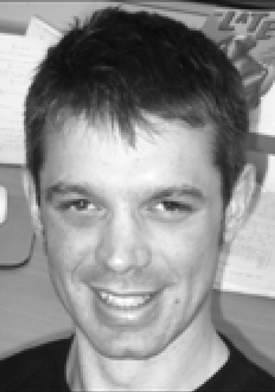 Jaco Vermaak合作论文数Department of Engineering;University of Cambridge28
 Patrick Langdon合作论文数24
 Patrick J. Wolfe合作论文数Purdue University;The Alan Turing Institute21
 Arnaud Doucet合作论文数DeepMind;Department of Statistics, University of Oxford19
 James Murphy合作论文数18
 Ali Taylan Cemgil合作论文数Department of Computer Engineering, Bogazici University17
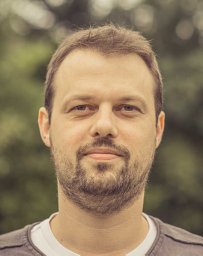 Francois Septier合作论文数Institut TELECOM/TELECOM Lille116
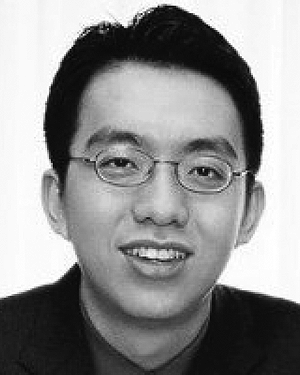 Sze Kim Pang合作论文数16
 Pete Bunch合作论文数Signal Processing and Communications Laboratory, University of Cambridge15
 Lyudmila Mihaylova合作论文数Department of Automatic Control and Systems Engineering, University of Sheffield15
 Runze Gan合作论文数14
 Christophe Andrieu合作论文数School of Mathematics, University of Bristol14
 Avishy Carmi合作论文数Faculty of Aerospace Engineering, Technion-Israel Institute of Technology14
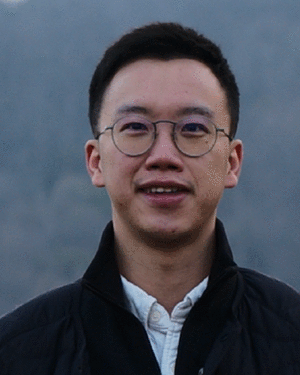 Jiaming Liang合作论文数13
 Peter Rayner合作论文数Division of Science, School of Geography, Earth and Atmospheric Sciences, The University of Melbourne13Rayner, P.J.W.合作论文数13
 Nick Whiteley合作论文数Sch Math, Univ Bristol13Qing Li (李青)合作论文数School of Computer Engineering and Science, Shanghai University12
 Jack Li合作论文数12
 Lee Skrypchuk合作论文数11
 William Ng合作论文数11
 Marina Riabiz合作论文数Department of Engineering Signal Processing and Communications SigProC Laboratory, University of Cambridge10
 Cédric Févotte合作论文数Institut de Recherche en Informatique de Toulouse10
 Paul Peeling合作论文数10
 Paul Thomas Troughton合作论文数9Robert Hardy合作论文数9
 Sumeetpal Sidhu Singh合作论文数Department of Engineering, University of Cambridge9
 Mahesan Niranjan合作论文数School of Electronics and Computer Science, University of Southampton;Southampton Biomedical Research Centre, National Institute for Health and Care Research8
 Yaman Kındap合作论文数University of Cambridge7
 Tohid Ardeshiri合作论文数Linköpings Universitet7
 Petar M. Djuric合作论文数Department of Electrical and Computer Engineering, College of Engineering and Applied Sciences, Stony Brook University7
 Pat Langdon合作论文数Transport Research Institute, School of Computing Engineering and the Built Environment, Edinburgh Napier University6
 Simo Särkkä合作论文数Department of Electrical Engineering and Automation, School of Electrical Engineering, Aalto University;Helsinki Institute for Information Technology, Department of Computer Science, School of Science, Aalto University6
 Maurice Fallon合作论文数Department of Engineering Science, University of Oxford;Oxford Robotics Institute, University of Oxford6
 Herbert Buchner合作论文数Department of Engineering, University of Cambridge6M Davy合作论文数5James K. Murphy合作论文数5
 Hugh L. Christensen合作论文数Signal Proc & Commun Lab, Univ Cambridge5
 Mike West合作论文数Department of Statistical Science, Duke University5
 Daniel E. Clark合作论文数Institut Polytechnique de Paris, Telecom SudParis5
 Ercan Engin Kuruoğlu合作论文数Tsinghua Shenzhen International Graduate School5Tatjana Lemke合作论文数5
 Jean-Yves Tourneret合作论文数Institut de Recherche en Informatique de Toulouse, University of Toulouse5
 Ioannis Kontoyiannis合作论文数Statistical Laboratory, Department of Pure Mathematics and Mathematical Statistics, University of Cambridge5Li, J.合作论文数4paul walmsley合作论文数4
 Ji Won Yoon合作论文数Department of Cyber Defense, Korea University4




