Design For Assembly methods generally focus on the product design and rarely on the associated assembly line. This paper describes a methodology that can be used to design both the product and the associated assembly line. The proposed methodology is based on the observation that essential characteristics of an optimal design can be determined regardless of production conditions : the latter only introduce supplementary and specific constraints on the design.In a first step, performances of all the assembly operations are evaluated for different assembly methods (i. e: manual, robotized and automated). The results of this first analysis are an optimized product design and information for the assembly line design.A second step concentrates on the balance of the assembly line taking into account the required production volume. It appears that some adaptations of the product design may be necessary to improve a station occupation rate.The paper concludes with an example of the redesign of a mass produced machine.
Upper limb loss alters individuals’ private and professional life. Prosthetic devices are thus a solution to supply the missing upper limb segments. Nevertheless, commercial prostheses are often unaffordable, or inaccessible, to underprivileged individuals (e.g., no health insurance, low incomes, warzone). Among potential affordable alternatives, additive manufacturing, commonly “3D printing”, has been increasingly employed. This technology offers higher availability and accessibility, and can produce complex geometrical and highly customized products, which are essential features for prostheses manufacturing. Therefore, this study aims to portray an overview of reliable open-source upper limb 3D-printed prostheses currently available. We thus searched the scientific literature and online repositories hosting 3D-printable designs. We extracted data relative to mechanical and kinematic properties, 3D printing process and efficacy for each device. We found six studies implementing open-source 3DP upper limb prostheses and twenty-five open-source designs from online databases meeting selection criteria. Devices’ technical specifications were not systematically reported. In conclusion, though open-source 3D-printed upper limb prostheses can perform some functional tasks and grasps, and are widely employed to supply limb differences, further research is mandatory to validate their usage and to prove their clinical efficacy. More guidelines are required to unify contributions from private makers and non-governmental organizations with scientific groups.
To overcome the challenges of reconstructive microsurgery, a teleoperated robot called ASTEMA was built to help surgeons performing microanastomoses. The surgeons’ needs are first analyzed then the design steps are summarized. This robot is composed of three orthogonal linear actuators and a spherical wrist with its remote center of motion at the instrument tip. Geometric model of the spherical wrist was calibrated through mathematical optimization in order to compensate for imperfections of machining and assembling. Two preliminary experiments were carried out to assess the ASTEMA performance. The first was performed with a simple circular position trajectory. The second was a complex angular trajectory. Results show a significant improvement of gesture precision with respect to manual trajectory execution. They also show that subjects instinctively compensate the errors from the non-ideal wrist, thanks to visual feedback from microscope.
L’École Polytechnique de Louvain (EPL) propose depuis de nombreuses années une formation en présentiel pour les étudiants de master. Ils sont appelés les tuteurs et ils encadrent des étudiants de première année dans des enseignements de types : travaux pratiques, apprentissages par problèmes (APP), des projets, apprentissages par exercices (APE), des laboratoires. Une formation en ligne a été créée pour un public d’assistants-chercheurs aux rôles du tuteur. Cette formation hybride intitulée « Tutorer l’Apprentissage en Groupe (TAG) » vise à permettre aux assistants-chercheurs novices et expérimentés de se questionner sur leurs manières d’enseigner pour les améliorer. Nous analysons particulièrement ici les interventions des tuteurs qui encadrent la formation en ligne et leurs impacts pour l’apprentissage. Suite à l’analyse des interventions faites en ligne et en présentiel, et plus précisément en regardant les effets de ces interventions sur le plan métacognitif (réflexivité), nous constatons un besoin patent de la présence du tuteur humain de manière plus régulière au sein de la formation que nous proposons. Ce besoin se manifeste par un sentiment d’isolement de la part des assistants les premières semaines, du besoin de se sentir appartenir à un groupe, de connaître les réflexions des autres pour être motivés à apprendre, et ce, même si tous les assistants évoquent que la formation, de par son dispositif, permet très clairement de se questionner sur ses pratiques de tuteur de manière continue pour les améliorer.
Cet article propose de décrire la conception, le déroulé et l’évaluation de quatre modules de formation aux compétences transversales instaurés dans le cadre d’une réforme du programme de bachelier dans la Faculté des bioingénieurs de l’UCLouvain en réponse à deux enjeux facultaires : 1) intégrer les disciplines dans un contexte plus appliqué et 2) développer les compétences transversales des futurs bioingénieurs. Le scénario des modules prenait pour point d’ancrage la connaissance de soi et la conscience des différences interpersonnelles et visait un développement progressif des compétences de collaboration, d’organisation et de communication, en articulation directe à la réalisation d’un projet. Quarante-quatre équipes d’étudiants ont pris part au dispositif. Celui-ci a fait l’objet d’une évaluation quantitative (enquête) et qualitative (focus group). Les résultats intègrent des mesures de l’efficacité du groupe et des émotions vécues.
Cet atelier s’adresse aux participants qui souhaitent publier un texte a une revue en sciences de l’education. Chaque domaine ayant ses regles de redaction, il faut les connaitre et les comprendre afin d’esperer voir son article accepte par les evaluateurs de la revue. Cet atelier a pour but d’accompagner les participants qui souhaitent se familiariser avec la structure d’un article scientifique en education afin qu’ils puissent mieux repondre aux exigences des revues de ce domaine.
Plusieurs approches pedagogiques impliquent de faire travailler les apprenants en equipe pour atteindre certains objectifs. Par une mise en situation qui consiste a realiser, en equipe, une mission precise, l'atelier vise a permettre d'identifier, puis de s'approprier les fonctions, roles, responsabilites necessaires ou utiles pour obtenir un travail en equipe efficace. Un bilan critique de l'utilisation de ces fonctions sur le fonctionnement de l'equipe sera ensuite realise afin de tirer des conclusions de l'experience. L'atelier, d'une duree d'1h30, necessite entre 12 et 24 participants afin de faire travailler entre 2 et 4 equipes de 6 personnes maximum.
Transcatheter aortic valve implantation was introduced into clinical practice in 2002 as a rescue approach in patients presenting with symptomatic severe aortic stenosis but not eligible for conventional aortic valve replacement. This technique allows implantation of a balloon expandable bioprosthesis without resection of the native aortic valve. Several complications are described as a consequence of the residual highly calcified valve being squeezed against the aortic wall by the stent of the implant. This can result in deformation of the metal stent and paravalvular leakage, risk of occlusion of the coronary ostia, or central and peripheral embolization of valvular debris. To avoid these complications, many authors suggest the possibility to resect and remove the native aortic valve before transcatheter aortic valve implantation. In this field, different authors have described possible techniques and different sources of energy to resect the calcified valve. In this article, we review the development of these experimental techniques and discuss future prospects in this field.
Transcatheter aortic valve implantation was introduced into clinical practice in 2002 as a rescue approach in patients presenting with symptomatic severe aortic stenosis but not eligible for conventional aortic valve replacement. This technique allows implantation of a balloon expandable bioprosthesis without resection of the native aortic valve. Several complications are described as a consequence of the residual highly calcified valve being squeezed against the aortic wall by the stent of the implant. This can result in deformation of the metal stent and paravalvular leakage, risk of occlusion of the coronary ostia, or central and peripheral embolization of valvular debris. To avoid these complications, many authors suggest the possibility to resect and remove the native aortic valve before transcatheter aortic valve implantation. In this field, different authors have described possible techniques and different sources of energy to resect the calcified valve. In this article, we review the development of these experimental techniques and discuss future prospects in this field.
Most students enter their first university physics course with a system of beliefs and intuitions which are often inconsistent with the Newtonian frame of reference. This article presents an experiment of collaborative learning aiming at helping first-year students in an engineering programme to transition from their naive intuition about dynamics to the Newtonian way of thinking. In a first activity, students were asked to critically analyse the contents of two video clips from the point of view of Newtonian mechanics. In a second activity, students had to design and realise their own video clip to illustrate a given aspect of Newtonian mechanics. The preparation of the scenario for the second activity required looking up and assimilating scientific knowledge. The efficiency of the activity was assessed on an enhanced version of the statistical analysis method proposed by Hestenes and Halloun, which relies on a pre-test and a post-test to measure individual learning.
 Benoit Herman合作论文数26
 Olivier Smal合作论文数19cecile vander borght合作论文数18
 Pascale Wouters合作论文数17
 Christine Jacqmot合作论文数17
 Robert Puers合作论文数Departement Elektrotechniek, KU Leuven16
 Michael De Volder合作论文数Department of Engineering, University of Cambridge;St John’s College, University of Cambridge16delphine ducarme合作论文数15
 Bruno Dehez合作论文数Center for Res. in Energy & Mechatron. (CEREM),, Univ. catholique de Louvain (UCL),;c;Center for Res. in Energy & Mechatron. (CEREM),, Univ. catholique de Louvain15
 Dominiek Reynaerts合作论文数katholieke universiteit leuven15Jan Peirs合作论文数12
 Benoît Galand合作论文数Faculté de Psychologie;Université catholique de Louvain;Faculté de Psychologie, Université catholique de Louvain12
 Khanh Tran Duy合作论文数Cliniques Universitaires Saint-Luc, Université Catholique de Louvain12leticia warnier合作论文数11elie milgrom合作论文数11
 Mariane Frenay合作论文数Université Catholique de Louvain11J. C. Samin合作论文数10
 Olivier Cartiaux合作论文数CEREM (Center for Research in Mechatronics) 2, U.C.L. Université catholique de Louvain10Johan Coosemans合作论文数10
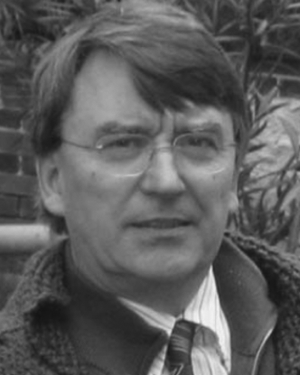 Piotr Sobieski合作论文数9L. Ferrière合作论文数9vincent croquet合作论文数8emmanuel dereine合作论文数8
 Xavier Bollen合作论文数8E. Aguirre合作论文数8
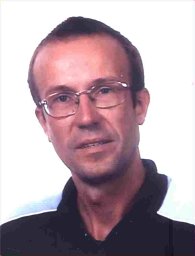 Paul Fisette合作论文数Center for Reasearch in Mechatronics, Université catholique de Louvain8Damien Grenier合作论文数8auguste laloux合作论文数7marietherese bouvy合作论文数7
 Raphael Olszewski合作论文数Cliniques Universitaires Saint Luc, Université Catholique de Louvain7
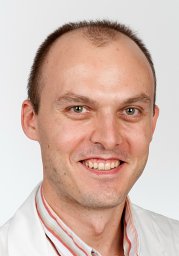 Pierre-Louis Docquier合作论文数Service de Chirurgie Orthopédique, Cliniques Universitaires Saint-Luc7
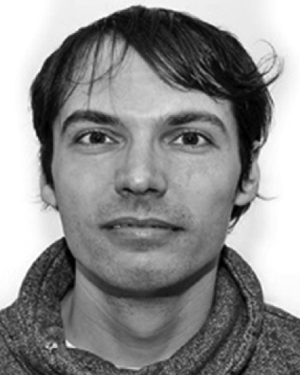 Frederik Ceyssens合作论文数ESAT-MICAS, Katholieke Universiteit Leuven7
 Alain Delchambre合作论文数Universite Libre de Bruxelles7Laurent Paul合作论文数Cliniques Universitaires Saint-Luc, Université catholique de Louvain7
 Caroline Verzat合作论文数Laboratoire de recherche en génie7O Smal合作论文数6patrick merken合作论文数6guy campion合作论文数6
 Hervé Reychler合作论文数Université Catholique de Louvain6
 Jean-Francois Debongnie合作论文数6
 Banse Xavier合作论文数Orthopaedic Research Laboratory, Université catholique de Louvain6genevieve moore合作论文数5Marie Noëlle DE THEUX合作论文数5
 Parla Astarci合作论文数Department of Thoracic and Cardiovascular Surgery, Saint-Luc Hospital5
 Etienne Dombre合作论文数CNRS 5
 Benoit Lengele合作论文数Université Catholique De Louvain;Department of Plastic, Reconstructive and Aesthetic Surgery, Saint-Luc University Clinics5Anne Hernandez合作论文数5
 Jérôme Szewczyk合作论文数Institut de Systèmes Intelligents et de Robotique, Université Pierre et Marie Curie - Paris 65Myriam Banaï合作论文数4




