Existing diffusion codecs typically build on text-to-image diffusion foundation models like Stable Diffusion. However, text conditioning is suboptimal from a compression perspective, hindering the potential of downstream diffusion codecs, particularly at ultra-low bitrates. To address it, we introduce \textbf{CoD}, the first \textbf{Co}mpression-oriented \textbf{D}iffusion foundation model, trained from scratch to enable end-to-end optimization of both compression and generation. CoD is not a fixed codec but a general foundation model designed for various diffusion-based codecs. It offers several advantages: \textbf{High compression efficiency}, replacing Stable Diffusion with CoD in downstream codecs like DiffC achieves SOTA results, especially at ultra-low bitrates (e.g., 0.0039 bpp); \textbf{Low-cost and reproducible training}, 300$\times$ faster training than Stable Diffusion ($\sim$ 20 vs. $\sim$ 6,250 A100 GPU days) on entirely open image-only datasets; \textbf{Providing new insights}, e.g., We find pixel-space diffusion can achieve VTM-level PSNR with high perceptual quality and can outperform GAN-based codecs using fewer parameters. We hope CoD lays the foundation for future diffusion codec research. Codes will be released.
Remote sensing images play a crucial and indispensable role in many fields such as environmental monitoring and geological disaster detection. With the advancement of satellite remote sensing acquisition technology, the remote sensing data shows explosive growth. However, the current communication bandwidth of the satellite-to-ground channel is difficult to meet the requirements for massive remote sensing data transmission. To this end, this paper proposes an elastic coding and decoding method for remote sensing image semantic transmission. The proposed transmission method includes a global-local feature extraction module, a key semantic feature selection module, a joint source channel coding module, a decoding module, and an analysis module. The global-local feature extraction module can effectively extract global context features and local detailed features via multi-directional mamba block and residual block, respectively. The key semantic feature selection module can elastically select key features according to channel state signal-to-noise ratios (SNRs). The joint source channel coding and decoding modules can further improve the transmission robustness via adding different types of channel conditions. The proposed method only needs to transmit key information in remote sensing images while discarding the redundant information, which significantly improves the transmission efficiency of remote sensing images. The extensive experimental results on the NWPU-RESISC45, UCMerced-LandUse, AID, and RSSCN7 datasets demonstrate that our method obtains higher transmission accuracies and transmission efficiency than state-of-the-art methods.
Recent advanced diffusion methods typically derive strong generative priors by scaling diffusion transformers. However, scaling fails to generalize when adapted for real-time compression scenarios that demand lightweight models. In this paper, we explore the design of real-time and lightweight diffusion codecs by addressing two pivotal questions. First, does diffusion pre-training benefit lightweight diffusion codecs? Through systematic analysis, we find that generation-oriented pre-training is less effective at small model scales whereas compression-oriented pre-training yields consistently better performance. Second, are transformers essential? We find that while global attention is crucial for standard generation, lightweight convolutions suffice for compression-oriented diffusion when paired with distillation. Guided by these findings, we establish a one-step lightweight convolution diffusion codec that achieves real-time 60 FPS encoding and 42 FPS decoding at 1080p. Further enhanced by distillation and adversarial learning, the proposed codec reduces bitrate by 85% at a comparable FID to MS-ILLM, bridging the gap between generative compression and practical real-time deployment. Codes are released at https://github.com/microsoft/GenCodec/CoD_Lite
GUI agents that interact with graphical interfaces on behalf of users are a promising direction for practical AI assistants, yet training them is hindered by scarce suitable environments. We present InfiniteWeb, a system that automatically generates functional web environments at scale for GUI agent training. While LLMs perform well on generating a single webpage, building a realistic and functional website with many interconnected pages faces challenges. We address these challenges through unified specification, task-centric test-driven development, and combining website seed variation with reference design images. Our system also generates verifiable task evaluators enabling dense reward signals for reinforcement learning. Experiments show that our system surpasses commercial coding agents at realistic website construction, and GUI agents trained on our generated environments achieve significant performance improvements on OSWorld and Online-Mind2Web, demonstrating the effectiveness of the proposed system.
The autoregressive video diffusion model has recently gained considerable research interest due to its causal modeling and iterative denoising. In this work, we identify that the multi-head self-attention in these models under-utilizes historical frames: approximately 25% heads attend almost exclusively to the current frame, and discarding their KV caches incurs only minor performance degradation. Building upon this, we propose Dummy Forcing, a simple yet effective method to control context accessibility across different heads. Specifically, the proposed heterogeneous memory allocation reduces head-wise context redundancy, accompanied by dynamic head programming to adaptively classify head types. Moreover, we develop a context packing technique to achieve more aggressive cache compression. Without additional training, our Dummy Forcing delivers up to 2.0x speedup over the baseline, supporting video generation at 24.3 FPS with less than 0.5% quality drop. Project page is available at https://csguoh.github.io/project/DummyForcing/.
While traditional and neural video codecs (NVCs) have achieved remarkable rate-distortion performance, improving perceptual quality at low bitrates remains challenging. Some NVCs incorporate perceptual or adversarial objectives but still suffer from artifacts due to limited generation capacity, whereas others leverage pretrained diffusion models to improve quality at the cost of heavy sampling complexity. To overcome these challenges, we propose S2VC, a Single-Step diffusion based Video Codec that integrates a conditional coding framework with an efficient single-step diffusion generator, enabling realistic reconstruction at low bitrates with reduced sampling cost. Recognizing the importance of semantic conditioning in single-step diffusion, we introduce Contextual Semantic Guidance to extract frame-adaptive semantics from buffered features. It replaces text captions with efficient, fine-grained conditioning, thereby improving generation realism. In addition, Temporal Consistency Guidance is incorporated into the diffusion U-Net to enforce temporal coherence across frames and ensure stable generation. Extensive experiments show that S2VC delivers state-of-the-art perceptual quality with an average 52.73
Diffusion models provide strong generative capabilities for video compression at ultra-low bitrates. Existing diffusion-based video codecs adapt base models originally developed for text-conditioned generation, whereas diffusion models designed and trained specifically for compression remain unexplored. To fill this gap, we introduce our Generative Video Codec (GenVC), built on a video diffusion model trained from scratch for compression. To our knowledge, this is the first compression-oriented video diffusion model. We realize this model directly in pixel space with a global-to-local hierarchy that recovers fine spatio-temporal details, enabling high-quality generative reconstruction from compressed representations. To accelerate inference, we distill the multi-step model into one step using distribution matching distillation (DMD). Applying DMD directly, however, drives the student toward motion-stalled reconstructions. We trace this to a teacher-side guidance failure: once student-induced perturbations leave the frozen teacher's training region, its guidance can become misleading, causing DMD updates to reinforce rather than correct the student drift. To break the resulting feedback loop, we propose Adaptive Score Distillation, which gates DMD updates according to their alignment with the ground-truth direction, enabling high-quality reconstruction with coherent motion. Experimental results show that GenVC achieves state-of-the-art perceptual quality at ultra-low bitrates, with average bitrate savings of 62.5% at matched LPIPS and 71.3% at matched FID over GLVC. Unlike prior codecs that inherit billion-scale pretrained backbones, our diffusion model has only 478.0M parameters and decodes 1080p video in a single step at 15.1 fps on an A100 GPU.
Unmanned aerial vehicles (UAVs) are an indispensable core component of low-altitude economic networks. It is very critical for achieving efficient UAV image transmission in air-to-ground communication. Due to the changes in flight area and unstable channel conditions, the signal-to-noise and transmission rate change rapidly. To adapt to these changes, we propose a channel adaptive encoding and decoding method for UAV image transmission. The proposed method includes a lightweight feature extraction module, a channel-wise feature enhancement module, a transmission rate adaptive module (TRAM), and the corresponding decoding module. The lightweight feature extraction module can quickly extract local detailed features and long-range spatial dependencies via residual block and Mobile Mamba. The channel-wise feature enhancement module can enhance channel-wise useful features via the involution operation and the SNR adjustment block according to channel state SNRs. The TRAM can further adaptively adjust the size of transmission features according to the transmission rate via the rate adjustment block and the rate mask block. The extensive experimental results on the SIRI-WHU, WHU-RS19, AID, and UCMerced Land Use datasets demonstrate that our method obtains a higher peak signal-to-noise ratio (PSNR), MS-SSIM, learned perceptual image patch similarity (LPIPS), and accuracy (ACC) than state-of-the-art methods.
The increasing deployment of powerful Multimodal Large Language Models (MLLMs), typically hosted on cloud platforms, urgently requires effective compression techniques to efficiently transmit signal inputs (e.g., images, videos) from edge devices with minimal bandwidth usage. However, conventional image codecs are optimized for fidelity to serve the Human Visual System (HVS) and ill-suited for MLLMs, in which diverse downstream tasks are jointly considered. In this paper, we first systematically analyze the impact of compression artifacts on several mainstream MLLMs. We find that: Compression distortion unevenly impacts different-level image features, leading to varying effects on MLLMs' downstream tasks depending on their feature-level reliance. Motivated by this discovery, we propose an image Codec TAilored to MLLMs (CoTAM) designed to adaptively protect multi-level features and suit different demands of downstream tasks. The encoder leverages CLIP's shallow-layer attention to generate an importance map for bit allocation, preserving critical semantic regions. Concurrently, the decoder integrates a lightweight adapter with a multi-level loss function to ensure the faithful reconstruction both of low-level details and high-level semantic context for robust synthesis of cross-level features. Extensive experiments validate that our method achieves up to 35.99\% bitrate saving while maintaining the same performance on the MLLM tasks, outperforming previous SOTA neural codecs.
Streaming video requires handling dynamic information density under strict latency budgets. Yet, existing methods typically employ static strategies, such as fixed memory compression or reliance on a single model, forcing a trade-off: fast models fail on complex queries, while always-on heavy models violate real-time constraints and overcomplicate simple queries. Rather than fixing these decisions upfront, we propose R3-Streaming (Remember, Respond, Reason), which formulates streaming video understanding as a cascaded control problem: for each query, the system compresses memory, judges response readiness, and routes computation sequentially, so that each downstream decision builds on progressively refined information states. To optimize this pipeline, we introduce an age-aware forgetting policy for memory compression, as aggressively compressing historical frames can yield substantial performance gains. For compute routing, we propose TB-GRPO, a target-balanced reinforcement learning objective that routes hard queries to a stronger model while preventing mode collapse. Extensive evaluations demonstrate that R3-Streaming achieves state-of-the-art results among streaming MLLMs, reaching 57.92 on OVO-Bench and 76.36 on StreamingBench, while reducing visual token usage by 95 to 96 percent.
Recent advanced diffusion methods typically derive strong generative priors by scaling diffusion transformers. However, scaling fails to generalize when adapted for real-time compression scenarios that demand lightweight models. In this paper, we explore the design of real-time and lightweight diffusion codecs by addressing two pivotal questions. First, does diffusion pre-training benefit lightweight diffusion codecs? Through systematic analysis, we find that generation-oriented pre-training is less effective at small model scales whereas compression-oriented pre-training yields consistently better performance. Second, are transformers essential? We find that while global attention is crucial for standard generation, lightweight convolutions suffice for compression-oriented diffusion when paired with distillation. Guided by these findings, we establish a one-step lightweight convolution diffusion codec that achieves real-time 60 FPS encoding and 42 FPS decoding at 1080p. Further enhanced by distillation and adversarial learning, the proposed codec reduces bitrate by 85% at a comparable FID to MS-ILLM, bridging the gap between generative compression and practical real-time deployment.
Modern visual generative models acquire rich visual knowledge through large-scale training, yet existing visual representations (such as pixels, latents, or tokens) remain external to the model and cannot directly exploit this knowledge for compact storage or reuse. In this work, we introduce a new visual representation framework that encodes a signal as a function, which is parametrized by low-rank adaptations attached to a frozen visual generative model. Such implicit representations are learned by compressing the visual signal, e.g., an 81-frame video, into a single compact vector, achieving strong perceptual video compression at extremely low bitrates. Beyond basic compression, the functional nature of this representation enables inference-time scaling and control, allowing additional refinement on the compression performance. More broadly, as the implicit representations directly act as a function of the generation process, this suggests a unified framework bridging visual compression and generation.
Recent advancements in generative video codec (GVC) typically encode video into a 2D latent grid and employ high-capacity generative decoders for reconstruction. However, this paradigm still leaves two key challenges in fully exploiting spatial-temporal redundancy: Spatially, the 2D latent grid inevitably preserves intra-frame redundancy due to its rigid structure, where adjacent patches remain highly similar, thereby necessitating a higher bitrate. Temporally, the 2D latent grid is less effective for modeling long-term correlations in a compact and semantically coherent manner, as it hinders the aggregation of common contents across frames. To address these limitations, we introduce Generative Video Compression with One-Dimensional (1D) Latent Representation (GVC1D). GVC1D encodes the video data into extreme compact 1D latent tokens conditioned on both short- and long-term contexts. Without the rigid 2D spatial correspondence, these 1D latent tokens can adaptively attend to semantic regions and naturally facilitate token reduction, thereby reducing spatial redundancy. Furthermore, the proposed 1D memory provides semantically rich long-term context while maintaining low computational cost, thereby further reducing temporal redundancy. Experimental results indicate that GVC1D attains superior compression efficiency, where it achieves bitrate reductions of 60.4\% under LPIPS and 68.8\% under DISTS on the HEVC Class B dataset, surpassing the previous video compression methods.
The application of Large Multimodal Models (LMMs) to long-form video understanding is constrained by limited context lengths and the computationally prohibitive cost of processing dense video tokens. Consequently, recent research has focused on query-aware frame selection, methods that often incur significant computational overhead. This paper challenges the assumption that such complex search mechanisms are universally necessary. We first identify and validate a query typology distinguishing between global query and localized query. We demonstrate that while uniform sampling is both effective and efficient for global queries, localized queries indeed necessitate query-aware selection for optimal performance. Building on this insight, we propose~\name, a training-free frame selection framework that adapts its strategy based on the query type. Specifically, DIG employs efficient uniform sampling for global queries while activating a specialized pipeline to extract query-relevant frames for localized queries. Experiments on three long-form video understanding benchmarks demonstrate that DIG consistently outperforms existing baselines and robustly improves LMM performance, even when scaling the input frame count to 256.
Modern visual generative models acquire rich visual knowledge through large-scale training, yet existing visual representations (such as pixels, latents, or tokens) remain external to the model and cannot directly exploit this knowledge for compact storage or reuse. In this work, we introduce a new visual representation framework that encodes a signal as a function, which is parametrized by low-rank adaptations attached to a frozen visual generative model. Such implicit representations of visual signals, e.g., an 81-frame video, can further be hashed into a single compact vector, achieving strong perceptual video compression at extremely low bitrates. Beyond basic compression, the functional nature of this representation enables inference-time scaling and control, allowing additional refinement on the compression performance. More broadly, as the implicit representations directly act as a function of the generation process, this suggests a unified framework bridging visual compression and generation.
Standard vision-language models (VLMs) suffer from Moravec's paradox: they excel at complex offline visual reasoning but struggle with simple streaming perception tasks and process them inefficiently. We present Mage-VL, an efficient codec-native streaming foundation model for real-time multimodal understanding and interaction. At its core, our custom tokenizer, Mage-ViT, replaces uniform frame sampling by selectively encoding dynamic, entropy-rich regions using motion vectors and residual energy across sparse anchor (I) and predicted (P) frames. Operating at a 16 x 16 patch level, this reduces visual token consumption by over 75
While neural video codecs (NVCs) have demonstrated superior compression ratio, their prohibitive computational complexity remains a critical barrier to real-world deployment. This paper introduces a chunk-based coding framework designed to significantly improve the rate-distortion-complexity trade-off. Instead of processing frames sequentially, our approach encodes a chunk of multiple frames into a single compact latent representation and decodes them simultaneously. This is enabled by cross-frame interaction modules for joint spatial-temporal modeling and frame-specific decoders for parallel reconstruction. This paradigm not only dramatically enhances coding throughput but also facilitates more effective modeling of long-term temporal correlations. To further boost speed, we propose a streamlined entropy coding mechanism that consolidates bit-stream interactions into a single step, substantially reducing decoding overhead. Building on these innovations, we present DCVC-UF (Ultra-Fast), a new NVC that sets a new SOTA in performance. Our experiments show that DCVC-UF can achieve ultra-fast encoding and decoding speeds, significantly outperforming previous leading codecs. DCVC-UF serves as a notable landmark in the journey of NVC evolution. Both training and testing codes will be released.
Large-scale visual generators are increasingly capable but costly to train, fine-tune, and deploy. We introduce Mage-Flow, a compact 4B-scale generative stack for efficient text-to-image generation and instruction-based image editing. The stack is built from two co-designed components: Mage-VAE, a lightweight high-fidelity latent tokenizer, and a Native-Resolution Multimodal Diffusion Transformer trained with rectified flow matching. Mage-VAE uses one-step diffusion-style encoding and decoding with anchor-latent regularization, preserving the reconstruction quality of strong public VAEs while reducing tokenization cost by more than an order of magnitude. Together with native-resolution packing and stack-level CUDA kernel fusion, the stack supports flexible-resolution training and improves end-to-end training throughput by about 2.5×. Built on this foundation, we develop a complete model family with Base, RL-aligned, and Turbo variants for both generation and editing. Diffusion-NFT improves prompt following, text rendering, aesthetic quality, and editing fidelity, while few-step distillation with adversarial perceptual guidance produces 4-step Turbo models for low-latency inference. Despite its compact scale, Mage-Flow and Mage-Flow-Edit achieves competitive performance across standard generation and editing benchmarks. More importantly, the Turbo variants make high-resolution generation and editing practical for interactive use: at 1024^2 resolution on a single NVIDIA A100 GPU, Mage-Flow-Turbo generates an image in 0.59s, and Mage-Flow-Edit-Turbo edits an image in 1.02s, while maintaining a small memory footprint. These results show that careful tokenizer–backbone–system co-design can deliver strong high-resolution generation and editing within an efficient 4B model family.
Recent studies in extreme image compression have achieved remarkable performance by compressing the tokens from generative tokenizers. However, these methods often prioritize clustering common semantics within the dataset, while overlooking the diverse details of individual objects. Consequently, this results in suboptimal reconstruction fidelity, especially at low bitrates. To address this issue, we introduce a Dual-generative Latent Fusion (DLF) paradigm. DLF decomposes the latent into semantic and detail elements, compressing them through two distinct branches. The semantic branch clusters high-level information into compact tokens, while the detail branch encodes perceptually critical details to enhance the overall fidelity. Additionally, we propose a cross-branch interactive design to reduce redundancy between the two branches, thereby minimizing the overall bit cost. Experimental results demonstrate the impressive reconstruction quality of DLF even below 0.01 bits per pixel (bpp). On the CLIC2020 test set, our method achieves bitrate savings of up to 27.93
The rapid progress of Large Multimodal Models (LMMs) and cloud-based AI agents is transforming human-AI collaboration into bidirectional, multimodal interaction. However, existing codecs remain optimized for unimodal, one-way communication, resulting in repeated degradation under conventional compress-transmit-reconstruct pipelines. To address this limitation, we propose UniMIC, a Unified token-based Multimodal Interactive Coding framework that bridges edge devices and cloud AI agents. Instead of transmitting raw pixels or plain text, UniMIC employs compact tokenized representations as the communication medium, enabling efficient low-bitrate transmission while maintaining compatibility with LMMs. To further enhance compression, lightweight Transformer-based entropy models with scenario-specific designs-generic, masked, and text-conditioned-effectively minimize inter-token redundancy. Extensive experiments on text-to-image generation, text-guided inpainting, outpainting, and visual question answering show that UniMIC achieves substantial bitrate savings and remains robust even at ultra-low bitrates (<0.05bpp), without compromising downstream task performance. These results establish UniMIC as a practical and forward-looking paradigm for next-generation multimodal interactive communication.
 Jiahao Li合作论文数Microsoft Research Asia33
 Yan Lu (吕岩)合作论文数Microsoft Research Asia33
 Houqiang Li (李厚强)合作论文数Department of Electronic Engineering and Information Science, University of Science and Technology of China;School of Information Science and Technology, University of Science and Technology of China17
 Zhaoyang Jia合作论文数University of Science and Technology of China14
 Zongyu Guo (郭宗昱)合作论文数University of Science and Technology of China11
 Jizheng Xu合作论文数ByteDance10
 Dong Liu (刘东)合作论文数Department of Electronic Engineering and Information Science, School of Information Science and Technology, University of Science and Technology of China7
 Feng Wu (吴枫)合作论文数Department of Electronic Engineering and Information Science, School of Information Science and Technology, University of Science and Technology of China;School of Artificial Intelligence, Xidian University5
 Dong Zhang合作论文数4
 Wenxuan Xie合作论文数Microsoft Research Asia4Linfeng Qi合作论文数University of Science and Technology of China3
 Xiao Li (李潇)合作论文数Microsoft Research Asia3
 Songlin Sun (孙松林)合作论文数School of Information and Communication Engineering, Beijing University of Posts and Telecommunications3
 Guangming Shi (石光明)合作论文数School of Artificial Intelligence, Xidian University3
 Naifu Xue (薛乃夫)合作论文数School of Information and Communication Engineering, Communication University of China2
 Jinming Liu (刘津铭)合作论文数Shanghai Jiao Tong University;Huawei2
 Jiajun He (何佳峻)合作论文数University of Cambridge2
 Xinjie Zhang合作论文数Department of Electronic and Computer Engineering, Hong Kong University of Science and Technology2
 Shuhang Zhang合作论文数Institute of Information and Communication Technology, School of Electronics, Peking University2Yaoyao Guo合作论文数2
 Xin Jin (金鑫)合作论文数College of Info Science & Technology, Eastern Institute of Technology, Ningbo;Ningbo Institute of Digital Twin, Eastern Institute of Technology, Ningbo2
 Xun Guo合作论文数MediaTek(Beijing) Inc., MediaTek, Inc.2
 Ning Yan (宁艳)合作论文数Health News and Communication Center, Ministry of Health2
 Ruiqin Xiong (熊瑞勤)合作论文数School of Electronics Engineering and Computer Science, Peking University;School of Computer Science, Peking University2
 José Miguel Hernández-Lobato合作论文数Division of Information Engineering, Department of Engineering, University of Cambridge;Boltzbit Limited;Angstrom AI2
 Wenjun (Kevin) Zeng (曾文军)合作论文数2Ziyun Zhang (张孜赟)合作论文数Peking University1Zihan Zheng合作论文数School of Information Science and Technology, University of Science and Technology of China1
 Jialuo Li (李家洛)合作论文数College of Computing, Georgia Institute of Technology1Yifei Shen合作论文数Microsoft Research Lab – Asia1w u feng合作论文数1
 Yuanhao Cai合作论文数Department of Computer Science, Whiting School of Engineering, Johns Hopkins University;Computational Cognition, Vision, and Learning Research Group, Johns Hopkins University1Junshi Xiao合作论文数1
 Hang Guo (郭航)合作论文数Tsinghua Shenzhen International Graduate School, Tsinghua University1
 Yili Jin合作论文数1Jiazhao Yang合作论文数1Huang Yue合作论文数1
 Wufei Ma合作论文数Johns Hopkins University;Amazon1Cong Huang合作论文数1
 Peng Zhang (张鹏)合作论文数Advanced Institute of Information Technology, Peking University1haitao yang合作论文数1
 Shuai Huo合作论文数CAS Key Laboratory of Technology in Geo-Spatial Information Processing and Application System, University of Science and Technology of China1
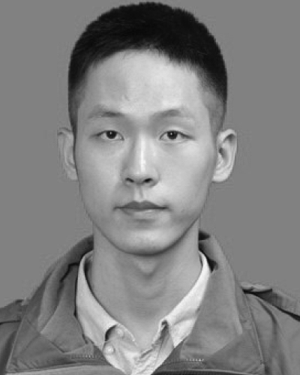 Xihua Sheng合作论文数1Yuan Zhang (张园)合作论文数1
 Chiya Zhang (张驰亚)合作论文数School of Information Science and Technology, College of Informatics, Harbin Institute of Technology, Shenzhen;Pengcheng Laboratory1
 Libiao Jin (金立标)合作论文数School of Information and Communication Engineering, Communication University of China1
 Wei Chen (陈伟)合作论文数School of Energy and Power Engineering, Nanjing University of Science and Technology1
 Wengang Zhou (周文罡)合作论文数MCC Lab, Department of Electronic Engineering and Information Science, School of Information Science and Technology, University of Science and Technology of China1




