We examine a simple two lane cellular automaton based upon the sin- gle lane CA introduced by Nagel and Schreckenberg. We point out impor- tant parameters defining the shape of the fundamental diagram. Moreover we investigate the importance of stochastic elements with respect to real life traffic.
This paper proposes a document-oriented modeling concept for cellular automata (CA), which supports the simple and rapid design of a huge variety of cellular au- tomata. This modeling concept is realized as a domain-specific modeling language derived from XML (eXtensible Markup Language). XML is in general considered as the future for internet documents and data exchange. The main concept behind XML is to separate the content of a document from its layout (its appearance). The presented modeling concept uses a document for describing a whole cellular automaton. Like the content of a document is separated from its layout, the abstract cellular automaton is separated from a concrete implementation and programming language. Everyone can create and use XSL(T) stylesheets for translating cellular-automaton-documents into ready to use source-code (covering the adequate cellular-automaton-functionality) as well as for documentation and exchange of the realised CA.
Unpredictable patterns generated by cellular automata (CA) can be decomposed with respect to a turbulent, positive entropy rate pattern basis. The resulting filtered patterns uncover significant structural organization in a CA's dynamics and information processing capabilities. We illustrate the decomposition technique by analyzing a binary, range-2 cellular automaton having two invariant chaotic domains of different complexities and entropies. Once identified, the domains are seen to organize the CA's state space and to dominate its evolution. Starting from the domains' structures, we show how to construct a finite-state transducer that performs nonlinear spatial filtering such that the resulting space-time patterns reveal the domains and the intervening walls and dislocations. To show the statistical consequences of domain detection, we compare the entropy and complexity densities of each domain with the globally averaged quantities. A more graphical comparison uses difference patterns and difference plumes which trace the space-time influence of a single-site perturbation. We also investigate the diversity of walls and particles emanating from the interface between two adjacent domains.
Abstract by Timothy J. Dysart While the end of Moore’s law has been predicted for many years, it appears that transistors may finally hit physical scaling and packing density limits in the next ten to twenty years. This possibility has led to the development of many nano- electronic devices such as carbon nanotubes, single electron transistors, molecular transistors, and quantum-dot cellular automata (QCA), among others. One com- mon issue with these nanoelectronic devices is that many manufacturing defects are likely to occur. To this end, defect-tolerant architectures for nanoelectronic systems will be required. In order to study how QCA wires could be made de- fect tolerant, the possible manufacturing defects were identified, and models to represent these defects were found. However, to perform simulation, QCA design tools were expanded by developing a file format framework capable of separat- ing the system architecture from the technology used to implement the system. This file format framework was developed using the Extensible Markup Language (XML). In this work, QCA wires of varying widths are examined to determine their resistance to certain individual defects and a specific subclass of manufac- turing defects: missing cells. The results show that “wide” wires, at least to five cells wide, can be used to offer inherent defect tolerance in a QCA system. CONTENTS
We investigate the ability of a genetic algorithm to design cellular au- tomata that perform computations. The computational strategies of the resulting cellular automata can be understood using a framework in which "particles" embed- ded in space-time configurations carry information and interactions between particles effect information processing. This structural analysis can also be used to explain the evolutionary process by which the strategies were designed by the genetic algorithm. More generally, our goals are to understand how machine-learning processes can design complex decentralized systems with sophisticated collective computational abilities and to develop rigorous frameworks for understanding how the resulting dynamical systems perform computation.
 Melanie Mitchell合作论文数Santa Fe Institute;Department of Computer Science, Portland State University2
 James P. Crutchfield合作论文数1ebrahim akhavan bazofti合作论文数1Wim Hordijk合作论文数Santa Fe Institute;c1Kenton Morgan合作论文数Institute of Life Course and Medical Sciences, School of Veterinary Science, University of Liverpool1Petra Meier合作论文数1Chris Lewis合作论文数1A Thesis合作论文数1
 Jui-Lin Lai合作论文数1
 Peter M. Kogge合作论文数Department of Computer Science and Engineering, College of Engineering, University of Notre Dame1A. Latour合作论文数1
 Mario Köppen合作论文数Fraunhofer IPK Pascalstr.1
 Rajarshi Das合作论文数FatBrain.Ai1
 James E Hanson合作论文数Thomas J. Watson Research Center, IBM1Elisabeth Hoggarth合作论文数1
 Michael Schreckenberg合作论文数Fakultät für Physik, Universität Duisburg-Essen1
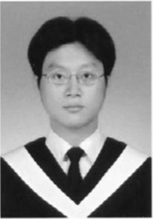 Chao-Shen Chen合作论文数1James P. Crutcheld合作论文数1Kiran Fernandes合作论文数1
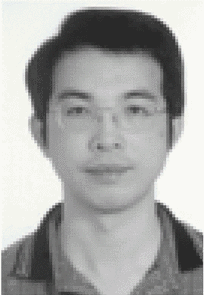 Yuan-Hsin Chen合作论文数1
 Kai Nagel合作论文数Fachgebiet Verkehrssystemplanung und Verkehrstelematik, Fakultät V (Verkehrs- und Maschinensysteme), Institut für Land- und Seeverkehr, Technische Universität Berlin1
 Marcus Rickert合作论文数SD&M AG1
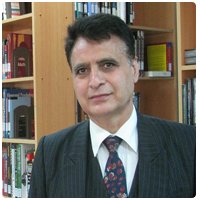 Mohammad V. Malakooti合作论文数Department of Computer Engineering, Islamic Azad University1Brahima Belem合作论文数1
 Peter Squires合作论文数1Gerhard-Mercator-Universitat Duisburg合作论文数1Notre Dame合作论文数1Timothy J. Dysart合作论文数1Christian Veenhuis合作论文数1Brian Holland合作论文数1i int roduction合作论文数1Jayanthi Santhanam合作论文数1
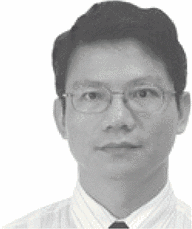 Rong-Jian Chen合作论文数1Giles Oatley合作论文数Centre for Adaptive Systems University of Sunderland
Senior Lecturer in the School of Computing and Technology at the University of Sunderland since September 20001Alexandra Imre合作论文数1
Rong-Jian Chen合作论文数1Giles Oatley合作论文数Centre for Adaptive Systems University of Sunderland
Senior Lecturer in the School of Computing and Technology at the University of Sunderland since September 20001Alexandra Imre合作论文数1




