Abstract Chromatin must fold tightly enough to protect the genome while being sufficiently accessible for DNA dependent processes such as transcription. The physical rules that balance these competing roles remain unclear, as DNA sequence encodes both biochemical information such as transcription factor binding sites, and biophysical cues that shape chromatin structure. Here, using synthetic chromatin fibres assembled from physiologically relevant DNA sequences, we show that nucleosome positioning dictates the material state of chromatin. Heterochromatin-like sequences produce compact fibres stabilised by nucleosome stacking, whereas euchromatin-like sequences generate irregular nucleosome positioning that yields disrupted, heterogeneous, and mechanically deformable fibres. Quantitative polymer modelling reveals that these irregular arrays are highly dynamic, continually sampling a broad ensemble of conformations as nucleosome stacking breaks down. We identify two previously unrecognised thresholds encoded by nucleosome positioning: minimal positional irregularity (2–3 bp) triggers a transition from an ordered paracrystalline state to a liquid-like phase, whereas an order of magnitude greater irregularity (∼18 bp) is required to generate accessibility and mechanical fragility permissive for transcription factor binding. Euchromatin-like arrays reside at this accessibility threshold. These findings indicate that nucleosome positioning tunes chromatin toward or away from critical structural states that couple genome protection, chromatin dynamics, and transcriptional potential—providing a physical mechanism that helps connect DNA sequence to gene expression.
Urinary catheters are used extensively in hospitals and long-term care and they are highly prone to infection. Understanding the pathways by which bacteria colonise a urinary catheter could guide strategies to mitigate infection, but quantitative models for this colonisation process are lacking. Here we present a mathematical model for bacterial colonisation of a urinary catheter, that integrates population dynamics and fluid dynamics. The model describes bacteria migrating up the outside surface of the catheter, spreading into the bladder and being swept through the catheter lumen. Computer simulations of the model reveal that clinical outcomes for long-term versus short-term catheterisation are controlled by different factors: the rate of urine production by the kidneys as opposed to urethral length, catheter surface properties and bacterial motility. Our work may help explain variable susceptibility to catheter-associated urinary tract infection (CAUTI) among individuals, and the mixed success of antimicrobial surface coatings. Our model suggests that for long-term catheterised patients, increasing fluid intake or reducing residual urine volume in the bladder may help prevent infection, while antimicrobial surface coatings are predicted to be effective only for short-term catheterised patients. Therefore, different catheter management strategies could be rationally targeted to long-term vs short-term catheterised patients.
Transcriptional noise, or heterogeneity, is important in cellular development and in disease. The molecular mechanisms driving it are, however, elusive and ill-understood. Here, we use computer simulations to explore the role of 3D chromatin structure in driving transcriptional noise. We study a simple polymer model where proteins - modeling complexes of transcription factors and polymerases - bind multivalently to transcription units - modeling regulatory elements such as promoters and enhancers. We also include cohesin-like factors which extrude chromatin loops that are important for the physiological folding of chromosomes. We find that transcription factor binding creates spatiotemporal patterning and a highly variable correlation time in transcriptional dynamics, providing a mechanism for intrinsic noise within a single cell. Instead, loop extrusion contributes to extrinsic noise, as the stochastic nature of this process leads to different networks of cohesin loops in different cells in our simulations. Our results could be tested with single-cell experiments and provide a pathway to understanding the principles underlying transcriptional plasticity in vivo.
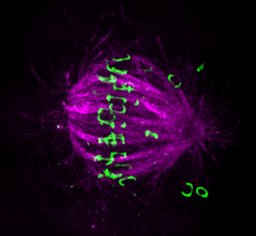
Centromeres are scaffolds for the assembly of kinetochores that ensure chromosome segregation during cell division. How vertebrate centromeres obtain a three-dimensional structure to accomplish their primary function is unclear. Using super-resolution imaging, capture-C, and polymer modeling, we show that vertebrate centromeres are partitioned by condensins into two subdomains during mitosis. The bipartite structure is found in human, mouse, and chicken cells and is therefore a fundamental feature of vertebrate centromeres. Super-resolution imaging and electron tomography reveal that bipartite centromeres assemble bipartite kinetochores, with each subdomain binding a distinct microtubule bundle. Cohesin links the centromere subdomains, limiting their separation in response to spindle forces and avoiding merotelic kinetochore-spindle attachments. Lagging chromosomes during cancer cell divisions frequently have merotelic attachments in which the centromere subdomains are separated and bioriented. Our work reveals a fundamental aspect of vertebrate centromere biology with implications for understanding the mechanisms that guarantee faithful chromosome segregation.
Classical observations suggest a connection between 3D gene structure and function, but testing this hypothesis has been challenging due to technical limitations. To explore this, we developed epigenetic highly predictive heteromorphic polymer (e-HiP-HoP), a model based on genome organization principles to predict the 3D structure of human chromatin. We defined a new 3D structural unit, a “topos,” which represents the regulatory landscape around gene promoters. Using GM12878 cells, we predicted the 3D structure of over 10,000 active gene topoi and stored them in the 3DGene database. Data mining revealed folding motifs and their link to Gene Ontology features. We computed a structural diversity score and identified influential nodes—chromatin sites that frequently interact with gene promoters, acting as key regulators. These nodes drive structural diversity and are tied to gene function. e-HiP-HoP provides a framework for modeling high-resolution chromatin structure and a mechanistic basis for chromatin contact networks that link 3D gene structure with function.
The myeloma overexpressed gene (MYEOV) has been proposed to be a proto-oncogene due to high RNA transcript levels found in multiple cancers, including myeloma, breast, lung, pancreas and esophageal cancer. The presence of an open reading frame (ORF) in humans and other primates suggests protein-coding potential. Yet, we still lack evidence of a functional MYEOV protein. It remains undetermined how MYEOV overexpression affects cancerous tissues. In this work, we show that MYEOV has likely originated and may still function as an enhancer, regulating CCND1 and LTO1. Firstly, MYEOV 3′ enhancer activity was confirmed in humans using publicly available ATAC-STARR-seq data, performed on B-cell-derived GM12878 cells. We detected enhancer histone marks H3K4me1 and H3K27ac overlapping MYEOV in multiple healthy human tissues, which include B cells, liver and lung tissue. The analysis of 3D genome datasets revealed chromatin interactions between a MYEOV-3′-putative enhancer and the proto-oncogene CCND1. BLAST searches and multi-sequence alignment results showed that DNA sequence from this human enhancer element is conserved from the amphibians/amniotes divergence, with a 273 bp conserved region also found in all mammals, and even in chickens, where it is consistently located near the corresponding CCND1 orthologues. Furthermore, we observed conservation of an active enhancer state in the MYEOV orthologues of four non-human primates, dogs, rats, and mice. When studying this homologous region in mice, where the ORF of MYEOV is absent, we not only observed an enhancer chromatin state but also found interactions between the mouse enhancer homolog and Ccnd1 using 3D-genome interaction data. This is similar to the interaction observed in humans and, interestingly, coincides with CTCF binding sites in both species. Taken together, this suggests that MYEOV is a primate-specific gene with a de novo ORF that originated at an evolutionarily older enhancer region. This deeply conserved putative enhancer element could regulate CCND1 in both humans and mice, opening the possibility of studying MYEOV regulatory functions in cancer using non-primate animal models.
In living cells, the 3D structure of gene loci is dynamic, but this is not revealed by 3C and FISH experiments in fixed samples, leaving a notable gap in our understanding. To overcome these limitations, we applied the highly predictive heteromorphic polymer (HiP-HoP) model to determine chromatin fiber mobility at the Pax6 locus in three mouse cell lines with different transcription states. While transcriptional activity minimally affects movement of 40-kbp regions, we observed that motion of smaller 1-kbp regions depends strongly on local disruption to chromatin fiber structure marked by H3K27 acetylation. This also substantially influenced locus configuration dynamics by modulating protein-mediated promoter-enhancer loops. Importantly, these simulations indicate that chromatin dynamics are sufficiently fast to sample all possible locus conformations within minutes, generating wide dynamic variability within single cells. This combination of simulation and experimental validation provides insight into how transcriptional activity influences chromatin structure and gene dynamics.
The myeloma overexpressed gene ( MYEOV ) has been proposed to be a proto-oncogene due to high RNA transcript levels found in multiple cancers, including myeloma, breast, lung, pancreas and esophageal cancer. The presence of an open reading frame (ORF) in humans and other primates suggests protein-coding potential. Yet, we still lack evidence of a functional MYEOV protein. It remains undetermined how MYEOV overexpression affects cancerous tissues. In this work, we show that MYEOV has originated and may still function as an enhancer, possibly regulating CCND1 . Firstly, MYEOV 3’ end enhancer activity was confirmed in humans using publicly available ATAC-STARR-seq data, performed on B-cell-derived GM12878 cells. We detected enhancer histone marks H3K4me1 and H3K27ac overlapping MYEOV in multiple healthy human tissues, which include B cells, liver and lung tissue. The analysis of 3D genome datasets revealed chromatin interactions between the MYEOV- 3’-enhancer and the proto-oncogene CCND1 . BLAST searches and multi-sequence alignments results showed that this human enhancer element is conserved from the amphibians/amniotes divergence, with a 273 bp conserved region also found in all mammals, and even in chickens, and it consistently located near the corresponding CCND1 orthologues. Furthermore, we observed conservation of active enhancer state in the MYEOV orthologues of four non-human primates, dog, rat and mouse. When studying this homologous region in mice, where the ORF of MYEOV is absent, we not only observed an enhancer chromatin state but also found interactions between the mouse enhancer homolog and Ccnd1 using 3D-genome interaction data. This is similar to the interaction observed in humans and, interestingly, coincides with CTCF binding sites in both species. Taken together, this suggests that MYEOV is a primate-specific gene with a de novo ORF that originated at an evolutionarily older enhancer region. This deeply conserved enhancer element is possibly regulating CCND1 in both humans and mice, opening the possibility of studying MYEOV regulatory functions in cancer using non-primate animal models.
Polymer simulations and predictive mechanistic modelling are increasingly used in conjunction with experiments to study the organization of eukaryotic chromosomes. Here we review some of the most prevalent models for mechanisms which drive different aspects of chromosome organization, as well as a recent simulation scheme which combines several of these mechanisms into a single predictive model. We give some practical details of the modelling approach, as well as review some of the key results obtained by these and similar models in the last few years.
Background: Chromosomal translocations are important drivers of haematological malignancies whereby proto-oncogenes are activated by juxtaposition with super-enhancers. The immunoglobulin (IG) and T-cell receptor loci are enhancer-rich regions that are commonly hijacked via translocation in many subtypes of lymphoid malignancies. However, the epigenomic landscape and 3D genome structure remains poorly understood. We previously analysed the epigenomic consequence of rearrangements between the super-enhancers of the IG heavy chain locus (IGH) and proto-oncogene CCND11. By integrating BLUEPRINT epigenomic data with DNA breakpoint detection, we observed a broad H3K4me3 domain (BD) within the IGH locus of healthy B-cells that was absent in samples with IGH-CCND1 translocations. Upon chromosomal translocation, we observed the appearance of an H3K4me3-BD over CCND1 concomitant with its overexpression and an extensive increase in chromatin accessibility of this locus. In addition, we observed similar cancer-specific H3K4me3-BDs associated with super-enhancer hijacking of other common oncogenes in B-cell (MAF, MYC and FGFR3/NSD2) and T-cell malignancies (LMO2, TLX3 and TAL1)1. Aims: To understand and predict the 3D genome consequence of IGH-CCND1 translocation events using the highly predictive heteromorphic polymer model (HiP-HoP). Methods: Using methods from polymer physics, HiP-HoP uses data on DNA accessibility, chromatin states, and protein binding to generate an ensemble of simulated 3D chromosome structures. After confirming that the model gives good predictions of Hi-C data for a healthy human B-cell derived cell line, we generated predictions for two B-cell malignant cell lines (U266, Z-138) possessing IGH-CCND1 rearrangements. Results: We confirmed that the insertion of a single IGH super enhancer (Eα1) in U266 leaves the local topologically associated domain (TAD) structure intact. Simulations of the reciprocal IGH-CCND1 translocation in Z-138, suggested the TAD boundaries are preserved, creating an oncogenic fusion TAD encompassing CCND1 and all four IGH super-enhancers. Further simulations suggested that it is the downstream epigenetic changes which drive the 3D structural changes, rather than the genomic rearrangement itself. This points to a scenario where the translocated IGH super-enhancers first recruit chromatin remodelers to the region; this then drives epigenomic changes which in turn disrupts the wider 3D structure leading to dysregulation of cyclin D1. The model was able to predict how the structure of CCND1 changes in these different cell lines, could simulate different breakpoints, and could predict the impact on gene expression. Using qPCR and 3D-FISH we were able to validate the predicted high mRNA expression levels and increase in volume of the CCND1 locus. Summary/Conclusion: Taken together, our analysis suggests that H3K4me3-BDs are created by super-enhancers and supports the new concept of epigenomic translocation, where the relocation of H3K4me3-BDs accompanies the translocation of super-enhancers, altering the local 3D genome. References 1. PMID:34933939
We perform simulations of a system containing simple model proteins and a polymer representing chromatin. We study the interplay between protein-protein and protein-chromatin interactions, and the resulting condensates which arise due to liquid-liquid phase separation, or a via a ‘bridging-induced attraction’ mechanism. For proteins which interact multivalently, we obtain a phase diagram which includes liquidlike droplets, droplets with absorbed polymer, and coated polymer regimes. Of particular interest is a regime where protein droplets only form due to interaction with the polymer; here, unlike a standard phase separating system, droplet density rather than size varies with the overall protein concentration. We also observe that protein dynamics within droplets slow down as chromatin is absorbed. If the proteinprotein interactions have a strictly limited valence, fractal or gel-like condensates are instead observed. Together this provides biologically relevant insights into the nature of protein-chromatin condensates in living cells.
Fitting-free mechanistic models based on polymer simulations predict chromatin folding in 3D by focussing on the underlying biophysical mechanisms. This class of models has been increasingly used in conjunction with experiments to study the spatial organisation of eukaryotic chromosomes. Feedback from experiments to models leads to successive model refinement and has previously led to the discovery of new principles for genome organisation. Here, we review the basis of mechanistic polymer simulations, explain some of the more recent approaches and the contexts in which they have been useful to explain chromosome biology, and speculate on how they might be used in the future.
The Structural Maintenance of Chromosomes (SMC) complexes cohesin and condensin establish the 3D organization of mitotic chromosomes 1–3 . Cohesin is essential to maintain sister chromatid pairing until anaphase onset 4 , while condensin is important for mitotic centromere structure and elastic resistance to spindle forces 5–8 . Both complexes are also important to form productive kinetochore-spindle attachments 6, 8, 9 . How condensin and cohesin work together to shape the mitotic centromere to ensure faithful chromosome segregation remains unclear. Here we show by super-resolution imaging, Capture-C analysis and polymer modeling that vertebrate centromeres are partitioned into two distinct condensin-dependent subdomains during mitosis. This bipartite sub-structure is found in human, mouse and chicken centromeres and also in human neocentromeres devoid of satellite repeats, and is therefore a fundamental feature of vertebrate centromere identity. Super-resolution imaging reveals that bipartite centromeres assemble bipartite kinetochores with each subdomain capable of binding a distinct microtubule bundle. Cohesin helps to link the centromere subdomains, limiting their separation in response to mitotic spindle forces. In its absence, separated bipartite kinetochores frequently engage in merotelic spindle attachments. Consistently, uncoupling of centromere subdomains is a common feature of lagging chromosomes in cancer cells. The two-domain structure of vertebrate regional centromeres described here incorporates architectural roles for both condensin and cohesin and may have implications for avoiding chromosomal instability in cancer cells.
Chromosomal translocations are important drivers of haematological malignancies whereby proto-oncogenes are activated by juxtaposition with enhancers, often called enhancer hijacking. We analyzed the epigenomic consequences of rearrangements between the super-enhancers of the immunoglobulin heavy locus (IGH) and proto-oncogene CCND1 that are common in B cell malignancies. By integrating BLUEPRINT epigenomic data with DNA breakpoint detection, we characterized the normal chromatin landscape of the human IGH locus and its dynamics after pathological genomic rearrangement. We detected an H3K4me3 broad domain (BD) within the IGH locus of healthy B cells that was absent in samples with IGH-CCND1 translocations. The appearance of H3K4me3-BD over CCND1 in the latter was associated with overexpression and extensive chromatin accessibility of its gene body. We observed similar cancer-specific H3K4me3-BDs associated with hijacking of super-enhancers of other common oncogenes in B cell (MAF, MYC, and FGFR3/NSD2) and T cell malignancies (LMO2, TLX3, and TAL1). Our analysis suggests that H3K4me3-BDs can be created by super-enhancers and supports the new concept of epigenomic translocation, in which the relocation of H3K4me3-BDs from cell identity genes to oncogenes accompanies the translocation of super-enhancers.
Classical observations have long suggested there is a link between 3D gene structure and transcription1–4. However, due to the many factors regulating gene expression, and to the challenge of visualizing DNA and chromatin dynamics at the same time in living cells, this hypothesis has been difficult to quantitatively test experimentally. Here we take an orthogonal approach and use computer simulations, based on the known biophysical principles of genome organisation5–7, to simultaneously predict 3D structure and transcriptional output of human chromatin genome wide. We validate our model by quantitative comparison with Hi-C contact maps, FISH, GRO-seq and single-cell RNA-seq data, and provide the 3DGene resource to visualise the panoply of structures adopted by any active human gene in a population of cells. We find transcription strongly correlates with the formation of protein-mediated microphase separated clusters of promoters and enhancers, associated with clouds of chromatin loops, and show that gene noise is a consequence of structural heterogeneity. Our results also indicate that loop extrusion by cohesin does not affect average transcriptional patterns, but instead impacts transcriptional noise. These findings provide a functional role for intranuclear microphase separation, and an evolutionary mechanism for loop extrusion halted at CTCF sites, to modulate transcriptional noise.
Genomic rearrangements are known to result in proto-oncogene deregulation in many cancers, but the link to genome 3D structure remains poorly understood. Here we used the highly-predictive heteromorphic polymer (HiP-HoP) model to predict chromatin conformations at the proto-oncogene CCND1 in healthy and malignant B-cells. After confirming that the model gives good predictions of Hi-C data for the non-malignant human B-cell derived cell line GM12878, we generated predictions for two cancer cell lines, U266 and Z-138. These possess genome rearrangements involving CCND1 and the immunoglobulin heavy chain locus ( IGH ), which we mapped using targeted genome sequencing. Our simulations showed that a rearrangement in U266 cells where a single IGH super-enhancer is inserted next to CCND1 leaves the local topologically associated domain (TAD) structure intact. We also observed extensive changes in enhancer-promoter interactions within the TAD, suggesting that it is the downstream chromatin remodelling which gives rise to the oncogene activation, rather than the presence of the inserted super-enhancer DNA sequence per se . Simulations of the IGH - CCND1 reciprocal translocation in Z-138 cells revealed that an oncogenic fusion TAD is created, encompassing CCND1 and the IGH super-enhancers. We predicted how the structure and expression of CCND1 changes in these different cell lines, validating this using qPCR and fluorescence in situ hybridization microscopy. Our work demonstrates the power of polymer simulations to predict differences in chromatin interactions and gene expression for different translocation break-points.
Biofouling of marine surfaces such as ship hulls is a major industrial problem. Antifouling (AF) paints delay the onset of biofouling by releasing biocidal chemicals. We present a computational model for microbial colonization of a biocide-releasing AF surface. Our model accounts for random arrival from the ocean of microorganisms with different biocide resistance levels, biocide-dependent proliferation or killing, and a transition to a biofilm state. Our computer simulations support a picture in which biocide-resistant microorganisms initially form a loosely attached layer that eventually transitions to a growing biofilm. Once the growing biofilm is established, immigrating microorganisms are shielded from the biocide, allowing more biocide-susceptible strains to proliferate. In our model, colonization of the AF surface is highly stochastic. The waiting time before the biofilm establishes is exponentially distributed, suggesting a Poisson process. The waiting time depends exponentially on both the concentration of biocide at the surface and the rate of arrival of resistant microorganisms from the ocean. Taken together our results suggest that biofouling of AF surfaces may be intrinsically stochastic and hence unpredictable, but immigration of more biocide-resistant species, as well as the biological transition to biofilm physiology, may be important factors controlling the time to biofilm establishment.
Surface-attached bacterial biofilms cause disease and industrial biofouling, as well as being widespread in the natural environment. Density-dependent quorum sensing is one of the mechanisms implicated in biofilm initiation. Here we present and analyze a model for quorum-sensing triggered biofilm initiation. In our model, individual, planktonic bacteria adhere to a surface, proliferate, and undergo a collective transition to a biofilm phenotype. This model predicts a stochastic transition between a loosely attached, finite layer of bacteria near the surface and a growing biofilm. The transition is governed by two key parameters: the collective transition density relative to the carrying capacity and the immigration rate relative to the detachment rate. Biofilm initiation is complex, but our model suggests that stochastic nucleation phenomena may be relevant.
The discovery that overexpressing one or a few critical transcription factors can switch cell state suggests that gene regulatory networks are relatively simple. In contrast, genome-wide association studies (GWAS) point to complex phenotypes being determined by hundreds of loci that rarely encode transcription factors and which individually have small effects. Here, we use computer simulations and a simple fitting-free polymer model of chromosomes to show that spatial correlations arising from 3D genome organisation naturally lead to stochastic and bursty transcription as well as complex small-world regulatory networks (where the transcriptional activity of each genomic region subtly affects almost all others). These effects require factors to be present at sub-saturating levels; increasing levels dramatically simplifies networks as more transcription units are pressed into use. Consequently, results from GWAS can be reconciled with those involving overexpression. We apply this pan-genomic model to predict patterns of transcriptional activity in whole human chromosomes, and, as an example, the effects of the deletion causing the diGeorge syndrome.
 Davide Marenduzzo合作论文数School of Physics and Astronomy, University of Edinburgh47
 Nick Gilbert合作论文数MRC Human Genetics Unit, Western General Hospital17
 Davide Michieletto合作论文数School of Physics and Astronomy, The University of Edinburgh14
 Julie a Johnson合作论文数8Peter R. Cook合作论文数Peter R Cook's Group, The Sir William Dunn School of Pathology, University of Oxford8
 Adam Buckle合作论文数University of Edinburgh6Michael Chiang合作论文数6Marco Thiel合作论文数Universität Potsdam Institute of Physics6
 Maria Carmen Romano合作论文数6
 Mikulasova Aneta合作论文数5
 Daniel Rico合作论文数4Giada Forte合作论文数MRC Institute of Genetics and Molecular Medicine, University of Edinburgh4Lisa J Russell合作论文数4
 Alexander Morozov合作论文数School of Physics and Astronomy, The University of Edinburgh4
 Argyris Papantonis合作论文数Sir William Dunn Sch Pathol, Univ Oxford4
 Rosalind Allen合作论文数School of Physics,University of Edinburgh4
 Cleis Battaglia合作论文数3
 M. F.C. Pereira合作论文数3
 Marco Ancona合作论文数School of Physics and Astronomy, University of Edinburgh3
 Marco Trevisan-Herraz合作论文数Centro de Biología Molecular Severo Ochoa (CSIC-UAM), Madrid, Spain;Centro Nacional de Investigaciones Cardiovasculares;Centro de Biología Molecular Severo Ochoa (CSIC-UAM),, Centro Nacional de Investigaciones Cardiovasculares3
 Brian Walker合作论文数Department of Medicine, Miller School of Medicine, University of Miami3
 Giuseppe Gonnella合作论文数Theoretical Physics;Oxford University;Oxford University3
 Bill Earnshaw合作论文数Wellcome Centre for Cell Biology, University of Edinburgh3
 Mario Nicodemi合作论文数Physics Department, University of Naples "Federico II"3
 Matthew Turner合作论文数Department of Physics, The University of Warwick;Centre for Complexity Science, The University of Warwick3
 Celso Grebogi合作论文数School of Natural and Computing Sciences, University of Aberdeen;Institute for Complex Systems and Mathematical Biology, King’s College, University of Aberdeen3Nefeli Karataraki合作论文数2Maaike L.A. Lambers合作论文数2Lorena Andrade Ruiz合作论文数2Nattaphong Rattanavirotkul合作论文数2Daniel Kent合作论文数2
 Yair Augusto Gutierrez Fosado合作论文数School of Physics and Astronomy, University of Edinburgh2François Mouvet合作论文数Lab Computat Chem & Biochem, Ecole Polytech Fed Lausanne2Juliana Estefania Arcila-Galvis合作论文数2Lilija Brant合作论文数2
 Kumiko Samejima合作论文数Wellcome Trust Centre for Cell Biology, ICMB, King's Buildings, The University of Edinburgh, Edinburgh, EH93JR, Scotland, UK2Patrick Sinclair合作论文数2
 Martín Carballo-Pacheco合作论文数Institute of Biological Information Processing: Structural Biochemistry (IBI-7),, Forschungszentrum Jülich2Milos Nikolic合作论文数School of Informatics, The University of Edinburgh2
 Javierre Biola M合作论文数Canc Epigenet & Biol Programme PEBC, Bellvitge Biomed Res Inst IDIBELL2Hori Tetsuya合作论文数2Webb Shaun合作论文数2
 Geert J.P.L.合作论文数Center for Molecular Medicine, Hubrecht Institute, University Medical Center Utrecht2
 Daniel Jordan Robertson合作论文数Department of Mechanical Engineering, New York University-Abu Dhabi2Naughton Catherine合作论文数2
 Steve Kelly合作论文数Department of Biology, University of Oxford;Department of Plant Sciences, University of Oxford;Wild Bioscience Ltd2Georgomanolis Theodore合作论文数2
 Sacristan Carlos合作论文数Molecular Cancer Research, University Medical Center Utrecht2
 Michael Cates合作论文数Department of Applied Mathematics and Theoretical Physics, University of Cambridge2




