During tumorigenesis, the extracellular matrix is extensively remodeled. Whereas the impact of such remodeling on tumor growth and invasion is well described, the consequences on immune infiltration are not well understood. Combining tissue imaging and machine learning, we show that immune cell localization in tumors can be predicted by the local topography of fibrillar collagens. Such topographies are dictated by a fibrotic pathway driven by transcription factor 4 (Tcf4) in both cancer and stromal cells, which promotes collagen III deposition and results in intermingled collagen networks that favor intratumor infiltration of T cells and neutrophils. Macrophages inhibit this pathway, highlighting their key structural role in shaping the tumor extracellular matrix. Reanalysis of data from human solid tumors revealed a strong correlation between TCF4, COL3A1, and T cell and neutrophil signatures. Together, our data identify collagen network topographies as a key regulator of tumor-infiltrating immune cells.
Immune cells are constantly exposed to microbiota-derived compounds that can engage innate recognition receptors. How this constitutive stimulation is downmodulated to avoid systemic inflammation and autoimmunity is poorly understood. Here, we show that aryl hydrocarbon receptor (AhR) deficiency in monocytes unleashed spontaneous cytokine responses in vivo, driven by stimulator of interferon genes (STING)-mediated tonic sensing of microbiota. This effect was specific to monocytes, as mice deficient for AhR specifically in macrophages did not show any dysregulation of tonic cytokine responses. AhR inhibition also increased tonic cytokine production in human monocytes. Finally, in patients with systemic juvenile idiopathic arthritis, low AhR activity in monocytes correlated with elevated cytokine responses. Our findings reveal an essential role for AhR in monocytes in restraining tonic microbiota sensing and in maintaining immune homeostasis.
During tumorigenesis, the extracellular matrix (ECM), which constitutes the structural scaffold of tissues, is profoundly remodeled. While the impact of such remodeling on tumor growth and invasion has been extensively investigated, much less is known on the consequences of ECM remodeling on tumor infiltration by immune cells. By combining tissue imaging and machine-learning, we here show that the localization of T lymphocytes and neutrophils, which orchestrate antitumor immune responses, can be predicted by defined topographical features of fibrillar collagen networks. We further show that these collagen topographies result from the activation of a fibrotic pathway controlled by the transcription factor Tcf4 upon depletion of tumor-associated macrophages at late tumor stages. This pathway promotes the deposition of collagen 3 by both tumor and stromal cells, resulting in intermingled collagen networks that favor intra-tumoral T cell and neutrophil localization. Importantly, analysis of human colorectal cancer public bulk RNAseq databases showed a strong correlation between Tcf4 and collagen 3, as well as between the expression of these genes and tumor infiltration by T lymphocytes and neutrophils, attesting the clinical relevance of our findings. This study highlights the key structural role of macrophages on the tumor extracellular matrix and identifies collagen network topographies as a major regulator of tumor infiltration by immune cells. ### Competing Interest Statement The authors have declared no competing interest.
Treating radioresistant tumors like glioblastoma multiforme remains a challenge exacerbated by their immunosuppressive nature. Radiotherapy (RT) plays an immunomodulatory role, exerting both immunosuppressive and immunostimulatory effects. The nature of these effects depends on the total dose, dose per fraction, dose delivery method, and treatment length. Hypofractionation is observed to tip the balance toward immune stimulation. However, the use of hypofractionation is restricted in bulky tumors, such as gliomas, because of the high risk of toxicity. Therefore, finding new strategies leading to more favorable immune responses while reducing normal tissue toxicities could improve cancer treatment. In this study, we examine antitumoral immune responses to proton minibeam RT (pMBRT). Its immunomodulatory effects are not fully understood. To explore this, we conducted an in-depth characterization of the immune response to a curative dose of pMBRT in a preclinical orthotopic rat model of glioblastoma. Our findings revealed a close association between pMBRT and the immune response. pMBRT increased lymphocyte density in tumors more effectively than conventional proton therapy. Single-cell transcriptomics identified several immune cell types and unique transcriptional changes in tumor immune cells following pMBRT, including increased antibody production, chemotactic cytokine expression, and IFN responses. These results underscore the critical role of adaptive immunity, specifically T cells, in pMBRT's mechanism. The potential of pMBRT to trigger an antitumor immune response in a single RT session with minimal damage to healthy tissue makes it a promising candidate for future clinical trials and radioimmunotherapy combinations.
We previously showed that chimeric antigen receptor (CAR) T-cell therapy targeting epidermal growth factor receptor variant III (EGFRvIII) produces upregulation of programmed death-ligand 1 (PD-L1) in the tumor microenvironment (TME). Here we conducted a phase 1 trial (NCT03726515) of CAR T-EGFRvIII cells administered concomitantly with the anti-PD1 (aPD1) monoclonal antibody pembrolizumab in patients with newly diagnosed, EGFRvIII+ glioblastoma (GBM) (n = 7). The primary outcome was safety, and no dose-limiting toxicity was observed. Secondary outcomes included median progression-free survival (5.2 months; 90% confidence interval (CI), 2.9-6.0 months) and median overall survival (11.8 months; 90% CI, 9.2-14.2 months). In exploratory analyses, comparison of the TME in tumors harvested before versus after CAR + aPD1 administration demonstrated substantial evolution of the infiltrating myeloid and T cells, with more exhausted, regulatory, and interferon (IFN)-stimulated T cells at relapse. Our study suggests that the combination of CAR T cells and PD-1 inhibition in GBM is safe and biologically active but, given the lack of efficacy, also indicates a need to consider alternative strategies.
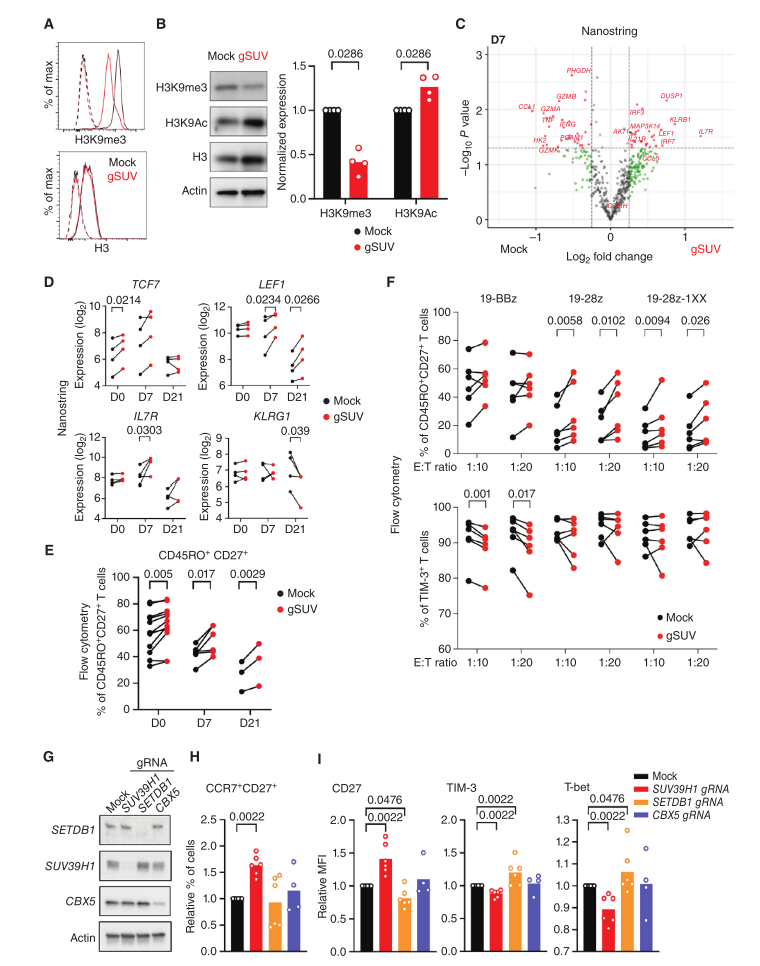
Differentially expressed genes between mock and gSUV clusters in CD8+ and CD4+ T cells. Related to Figures 3, 4, S4, S5.
Numbers of cells analyzed by single-cell ATAC-seq. Related to Figures 5 and S7.
List of OFF-target sites for Suv-1 gRNA. Differentially expressed genes between mock and gSUV CD8+ T cells by Nanostring. Related to Figures 1 and S1, S2.
Reagents or resources used in the study. Numbers of donors and CAR-T productions for in vitro experiments. Donor information for in vivo experiments.
Abstract Failure of adoptive T-cell therapies in patients with cancer is linked to limited T-cell expansion and persistence, even in memory-prone 41BB-(BBz)–based chimeric antigen receptor (CAR) T cells. We show here that BBz-CAR T-cell stem/memory differentiation and persistence can be enhanced through epigenetic manipulation of the histone 3 lysine 9 trimethylation (H3K9me3) pathway. Inactivation of the H3K9 trimethyltransferase SUV39H1 enhances BBz-CAR T cell long-term persistence, protecting mice against tumor relapses and rechallenges in lung and disseminated solid tumor models up to several months after CAR T-cell infusion. Single-cell transcriptomic (single-cell RNA sequencing) and chromatin opening (single-cell assay for transposase accessible chromatin) analyses of tumor-infiltrating CAR T cells show early reprogramming into self-renewing, stemlike populations with decreased expression of dysfunction genes in all T-cell subpopulations. Therefore, epigenetic manipulation of H3K9 methylation by SUV39H1 optimizes the long-term functional persistence of BBz-CAR T cells, limiting relapses, and providing protection against tumor rechallenges. Significance: Limited CAR T-cell expansion and persistence hinders therapeutic responses in solid cancer patients. We show that targeting SUV39H1 histone methyltransferase enhances 41BB-based CAR T-cell long-term protection against tumor relapses and rechallenges by increasing stemness/memory differentiation. This opens a safe path to enhancing adoptive cell therapies for solid tumors. See related article by Jain et al., p. 142. This article is featured in Selected Articles from This Issue, p. 5
Cytokines induce functional and metabolic adaptations in immune cells, typically through transcriptional responses that can be influenced by other extracellular signals and by intracellular factors. The binding of the cytokine interleukin-4 (IL-4) to its receptor induces the phosphorylation and activation of the transcription factor STAT6. The aryl hydrocarbon receptor (AhR), a transcription factor activated by various endogenous and microbe-derived metabolites, modulates the responses of immune cells to danger signals or inflammatory mediators such as cytokines. Here, we investigated cross-talk between the AhR and signaling stimulated by IL-4 in human and mouse monocytes. AhR activation was required for a subset of IL-4-induced transcriptional responses and inhibited the IL-4-induced metabolic switch to fatty acid beta-oxidation. The promoters of the genes that were induced by IL-4 in an AhR-dependent manner lacked canonical AhR binding sites, implying a nongenomic mechanism of AhR action. Mechanistically, AhR activation reduced the activity of SHP-1, a phosphatase that targets and inhibits STAT6, and prolonged STAT6 phosphorylation and binding to specific target loci, thus extending the duration of STAT6 activity. Our results identify AhR as a key player in the molecular control of responses to IL-4 in monocytes and suggest a nongenomic mechanism through which AhR ligands may influence the functional responses of cells to IL-4.
Activation of CD8+ T cells leads to the differentiation of short-lived terminal effectors and memory precursors. Some of these memory precursors remain in lymphoid organs and become long-lived central memory T cells (TCM), while others home to non-lymphoid peripheral tissues early after antigen recognition and differentiate into tissue resident memory T cells (TRM). The early stages of memory precursor tissue homing and TRM differentiation remain poorly understood. We show here that at steady state, during space-induced “homeostatic” expansion, and after flu infection, deletion of the histone 3-lysine 9 methyltransferase SUV39H1 in CD8+ T cells, increases the homing to non-lymphoid tissues (including liver, lungs, gut and skin). SUV39H1-defective cells in tissues express CD49d and differentiate into CD69+/CD103-TRM after adoptive transfer or Flu infection. SUV39H1-defective T cells that accumulate in lungs are fully functional in both Flu re-infection and lung tumor models. We conclude that SUV39H1 restrains CD8+ T cell tissue homing and TRM differentiation in WT mice. These results should encourage the use of SUV39H1-depletion in the context of adoptive T cell therapies to enhance tissue homing, thereby optimizing the efficiency of target cell eradication and long-term protection in the context of infection and cancer.### Competing Interest StatementSA is Scientific co-founder and Chief Schientific Oficer of MNEMO therapeutics. SA and GS are owners of a patent on SUV39H1.
Numbers of cells analyzed by single-cell RNA-seq and identification genes used for cluster definitions. Related to Figures 3 and S4.
Supplementary Figures and Legends, Supplementary Table Legends Supplementary Figure S1.Engineering SUV39H1-deficient human T cells. Supplementary Figure S2. SUV39H1-deficient T cells show enhanced stem/memory and less effector/exhausted phenotype. Supplementary Figure S3. SUV39H1 deletion in CAR T cells promotes stronger rejection of liquid and solid tumors. Supplementary Figure S4. Single-cell transcriptomics reveals enrichment of stem/memory cells and signatures in SUV39H1-deficient CAR T cells. Supplementary Figure S5. Enhanced self-renewal in SUV39H1-deficient stem/memory populations. Supplementary Figure 6. SUV39H1-deficient memory CAR T cell signature correlates with clinical response. Supplementary Figure 7. SUV39H1 ablation induces chromatin opening at stem/memory loci in all CAR T cell subpopulations. Supplementary Figure 8. SUV39H1-deficient BBz-CAR T cells show stronger memory persistence and mediate long-term protection against tumor rechallenge.
Alternative splicing enhances protein diversity in different ways, including through exonization of transposable elements (TEs). Recent transcriptomic analyses identified thousands of unannotated spliced transcripts with exonizing TEs, but their contribution to the proteome and biological relevance remains unclear. Here, we use transcriptome assembly, ribosome profiling, and proteomics to describe a population of 1,227 unannotated TE exonizing isoforms generated by mRNA splicing and recurrent in human populations. Despite being shorter and lowly expressed, these isoforms are shared between individuals and efficiently translated. Functional analyses show stable expression, specific cellular localization, and, in some cases, modified functions. Exonized TEs are rich in ancient genes, whereas the involved splice sites are recent and can be evolutionarily conserved. In addition, exonized TEs contribute to the secondary structure of the emerging isoforms, supporting their functional relevance. We conclude that TE-spliced isoforms represent a diversity reservoir of functional proteins on which natural selection can act.
Cell polarity is an essential and highly conserved process governing cell function. Cell polarization is generally triggered by an external signal that induces the relocation of the centrosome, thus defining the polarity axis of the cell. Here, we took advantage of B cells as a model to study cell polarity and perform a medium-throughput siRNA-based imaging screen to identify new molecular regulators of polarization. We first identified candidates based on a quantitative proteomic analysis of proteins differentially associated with the centrosome of resting non-polarized and stimulated polarized B cells. We then targeted 233 candidates in a siRNA screen and identified hits regulating the polarization of the centrosome and/or lysosomes in B cells upon stimulation. Our dataset of proteomics, images, and polarity indexes provides a valuable source of information for a broad community of scientists interested in the molecular mechanisms regulating cell polarity.
Abstract Treatment efficacy with chimeric antigen receptor (CAR) T cell therapy in glioblastoma (GBM) is undermined by an immunosuppressive tumor microenvironment (TME). We previously showed that CAR T cell therapy targeting epidermal growth factor receptor variant III (EGFRvIII) produces anti-tumor activity against recurrent GBM and causes upregulation of programmed death-ligand 1 (PD-L1) in the TME. Here, we conducted a phase I trial to study the safety and tolerability of CART-EGFRvIII cells administered concomitantly with the PD-1 inhibitor pembrolizumab in patients with newly diagnosed, EGFRvIII+ GBM (n = 7). Treatment was well tolerated without incidence of dose-limiting toxicity. However, no signal of efficacy was detected with a median progression-free survival of 5.2 months (90% CI, 2.9 – 6.0 months) and overall survival of 11.8 months (90 % CI, 9.2 – 14.2 months). We aimed to elucidate reasons for limited efficacy through correlative analyses. Using BBZ qPCR, we found circulating CAR T cells in 5 out of 7 patients at the time of repeat resection, but only in one patient in the tumor. However, shared TCRs were found between the infusion product and the relapsed tumors, which could indicate an infiltration but lack of persistence of the CART. We further compared the tumor microenvironment of the tumors harvested before and after CAR+aPD1 administration using single cell RNAseq, and observed comparable proportions of the major immune cell subsets. However, the myeloid and T cells infiltrating the tumors significantly evolved, with more exhausted, regulatory and IFN-stimulated T cells at the relapse. At that time, the amount of IFN-stimulated T cells positively correlated with time from relapse to death. Together, these findings suggest that the combination of CAR T cells and PD-1 inhibition in GBM is safe and biologically active but, given the lack of efficacy, also indicate a need to consider alternative immunotherapeutic strategies. ClinicalTrials.gov registration: NCT03726515.
Oncogenesis often implicates epigenetic alterations, including derepression of transposable elements (TEs) and defects in alternative splicing. Here, we explore the possibility that noncanonical splice junctions between exons and TEs represent a source of tumor-specific antigens. We show that mouse normal tissues and tumor cell lines express wide but distinct ranges of mRNA junctions between exons and TEs, some of which are tumor specific. Immunopeptidome analyses in tumor cell lines identified peptides derived from exon-TE splicing junctions associated to MHC-I molecules. Exon-TE junction-derived peptides were immunogenic in tumor-bearing mice. Both prophylactic and therapeutic vaccinations with junction-derived peptides delayed tumor growth in vivo. Inactivation of the TE-silencing histone 3-lysine 9 methyltransferase Setdb1 caused overexpression of new immunogenic junctions in tumor cells. Our results identify exon-TE splicing junctions as epigenetically controlled, immunogenic, and protective tumor antigens in mice, opening possibilities for tumor targeting and vaccination in patients with cancer.
 Sebastian Amigorena合作论文数Immunology Department, Curie Institute;Centre National de la Recherche Scientifique30
 Pierre-Emmanuel Bonté合作论文数Institut Curie, PSL∗ Research University18
 Paul Gueguen合作论文数16
 Joshua Waterfall合作论文数Translational Research Department, Institut Curie;INSERM12
 Sylvain Baulande合作论文数Recherche et Développement, Laboratoire PiLeJe, 37, quai de Grenelle, 75015 Paris, France. sylvain.baulande@cea.fr11
 Eliane Piaggio合作论文数10
 Jaime Fuentealba合作论文数9
 Saitakis Michael合作论文数Institut Curie, Centre de Recherche, Pavillon Pasteur, Paris, France;Unité 932, Immunité et Cancer, Institut National de la Santé et de la Recherche Médicale;Institut Curie, Institut National de la Santé et de la Recherche Médicale9
 Elina Zueva合作论文数9Kyriaki Tsalkitzi合作论文数8Lisseth Silva合作论文数8Sheila López-Cobo合作论文数8Ariane Biquand合作论文数8
 Zelia Gouveia合作论文数8
 Armelle Bohineust合作论文数Institut Curie, Centre de Recherche, Pavillon Pasteur, Paris, France;Unité 932, Immunité et Cancer, Institut National de la Santé et de la Recherche Médicale8Ye Mengliang合作论文数8Salome Glauzy合作论文数8
 Franck Perez合作论文数CNRS UMR144, 26 rue d'Ulm, F75248 Paris Cedex 05, France;Research Center, Institut Curie;France|Research Center, Institut Curie8Antonela Merlotti合作论文数7
 Marianne Burbage合作论文数6Maurin Mathieu合作论文数6Elodie Segura合作论文数6Luigia Pace合作论文数5Yago A Arribas合作论文数5Sandrine Heurtebise-Chrétien合作论文数5
 Guadalupe V Suarez合作论文数5Hélène D. Moreau合作论文数5
 Genevieve Almouzni合作论文数Research Center, Institut Curie;CNRS5
 Montserrat Carrascal合作论文数5Nina Burgdorf合作论文数4Sonia Lameiras合作论文数4Blandine Baudon合作论文数4Benjamin Sadacca合作论文数4Leticia Laura Niborski合作论文数PSL Res Univ, INSERM, TransImm Team, Inst Curie,U932, Paris, France4
 Cecile Alanio合作论文数Center for Human Immunology, Institut Pasteur;Laboratory of Dendritic Cell Immunobiology, Institut Pasteur;INSERM U818, France.;Institut Pasteur, Institut Pasteur4Jean-Pierre Quivy合作论文数4
 Gaëlle Lelandais合作论文数INSERM;Equipe de Bioinformatique Génomique et Moléculaire;Université Paris Diderot;Equipe de Bioinformatique Génomique et Moléculaire, Université Paris Diderot - Paris 74
 Ana-Maria Lennon Duménil合作论文数Immunity & Cancer Department, Institut Curie4Wilfrid Richer合作论文数4
 Christine Sedlik合作论文数4Nicolas Girard合作论文数3Anne Soude合作论文数3Bruno Bournique合作论文数3Jean-Michel Luccarini合作论文数3Derek C. Rookhuizen合作论文数3
 Alice Coillard合作论文数3Mylène Bohec合作论文数3Jordan Denizeau合作论文数PSL Univ, INSERM, U932, Inst Curie, F-75005 Paris, France3
 Agathe Seguin-Givelet合作论文数Thoracic Surgery Department, Curie-Montsouris Thorax Institute - Institut Mutualiste Montsouris3




