The TISO 10 kWp m-Si PV plant was set up on 13th May 1982. It was the first plant in Europe to be connected to the electricity grid. It consists of 252 ASI 16-2300 Arco-Solar m-Si modules and is sited on the flat roof of the LEEE-TISO. At first, the aim of the piant was to study possible technical and safety problems when connecting a plant to a public grid, whilst now, the aim is the study of mechanical and electrical degradation as well as that of the lifespan of PV modules. The detailed observations of the various PV components and, above all, of the modules supply important information on the critical spots of the PV plants. Observation of the life cycle of the modules makes it possible in particular to verify reliability and working life predictions that are also used for economic evaluation. The initial electrical performance of the plant was measured in January 1983, and system operation has been monitored continuously. Furthermore, indoor measurements have been performed periodically at ESTI on a reference batch of modules. This combination of systematic monitoring and laboratory measurements provide a unique opportunity to study the system at the end of its 20-year design life. More recently, particular emphasis has been placed on the reliability of the modules: at present a special study is being performed to correlate field reliability with accelerated lifetime tests in order to assess PV module reliability.
Initially the purpose of this work was to study the phenomenon of degradation induced by exposition to sun-light (Staebler-Wronski effect) on triple junction a-Si modules. Then the modules were connected to the grid. The aim of this plan is to compare the behaviour of old (TISO 4kW plant) and new generation of amorphous modules observing the cycles of degradation and regeneration.
At the Testing Centre for photovoltaic components (TISO-LEEE) the modules, chosen among the ones most frequently used in the PV power grid connected plants in Switzerland, undergo a series of tests in order to verify their characteristics, reliability, medium and long-term performance and high voltage reliability. The most important aspect of the tests is to compare energy output of modules exposed in identical real outdoor conditions. The aim of these tests is to answer the questions which need to be posed when planning a PV plant. At the moment of purchase 1/3 of the modules are no longer under guarantee, while after a year of exposure under real environmental conditions and at MPP, 2/3 of the modules have a power which is lower than the limit stated in the guarantee. Not only do the amorphous-Silicon modules undergo initial degradation, but also a number of crystalline-Silicon modules show significant degradation. Comparison between c-Si modules exposed to different high voltage conditions demonstrate that, in the short term, a correlation between the degradation observed and the voltage applied does not exist
In the current market, the specific annual energy yield (kWh/kWp) of a PV system is gaining in importance due to its direct link to the financial returns for possible investors who typically demand an accuracy of 5% in this prediction. This paper focuses on the energy prediction of photovoltaic modules themselves, as there have been significant advances achieved with module technologies which affect the device physics in a way that might force the revisiting of device modelling. The paper reports the results of a round robin based evaluation of European modelling methodologies. The results indicate that the error in predicting energy yield for the same module at different locations was within 5% for most of the methodologies. However, this error increased significantly if the nominal nameplate rating is used in the characterization stage. For similar modules at the same location the uncertainties were much larger due to module-module variations.
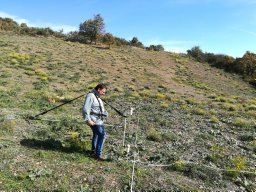
High resolution techniques for data acquisition and processing procedures are increasingly applied in near-surface geophysics for archaeology. In this paper we present the preliminary results of two geophysical measurements campaigns aimed to the investigation of buried remains in the archaeological sites of Θουρία (Péloponnèse, Hellas) and Sibari (Southern Italy). In the first field survey the geophysical approach involved the integrated application of the geoelectrical and magnetic methods and an innovative tomographic analysis for the inversion of both resistivity and magnetic data. In the second case, we carried out high resolution magnetic measurements, interpreted by means of the use of an appropriate filtering procedure. The applied data inversion allows us to provide reliable space patterns of the most probable specific target boundaries, improving the information quality of geophysical methods. The results obtained at this early stage of data processing confirm some archaeological hypothesis about the investigated areas and confirm that the use of integrated geophysical methods allows the archaeologists to reduce the time and the costs of their surveys.
The electricity network in developing countries is often characterized by a weak stability of voltage and frequency, frequent accidental power cuts, high losses in the distribution network and regular planned load shedding schemes. All these issues prevent normal access to electricity by the population, inhibiting and impoverishing the whole country. One approach to overcoming these issues is to switch from the centralized paradigm of old power production schemes to a new decentralized generation of power. Needs and difficulties in developing countries are different compared to residential and SME in developed countries. Therefore, new inverters which are suitable in power range and settings for a decentralized residential PV system with backup are needed. In this project we explore the technical challenges to connecting small residential grid-connected (GC) PV systems with and without storage capabilities. The first five small photovoltaic residential systems (1.1kWp) were installed in the Kathmandu Valley in October 2012. Three locations reflecting the typical conditions of the electricity grid in Kathmandu were chosen. Load shedding and power cuts occur during 38.1% of the time (9.2 hrs/day and ranging from 6.7 to 12 hrs/day). In the reference location without load shedding, three PV systems produced an average of 1600 kWh/kWp annually. With load shedding, production was 44% lower. In the third location a residential microgrid with a 9.6kWh storage system generated 15% lower energy compared to the reference location but delivered energy 100% of the time
The current unreliability of the electrical network in Nepal, and the growing needs of users, together with the high level of losses in the electricity distribution grid can be partially resolved by means of a decentralized and partly autonomous electricity supply. The Nepali grid is characterized by weak stability, frequent accidental powercuts and regular planned load shedding schemes (up to 20 hrs. a day in the dry season), causing particular suffering to SMEs (Small and Medium Enterprises). A feasibility study [1] has demonstrated the cost advantages of a small solar PV grid connected system in combination with a battery back-up, compared to traditional petrol gensets or battery chargers from the grid with stand-alone inverters. The pilot project foresaw the design, construction and monitoring of 5 grid-connected 1.11 kWp PV plants at three different strategic locations, P1, P2 and P3, in the urban and semi-urban environment of the Kathmandu valley. While four of the PV systems are standard grid connected systems, of which three are installed in “No-Load Shedding Zone” P2 and one in “Load Shedding Zone” P1, the fifth system P3, is installed in a “Load-Shedding Zone”, but is designed with a battery bank backup system, and can therefore function as a micro-grid. The setup parameter limit of the grid-connected inverter was adjusted in accordance with the effective situation of the distribution grid (voltage and frequency limits, duration of power cut, etc.). Performance monitoring of the plants started in late 2012. The first 9 months of analysis shows energy generation losses of about 47.6% (475kWh) at P1, due to the load shedding schedule at the time. The performance of the three PV plants at P2, where no load shedding occurs, was as expected, with all generated energy fed into the grid. The 1.11 kWp PV grid-connected plant with a battery backup at P3 in effect performs as a stand-alone system providing enough energy for one household and an NGO office.
For several reasons, amorphous silicon is expected to be the preferred technology for hot climates: low temperature coefficients for maximum power, prevalence of annealing effect over light induced degradation, better matching of the solar spectrum due to air mass effects and smaller fraction of diffused light in comparison to direct one. An empirical method of the energy yield prediction of the amorphous silicon technology using full time series of irradiance and temperature for different geographical locations was developed, validated for a roof integrated PV system and a free mounted triple junction amorphous silicon module and simulated for different sites in Europe and Africa.
The Institute for Applied Sustainability to the Built Environment (ISAAC) of the University of Applied Sciences and Arts of Southern Switzerland (SUPSI) has over twenty years of experience in the field of PV module testing. Single PV modules are tested outdoor and indoor with the aim to assess their quality and reliability in terms of power, energy output and stability. To achieve a high accuracy in delivered results, improved data quality control and new data analysis features have been implemented at SUPSI over the last years. The outdoor measurements are carried out with Maximum-Power-Point-Tracker's (MPPT3000), whereas all indoor measurements with a class A+ solar simulator. The MPPT3000 system allows customized measurements of all module I-V parameters as well as module and ambient temperatures and irradiance. All data undergoes an automatic quality control, which facilitates data analysis and improves energy yield comparisons. This contribution reports on the implementation of these quality control activities. The paper will focus on the detection of errors like e.g. shading, missing data, MPPT tracking problems and drift of sensors and their influence on the final performance ratio and kWh/Wp inter-comparison.
The purpose of this paper is to present the activity of the MPVT (Multi-Purpose PV Module Tester) project funded by the Innovation Promotion Agency (CTI) of the Swiss Confederation. The aim of the project is to develop an extremely versatile measurement equipment for the indoor testing of PV modules by upgrading and integrating new functionalities into an existing pulsed solar-simulator based IV measurement set-up. The newly developed MPVT set-up will be able to realize IV measurements at standard test conditions, temperature coefficients (TCO's) and measurement at different irradiance levels. In addition, a set-up to measure spectral response (SR) of large-area module will be implemented in the system. The MPVT system will be adapted to the needs of the different PV technologies present today on the market, which require a larger flexibility in terms of electrical measurement conditions (high-voltage/low-current thin film PV and high-current/low-voltage c-Si technologies). Moreover, traditional or alternative solutions will be implemented to overcome problems - related to the short duration of the light pulse - which some technologies may encounter when performing power measurements with flashers, as for example, high efficient c-Si modules, which are characterized by high cell capacitances.
The paper presents the results of a two years outdoor monitoring campaign that has been carried out on the same polycrystalline photovoltaic module at two different locations in Europe: the SUPSI-ISAAC outdoor facility in Lugano, Switzerland, from April 2006 till May 2007, and the outdoor ESTER facility in Rome, from April 2008 till May 2009. Since the same module has been tested in two places using the same testing electronic unit (MPPT 3000), the device performance differences can mainly be ascribed to the different local environmental conditions. A detailed characterization of the climatic conditions in Lugano and Rome for the periods of interest have been performed and the PV module performance comparison has been carried out in terms of module efficiency, module yield (Y) and Performance Ratio (PR). No evident influence of the PV module different mounting and monitoring management has been observed on the module performance. The PR monthly trend is mainly due to the temperature influence on the module behaviour, with lower values during summer months; for the same reason, the higher temperatures experienced in Rome penalize the performance. The monthly PR appears higher for Lugano than for Rome apart from the April 07-09 case where the performance in Rome has been higher. A 3% maximum PR deviation between the two sites has been registered during the autumn months.
 Friesen, G.合作论文数23Enrico Burà合作论文数13Serge Rezzonico合作论文数12V. Lapenna合作论文数11N. Cereghetti合作论文数11A. Realini合作论文数8I. Pola合作论文数7
 Sebastian Dittmann合作论文数6
 Ralph Gottschalg合作论文数Centre for Renewable Energy Systems Technology;Department of Electronic and Electrical Engineering;Loughborough University;Centre for Renewable Energy Systems Technology, Loughborough University6i zanetti合作论文数5d stellbogen合作论文数5Antonella Realini合作论文数5
 Thomas R. Betts合作论文数Centre for Renewable Energy Systems Technology (CREST), Loughborough University5
 Alessandro Virtuani合作论文数5W. Herrmann合作论文数5
 Enzo Rizzo合作论文数Istituto di Metodologie Avanzate di Analisi Ambientale, CNR5Mariagrazia D'Emilio合作论文数5H. De Moor合作论文数5
 Antoine Guerin de Montgareuil合作论文数5k nagel合作论文数4r meoli合作论文数4
 Davide Strepparava合作论文数ISAAC Univ Appl Sci & Arts Southern Switzerland4
 S.R. Williams合作论文数School of Electronic, Electrical and Systems Engineering, Loughborough University4Zdanowicz, Tadeusz合作论文数4
 Noud van der Borg合作论文数4Nerio Cereghetti合作论文数4A. R. Burgers合作论文数4Angelo Bernasconi合作论文数4Sabatino Piscitelli合作论文数4
 A. Zahnd合作论文数Department of Mechanical Engineering, Kathmandu University and RIDS-Nepal4
 Antonio Loperte合作论文数4m camani合作论文数3D. Domine合作论文数3B. Di Fiore合作论文数3
 G. Di Bello合作论文数3Paolo Vitti合作论文数Univ Notre Dame3
 David Infield合作论文数Department of Electronic & Electrical Engineering, Faculty of Engineering, University of Strathclyde3
 Perrone Angela合作论文数3
 Wilhelm Warta合作论文数Fraunhofer Institute for Solar Energy Systems3
 Marianna Balasco合作论文数Dipartimento di Geologia e Geofisica, Università degli studi di Bari3
 Vincenzo Lapenna合作论文数Istituto di Metodologie per l’Analisi Ambientale, Consiglio Nazionale delle Ricerche3
 Davide Rivola合作论文数3
 Maria Lanfredi合作论文数3Uma Murthy合作论文数Department of Computer Science;Virginia Tech;Department of Computer Science, Virginia Tech3
 Ewan Dunlop合作论文数Joint Research Centre, European Commission3A SENMAJUMDAR合作论文数3Manjusri Das合作论文数3D. Iacobucci合作论文数2




