We describe the design, fabrication and test results of a segmented Hybrid Photon Detector with integrated auto-triggering front-end electronics. Both the photodetector and its VLSI readout electronics are custom designed and have been tailored to the requirements of a recently proposed novel geometrical concept of a Positron Emission Tomograph. Emphasis is laid on the PET specific features of the device. The detector has been fabricated in the photocathode facility at CERN.
The design of a data acquisition system (DAQ) for a novel positron emission tomography (PET) scanner is reported. The PET system, based on long axially oriented scintillation crystals, readout by hybrid photon detectors (HPD), allows 3-D parallax-error free Compton enhanced gamma reconstruction. The DAQ system is composed of several readout cards, each one associated with a module of the PET scanner, and of a main card that controls the whole system. Using fast triggering signals from the silicon sensor back-planes, the main card performs the coincidence analysis and, in case of coincidence, it enables the readout of the two modules involved. The other modules are left free to perform new acquisitions. This concept based on several independent, event-driven and parallel readout chains, drastically reduces the acquisition dead time. Each enabled readout card digitizes, encodes and stores data from the associated module. Data are stored in a local FIFO and then are transferred through a network into a single computer. The system is designed according to the specifications of the IDEAS VaTaGP5. chip. Each readout card is able to accommodate all the chip readout modes and the test procedures and can be used as a standalone readout system that allows reading out up to 16 daisy chained chips per channel. The DAQ system here reported, designed for a two module demonstrator setup, was developed to study and optimize the essential design parameters.
The design of a data acquisition system (DAQ) for a positron emission tomography scanner is reported. The PET system, based on long axially oriented scintillation crystals, read out by hybrid photon detectors (HPD), allows 3D parallax-error free Compton enhanced gamma reconstruction. The DAQ system is composed of several readout cards, each one associated with a module of the PET scanner, and of a main card that controls the whole system. Using fast triggering signals from the silicon sensor backplanes, the main card performs the coincidence analysis and, in case of coincidence, it enables the read-out of the two modules involved. The other modules are left free to perform new acquisitions. This concept based on several independent, events driven and parallel read-out chains, drastically reduces the acquisition dead time. The DAQ system here reported, designed for a two module demonstrator set-up, was developed to study and optimize the essential design parameters
We describe the design, fabrication and test results of a segmented hybrid photon detector with integrated auto-triggering front-end electronics. Both the photodetector and its VLSI readout electronics are custom designed and have been tailored to the requirements of a recently proposed novel geometrical concept of a positron emission tomograph. Emphasis is put on the PET-specific features of the device. The detector has been fabricated in the photocathode facility at CERN.
The fibre optic transmission systems require a bandwidth of about 25 THz in telecommunications networks, for which it is necessary to resort to dense wavelength division multiplexing (DWDM) systems. These systems need optical filters to broadcast selectively or not in a given wavelength band.A new very promising technology for these applications is the photonic crystals with forbidden bandgap (photonic bandgap (PBG)).In this paper, we propose a model of PBG devices to design DWDM filters on PBG materials. Copyright © 2004 John Wiley & Sons, Ltd.
A powerful and efficient model recently proposed by the authors based on the leaky mode propagation method is used to characterize photonic bandgap structures incorporating multiple defects, having arbitrary shape and goemetrical parameter values. The importance of the defect-mode characterization in photonic bandgap materials is due to the intensive use of defects for ligth localization to design very, promising optical devices. This paper provides a new, efficient method to model defects in waveguiding, finite-size photonic bandgap devices and analytical and closed-form expressions for the reflection and transmission coefficients and out-of-plane losses,which is very useful and easily implemented under any operating conditions. Moreover, the method has been applied to examine the capabilities of waveguiding photonic bandgap devices in dense wavelength division multiplexing filtering applications. Therefore, the design of two optical filters for such applications has been carried out and optimal design rules have been drawn using the new model.
Several studies have shown that removing mass from a plate has the same, or even greater effect, as losing rigidity. The result is a lighter structure with an equal or higher fundamental frequency of transverse vibration; in other words, dynamic stiffening has been achieved.
A numerical solution is obtained for the title problem by means of the popular finite element method. An experimental investigation of the problem is also presented for plates of square planform. The agreement between theoretical and experimental values is very good in the case of the fundamental frequency, and reasonably good when the second and third normal modes of transverse vibration are considered. It is concluded that beneficial effects are obtained in the sense that one generates a lighter structural element with higher fundamental frequency of transverse vibration. Hence, dynamic stiffening is achieved.
The present study deals with two types of considerations which are of practical importance when dealing with vibrating, simply supported Timoshenko beams: (1) range of validity of the theory, taking as a basic geometric-mechanical parameter the ratio: radius of gyration of the cross-section/beam length; and (2) the position of the supports at the beam ends.
 E. Chesi合作论文数4C. Joram合作论文数4R. De Leo合作论文数4
 Eugenio Nappi合作论文数Istituto Nazionale di Fisica Nucleare4J. Seguinot合作论文数4
 Annabel Braem合作论文数CERN4P.A.A. Laura合作论文数4Peter Weilhammer合作论文数4
 Angelo Dragone合作论文数INFN, Sezione di Bari and Politechnic of Bari4
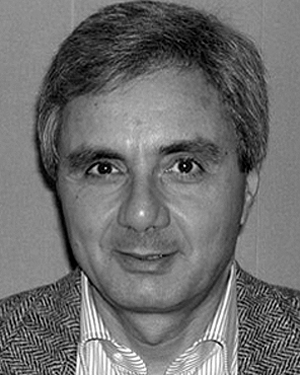 Francesco Corsi合作论文数Dipartimento di Ingegneria Elettronica4Re Rossi合作论文数3A. Argentieri合作论文数3H. Zaidi合作论文数2F. Ciocia合作论文数2p losito合作论文数2s mathot合作论文数2
 Anna Gina Perri合作论文数Elect Devices Lab, Polytech Univ Bari2
 Liberto Ercoli合作论文数2J.L. Pombo合作论文数2
 Cristoforo Marzocca合作论文数2
 S. La Malfa合作论文数2I. Vilardi合作论文数2Franco Garibaldi合作论文数2
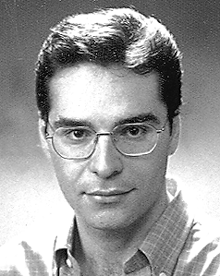 Agostino Giorgio合作论文数Dipartimento di Elettrotecnica ed Elettronica;Politecnico di Bari;Dipartimento di Elettrotecnica ed Elettronica, Politecnico di Bari2P.M. Bellés合作论文数1
 V. W. Scarola合作论文数Condensed Matter Theory Center;Department of Physics;University of Maryland;Condensed Matter Theory Center, University of Maryland1




