In the present worldwide, the structure of the education faces various difficulties because of the powerful idea of the environment. One of the innumerable difficulties for enlightenment structure today is to fulfil its highly skilled faculty to manage the regularly adjusting and embryonic illumination globe A faculty can do his/her utmost capability if she/he is pleased with the task. A well-satisfied faculty can utilize his/her talent for the welfare of the students. This paper explores the job satisfaction level of contract faculty, serving in government and private institutions functioning near the border area of Gurdaspur district in Punjab, India. It also focuses on the problem and exploitation which are faced by contractual faculty due to the policies adopted by the management of these engineering institutions during their career. Approximately 700 questionnaires were distributed personally for survey and through emails. Information was collected through a study of 150 faculty members of educational institutes, serving in seven governments and self-financed colleges and private universities functioning near the perimeter area of Gurdaspur. The outcomes show that there is an immediate relationship between parameters like professional development and job satisfaction. The study presumes that by giving the best workplace, the educational institutes can build the level of job satisfaction of their faculty. Analytical results of the study have been verified with the help of SPSS-16 software. Keywords: Job satisfaction, Edification system, Contractual faculty, Rural Area, Border area.
The tradition and practice of hiring contract labour have been common in many parts of India for the long time back. Although believed to be a monetary necessity, but it has been condemned on the ground that it creates employee exploitation. Though system cannot be abolished exploitation absolutely. In spite, the many harm linked to it, but the structure offers much essential employment to a considerable number of employees. This paper aimed to explore the feelings of contractual faculty towards administrative discrimination in engineering institutions in the border area of Gurdaspur district. In this article helps in finding the relationship between parameters like stress level of work, welfare services, pay satisfaction, provident fund facility, gratuity facility, professional with the satisfaction level of the contract faculty. The diagnosis of this study is that the technical institutions and private university in border area Gurdaspur need to understand the importance of feelings of contract faculty.
For sustainable management, i.e., environmental, economic and social issues in supply chain, there is an urge need to focus on operational issues. This current research presents a new decision making framework to facilitate this on the basis of questionnaire based survey in Indian industries. Nine operational issues in sustainable supply chain management are considered in this research for analysis. Regarding this, weighted interpretive structural modelling (W-ISM) an extended version of interpretive structural modelling (ISM) has been used to find effectiveness index and to identify the strong and weak areas, to establish a relationship and to identify driving and dependence powers among operational issues in sustainable supply chain management. The results of this analysis are highly beneficial towards society and environment perspectives for industries.
In this paper, Artificial bee colony (ABC) and Grey wolf optimization (GWO) techniques have been proposed to find kinematics solution. Inverse kinematics is an important parameter for the movement of joints from one location to end-effectors' position. During the movement to reach to the destination various errors will incur. Different evolutionary and metaheuristics have been proposed to solve the inverse kinematics solution with minimum errors. ABC and GWO are two novel metaheuristic techniques that are based on population. These algorithms are used to minimize the errors present in the inverse kinematics solution. Errors to be calculated are position error and absolute error. GWO takes less time than ABC algorithm during the iteration. ABC and GWO are naturally inspired swarm techniques.
Supplier selection acts as the pivotal role in an enterprise's business development, with future competitive ability in an industrial environment. The selecting process mainly involves evaluation of different alternative suppliers based on different criteria. Both qualitative and quantitative factors have to be considered and a trade-off is made between tangible and intangible factors while selecting a supplier. In the present paper, an analytical model has been developed for selecting supplier for Indian chemical organisations using TOPSIS method. In the present example, we have attempted to give empirical evidence to provide manufacturing managers a practical methodology for selecting suitable suppliers. It has been concluded that quality products are beneficial only if their customers are satisfied with the service being provided by the suppliers.
Intelligent manufacturing system (IMS) presents system with autonomous ability to adapt to unexpected changes. In order to succeed in this ever so demanding, fast pace business environment, managers need integrated and IMS capable of supporting them throughout the decision-making lifecycle. Therefore, it is worthwhile to invest on making appropriate decisions on IMS selection. The selecting process mainly involves evaluation of different alternatives based on different criteria. This process is essentially considered as a multiple criteria decision-making (MCDM) problem which is affected by different tangible and intangible criteria including price, quality, performance, lead-time, efficiency, etc. This paper presents a model based on VIKOR method to select an appropriate IMS. Based on the concept of fuzzy logic and the VIKOR method, the proposed fuzzy VIKOR method has been developed to provide a rational and systematic process. The proposed method can be used to find a best solution to resolve a fuzzy MCDM problem and to specify the preferred solution for any decision problem in real organisational set up.
Supplier selection and evaluation are arguably one of the most critical functions for the success of an organisation in today's competitive scenario. Both qualitative and quantitative factors have to be considered and a trade off is made between tangible and intangible factors while selecting a supplier. This selection is one of the decisions which determine the long-term viability of the organisation. Literature reveals that many methods have been used to objectively evaluate suppliers including analytic hierarchy process (AHP). AHP has been proposed in this paper for supplier selection for a textile industry. The criteria and sub-criteria for alternate suppliers have been taken by a study of a real problem with the help of engineers working in production, purchase and quality control departments of the concerned industry.
Supply chain management is an increasingly important organizational concern, and proper evaluation of suppliers constitutes one essential element of supply chain success. Continuous evaluation of a particular supplier becomes more important considering the fact that in most industries the cost of raw materials and component parts constitutes the main cost of a product, such that in some cases it can account for up to 70%. However, there is little research that has helped organizations in continuous evaluation of their suppliers. We propose a new model based on fuzzy logic to handle the various attributes associated with supplier evaluation problems. Four multi-input single-output (MISO) Mamdani fuzzy inference systems have been proposed for supplier evaluation. The proposed model has also been illustrated through a case study.
This paper is based on the data collected from a survey of 66 Indian textile-related organizations carried out to ascertain issues related to effects of timely fulfillment of customer demand in supply chain management (SCM) practices. Using the data collected, fuzzy set theory has been applied to reach a decision regarding effects of timely fulfillment of customer demand on an organization. Four multi-input single-output (MISO) Mamdani fuzzy inference systems have been proposed as an alternative approach to handle the various variables that are normally considered in such cases in Indian textile organizations. First three MISO systems consist of four inputs (decrease in production lead time, reduction in overall cycle time, improvement in quality, betterment in process integration), three inputs (decrease in production cost, increase in profits, increase in market share), and three inputs (decrease in internal conflicts, increase in customer satisfaction, betterment in buyer–supplier relations), respectively, and give out single output each, namely production effect, monetary effect, and relation effect, respectively. These three outputs are used as inputs to the fourth MISO system to give out single output, termed as final effect.
This paper is based on the data collected from a survey of 66 Indian textile-related organisations carried out to ascertain issues related to supplier selection. Using the data collected, fuzzy set theory has been applied to reach a decision regarding selection or rejection of a particular supplier. Four Multi-Input Single-Output (MISO) mamdani fuzzy inference systems have been proposed. First three MISO systems consist of three inputs, four inputs and three inputs respectively and give out single output each. These three outputs are used as inputs to the fourth MISO system to give out single output, termed as final decision.
Supply chain integration is considered one of the major factors in improving performance. While each manufacturer must customise its supply chain to fit its particular circumstances, several core supply chain concepts must be embraced throughout the organisation. This paper is based on the data collected from a survey of 66 Indian textile-related organisations, carried out to ascertain issues related to integrated supply chain management. Issues related to objectives of integrated supply chain, importance of integrated supply chain, useful index for performance measurement of integrated supply chain and factors helpful in supply chain integration have been discussed.The findings indicate that theorganisations consider lowering the production cost as the most crucial objective as well as a factor for performance measurement in integrated supply chain design.It has further been found that customer satisfaction is considered as most useful index forperformance measurement in integrated supply chain design. Barriers in design and implementation of integrated supply chain are also discussed.
There can be little dispute that supply chain management and design is an area of importance in the field of engineering, yet there have been few literature reviews on this topic. Over the past decade, the traditional purchasing and logistics functions have evolved into a broader strategic approach to materials and distribution management in engineering, known as supply chain management. This paper sets out not to review the work carried out for different stages in supply chain per se, but rather to contribute to a critical theory debate through the presentation and use of a framework for the categorisation of literature linked to various stages of supply chain management and design. In addition, this paper attempts to clearly describe supply chain management since the literature is replete with buzzwords that address elements or stages of this new management philosophy. The present study is based on the analysis of a large number of publications on supply chain management and design.
Supplier selection is arguably one of the most critical functions for the success of an organisation in today’s competitive scenario. Both qualitative and quantitative factors are considered and a trade off is made between tangible and intangible factors while selecting a supplier. This selection is one of the decisions which determine the long-term viability of the organisation. Literature reveals that many methods have been used to objectively evaluate suppliers including analytic hierarchy process (AHP). Considering drawback of AHP that it handles crisp values only, use of AHP based on fuzzy simulation (FSAHP) has been proposed in this paper. The weights of criteria and sub-criteria of alternatives have been represented by fuzzy linguistic variables and fuzzy simulation has been used to estimate the expected value of fuzzy weights of different alternatives for the decision analysis of three suppliers for a textile-based industry.
Supply chain management (SCM) is regarded as a means to maximise the overall value generated. The importance of SCM in Indian textile industry has increased when more and more companies have realised the possibilities of gaining additional value for their customers with the implementation of supply chain concepts. Distribution system is one of the main parts of supply chain. This paper is based on the data collected from a survey of 66 Indian textile-related organisations carried out to ascertain issues related to distribution system of supply chain and customers. Issues related to capability of SCM in reading and responding real customer demand, ability of organisations to respond quickly to volatile market, advantages that can be achieved by quick response to customers' demands and management of relations with the customers have been discussed. The findings indicate that the organisations consider 'delivery speed' as the most influential factor in reading and responding real customer demand. Barriers in implementation of supply chain concepts in distribution system and relationships between manufacturers and customers are also discussed.
Supply chain management (SCM) is regarded as a means to maximise the overall value generated. SCM includes all functions involved in receiving and filling a customer request by forging close relationships with customers and suppliers. Strong relationships and mutual trust between buyer and suppliers are essential for the successful implementation of SCM. This paper is based on the data collected from a survey of 66 Indian textile-related organisations carried out to ascertain issues related to supplier selection and evaluation. The findings indicate that the main criteria for supplier selection in Indian textile organisations are service provided, quality and on-time delivery of material. Effect of supplier selection on performance of organisation and factors influencing development of trust between buyer and suppliers are also discussed.
In an attempt to prepare permselective membrane, grafting of acrylic acid (AAc) onto Teflon-fluorinated ethylene-propylene (FEP) film was studied in aqueous medium by the preirradiation method in air. Grafting was carried out by heating a mixture of AAc, water, and preirradiated Teflon-FEP film in air at 93 degrees C for definite time periods. Percentage of grafting was determined as a function of total dose, monomer concentration, reaction time, and amount of water. Maximum percentage of grafting (60.17%) was obtained at a total dose of 4.8 Mrad using 0.07M [AAc]. Evidence of grafting was obtained from the physical appearance and swelling behavior of the grafted film in polar solvents. Infrared spectroscopic and thermal analysis of the grafted film provided additional evidence for grafting. A plausible mechanism for grafting of AAc onto preirradiated Teflon-FEP film in air has been proposed. (C) 1995 John Wiley and Sons, Inc.
 Om Pal Singh合作论文数Indira Gandhi Centre for Atomic Research9
 Vishal Mahajan合作论文数Srinivas University, State University2Seema合作论文数2Bn Misra合作论文数1seema合作论文数1
 Pawan Kumar Sondhi合作论文数1
 Vijay Kumar Banga合作论文数Amritsar Coll Engn & Technol, Dept Elect & Commun Engn, Amritsar, Punjab, India1
 Mahesh Chand合作论文数1
 Jagdev Singh合作论文数Department of Mathematics, JECRC University1
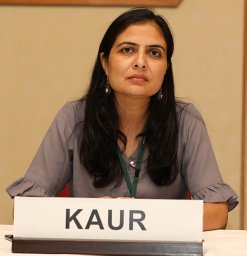 Inderjeet Kaur合作论文数Department of Dermatology, Venerology, and Leprology, Postgraduate Institute of Medical Education and Research1
 Thaweesak Yingthawornsuk合作论文数1




