Solid tumors, especially those with aberrant MYCN activation, often harbor an immunosuppressive microenvironment to fuel malignant growth and trigger treatment resistance. Despite this knowledge, there are no effective strategies to tackle this problem. We found that chemokine-like factor ( CKLF ) is highly expressed by various solid tumor cells and transcriptionally up-regulated by MYCN. Using the MYCN-driven high-risk neuroblastoma as a model system, we demonstrated that as early as the premalignant stage, tumor cells secrete CKLF to attract CCR4-expressing CD4 + cells, inducing immunosuppression and tumor aggression. Genetic depletion of CD4 + T regulatory cells abolishes the immunorestrictive and protumorigenic effects of CKLF. Our work supports that disrupting CKLF-mediated cross-talk between tumor and CD4 + suppressor cells represents a promising immunotherapeutic approach to battling MYCN-driven tumors.
Abstract Neuroblastoma, especially those with aberrant MYCN activation, often harbor an immunosuppressive microenvironment to fuel malignant growth and trigger treatment resistance. Despite this knowledge, there are no effective strategies to tackle this problem. Here we combined analyses of human neuroblastoma with live tracking and functional studies of the tumor microenvironment (TME) in zebrafish. We identified chemokine-like factor (CKLF) as a key driver of MYCN-mediated immunosuppression and neuroblastoma aggression. We showed that human MYCN-activated neuroblastoma upregulates and secretes CKLF, which is a reliable predictor of poor patient survival. Analysis of primary patient samples demonstrates a strong positive association between MYCN and CKLF expression in neuroblastoma cells together with the enrichment of FOXP3+ T cells in the TME. Taking advantage of in vivo zebrafish models of MYCN-driven neuroblastoma that resemble human high-risk disease, we demonstrated that cklf overexpression in zebrafish neural crest cells induces an immunosuppressive TME while promoting rapid tumor onset and progression. We also demonstrated that as early as the premalignant stage, tumor cells secrete CKLF to attract CCR4-expressing Cd4+ cells to induce immunosuppression and tumor aggression. Conversely, genetic depletion of cklf in tumor cells reduces the recruitment of Cd4+ cells to the TME while increasing cytotoxic Cd8+ and natural killer cells infiltration, inhibiting neuroblastoma development in zebrafish. Our work provides the first example that MYCN can activate CKLF to allure CD4+ immune cells to the TME and incite immunosuppression, positioning CKLF as a potential novel immunotherapeutic target for the treatment of MYCN-driven high-risk neuroblastoma. Citation Format: Xiaodan Qin, Hui Feng, Andrew Lam, Xu Zhang, Satyaki Sengupta, Bryan Iorgulescu, Sanjukta Das, Zhenwei Zhou, Tao Zuo, Grace Meara, Madison Rager, Alexander Floru, Hongru Ni, Chinyere Kemet, Divya Veerapaneni, Daniel Kashy, Liang Lin, Kenneth Lloyd, Lauren Kwok, Kaylee Smith, Raghavendar Nagaraju, Rob Meijers, Craig Ceol, Ching-Ti Liu, Sanda Alexandrescu, Catherine J. Wu, Derin Keskin, Rani George. CKLF attracts CCR4-expressing CD4+ cells to foster immune repression and tumor aggressiveness in MYCN-driven neuroblastoma [abstract]. In: Proceedings of the AACR Special Conference in Cancer Research: Tumor-body Interactions: The Roles of Micro- and Macroenvironment in Cancer; 2024 Nov 17-20; Boston, MA. Philadelphia (PA): AACR; Cancer Res 2024;84(22_Suppl):Abstract nr C002.
The proliferation of scientific podcasts has generated an extensive repository of audio content, rich in specialized terminology, diverse topics, and expert dialogues. Here, we introduce a computational framework designed to enhance large language models (LLMs) by leveraging this informational content from publicly accessible podcast data across science, technology, engineering, mathematics and medical (STEMM) disciplines. This dataset, comprising over 3, 700 hours of audio content, was transcribed to generate over 42 million text tokens. Our model, PodGPT, integrates this wealth of complex dialogue found in audio podcasts to improve understanding of natural language nuances, cultural contexts, as well as scientific and medical knowledge. PodGPT also employs retrieval augmented generation (RAG) on a vector database built from articles in Creative Commons PubMed Central and The New England Journal of Medicine , enhancing STEMM research and education by providing real-time access to emerging scientific literature. Evaluated across multiple benchmarks, PodGPT demonstrated an average improvement of 3.51 percentage points over standard open-source benchmarks and 3.81 percentage points when augmented with evidence from the RAG pipeline. Moreover, it showcased an average improvement of 4.06 percentage points in its zero-shot multi-lingual transfer ability, effectively generalizing to different linguistic contexts. By harnessing the untapped potential of podcast content, PodGPT advances natural language processing and conversational AI, offering enhanced capabilities for STEMM research and education.
Abstract Neuroblastoma, especially those with aberrant MYCN activation, often harbor an immunosuppressive microenvironment to fuel malignant growth and trigger treatment resistance. Despite this knowledge, there are no effective strategies to tackle this problem. Here we combined analyses of human neuroblastoma with live tracking and functional studies of the tumor microenvironment (TME) in zebrafish. We identified a tumor-associated chemokine (TAC) as a key driver of MYCN-mediated immunosuppression and neuroblastoma aggression. Taking advantage of in vivo zebrafish models of MYCN-driven neuroblastoma that resemble human high-risk disease, we demonstrated that TAC overexpression in zebrafish neural crest cells induces an immunosuppressive TME while promoting rapid tumor onset and progression. We also demonstrated that as early as the premalignant stage, tumor cells secrete TAC to attract CCR4-expressing Cd4+ cells to induce immunosuppression and tumor aggression. In addition, genetically depleting Cd4+ T regulatory cells abolishes the immunorestrictive and pro-tumorigenic effects of TAC. We showed that human MYCN-activated neuroblastoma upregulates and secretes TAC, which is a reliable predictor of poor patient survival. Analysis of primary patient samples demonstrates a strong positive association between MYCN and TAC expression in neuroblastoma cells together with the enrichment of FOXP3+ T cells in the TME. Our work provides the first example that MYCN can activate TAC to allure CD4+ immune cells to the TME and incite immunosuppression, positioning TAC as a potential novel immunotherapeutic target for the treatment of MYCN-driven high-risk neuroblastoma. Citation Format: Xiaodan Qin, Andrew Lam, Xu Zhang, Satyaki Sengupta, J. Bryan Iorgulescu, Sanjukta Das, Zhenwei Zhou, Tao Zuo, Grace K. Meara, Madison Rager, Alexander E. Floru, Hongru Ni, Chinyere Kemet, Divya Veerapaneni, Daniel Kashy, Liang Lin, Kenneth Lloyd, Lauren Kwok, Kaylee S. Smith, Raghavendar T. Nagaraju, Rob Meijers, Craig Ceol, Ching-Ti Liu, Sanda Alexandrescu, Catherine J. Wu, Derin B. Keskin, Rani E. George, Hui Feng. A tumor-associated chemokine attracts CCR4-expressing CD4+ cells to foster immune repression and tumor aggressiveness in MYCN-driven neuroblastoma [abstract]. In: Proceedings of the AACR-NCI-EORTC Virtual International Conference on Molecular Targets and Cancer Therapeutics; 2023 Oct 11-15; Boston, MA. Philadelphia (PA): AACR; Mol Cancer Ther 2023;22(12 Suppl):Abstract nr LB_C20.
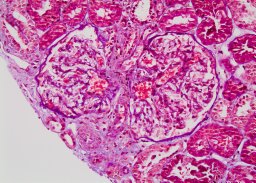
Interstitial fibrosis and tubular atrophy (IFTA) on a renal biopsy are strong indicators of disease chronicity and prognosis. Techniques that are typically used for IFTA grading remain manual, leading to variability among pathologists. Accurate IFTA estimation using computational techniques can reduce this variability and provide quantitative assessment. Using trichrome-stained whole-slide images (WSIs) processed from human renal biopsies, we developed a deep-learning framework that captured finer pathologic structures at high resolution and overall context at the WSI level to predict IFTA grade. WSIs (n = 67) were obtained from The Ohio State University Wexner Medical Center. Five nephropathologists independently reviewed them and provided fibrosis scores that were converted to IFTA grades: ≤10% (none or minimal), 11% to 25% (mild), 26% to 50% (moderate), and >50% (severe). The model was developed by associating the WSIs with the IFTA grade determined by majority voting (reference estimate). Model performance was evaluated on WSIs (n = 28) obtained from the Kidney Precision Medicine Project. There was good agreement on the IFTA grading between the pathologists and the reference estimate (κ = 0.622 ± 0.071). The accuracy of the deep-learning model was 71.8% ± 5.3% on The Ohio State University Wexner Medical Center and 65.0% ± 4.2% on Kidney Precision Medicine Project data sets. Our approach to analyzing microscopic- and WSI-level changes in renal biopsies attempts to mimic the pathologist and provides a regional and contextual estimation of IFTA. Such methods can assist clinicopathologic diagnosis.
 Kaylee S Smith合作论文数5Grace K. Meara合作论文数5Xu Zhang合作论文数5Kenneth Lloyd合作论文数5Andrew Lam合作论文数5Lauren Kwok合作论文数5
 Chinyere Kemet合作论文数5Zhenwei Zhou合作论文数5
 Xiaodan Qin合作论文数Sect Hematol & Med Oncol, Boston Univ5Satyaki Sengupta合作论文数Department of Pediatrics, Harvard Medical School5
 Sanjukta Das合作论文数Dept Pediat Hematol Oncol, Dana Farber Canc Inst5Tao Zuo合作论文数5
 Liang Lin (林梁)合作论文数LeBow Inst Myeloma Therapeut, Dana Farber Canc Inst5
 Sanda Alexandrescu合作论文数5
 Iorgulescu J Bryan合作论文数Brigham & Womens Hosp5Meijers Rob合作论文数5
 Craig Ceol合作论文数5
 Ching-Ti T. Liu合作论文数School of Public Health, Boston University5Rani E. George合作论文数5
 Derin Keskin合作论文数Translational Immunogenomics Lab, Center for Immuno-Oncology, Dana Farber Cancer Institute, Medical School, Harvard University;Department of Medicine, Medical School, Harvard University5
 Catherine J. Wu合作论文数Department of Medical Oncology, Dana-Farber Cancer Institute;Division of Stem Cell Transplantation and Cellular Therapies, Dana-Farber Cancer Institute;Harvard Medical School4Alexander E. Floru合作论文数3
 Raghavendar Nagaraju合作论文数Faculty of Life Sciences, The University of Manchester3
 Vijaya B. Kolachalama合作论文数Alzheimer's Disease Research Center, Boston University;Department of Computer Science, College of Arts & Sciences, Boston University;CogniScreen;Altoida, Inc.;DeepPath.AI2Peter Boor合作论文数1Edward Searls合作论文数1Zheng Yi合作论文数1
 Shuyue Jia合作论文数Dept Comp Sci, City Univ Hong Kong1Kevin Ren合作论文数1
 Hui Feng合作论文数Shanghai Junshi Biosci Co Ltd, Shanghai, Peoples R China1
 Laura Barisoni合作论文数Department of Medicine, Duke University School of Medicine1
 Vipul Chitalia合作论文数1
 Claus Lindsey合作论文数Department of Physics and Center for Brain Science, Harvard University1Bellur Shubha S合作论文数1
 Rhoda Au合作论文数Chobanian & Avedisian School of Medicine, Boston University1
 Clarissa A. Cassol合作论文数Department of Pathology, University of Toronto1Sushrut S. Waikar合作论文数1
 Margrit Betke合作论文数Department of Computer Science, Boston University Arts & Sciences;Faculty of Computing & Data Sciences, Boston University1




