A few localities world wide are known to have remainsof dinosaurs andothervertebrate animalsthat livedin thepolarlatitude region during the Mesozoic era. The Teete locality in the Vilyui River Basin, Yakutia (Russia) is one of the few known dinosaur localities in the Northern Hemisphere. In 1988, 2002–2012 school children participated in asearch for Early Cretaceous dinosaurs and other vertebrates at the Teete locality, and teeth and bones were collected and briefly described.Additional vertebrate remains, including lizards, salamanders, choristoderes, and tritylodonts, were discovered in Early Cretaceous sediments in Yakutia, which expanded the number of known locations wherethese animals lived in polar regions. In 2017–2019 comprehensive paleontological studies were conducted in Teete,during which time fragmentary skeletal elements and teeth of various dinosaur groups, as wellas bone elements from other vertebrates, were collected using surface collection methods. This study also yielded new genera of Mesozoic mammaliforms,mammals,and salamanders.The presence of astem salamander, basalturtle, and other Jurassic relicts in the Early Cretaceous vertebrate fauna of Teete suggests that the area was a refugium for these animals during that time. Further study of the Teete locality is expected to lead to the description of new dinosaur and other vertebrate taxa, as wellas to theacquisitionof new data on the adaptation of these animals to circumpolar conditions.
Docodonta are the most abundant and taxonomically diverse group of mammaliaforms in the high paleolatitude Lower Cretaceous Teete locality in Yakutia, Russia. Docodontans are represented by the tegotheriids Khorotherium yakutense and Ergetiis ichchi gen. et sp. nov., and possibly two more taxa known from fragmentary specimens (Docodonta indet.). Ergetiis ichchi gen. et sp. nov. shows a reduction and posterior shift of the angular process of the dentary which could indicate a reduction of the mandibular middle ear potentially in a way analogous to the transitional mammalian middle ear of Eutriconodonta. A revised phylogenetic analysis of Docodonta suggests a stemward position of Docodontidae and a sister group relationship for Simpsonodontidae and Tegotheriidae.
The first findings of frogs (Anura) from the Upper Cretaceous of Russia—the distal part of the humerus and a tibiofibula fragment—were described. They come from the Maastrichtian dinosaur locality in the city of Blagoveshchensk (Amur oblast). The described remains are characterized by the outer and inner structure typical of Anura, and their exact taxonomic affiliation is not defined. These are the easternmost and the youngest frog remains from the Upper Cretaceous of Asia.
Eutriconodonta are an important group of early crown mammals with a wide distribution in the Jurassic-Cretaceous of the Northern Hemisphere and few occurrences in the Southern Hemisphere. Three taxa of eutriconodontans are known from the Early Cretaceous high-latitude Teete vertebrate assemblage in Yakutia, Russia: Sangarotherium aquilonium (Eutriconodonta incertae sedis), Gobiconodon sp. A (large), and Gobiconodon sp. B (small) (Gobiconodontidae). These three taxa are based on four specimens and indicate a remarkable taxonomic diversity of eutriconodontans at this locality. The coexistence of two Gobiconodon species, large and small, is characteristic for several Early Cretaceous vertebrate assemblages in Asia. Gobiconodon sp. A from the Teete locality is the largest species of this genus known from Asia, but is smaller than the North American G. ostromi. The spreading of Gobiconodon from Asia to North America likely occurred during the Aptian-Albian faunal dispersal event. The discovery of Gobiconodon in the Teete locality is further evidence for a dispersal route via Beringia from Asia to North America which previously has been postulated based on the occurrence of Asian dinosaur taxa in western North America at this time. The questionable record of Gobiconodon from Europe and its lack from eastern North America make a dispersal from Asia to North America via Europe less probable.
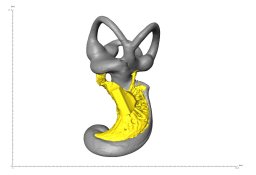
Abstract A mammalian petrosal from the Lower Cretaceous Teete locality in Yakutia (Russia) shows a prominent and complex system of venous channels in the bony wall of the pars cochlearis surrounding the straight cochlear canal. This complex venous system is distinctive and more strongly developed than in other mammalian petrosals. A bony ridge is present on the ventral side of the cochlear canal endocast, continuing from between fenestra vestibuli and fenestra cochleae in anterior direction. This ridge corresponds to the position of the scala tympani, and is similar to the secondary bony lamina of crown therians, but lacks the sharp laminar edge. The fenestra cochleae is separate from the canal for the aquaeductus cochleae (derived), but the fenestra retains a deep sulcus that resembles the perilymphatic sulcus (plesiomorphic). The fenestra cochleae is oval shaped and deep. The straight cochlear canal with a ridge on the ventral side strongly resembles that of eutriconodontans like Priacodon fruitaensis from the Upper Jurassic of North America. However, thick and extensive venous channels in the pars cochlearis are otherwise known from docodontans. In the Teete petrosal the channels are even more developed, and resemble the pattern recently reported from possible haramiyidan petrosals from the Middle Jurassic of western Siberia (Russia). Both eutriconodontan and haramiyidan dental remains are known from the Teete locality beside that of tritylodontids and docodontans.
Isolated stegosaurian teeth from the Early Cretaceous high-latitude (palaeolatitude estimate of N 62°- 66.5°) Teete locality in Yakutia (Eastern Siberia, Russia) are characterized by a labiolingually compressed, slightly asymmetrical and mesiodistally denticulated (9-14 denticles) crown, a pronounced ring-like cingulum, as well as a "complex network of secondary ridges". The 63 teeth (found during on-site excavation in 2012, 2017-2019 and screen-washing in 2017-2019) most likely belong to one species of a derived (stegosaurine) stegosaur. Most of the teeth exhibit a high degree of wear and up to three wear facets has been observed on a single tooth. The prevalence of worn teeth with up to three wear facets and the presence of different types of facets (including steeply inclined and groove-like) indicate the tooth-tooth contact and precise dental occlusion in the Teete stegosaur. The microwear pattern (mesiodistally or slightly obliquely oriented scratches; differently oriented straight and curved scratches on some wear facets) suggest a complex jaw mechanism with palinal jaw motion. Histological analysis revealed that the Teete stegosaur is characterized by relatively short tooth formation time (95 days) and the presence of a "wavy enamel pattern". Discoveries of a "wavy enamel pattern" in the Teete stegosaur, in a Middle Jurassic stegosaur from Western Siberia, and in the basal ceratopsian Psittacosaurus, suggest that this histological feature is common for different ornithischian clades, including ornithopods, marginocephalians, and thyreophorans. A juvenile tooth in the Teete sample indicates that stegosaurs were year-round residents and reproduced in high latitudes. The combination of high degree of tooth wear with formation of multiple wear facets, complex jaw motions, relatively short tooth formation time and possibly high tooth replacement rates is interpreted as a special adaptation for a life in high-latitude conditions or, alternatively, as a common stegosaurian adaptation making stegosaurs a successful group of herbivorous dinosaurs in the Middle Jurassic-Early Cretaceous and enabeling them to live in both low- and high-latitude ecosystems.
Isolated sauropod teeth from the Early Cretaceous Teete locality in Yakutia (Eastern Siberia, Russia) are the only evidence that sauropods lived in high latitudes (palaeolatitude estimate of N 62°) in the Northern Hemisphere. The spatulate broad tooth crowns of adult individuals lack marginal denticles while these are present in a juvenile tooth. The teeth have overlapping facets and likely belong to a basal macronarian. The juvenile tooth indicates that sauropods reproduced in high latitudes and possibly stayed there around the year. The Teete vertebrate assemblage comprises both endothermic, or presumably endothermic tetrapods (theropod dinosaurs, tritylodontids and mammals), and ectothermic tetrapods (salamanders, turtles, choristoderes and lizards), but no crocodyliforms. This suggests a temperate climate, with an annual mean temperature well above freezing level but below 14°C.
This paper describes fragmentary turtle material (isolated basisphenoid, shell bones, humerus and ilium) from the Lower Cretaceous (Berriasian–Barremian) Teete locality in Yakutia (Eastern Siberia, Russia). All the material is attributed to one taxon of basal turtles (Mesochelydia indet.), based on the morphology of the basisphenoid, shell bones and humerus, as well as microanatomy and histology of the shell bones and humerus. Canals and foramina of the basisphenoid of this taxon revealed by CT scanning show an unusual pattern, which allows various interpretations and suggests a higher diversity of carotid and/or vidian systems in basal turtles than hitherto believed. Mesochelydia indet. from Teete fills an Early Cretaceous gap in the record of Asian basal turtles and represents the northernmost Asian non-marine turtle occurrence of the Mesozoic. All in all, the record of Asian basal turtles appears to be wider geographically and more complete temporally than previously thought. The Asian basal turtles are represented by at least three phylogenetic lineages: primitive Testudinata in the Late Triassic, primitive Mesochelydia from the Early Jurassic to the Early Cretaceous and primitive Perichelydia from the Middle Jurassic to the Late Cretaceous. The presence of such a primitive (Jurassic level) turtle in Teete supports the hypothesis that the vast territory of Siberia was a refugium for Jurassic vertebrate faunal elements. Details of the external morphology and histology of the Teete turtle material as well as its high paleolatitude occurrence argue in favor of its aquatic lifestyle.
Euharamiyida represent [Euharamiyida plural] a clade of Mesozoic mammaliaforms with gliriform-like dentition and a dental formula of 1–2.0.2.2/1.0.1.2. By having a high triangular last premolar, on...
A new stem salamander, Kulgeriherpeton ultimum gen. et sp. nov., is described based on a nearly complete atlas from the Lower Cretaceous (Beniasian-Barremian) Teete vertebrate locality in southwestern Yakutia (Eastern Siberia, Russia). The new taxon is diagnosed by the following unique combination of atlantal characters: the presence of a transversal ridge and a depression on the ventral surface of the posterior portion of the centrum; ossified portions of the intercotylar tubercle represented by dorsal and ventral lips; the absence of a deep depression on the ventral surface of the anterior portion of the centrum; the absence of pronounced ventrolateral ridges; the absence of spinal nerve foramina; the presence of a pitted texture on the ventral and lateral surfaces of the centrum and lateral surfaces neural arch pedicels; the presence of a short neural arch with its anterior border situated far behind the level of the anterior cotyles; moderately dorsoventrally compressed anterior cotyles; and the absence of a deep incisure on the distal-most end of the neural spine. The internal microanatomical organization of the atlas is characterized by the presence of a thick, moderately vascularized cortex and inner cancellous endochondral bone. The recognition of stem salamanders and other vertebrates with Jurassic affinities in the Early Cretaceous high-latitude (paleolatitude estimate N 63-70 degrees) vertebrate assemblage of Teete suggests that: (i) the large territory of present day Siberia was a refugium for Jurassic relicts; (ii) there were no striking differences in the composition of high-latitude Yakutian and mid-latitude Western Siberian Early Cretaceous vertebrate assemblages; and (iii) there was a smooth transition from the Jurassic to Cretaceous biotas in North Asia.
Fossil remains (fragmentary dentaries and vertebrae) of Choristodera indet. from the Lower Cretaceous Shestakovo 1 locality (Kemerovo Region, Russia) are described. The taxon from Shestakovo is characterized by primitive vertebral features (fused neural arches and centra of the cervical vertebrae, elongated dorsal vertebrae) combined with the presence of dentin folds at the tooth bases (advanced character typical of neochoristoderes). Phylogenetic relationships of the form from Shestakovo and other Choristodera are uncertain.
 Pavel Skutschas合作论文数Department of Vertebrate Zoology, Saint Petersburg State University12
 Alexander Averianov合作论文数Laboratory of Theriology, Zoological Institute of the Russian Academy of Sciences;Divisions & Labs, Institute of Earth Sciences, Department of Paleontology, St.Petersburg State University10
 Petr N. Kolosov合作论文数9
 Thomas Martin合作论文数Steinmann-Institut für Geologie, Universität Bonn9
 Rico Schellhorn合作论文数9
 Alexander V. Lopatin合作论文数7Veniamin V. Kolchanov合作论文数6
 Dmitry Victorovich Grigoriev合作论文数Ctr Econometr & Business Analyt CEBA, St Petersburg State Univ6
 Ivan Kuzmin合作论文数Dept Vertebrate Zool, Saint Petersburg State Univ4Valentina D. Markova合作论文数2
 Julia A. Schultz合作论文数Universität Bonn Steinmann-Institut für Geologie2
 Ekaterina M. Obraztsova合作论文数Russian Acad Sci, Zool Inst1
 Igor G. Danilov合作论文数Zoological Institute, the Russian Academy of Sciences;Universitetskaya Emb;Zoological Institute of the Russian Academy of Sciences, Universitetskaya Emb1




