Programming current supercomputers efficiently is a challenging task. Multiple levels of parallelism on the core, on the compute node, and between nodes need to be exploited to make full use of the system. Heterogeneous hardware architectures with accelerators further complicate the development process. waLBerla addresses these challenges by providing the user with highly efficient building blocks for developing simulations on block-structured grids. The block-structured domain partitioning is flexible enough to handle complex geometries, while the structured grid within each block allows for highly efficient implementations of stencil-based algorithms. We present several example applications realized with waLBerla, ranging from lattice Boltzmann methods to rigid particle simulations. Most importantly, these methods can be coupled together, enabling multiphysics simulations. The framework uses meta-programming techniques to generate highly efficient code for CPUs and GPUs from a symbolic method formulation.
Realistic simulations in engineering or in the materials sciences can consume enormous computing resources and thus require the use of massively parallel supercomputers. The probability of a failure increases both with the runtime and with the number of system components. For future exascale systems, it is therefore considered critical that strategies are developed to make software resilient against failures. In this article, we present a scalable, distributed, diskless, and resilient checkpointing scheme that can create and recover snapshots of a partitioned simulation domain. We demonstrate the efficiency and scalability of the checkpoint strategy for simulations with up to 40 billion computational cells executing on more than 400 billion floating point values. A checkpoint creation is shown to require only a few seconds and the new checkpointing scheme scales almost perfectly up to more than 260, 000 (218) processes. To recover from a diskless checkpoint during runtime, we realize the recovery algorithms using ULFM MPI. The checkpointing mechanism is fully integrated in a state-of-the-art high-performance multi-physics simulation framework. We demonstrate the efficiency and robustness of the method with a realistic phase-field simulation originating in the material sciences and with a lattice Boltzmann method implementation.
In this article, we present a novel approach for block-structured adaptive mesh refinement (AMR) that is suitable for extreme-scale parallelism. All data structures are designed such that the size of the meta data in each distributed processor memory remains bounded independent of the processor number. In all stages of the AMR process, we use only distributed algorithms. No central resources such as a master process or replicated data are employed, so that an unlimited scalability can be achieved. For the dynamic load balancing in particular, we propose to exploit the hierarchical nature of the block-structured domain partitioning by creating a lightweight, temporary copy of the core data structure. This copy acts as a local and fully distributed proxy data structure. It does not contain simulation data, but only provides topological information about the domain partitioning into blocks. Ultimately, this approach enables an inexpensive, local, diffusion-based dynamic load balancing scheme. We demonstrate the excellent performance and the full scalability of our new AMR implementation for two architecturally different petascale supercomputers. Benchmarks on an IBM Blue Gene/Q system with a mesh containing 3.7 trillion unknowns distributed to 458,752 processes confirm the applicability for future extreme-scale parallel machines. The algorithms proposed in this article operate on blocks that result from the domain partitioning. This concept and its realization support the storage of arbitrary data. In consequence, the software framework can be used for different simulation methods, including mesh based and meshless methods. In this article, we demonstrate fluid simulations based on the lattice Boltzmann method.
The lattice Boltzmann method exhibits excellent scalability on current supercomputing systems and has thus increasingly become an alternative method for large-scale non-stationary flow simulations, reaching up to a trillion grid nodes. Additionally, grid refinement can lead to substantial savings in memory and compute time. These saving, however, come at the cost of much more complex data structures and algorithms. In particular, the interface between subdomains with different grid sizes must receive special treatment. In this article, we present parallel algorithms, distributed data structures, and communication routines that are implemented in the software framework waLBerla in order to support large-scale, massively parallel lattice Boltzmann-based simulations on non-uniform grids. Additionally, we evaluate the performance of our approach on two current petascale supercomputers. On an IBM Blue Gene/Q system, the largest weak scaling benchmarks with refined grids are executed with almost two million threads, demonstrating not only near-perfect scalability but also an absolute performance of close to a trillion lattice Boltzmann cell updates per second. On an Intel-based system, the strong scaling of a simulation with refined grids and a total of more than 8.5 million cells is demonstrated to reach a performance of less than one millisecond per time step. This enables simulations with complex, non-uniform grids and four million time steps per hour compute time.
In spring 2015, the Leibniz Supercomputing Centre (Leibniz-Rechenzentrum, LRZ), installed their new Peta-Scale System SuperMUC Phase2. Selected users were invited for a 28 day extreme scale-out block operation during which they were allowed to use the full system for their applications. The following projects participated in the extreme scale-out workshop: BQCD (Quantum Physics), SeisSol (Geophysics, Seismics), GPI-2/GASPI (Toolkit for HPC), Seven-League Hydro (Astrophysics), ILBDC (Lattice Boltzmann CFD), Iphigenie (Molecular Dynamic), FLASH (Astrophysics), GADGET (Cosmological Dynamics), PSC (Plasma Physics), waLBerla (Lattice Boltzmann CFD), Musubi (Lattice Boltzmann CFD), Vertex3D (Stellar Astrophysics), CIAO (Combustion CFD), and LS1-Mardyn (Material Science). The projects were allowed to use the machine exclusively during the 28 day period, which corresponds to a total of 63.4 million core-hours, of which 43.8 million core-hours were used by the applications, resulting in a utilization of 69%. The top 3 users were using 15.2, 6.4, and 4.7 million core-hours, respectively.
The motion of ionic solutes and charged particles under the influence of an electric field and the ensuing hydrodynamic flow of the underlying solvent is ubiquitous in aqueous colloidal suspensions. The physics of such systems is described by a coupled set of differential equations, along with boundary conditions, collectively referred to as the electrokinetic equations. Capuani et al. [J. Chem. Phys. 121, 973 (2004)] introduced a lattice-based method for solving this system of equations, which builds upon the lattice Boltzmann algorithm for the simulation of hydrodynamic flow and exploits computational locality. However, thus far, a description of how to incorporate moving boundary conditions into the Capuani scheme has been lacking. Moving boundary conditions are needed to simulate multiple arbitrarily moving colloids. In this paper, we detail how to introduce such a particle coupling scheme, based on an analogue to the moving boundary method for the pure lattice Boltzmann solver. The key ingredients in our method are mass and charge conservation for the solute species and a partial-volume smoothing of the solute fluxes to minimize discretization artifacts. We demonstrate our algorithm’s effectiveness by simulating the electrophoresis of charged spheres in an external field; for a single sphere we compare to the equivalent electro-osmotic (co-moving) problem. Our method’s efficiency and ease of implementation should prove beneficial to future simulations of the dynamics in a wide range of complex nanoscopic and colloidal systems that were previously inaccessible to lattice-based continuum algorithms.
We present a Python extension to the massively parallel HPC simulation toolkit waLBerla. waLBerla is a framework for stencil based algorithms operating on block-structured grids, with the main application field being fluid simulations in complex geometries using the lattice Boltzmann method. Careful performance engineering results in excellent node performance and good scalability to over 400,000 cores. To increase the usability and flexibility of the framework, a Python interface was developed. Python extensions are used at all stages of the simulation pipeline: they simplify and automate scenario setup, evaluation, and plotting. We show how our Python interface outperforms the existing text-file-based configuration mechanism, providing features like automatic nondimensionalization of physical quantities and handling of complex parameter dependencies. Furthermore, Python is used to process and evaluate results while the simulation is running, leading to smaller output files and the possibility to adjust parameters dependent on the current simulation state. C++ data structures are exported such that a seamless interfacing to other numerical Python libraries is possible. The expressive power of Python and the performance of C++ make development of efficient code with low time effort possible.
Microstructures forming during ternary eutectic directional solidification processes have significant influence on the macroscopic mechanical properties of metal alloys. For a realistic simulation, we use the well established thermodynamically consistent phase-field method and improve it with a new grand potential formulation to couple the concentration evolution. This extension is very compute intensive due to a temperature dependent diffusive concentration. We significantly extend previous simulations that have used simpler phase-field models or were performed on smaller domain sizes. The new method has been implemented within the massively parallel HPC framework waLBerla that is designed to exploit current supercomputers efficiently. We apply various optimization techniques, including buffering techniques, explicit SIMD kernel vectorization, and communication hiding. Simulations utilizing up to 262,144 cores have been run on three different supercomputing architectures and weak scalability results are shown. Additionally, a hierarchical, mesh-based data reduction strategy is developed to keep the I/O problem manageable at scale.
We present a Python extension to the massively parallel HPC framework WALBERLA. WALBERLA is a framework for stencil based algorithms operating on block-structured grids, with the main application field being fluid simulations in complex geometries using the lattice Boltzmann method. Careful performance engineering results in good scalability to over 400,000 cores. To increase the usability and flexibility of the framework, a Python interface was developed. Python extensions are used at all stages of the simulation pipeline: They simplify and automate scenario setup, evaluation, and plotting. We show how our Python interface outperforms the existing a text-filebased configuration mechanism, providing features like automatic nondimensionalization of physical quantities and handling of complex parameter dependencies. Furthermore, Python is used to process and evaluate results while the simulation is running, leading to smaller output files and the possibility to adjust parameters dependent on the current simulation state. C++ data structures are exported such that a seamless interfacing to other numerical Python libraries is possible. The expressive power of Python and the performance of C++ make development of efficient code with low time effort possible.
waLBerla is a massively parallel software framework for simulating complex flows with the lattice Boltzmann method (LBM). Performance and scalability results are presented for SuperMUC, the world's fastest x86-based supercomputer ranked number 6 on the Top500 list, and JUQUEEN, a Blue Gene/Q system ranked as number 5. We reach resolutions with more than one trillion cells and perform up to 1.93 trillion cell updates per second using 1.8 million threads. The design and implementation of waLBerla is driven by a careful analysis of the performance on current petascale supercomputers. Our fully distributed data structures and algorithms allow for efficient, massively parallel simulations on these machines. Elaborate node level optimizations and vectorization using SIMD instructions result in highly optimized compute kernels for the single- and two-relaxation-time LBM. Excellent weak and strong scaling is achieved for a complex vascular geometry of the human coronary tree.
Various patterns form during directional solidification of ternary eutectic alloys. These macroscopic patterns strongly influences the material properties. To study the influence of the material and process parameters for a wide range of ternary alloys during solidification, simulations are conducted to gain new insights. In this poster, we present the results of massive parallel phase-field simulations on up to 262 144 cores, based on the HPC framework waLBerla. Results of optimization techniques are shown, starting from the model up to the code level, including buffering strategies and vectorization. The approach comprises systematic node level performance engineering and gains in a speedup of factor 80 compared to the original code. Excellent weak scaling results on the currently largest German supercomputers, SuperMUC, Hornet and Juqueen, are presented. Novel methods like principle component analysis and graph based approaches are applied to compare the computed microstructural patterns with experimental Ag-Al-Cu micrographs.
 Martin Bauer合作论文数9
 Christian Godenschwager合作论文数Siemens AG, Friedrich-Alexander-Universität Erlangen-Nürnberg9
 Harald Kostler合作论文数Chair for System Simulation, University of Erlangen-Nuremberg7
 Ulrich Rüde合作论文数Dept. of Computer Science, University Erlangen-Nuremberg5Ulrich Ruede合作论文数3
 Britta Nestler合作论文数Institut für Angewandte Materialien, Karlsruhe Institute of Technology3
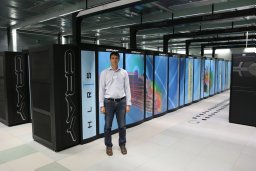 Johannes Hötzer合作论文数Institute of Applied Materials - Reliability of Components and Systems, Karlsruhe Institute of Technology3
 Nils Kohl合作论文数Univ Erlangen Nurnberg2Philipp Steinmetz合作论文数2
 Kuron Michael合作论文数Institut für Computerphysik, Universität Stuttgart2Anderl Daniela合作论文数2
 Berghoff Marco合作论文数Institute of Applied Materials, Karlsruhe Institute of Technology2
 Matthias Markl合作论文数2Marcus Jainta合作论文数2U. Rüde合作论文数1Karl-Ulrich Bamberg合作论文数1
 Dominik Thoennes合作论文数Chair Syst Simulat, Friedrich Alexander Univ Erlangen Nurnberg1Nikhil Anand合作论文数1Christoph Schwarzmeier合作论文数1
 Jiaxing Qi合作论文数1
 Momme Allalen合作论文数1Abhishek Y. Deshmukh合作论文数German Research School for Simulation Sciences, Rheinisch Westfalische Technische Hochschule Aachen Fakultat 4 Maschinenwesen1Holger Schüttrumpf合作论文数1Tobias Falkenstein合作论文数1Sebastian Eibl合作论文数Friedrich Alexander Univ Erlangen Nurnberg, Chair Syst Simulat, Cauerstr 11, D-91058 Erlangen, Germany1Christoph Rettinger合作论文数Corresponding author.1Antonio Ragagnin合作论文数Univ Trieste, Dipartimento Fis, Sez Astron, I-34131 Trieste, Italy1
 Christoph Federrath合作论文数Research School of Astronomy and Astrophysics, College of Science and Medicine, Australian National University1
 Anupam Karmakar合作论文数1
 Klaus Dolag合作论文数Fakultät für Physik, Ludwig-Maximilians-Universität München;Max Planck Institute for Astrophysics1Georg Rempfer合作论文数1Lorenzen Konstantin合作论文数1Schwörer Magnus合作论文数1Philipp Edelmann合作论文数Max-Planck-Institut für Astrophysik, Max-Planck-Institut für Astrophysik1
 Christian Holm合作论文数Institute for Computational Physics, University of Stuttgart1Luigi Iapichino合作论文数Institut fur Theoretische;Physik und Astrophysik;Universitat Wurzburg1Markus Wittmann合作论文数1
 Ralf Klessen合作论文数Institut für Theoretische Astrophysik, Zentrum für Astronomie, Universität Heidelberg1
 Arndt Bode合作论文数School of Computation, Information and Technology, Technische Universitat Munchen1
 Margarita Petkova合作论文数1Hinnerk Stüben合作论文数1
 Herbert Huber合作论文数1Reinhold Bader合作论文数1
 Helmut Satzger合作论文数Sektion Physik, Ludwig-Maximilians-Universität1
 Rui Machado合作论文数Techno- und Wirtschaftsmathematik Competence Center for High Performance Computing, Fraunhofer Institut1Nicolay Hammer合作论文数1
 Dieter Kranzlmüller合作论文数1
 Friedrich (Fritz) Röpke合作论文数Heidelberg Institute for Theoretical Studies;Zentrum für Astronomie der Universität Heidelberg, Institut für Theoretische Astrophysik, Heidelberg University1
 Thomas Zeiser合作论文数1




