Acoustic feedback remains a significant challenge in open-fitting digital hearing aids, as it severely degrades signal quality and restricts the maximum achievable stable gain. Adaptive feedback control (AFC) is widely adopted to mitigate this issue; however, its performance is often compromised by bias in the feedback path estimation, particularly due to the high correlation between the loudspeaker and incoming signals—an issue exacerbated when the input is spectrally colored, such as in speech or music. The prediction error method (PEM) has been extensively utilized to alleviate this bias by decorrelating the signals. To enhance the performance of PEM-based AFC, we propose a novel switched method that introduces a novel update rule guided by a soft-clipping-based stability detector (SCSD), enabling dynamic switching between two AFC algorithms: PEM-APSA is activated during steady-state convergence, while NLMS is chosen when rapid adaptation is required, such as during abrupt changes in the acoustic feedback path or initialization state. The former, with a low step size, achieves low steady-state error but suffers from slow adaptation, whereas the latter, utilizing a larger step size, provides faster convergence and tracking rates, especially robustness towards impulsive noise. By intelligently combining these methods, the proposed sw2 harnesses the advantages of both algorithms. Simulation results, obtained under various noisy environments and sudden changes in the feedback path, demonstrate that sw2 significantly accelerates adaptation and maintains low steady-state error while preserving high signal quality and low complexity.
Active noise control (ANC) improves audio quality in applications such as VoIP, headsets, earbuds, and speakerphones. However, impulsive noise consisting on unpredictable, high-amplitude spikes from sources like traffic or industrial equipment poses significant challenges to conventional ANC algorithms. To ensure reliable performance under such conditions, developing robust active impulsive noise control (AINC) systems is needed for mitigating these real-world acoustic disturbances and preserving sound clarity. In this paper new algorithms for active impulsive noise control using the proportionate affine projection tanh versions, dichotomous coordinate descent iterations (DCD), and the approximated tanh rational function are proposed. The impact of the tanh parameter, step size and projection order on convergence properties is analyzed or both monochannel and multichannel cases, revealing similar performance to that of previously designed tanh-based algorithms. An important contribution of this work is the investigation of the logarithmic update rule within the proportionate-type algorithms for active impulsive noise control. It is shown that the incorporation of the multiplier-free and division-free dichotomous coordinate descent (DCD) method reduces the computational complexity associated with tanh-based affine projection algorithms for AINC. Furthermore, a rational-function approximation of the tanh function is used, facilitating efficient implementation on digital signal processors and field-programmable gate arrays.
An open-fitting hearing aid often experiences acoustic feedback, limiting the achievable amplification gain and degrading sound quality. Prediction-error-method-based adaptive feedback cancellation (PEM-AFC) is a widely recognized approach for mitigating the adverse effects of acoustic feedback. Proportionate-type algorithms combined with affine projection sign algorithms, known as PAPSA, along with its variants such as improved PAPSA (IPAPSA), memory IPAPSA (MIPAPSA), and block-sparse MIPAPSA (BS-MIPAPSA), have been successfully applied to network echo cancellation applications. However, using these fast adaptive algorithms for acoustic feedback cancellation remains limited due to the inherent correlation between the incoming and the loudspeaker signals. To address this challenge, we propose integrating these adaptive algorithms with PEM-AFC, resulting in a new class of AFC methods for hearing aids, including PEM-IPAPSA, PEM-MIPAPSA, and PEM-BSMIPAPSA. The proposed AFC methods leverage the pre-filter, the sparse nature of the feedback path, and fast adaptive filtering techniques to enhance convergence rate and tracking ability while maintaining similar steady-state error levels. We provide a detailed derivation of the proposed AFC methods and evaluate their performance using recorded speech as the incoming signal, with abrupt changes in the feedback path. Simulations were conducted in environments with/without background noise and impulsive noise. Simulation results show that the proposed methods are robust against impulsive interference and colored input, achieving higher convergence and tracking rates while maintaining similar steady-state errors compared to state-of-the-art competing methods. Additionally, the proposed methods offer low computational complexity, which is crucial for hearing aids where low power consumption is a significant concern.
This paper presents a modified algorithm for addressing acoustic impulse responses identification for communication systems. This study introduces an enhanced sub-band version of variable-step-size mu -law proportionate normalized least-mean-square algorithm for achieving rapid convergence and minimal steady-state error. This algorithm is noted as SPV-NLMS: Sub-band Proportionate Variables-step-sizes NLMS algorithm. The proposed SPV-NLMS algorithm is dynamically and independently adjusting the N step-sizes parameters during adaptation using an optimal estimation of each sub-filter. The SPV-NLMS is adaptable and can be employed with various acoustic more dispersive, dispersive, more sparse or sparse environments. The effectiveness of this algorithm is validated through simulations in the context of acoustic impulse response identification. The SPV-NLMS algorithm has the potential to significantly improve the convergence and the steady-state error using the Mean Square Error (MSE) and Echo Return Loss Enhancement (ERLE) criteria.
In this paper, two new correntropy-based data-selective algorithms using the prediction error method and proportionate principle are proposed for acoustic feedback cancellation (AFC). The proposed data selective approach is applied for the improved practical variable step size proportionate normalized least mean square algorithm (IPNLMS-IPVSS) and its novel tanh-based version. It is shown that the proposed data-selective algorithms can achieve close performance to the original algorithms at a reduced average numerical complexity.
Two new affine projection and improved proportionate affine projection tanh-based algorithms for active impulsive noise control are presented. It is shown that they can obtain better performance for active impulsive noise control systems than the original algorithms when using a modified filtered-x (MFx) structure.
For system identification problems associated with long-length impulse responses, the recently developed decomposition-based technique that relies on a third-order tensor (TOT) framework represents a reliable choice. It is based on a combination of three shorter filters, which merge their estimates in tandem with the Kronecker product. In this way, the global impulse response is modeled in a more efficient manner, with a significantly reduced parameter space (i.e., fewer coefficients). In this paper, we further develop a Kalman filter based on the TOT decomposition method. As compared to the recently designed recursive least-squares (RLS) counterpart, the proposed Kalman filter achieves superior performance in terms of the main criteria (e.g., tracking and accuracy). In addition, it significantly outperforms the conventional Kalman filter, while also having a lower computational complexity. Simulation results obtained in the context of echo cancellation support the theoretical framework and the related advantages.
In this paper, a new tanh-based is proposed for the acoustic feedback cancellation in hearing aids. It uses the proportionate affine projection tanh algorithm, combined with a novel neural network-based stability detector. Our simulations and the 32-bit floating point implementation indicate that the proposed algorithm can be an attractive alternative to the considered competing AFC algorithms for incoming speech and music signals.
In this paper, we explore an acoustic feedback cancellation (AFC) algorithm that integrates the correntropy-based data-selective algorithm within the prediction error method (PEM). The data selective approach compares the performance of using the error signal $e(n)$ and the pre-whitened error signal $e_{p}(n)$ as data samples. It is shown that using the error signal provides superior system performance and audio quality compared to the pre-whitened error signal, while closely approximating the performance of the original algorithm.
This study presents a novel combined-step-size improved proportionate normalized least mean square tanh algorithm for the two-microphone acoustic feedback cancellation (AFC) system. It is shown that the proposed algorithm can obtain superior convergence properties than competing algorithms for normal feedback paths if its parameters are well chosen. Also, the 32-bit floating-point implementation robustness is proved for a two-microphone AFC system.
Sign language is a common way of communication for people with hearing and/or speaking impairments. AI-based automatic systems for sign language recognition are very desirable since they can reduce barriers between people and improve Human-Computer Interaction (HCI) for the impaired community. Automatically recognizing sign language is still an open challenge since the sign language itself has a complex structure to convey messages. The key role is played by the isolated signs that refer to single gestures carried out by hand movements. In the last decade, research has improved the automatic recognition of isolated sign language from videos using machine learning approaches. Starting from a comprehensive analysis of existing recognition techniques, with an in-depth focus on existing public datasets, the study proposes an advanced convolution-based hybrid Inception architecture to improve the recognition accuracy of isolated signs. The main contributions are to enhance InceptionV4 with optimized backpropagation through uniform connections. Besides, an ensemble learning framework with different Convolution Neural Networks has been also introduced and exploited to further increase the recognition accuracy and robustness of isolated sign language recognition systems. The effectiveness of the proposed learning approaches has been proved on a benchmark dataset of isolated sign language gestures. The experimental results demonstrate that the proposed ensemble model outperforms sign identification, yielding higher recognition accuracy (98.46%) and improved robustness.
Decomposition-based algorithms have gained much attention lately, in the context of low-rank system identification problems. These algorithms exploit the nearest Kronecker product (NKP) decomposition of the impulse response (usually of long length) and take advantage of low rank approximations. Among them, the recursive least-squares (RLS) algorithm developed in this framework, namely RLS-NKP, has been found to be very suitable in challenging system identification problems that involve long length impulse responses, e.g., like in acoustic echo cancellation. The performance of the RLS-NKP algorithm depends on its decomposition parameter, which is related to the accuracy of low rank approximation. The current paper focuses on the investigation of this aspect and proposes a simple solution for choosing the decomposition parameter, using a preprocessing stage that relies on a low-complexity algorithm. Experiments are performed in the framework of acoustic echo cancellation and the obtained results support the validity of the proposed solution.
It is known that the Proportionate Normalized Least-Mean-Squares (PNLMS) algorithm is an efficient solution applicable to both Adaptive Echo Cancellation (AEC) and Adaptive Feedback Cancellation (AFC) systems. It enhances the performance by individually assigning step sizes to each filter coefficient, resulting in superior initial convergence and tracking rates compared to the NLMS. The Improved PNLMS (IPNLMS) surpasses the PNLMS by incorporating a novel rule that optimally leverages the predicted feedback channel’s characteristics to compute tap-specific step sizes.In this paper, we introduce an enhancement strategy aimed at improving the performance of the IPNLMS algorithm on the prediction error method (PEM) in the context of Adaptive Feedback Cancellation for hearing aids. This enhancement involves the implementation of variable step-size control. We introduce the Improved Practical Variable Step-Size (IPVSS) built upon the Practical Variable Step-Size (PVSS) approach that incorporates upper and lower fixed step sizes to define a bounded range for step-size adjustments. We evaluate the proposed approach using incoming signals containing both speech and music. We also employ real-world feedback channel measurements. Our simulation outcomes clearly indicate that our method delivers an important enhancement in performance when compared to the PEM-IPNLMS approach, irrespective of whether we utilize the upper or lower step-size bounds. Furthermore, our method outperforms the PEM approach when employing the NLMS and IPVSS while preserving a good signal quality.
In this paper, a low-complexity implementation of the recently proposed affine projection tanh algorithm in conjunction with a frequency shifting performed on speech segments for acoustic feedback cancellation (AFC) is presented. Dichotomous coordinate descent (DCD) iterations having a variable input parameter are used to reduce its numerical complexity. The simulation results show that the proposed approach can achieve better performance than competing methods for both incoming speech and music signals.
In this study, a low-complexity gait monitoring system using an ESP32 microcontroller, and an MPU-9250 module with an accelerometer, gyroscope, and magnetometer is described. Its performance for binary gait classification using a multilayer perceptron is shown.
In this paper, a new algorithm is proposed for the acoustic feedback cancellation for hearing aids. It is based on the affine projection tanh algorithm, combined with a modified practical variable step size and frequency shifting. A modified soft clipping stability detector that controls both the variable step sizes and the frequency shifting is used. It is shown that the proposed variable step size approach that considers the tanh nonlinearities applied to both the preprocessed error signal with the pre-whitening filter and the error signal is beneficial for faster recovery from howling. Dichotomous coordinate descent iterations reduce the numerical complexity of the algorithm. Our experiments indicate that the proposed algorithm outperforms competing methods for incoming speech and music signals.
This work develops an effective technique acoustic feedback cancellation (AFC) in the digital hearing aid (DHAid) devices. The normalized least mean square (NLMS) algorithm-based AFC method may suffer from a biased convergence. The biased convergence problem is considerably resolved by the prediction error method (PEM)-based AFC (PEM-AFC); however, it may demonstrate a slow convergence. The proposed method’s main structure is based two adaptive filters. The main adaptive AFC filter receives its input from the DHAid receiver signal, while the auxiliary AFC filter is activated by a probe signal. The main idea is to apply a lattice filtering-based pre-processing for decorrelation in the main AFC filter’s update equation. This produces a Newton-like adaptive algorithm with fast convergence. Additionally, the lattice filtering is executed on a sample-by-sample basis, in contrast to the frame-based execution in the traditional PEM-AFC method. As the AFC system converges, the level of the probe signal is decreased to improve the output SNR; however, the low-level input signal slows down auxiliary AFC filter’s convergence. In order to improve the convergence speed, the gradient information from a maximum Versoria-criterion (MVC) is incorporated into the auxiliary AFC filter’s update algorithm. The two adaptive filters’ coefficients are exchanged, to ensure that both adaptive filters converge to a good estimate of the true acoustic feedback path. Simulations show that the proposed method works well for speech/signals and for DHAid devices with different gain settings. Additionally, the proposed method shows robust performance in the event of a sudden change in the acoustic environment.
Data scarcity is a major challenge when training deep learning (DL) models. DL demands a large amount of data to achieve exceptional performance. Unfortunately, many applications have small or inadequate data to train DL frameworks. Usually, manual labeling is needed to provide labeled data, which typically involves human annotators with a vast background of knowledge. This annotation process is costly, time-consuming, and error-prone. Usually, every DL framework is fed by a significant amount of labeled data to automatically learn representations. Ultimately, a larger amount of data would generate a better DL model and its performance is also application dependent. This issue is the main barrier for many applications dismissing the use of DL. Having sufficient data is the first step toward any successful and trustworthy DL application. This paper presents a holistic survey on state-of-the-art techniques to deal with training DL models to overcome three challenges including small, imbalanced datasets, and lack of generalization. This survey starts by listing the learning techniques. Next, the types of DL architectures are introduced. After that, state-of-the-art solutions to address the issue of lack of training data are listed, such as Transfer Learning (TL), Self-Supervised Learning (SSL), Generative Adversarial Networks (GANs), Model Architecture (MA), Physics-Informed Neural Network (PINN), and Deep Synthetic Minority Oversampling Technique (DeepSMOTE). Then, these solutions were followed by some related tips about data acquisition needed prior to training purposes, as well as recommendations for ensuring the trustworthiness of the training dataset. The survey ends with a list of applications that suffer from data scarcity, several alternatives are proposed in order to generate more data in each application including Electromagnetic Imaging (EMI), Civil Structural Health Monitoring, Medical imaging, Meteorology, Wireless Communications, Fluid Mechanics, Microelectromechanical system, and Cybersecurity. To the best of the authors’ knowledge, this is the first review that offers a comprehensive overview on strategies to tackle data scarcity in DL.
This study describes a low-cost and easy to deploy gait monitoring system that uses an ESP32 microcontroller and an ICM-20948 module. The ESP32 microcontroller collects data from the ICM-20948 module and these data are used to train a convolutional neural network (CNN) to classify gait patterns into two categories: normal and pathological. The results show that the system can achieve a high accuracy for binary gait classification, being able to correctly classify 97.05% of the normal gait samples and 84.54% of the pathological gait samples. The power consumption of the devive was measured using a calibrated and dual-acquisition digital multimeter. The estimated operating time was around 12 hours, with a battery capacity of 1800 mAh LiPo type. Therefore, it could be used to track the gait of patients with neurological disorders or to assess the effectiveness of gait rehabilitation treatments.
In recent years, the hyperbolic family of adaptive algorithms have been widely used to combat impulsive noise. The novel exponential hyperbolic sine adaptive filters (EHSAF) and the normalized exponential hyperbolic sine adaptive filter (NEHSAF) suitable for impulsive noise environments are proposed in this brief. The cost function is based on the exponential hyperbolic sine-based error function. The stability condition based on the learning rate and the steady-state analysis are investigated too. Additionally, a variable scheme for the scaling parameter is proposed to remove the tradeoff between convergence speed and steady-state excess mean square error (EMSE). The computational complexity is presented too. The simulation results in the context of unknown system identification and echo cancellation application have been performed to prove the performance improvement of the proposed algorithms.
 Constantin Paleologu合作论文数University Politehnica of Bucharest22
 Corneliu Florea合作论文数Image Processing and Analysis Laboratory, University "Politehnica" of Bucharest11
 Jacob Benesty合作论文数Énergie Matériaux Télécommunications Research Centre, Institut National de la Recherche Scientifique11
 Henri George Coanda合作论文数10
 Yingsong Li (李迎松)合作论文数School of Electronic and Information Engineering, Anhui University10
 Adrian Zamfir合作论文数Cent Business Pk, Tessera Romania10
 Hitoshi Kiya (貴家仁志)合作论文数Department of Computer Science, Graduate School of Systems Design, Tokyo Metropolitan University;National Institute of Informatics;Tohoku University;Monash University Malaysia10
 Alexandru Drimbarean合作论文数Tessera Romania SRL10
 Silviu Ciochina合作论文数Telecommunications Department, Politehnica University of Bucharest9Ion Caciula合作论文数"VALAHIA" University of Targoviste8
 Sven Nordholm合作论文数Western Australian Telecommunications Research Institute7
 Dinu Coltuc合作论文数Electrical Engineering, Electronics and Information Technology School, Valahia University of Targoviste;Doctoral School of Engineering, Valahia University of Targoviste;Faculty of Electrical Engineering, Electronics and Information Technology, Valahia University of Targoviste7
 Linh Tran合作论文数6
 Peter Corcoran合作论文数College of Science and Engineering, University of Galway;C3 Imaging Research Centre, University of Galway6
 Hon Keung Kwan合作论文数Department of Electrical and Computer Engineering, Faculty of Engineering, University of Windsor6Daniela Hagiescu合作论文数5
 Nick Coleman合作论文数5S. Radhika合作论文数Sathyabama Univ, Fac Elect & Elect Engn, Madras, Tamil Nadu, India5
 Chandrasekar Arumugam合作论文数5larry murray合作论文数4ilariu raducan合作论文数4
 Rakesh Pogula合作论文数Dept Elect & Commun Engn, Natl Inst Technol Warangal4
 T. Kishore Kumar合作论文数4
 Yuriy Zakharov合作论文数School of Physics, Engineering and Technology, University of York4Rui Yang (杨锐)合作论文数College of Engineering, Huazhong Agricultural University4Piotr Stec合作论文数4Andrei Alexandru Enescu合作论文数4
 Feiran Yang (杨飞然)合作论文数Key Laboratory of Noise and Vibration Research, Institute of Acoustics, Chinese Academy of Sciences;University of Chinese Academy of Sciences3Antonin Hermanek合作论文数3
 Marius G. Ionita合作论文数Electrical Engineering Electronics and Information Technology, Valahia University of Targoviste3Rotaru, M.合作论文数3
 Yanyan Wang (王艳艳)合作论文数School of Computer and Information Technology, Shanxi University3
 Nishihara Akinori合作论文数Electronics, Graduate School of Science and Engineering, Tokyo Institute of Technology3
 Muhammad Tahir Akhtar合作论文数The Center for Frontier Science and Engineering (CFSE),, The University of Electro-Communications3
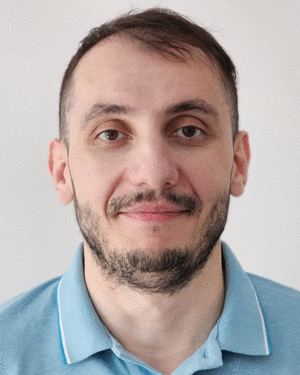 Cristian Lucian Stanciu合作论文数University of Craiova;Anadolu University;University of Craiova, Anadolu University3
 Jiri Kadlec合作论文数Department of Signal Processing, UTIA, CAS3
 Nicoleta Angelescu合作论文数"VALAHIA" University of Targoviste3
 Constantine Kotropoulos合作论文数Department of Informatics, Aristotle University of Thessaloniki3
 Jianming Liu合作论文数2
 Alberto González合作论文数2
 Miguel Ferrer合作论文数2
 de Diego, M.合作论文数Polytechnic University of Valencia2
 Jun Yang (杨军)合作论文数Institute of Acoustics, Chinese Academy of Sciences2
 Martin Bouchard合作论文数School of Electrical Engineering and Computer Science, Faculty of Engineering, University of Ottawa2Vlad Poenaru合作论文数2Carlos Renato C. Nakagawa合作论文数2
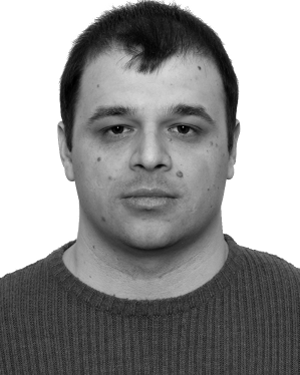 Ioan-Catalin Dragoi合作论文数Dept Elect Engn, Valahia Univ Targoviste2
 Steven L. Grant合作论文数2
 Petronel Bigioi合作论文数FotoNation2




