Although global research on the 5Cs model of Positive Youth Development (PYD; competence, confidence, connection, character, and caring) has expanded in recent years, there is a lack of understanding about distinct and consistent PYD profiles across youth from diverse socio-cultural contexts. To address this gap, this study utilized a person-oriented analytic approach to examine the PYD profiles of 11,481 emerging adults (Mage = 21.77; SDage = 2.74; 68.66
Abstract The current study investigated the motives that underlie support for COVID-19 preventive behaviorsin a large, cross-cultural sample of 12,758 individuals from 34 countries. We hypothesized that the associations of empathic prosocial concern and fear of disease, with support towards preventive COVID-19 behaviors would be moderated by the individual-level and country-level trust in the government. Results suggest that the association between fear of disease and support for COVID-19 preventive behaviors was strongest when trust in the government was weak (both at individual and country-level). Conversely, the association with empathic prosocial concern was strongest when trust was high, but this moderation was only found at individual-level scores of governmental trust. We discuss how both fear and empathy motivations to support preventive COVID-19 behaviors may be shaped by socio-cultural context, and outline how the present findings may contribute to a better understanding of collective action during global crises.
With the COVID-19 pandemic, behavioural scientists aimed to illuminate reasons why people comply with (or not) large-scale cooperative activities. Here we investigated the motives that underlie support for COVID-19 preventive behaviours in a sample of 12,758 individuals from 34 countries. We hypothesized that the associations of empathic prosocial concern and fear of disease with support towards preventive COVID-19 behaviours would be moderated by trust in the government. Results suggest that the association between fear of disease and support for COVID-19 preventive behaviours was strongest when trust in the government was weak (both at individual- and country-level). Conversely, the association with empathic prosocial concern was strongest when trust in the government was high, but this moderation was only found at individual-level scores of governmental trust. We discuss how motivations may be shaped by socio-cultural context, and outline how findings may contribute to a better understanding of collective action during global crises.
BACKGROUND:The extreme social circumstances caused by declared COVID-19 pandemic deeply intervene people's everyday life and should not be neglected but seen through the view of social reality pinpointing the 'ordinary' people. In this article, authors explored basic segments of everyday and their subjective perception to what extent sleeping habits, physical inactivity, physical activity, nutritional habits and smoking have changed. METHODS:The online survey was conducted in nine European countries (Bosnia and Herzegovina, Croatia, Greece, Kosovo*, Italy, Serbia, Slovakia, Slovenia and Spain) in 4108 participants, aged 15-82 years. The survey took place 30-40 days after World Health Organization declared COVID-19 pandemic state, from 15 April to 3 May 2020. RESULTS:The results have shown 30 min longer sleeping time, 50% longer physical inactivity time, 65% longer screen time, 43% shorter walking time, 24% shorter sport time and 37% longer physical work time. Additionally, body mass gains (0.3 kg) could be explained in 20.6% with meals sizes, unhealthy food consumption, screen time and sport time. Further, respondents reported more regular meals (44%) and healthier meals with less alcohol consumption and less smoking, which have been positive outcomes of home confinement. CONCLUSION:The findings draw attention to negative changes in everyday praxis (inactivity, body mass gain) after such a short period. Because of possible risk to population's health (especially of countries such as Italy and Spain with serious threat and more stringent measures), findings enable development of recommendations for maintaining healthy lifestyle habits with minimal negative health consequences in similar pandemic circumstances.
PURPOSE: The aim of this research was to establish external validity of the Attitude Toward Combat Sports Scale (SBS, Bosnar, Sertić, & Prot, 1999). METHODS: The research was done on the male and female samples of the adults from the Croatian population. The first sample consisted of 851 males, aged 19 to 81 years; the second sample consisted of 776 females, aged 15 to 78 years. The examinees were measured by the SBS scale along five 7-point scales assessing attitudes toward boxing, karate, taekwondo, wrestling and judo. External validity of the SBS scale was established in two ways, by the correlation of the principal component of the set of items in the SBS scale and the principal component of the five combat sports attitude scales, and by the linear regression analysis with the total score in the SBS scale being the dependent variable and results on the five combat sports attitude scales being the independent variables. RESULTS: In the male sample, the correlation between the principal components was high, r=-0.653; multiple correlation was even higher, ρ=0.703. In the female sample, the value of correlation of two principal components was r=-0.747; multiple correlation was ρ=0.770. CONCLUSION: The external validity of the SBS scale was examined on the two samples and by two methods. In both samples, the values obtained by the two methods show that the SBS scale is a valid instrument to measure general attitude toward combat sports.
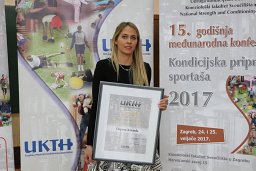
We are exceptionally happy that we can greet you once more on this occasion. The Faculty of Kinesiology, as a proud member of the University of Zagreb and a higher education institution that is 57 years old, is organizing The International Scientific Conference on Kinesiology for the 8th time. Identically as three years ago, this is a good opportunity to remember some important anniversaries. First of all, this year we celebrate 160 years since Nicolas Dally published his work in 1857 under the title “Kinesiology – Science of Movement in Relation to Education, Hygiene and Therapy”. This was the first book that introduced Kinesiology as a science of movement. The second important anniversary is 20 years since the establishment of our Conference. In 1997 the first International Scientific Conference on Kinesiology was held in Dubrovnik. Until today a great number of leading experts in the field of contemporary kinesiology were keynote lectures and presenters of the most important scientific breakthroughs in the field. Once again, the Conference will be a great opportunity for broadening of scientific insights into this miraculous, beautiful phenomenon of physical activity and its effects – its perfection when performed by sport artists, as seen at the XXXI Olympic Games, its joyfulness when happy children enjoy being competent to be in motion, or when we see eager people who enjoy life and nature because they have enough energy and they are healthy thanks to an active lifestyle. We are especially proud of the 17th place on the medal list thanks to the ten Olympic medals won by Croatian athletes. All fundamental and applied fields of our science will be discussed within 10 tentative sessions and 3 Satellite symposiums. The ultimate purpose of papers or abstracts published in this Proceedings book is to know and understand human beings and to apply the findings in everyday practice of education, sports, health promotion, recreation, sports management and kinesitherapy. The Proceedings Book contains 249 contributions, which were submitted by the submission deadline, written by 557 authors from 30 countries from all over the world. We expect a number of graduate, doctoral and postdoctoral students from Croatia and abroad for whom the Conference School of Kinesiology for Postgraduate and Doctoral Students will be organised during the Conference. From the very beginning the Croatian Academy of Sciences and Arts has given its highly respected patronage to the Conference, thus underpinning the recognition of kinesiology in the structure of sciences. Special thanks go to our partner institutions: Beijing Sports University, China and the Faculty of Sports Studies, Masaryk University, Brno, Czech Republic, to our collaboration institutions: the Lithuanian University of Educational Sciences, Lithuania, the Otto-von-Guericke University, Magdeburg, Germany and the Faculty of Sport and Physical Education, University of Novi Sad, Serbia. We wish to express much gratitude to all the authors, reviewers, participants, members of the Organisation and Program Committee, Section Editors, technical support staff, and sponsors for their contributions, time and effort inbuilt in the quality of the 8th International Conference on Kinesiology and its Proceedings. We wish success in the conference work to all the participants and a pleasant time in Opatija. Convinced that the Conference will give the expected impetus to further cooperation between scholars and institutions, we are looking forward in advance to meeting you again at the 9th International Conference on Kinesiology in 2020. Organising Committee
The aim of this study is to establish the metric properties of the Attitude toward female boxing scale (FBA, Vaci, 2013) on adult population. The study was conducted on 563 midlife adults of both sexes aged 40 to 65 years, from different parts of Croatia. The participants were given questionnaire with FBA scale incorporated into the Attitude toward combat sports scale (SBS, Bosnar et al., 1996) and a seven-point scale of general attitude toward boxing (BOX7). The FBA scale show excellent metric properties. Cronbach's alpha coefficient of reliability is high alpha=0,85; the face validity of the scale is confirmed by correlations with SBS and BOX7 scale.
In this paper development of kinesiometrics in Zagreb kinesiology circle is presented.Related to previous experiences in observation and measurement of human movement the term kinesimetrics appeared as kinesimetrie "kinesimetrie" s.f. (ki-ne-zu-me-tri) - from greek: kinesis, movement; metron, mesur), 19th century Francophone circle. It was Momirovic (1968/1969), who introduced the term "kineziometrija", "kinesiometry" i.e. "kinesiometrics", in two papers published as outcome of Zagreb methodological circle the term that incorporate measurement theory, statistics, and mathematical analysis in the area of kinesiology. With equivalent goal, but 30 years later, i.e. in 1998., the term "kinesmetrics" as a term for a discipline intended to develop and apply measurement theory. This short overview is the core of a more elaborate presentation scheduled for introductory speech for Research Methodology section at 8th International conference on Kinesiology at Opatija 2017.
The aim of this paper is to determine the differences in kinanthropological characteristics of elementary school pupils in relation to macro-regional characteristics of the Republic of Croatia. The research included 2358 subjects (1089 boys--average age 10.4 ± 0.6; height 150.27 ± 7.32; body mass 44.06 ± 9.74; and 1269 girls--average age 10.6 ± 0.5; height 152.02 ± 7.74; body mass 45.12 ± 10.39)--fifth grade elementary school pupils. Analyzed kinanthropological characteristics refer to statistically significant differences in the results based on the macro-region criterion (p < 0.05). It is possible to assume that climatic and temperature differences as well as gene frequency differences to a certain extent incite differences in the level of participating in physical activities, and with it the differences in kinanthropological characteristics of subjects.
 Ksenija Bosnar合作论文数Fac Kinesiol, Univ Zagreb57
 Dušan Metikoš合作论文数27Boris Neljak合作论文数16Miloš Mraković合作论文数14
 Goran Sporis合作论文数Faculty of Kinesiology, University of Zagreb14Findak Vladimir合作论文数12Konstantin Momirović合作论文数11Zlatko Šafarić合作论文数8Suncica Bartoluci合作论文数7Dragan Milanovic合作论文数7
 Gordana Furjan-Mandic合作论文数7Igor Jukic合作论文数7Marijan Gredelj合作论文数6Goran Markovic合作论文数6Darko Katovic合作论文数Faculty of Kinesiology, University of Zagreb5
 Zrinka Greblo Jurakic合作论文数Faculty of Kinesiology, University of Zagreb5Jelka Gošnik合作论文数4Vesna Lužar-Stiffler合作论文数4Nenad Marelić合作论文数4
 Marjeta misigoj-durakovic合作论文数Faculty of Kinesiology, University of Zagreb4
 Goran Oreb合作论文数Fac Kinesiol, Univ Zagreb4
 Sertic, H.合作论文数4Novak Dario合作论文数Faculty of Kinesiology, University of Zagreb4Ankica Hošek合作论文数4Emil Hofman合作论文数3Mirna Andrijasevic合作论文数3bojan matkovic合作论文数3Tatjana Trošt Bobić合作论文数3
 Josipa Radas合作论文数3
 Tomica Resetar合作论文数3Marijo Baković合作论文数3
 Dajana Karaula (ex.Zoretic)合作论文数Dept Sport, Univ Zagreb3maja horvatinfuckar合作论文数Fac Kinesiol, Univ Zagreb3Lidija Petrinović合作论文数Fac Kinesiol, Univ Zagreb3Norzihan Ayub合作论文数universiti malaysia sabah3
 tomislav đurkovic合作论文数Fac Kinesiol, Univ Zagreb3
 Ivan Krakan合作论文数3
 Dario Skegro合作论文数Fac Kinesiol, Univ Zagreb3Andrii Andres合作论文数3
 Rita M Rivera合作论文数Dept Clin Psychol, Albizu Univ3
 Ivanna Bodnar合作论文数Theory & Methods Phys Culture Dept, Lviv State Univ3
 Tomislav Krističević合作论文数Faculty of Kinesiology, University of Zagreb3petar barbaros tudor合作论文数Fac Kinesiol, Univ Zagreb3
 Marta Martin合作论文数Psychology Department, Universidad Cooperativa de Colombia3
 Dalibor Krpan合作论文数3
 Kamenka zivcic markovic合作论文数Fac Kinesiol, Univ Zagreb3Aleksandra Lewandowska-Walter合作论文数3
 Cvita Gregov合作论文数Fac Kinesiol, Univ Zagreb3Carmen Buzea合作论文数3




