The production of medical radionuclides is one of the research activities carried out in the framework of the SPES (Selective Production of Exotic Species) project under the completion stage at the Legnaro National Laboratories of the National Institute for Nuclear Physics (INFN-LNL). The heart of SPES is the 70-MeV proton cyclotron having a dual-beam extraction, installed and commissioned in a new building equipped with ancillary laboratories currently under construction. The SPES main goal is the realization of an advanced ISOL (Isotope Separation On-Line) facility to produce re-accelerated exotic ion beams for fundamental nuclear physics studies. The cyclotron double-beam extraction system allows to simultaneously carry out applied research, such as radionuclides production for medicine (SPES- γ ). This paper summarizes the results obtained with the interdisciplinary projects LARAMED (LAboratory of RAdionuclides for MEDicine) and ISOLPHARM (ISOL technique for radioPHARMaceuticals). The first one, based upon the direct activation method, is focused on the production of the radionuclides under the spotlight of the international community (e.g., ^99m Tc, ^67 Cu, ^52/51 Mn, ^47 Sc and Tb isotopes), from the nuclear cross-section measurements up to the preclinical studies. The other one exploits the ISOL technique for the development and production of radioisotopes with high-specific activity, such as ^111 Ag, going beyond the state of the art in the field. The most recent SPES- γ research activities and future perspective are here described, characterized by a consolidated network of collaborations with national and international institutions.
The present work reports the status of the LAboratory of RAdionuclides for MEDicine facility, as part of the Selective Production of Exotic Species research infrastructure under completion, along with the main project outcomes gained during the last years, thanks to an ongoing fruitful network of collaborations. The interdisciplinary aspects of the production of medically-relevant radionuclides, such as 67 Cu, 47 Sc, 52 Mn etc., are shown, including the latest technological achievements in targetry, radiochemistry, and applied nuclear physics.
The REMIX project is focused on the cyclotron-based production of 47 Sc, 149 Tb, 152 Tb, 155 Tb and 161 Tb radionuclides, whose decay characteristics make them suitable for medical applications. This work will outline the main results achieved withing the REMIX collaboration, that is organized in the following Work Packages (WP): WP1. Target manufacturing ( 49 Ti, 50 Ti and 155 Gd 2 O 3 ) and characterization; WP2. Nuclear cross section (XS) measurements with 49 Ti and 50 Ti targets for 47 Sc production; WP3. Nuclear XS measurements with nat Dy, 159 Tb and nat Eu targets for xx Tb production; WP4. Nuclear XS modeling for 47 Sc and 155 Tb production; WP5. Dosimetric calculations for 47 Sc- and xx Tb-labelled radiopharmaceuticals; WP6. 155 Tb Thick Target Yield (TTY) measurements; WP7. Apparatus design and realization for irradiation tests with the LARAMED beamline. Since the LARAMED bunkers and ancillary laboratories are currently under completion at the INFN-LNL, the nuclear XS experiments are carried out in collaboration with the GIP ARRONAX facility (Saint-Herblain, France) and the Thick Target Yield (TTY) measurements are performed at the Sacro Cuore Don Calabria hospital (SCDCh, Negrar, Verona, Italy).
The Spark Plasma Sintering Technique (SPS) (or Field Assisted Sintering Technique (FAST) or Pulsed Electric Current Sintering (PECS)) is a versatile technique used in different application fields due to its advantages. In the framework of the LARAMED project at Legnaro National Laboratories of INFN (National Institute for Nuclear Physics) it was used, for the first time, for manufacturing cyclotron targets for the production of medical radionuclides aimed at the development of novel radiopharmaceutical for nuclear medicine. In this work, the first feasibility studies performed with different materials (Cr, Y, Au, Nb, ZnO) realized by using a new prototype SPS machine appropriately designed for this purpose, in collaboration with the University of Pavia, are presented. The microstructural interface investigations, aimed at evaluating the manufacturing process capabilities and properties of the obtained targets, were performed in collaboration with the metallurgy group of the University of Padova.
The High Energy Vibrational Powder Plating (HIVIPP) technique allows for the preparation of targets starting from refractory metal powders with negligible material losses during the process, thus preserving the expensive isotope-enriched materials. An upgraded HIVIPP apparatus was developed at the Legnaro National Laboratory of the National Institute of Nuclear Physics (INFN-LNL), and it is reported in this work. Particular attention was paid to the design of the sample holder, the automation of the power supply, and the control of the process, all with the aim of obtaining a versatile and reliable apparatus. Several tests have been carried out and the related results are reported proving the flexibility of the apparatus and the process reproducibility. The main result is a ‘ready to use’ technology at INFN-LNL for the preparation of isotopically enriched refractory metal targets that cannot be manufactured using standard techniques.
One of the technological challenges aimed at improving the cyclotron-based radionuclides'(RNs) supply for Nuclear Medicine (NM), is the availability of proper heat sink systems able to remove the large amount of heat deposited during the irradiation stage onto isotope-enriched targets. In this regard, three different non-standard mockup configurations, made of pure copper by means of the Laser Powder Bed Fusion (LBPF) technique, have been tested with an in-house developed experimental apparatus. The experimental characterization has subsequently been compared with numerical results carried out by means of Computational Fluid Dynamics (CFD) simulations. Our numerical model, based on the Re-Normalization Group (RNG) k-epsilon formulation, has shown close agreement (within 1.06 % Mean Absolute Error) with the experimental results, despite the geometrical complexity of the heat sinks prototypes. The combined experimental and numerical approach, together with the flexibility of additive manufacturing production, was proved to be apt for further development of high-efficiency heat exchange applications in this field.
Cyclotron-based radionuclides production by using solid targets has become important in the last years due to the growing demand of radiometals, e.g., 68Ga, 89Zr, 43/47Sc, and 52/54Mn. This shifted the focus on solid target management, where the first fundamental step of the radiochemical processing is the target dissolution. Currently, this step is generally performed with commercial or home-made modules separated from the following purification/radiolabelling modules. The aim of this work is the realization of a flexible solid target dissolution system to be easily installed on commercial cassette-based synthesis modules. This would offer a complete target processing and radiopharmaceutical synthesis performable in a single module continuously. The presented solid target dissolution system concept relies on an open-bottomed vial positioned upon a target coin. In particular, the idea is to use the movement mechanism of a syringe pump to position the vial up and down on the target, and to exploit the heater/cooler reactor of the module as a target holder. All the steps can be remotely controlled and are incorporated in the cassette manifold together with the purification and radiolabelling steps. The performance of the device was tested by processing three different irradiated targets under different dissolution conditions.
The LARAMED project, acronym for LAboratory of RAdioisotopes for MEDicine, is the new research infrastructure being established at the Legnaro National Laboratories (LNL), focused on the production of novel medical radionuclides, actually unavailable for the scientific community. This work presents the recent advancements of the LARAMED laboratories and bunkers in the SPES facility, where the 70-MeV high current proton cyclotron was installed in 2015 to perform not only fundamental nuclear physics studies but also research activities related to medical applications. The latest research outcomes on the production of the theranostic 67Cu and 47Sc radionuclides, obtained thanks to the Italian and international LARAMED network, are also summarized.
The widespread availability of novel radioactive isotopes showing nuclear characteristics suitable for diagnostic and therapeutic applications in nuclear medicine (NM) has experienced a great development in the last years, particularly as a result of key advancements of cyclotron-based radioisotope production technologies. At Legnaro National Laboratories of the National Institute of Nuclear Physics (LNL-INFN), Italy, a 70-MeV high current cyclotron has been recently installed. This cyclotron will be dedicated not only to pursuing fundamental nuclear physics studies, but also to research related to other scientific fields with an emphasis on medical applications. LARAMED project was established a few years ago at LNL-INFN as a new research line aimed at exploiting the scientific power of nuclear physics for developing innovative applications to medicine. The goal of this program is to elect LNL as a worldwide recognized hub for the development of production methods of novel medical radionuclides, still unavailable for the scientific and clinical community. Although the research facility is yet to become fully operative, the LARAMED team has already started working on the cyclotron production of conventional medical radionuclides, such as Tc-99m, and on emerging radionuclides of high potential medical interest, such as Cu-67, Sc-47, and Mn-52.
 Juan Esposito合作论文数Laboratori Nazionali di Legnaro, INFN15
 Petra Martini合作论文数13
 Gaia Pupillo合作论文数12
 Liliana Mou合作论文数11
 Sara Cisternino合作论文数11
 Alessandra Boschi合作论文数10
 Emiliano Cazzola合作论文数9
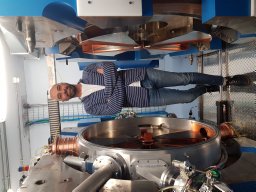 Gorgoni Giancarlo合作论文数8
 Adriano Duatti合作论文数7Jonathan Amico合作论文数5Carlos Rossi Alvarez合作论文数5
 Hanna Skliarova合作论文数5
 Salvatore Cisternino合作论文数5
 Licia Uccelli合作论文数4Lorenzo Pranovi合作论文数3Lucia De Dominicis合作论文数3G. Fiorentini合作论文数Dept Phys & Earth Sci, Univ Ferrara3Mou L合作论文数3
 Giorgio Keppel合作论文数INFN-Legnaro National Labs3
 P. Antonini合作论文数Dipartimento di Fisica, Università di Padova3Lorenza Marvelli合作论文数3
 Laura Melendez-Alafort合作论文数3J. Amico合作论文数2Matteo Campostrini合作论文数2Michele Calderolla合作论文数2
 Teresa Ghirardi合作论文数2Lucia Sarchiapone合作论文数2M. Pasquali合作论文数2C. Rossi Alvarez合作论文数2Diego Bettoni合作论文数2M. Maggiore合作论文数Laboratori Nazionali del Sud2Micol Pasquali合作论文数2
 Umberto Anselmi Tamburini合作论文数Dipartimento di Chimica, Facoltà di Ingegneria, Università di Pavia2C. Gennari合作论文数1M. Colucci合作论文数1S. Manenti合作论文数1Davide Serafini合作论文数1
 Alberto Arzenton合作论文数1Michele Bello合作论文数1
 A. Pepato合作论文数1Federico Evangelisti合作论文数1L. De Dominicis合作论文数1
 Irene Calliari合作论文数1
 Silva Bortolussi合作论文数1A. Colombi合作论文数1Mario Pietro Carante合作论文数1
 Andrea Roberto Calore合作论文数Aachen Maastricht Inst Biobased Mat AMIBM, Maastricht Univ1
 Augusto Lombardi合作论文数1
 Mirko Sinico合作论文数1




