We provide the first solar system wide compendium of speleogenic processes and products. An examination of 15 solar system bodies revealed that six cave‐forming processes occur beyond Earth including volcanic (cryo and magmatic), fracturing (tectonic and impact melt), dissolution, sublimation, suffusion, and landslides. Although no caves (i.e., confirmed entrances with associated linear passages) have been confirmed, 3,545 SAPs (subsurface access points) have been identified on 11 planetary bodies and the potential for speleogenic processes (and thus SAPs) was observed on an additional four planetary bodies. The bulk of our knowledge on extraterrestrial SAPs is based on global databases for the Moon and Mars, which are bodies for which high‐resolution imagery and other data are available. To further characterize most of the features beyond the Moon and Mars, acquisition (preferably global coverage) and subsequent analysis of high‐resolution imagery will be required. The next few decades hold considerable promise for further identifying and characterizing caves across the solar system.
The formation process for Martian gullies is a critical unknown for understanding recent climate conditions. Leading hypotheses include formation by snowmelt in a past climate, or formation via currently active CO2 frost processes. This paper presents an expanded catalog of >300 recent flows in gullies. The results indicate that sediment transport in current gully flows moves the full range of materials needed for gully formation. New flows are more likely to transport boulders in gullies that have pre-existing boulder-covered aprons, indicating that current flows are transporting the same materials required for gully formation overall. The distribution of gully activity frequencies can be described by a power law and indicates that the recurrence intervals for flows in individual gullies are commonly tens to hundreds of Mars years. Over the last ~300 kyr, climate variations have been modest but individual gullies have had tens to thousands of flow events. This could be sufficient to account for the entirety of gully formation in some cases, although the same processes are likely to have occurred further in the past. For any gullies that may have initiated under higher-obliquity conditions, this level of recent activity indicates that the observable morphology has been shaped by CO2-driven flows. These observations of sediment transport and the tempo of gully activity are consistent with gully formation entirely by CO2 frost processes, likely with spatial and temporal variability, but with no role required for liquid water.
Nearly half a century ago, two papers postulated the likelihood of lunar lava tube caves using mathematical models. Today, armed with an array of orbiting and fly-by satellites and survey instrumentation, we have now acquired cave data across our solar system-including the identification of potential cave entrances on the Moon, Mars, and at least nine other planetary bodies. These discoveries gave rise to the study of planetary caves. To help advance this field, we leveraged the expertise of an interdisciplinary group to identify a strategy to explore caves beyond Earth. Focusing primarily on astrobiology, the cave environment, geology, robotics, instrumentation, and human exploration, our goal was to produce a framework to guide this subdiscipline through at least the next decade. To do this, we first assembled a list of 198 science and engineering questions. Then, through a series of social surveys, 114 scientists and engineers winnowed down the list to the top 53 highest priority questions. This exercise resulted in identifying emerging and crucial research areas that require robust development to ultimately support a robotic mission to a planetary cave-principally the Moon and/or Mars. With the necessary financial investment and institutional support, the research and technological development required to achieve these necessary advancements over the next decade are attainable. Subsequently, we will be positioned to robotically examine lunar caves and search for evidence of life within Martian caves; in turn, this will set the stage for human exploration and potential habitation of both the lunar and Martian subsurface.
To the Editor-2021 is the International Year of Caves and Karst (IYCK).To honor this occasion, we wish to emphasize the vast potential embodied in planetary
Both the northern and southern arms of Kasei Valles are occupied by platy-ridged flood lavas. We have mapped these flows and examined their morphology to better understand their emplacement. The lavas were emplaced as high-flux, turbulent flows (exceeding 10(6)m(3)s(-1)). Lava in southern Kasei Valles can be traced back up onto the Tharsis rise, which is also the likely source of lavas in the northern arm. These eruptions were similar to, but somewhat smaller than, the Athabasca Valles flood lava in Elysium Planitia, with estimated volumes of > 1200 km(3) here and 5000 km(3) in Athabasca Valles. The flood lavas in both Kasei and Athabasca Valles have evidence for distal inflation as well as widespread drainage or volume loss in medial areas; this may be an important characteristic of many large, recent Martian eruptions. Despite their great size and flux, the Kasei Valles flood lavas are only a late modification to the valley system capable of only modest local erosion. The more vigorous Athabasca Valles lava may have been capable of somewhat more erosion in its smaller valley system.
Infrasonic resonance has previously been measured in terrestrial caves by other researchers, where Helmholtz resonance has been suggested as the plausible mechanism resulting in periodic wind reversals within cave entrances. We extend this reasoning to possible Martian caves, where we examine the characteristics of four atypical pit craters (APCs) on Tharsis, suggested as candidate cave entrance locations. The results show that, for several possible cave air movement periods, we are able to infer the approximate cave volumes. The utility of inferring cave volumes for planetary cave exploration is discussed.
More than 100 pit craters in the Tharsis region of Mars exhibit morphologies, diameters, and thermal behaviors that diverge from the much larger bowl‐shaped pit craters that occur in most regions across Mars. These Atypical Pit Craters (APCs) generally have sharp and distinct rims, vertical or overhanging walls that extend down to their floors, surface diameters of ~50–350 m, and high depth to diameter (d/D) ratios that are usually greater than 0.3 (which is an upper range value for impacts and bowl‐shaped pit craters) and can exceed values of 1.8. Observations by the Mars Odyssey Thermal Emission Imaging System (THEMIS) show that APC floor temperatures are warmer at night and fluctuate with much lower diurnal amplitudes than nearby surfaces or adjacent bowl‐shaped pit craters. Kīlauea volcano, Hawai'i, hosts pit craters that formed through subsurface collapse into active volcanic dikes, resulting in pits that can appear morphologically analogous to either APCs or bowl‐shaped pit craters. Partially drained dikes are sometimes exposed within the lower walls and floors of these terrestrial APC analogs and can form extensive cave systems with unique microclimates. Similar caves in Martian pit craters are of great interest for astrobiology. This study uses new observations by the Mars Reconnaissance Orbiter High Resolution Imaging Science Experiment (HiRISE) and Context Camera to refine previous work where seven APCs were described from lower resolution THEMIS visible wavelength observations. Here we identify locations of 115 APCs, map their distribution across the Tharsis region, characterize their internal morphologies with high‐resolution observations, and discuss possible formation mechanisms.
This paper presents newly discovered candidate cave entrances into Martian near-surface lava tubes, volcano-tectonic fracture systems, and pit craters and describes their characteristics and exploration possibilities. These candidates are all collapse features that occur either intermittently along laterally continuous trench-like depressions or in the floors of sheer-walled atypical pit craters. As viewed from orbit, locations of most candidates are visibly consistent with known terrestrial features such as tube-fed lava flows, volcano-tectonic fractures, and pit craters, each of which forms by mechanisms that can produce caves. Although we cannot determine subsurface extents of the Martian features discussed here, some may continue unimpeded for many kilometers if terrestrial examples are indeed analogous. The features presented here were identified in images acquired by the Mars Odyssey's Thermal Emission Imaging System visible-wavelength camera, and by the Mars Reconnaissance Orbiter's Context Camera. Select candidates have since been targeted by the High-Resolution Imaging Science Experiment. Martian caves are promising potential sites for future human habitation and astrobiology investigations; understanding their characteristics is critical for long-term mission planning and for developing the necessary exploration technologies.
Temperatures of the Arsia Mons caldera floor and two nearby control areas were obtained by the Mars Global Surveyor (MGS) Thermal Emission Spectrometer (TES). These observations revealed that the Arsia Mons caldera floor exhibits thermal behavior different from the surrounding Tharsis region when compared with thermal models. Our technique compares modeled and observed data to determine best fit values of thermal inertia, layer depth, and albedo. Best fit modeled values are accurate in the two control regions, but those in the Arsia Mons' caldera are consistently either up to 15 K warmer than afternoon observations, or have albedo values that are more than two standard deviations higher than the observed mean. Models of both homogeneous and layered (such as dust over bedrock) cases were compared, with layered‐cases indicating a surface layer at least thick enough to insulate itself from diurnal effects of an underlying substrate material. Because best fit models of the caldera floor poorly match observations, it is likely that the caldera floor experiences some physical process not incorporated into our thermal model. Even on Mars, Arsia Mons is an extreme environment where CO2 condenses upon the caldera floor every night, diurnal temperatures range each day by a factor of nearly 2, and annual average atmospheric pressure is only around one millibar. Here, we explore several possibilities that may explain the poor modeled fits to caldera floor and conclude that temperature dependent thermal conductivity may cause thermal inertia to vary diurnally, and this effect may be exaggerated by presence of water‐ice clouds, which occur frequently above Arsia Mons.
 Timothy N. Titus合作论文数8
 Kaj E. Williams合作论文数4
 Francesco Sauro合作论文数4
 Laura Kerber合作论文数Department of Geological Sciences, Brown University4
 Jut Wynne合作论文数4
 John E. Mylroie合作论文数4
 Amos Frumkin合作论文数Department of Geography;Hebrew University of Jerusalem;Department of Geography, Hebrew University of Jerusalem4
 Matteo Massironi合作论文数Dipartimento di Geoscienze, Universita' degli Studi di Padova4Leroy Chiao合作论文数3John DeDecker合作论文数3
 Cansu Demirel-Floyd合作论文数Department of Geological Engineering, Istanbul Technical University3
 E. Calvin Alexander Jr.合作论文数3
 Manyapu, K.合作论文数3
 Armando Azua合作论文数Faculty of Biological Sciences, Pontificia Universidad Católica de Chile3
 Haley M Sapers合作论文数3
 Wagner R合作论文数3
 Jo De Waele合作论文数3
 Ana Z Miller合作论文数Faculdade de Ciências e Tecnologia, Universidade Nova de Lisboa3
 Pablo De León合作论文数Department of Medicinal Chemistry, Merck Research Laboratories3Dirk Schulze合作论文数Assistant Professor, Department of Head and Neck Diagnosing, University Hospital Freiburg, Freiburg, Germany3
 Thomas H. Prettyman合作论文数Los Alamos National Laboratory3
 Alberto G. Fairen合作论文数Department of Astronomy, College of Arts & Sciences, Cornell University;Centro de Astrobiología3
 Michael J Malaska合作论文数Neurochemistry Research3
 Heather L. Jones合作论文数Division of Surgical Oncology, University of Pittsburgh Medical Center3
 Charity Phillips-Lander合作论文数Department of Geology, Miami University3
 K. Uckert合作论文数3
 Chris Okubo合作论文数U. S. Geological Survey3Richard Léveillé合作论文数3
 Uland Wong合作论文数3Gary L. Harris合作论文数3
 Scott E. Parazynski合作论文数NASA Johnson Space Center3James W. Ashley合作论文数2
 Erin Leonard合作论文数Jet Propulsion Laboratory, California Institute of Technology2
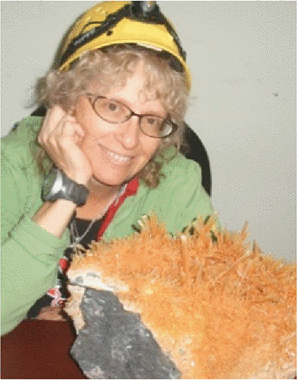 Penelope J. Boston合作论文数2
 Peter Buhler合作论文数Lockheed Martin Space2
 Cynthia B Phillips合作论文数NASA Jet Propulsion Laboratory2
 Norbert Schörghofer合作论文数Planetary Science Institute2
 Colin M. Dundas合作论文数2
 Debra L. Buczkowski合作论文数2
 William (Red) L. Whittaker合作论文数The Robotics Institute, Carnegie Mellon University2
 Ali-akbar Agha-mohammadi合作论文数NASA's Jet Propulsion Laboratory, California Institute of Technology2
 Bogdan P. Onac合作论文数“Emil Racoviţă” Institute of Speleology, Clinicilor 5, Cluj Napoca, 400006, Romania2Mike Malaska合作论文数1Ali Agha-Mohammadi合作论文数1
 Elodie Lesage合作论文数Jet Prop Lab, NASA1
 Jason D. Hofgartner合作论文数Jet Propulsion Laboratory, California Institute of Technology, Pasadena, CA, United States1
 Kynan Hughson合作论文数Univ Alaska Anchorage1
 Susan J. Conway合作论文数Univ Nantes, CNRS, UMR 6112, Lab Planetol & Geodynam, Nantes, France1
 Margaret E. Landis合作论文数Lab Atmospher & Space Phys, Univ Colorado1




