We present rosbridge, a middleware abstraction layer which provides robotics technology with a standard, minimalist applications development framework accessible to applications programmers who are not themselves roboticists. Rosbridge provides a simple, socket-based programmatic access to robot interfaces and algorithms provided (for now) by ROS, the open-source “Robot Operating System”, the current state-of-the-art in robot middleware. In particular, it facilitates the use of web technologies such as Javascript for the purpose of broadening the use and usefulness of robotic technology. We demonstrate potential applications in the interface design, education, human-robot interaction and remote laboratory environments.
This paper documents the technology developed during the creation of the PR2 Remote Lab and the process of using it for shared development for Learning from Demonstration. Remote labs enable a larger and more diverse group of researchers to participate directly in state-of-the-art robotics research and will improve the reproducibility and comparability of robotics experiments. We present solutions to interface, control, and design difficulties in the client and server-side software when implementing a remote laboratory architecture. We describe how researchers can interact with the PR2 and its environment remotely through a web interface, as well as develop similar interfaces to visualize and run experiments remotely. Additionally, we describe how the remote lab technology was used by researchers participating in the Robot Learning from Demonstration Challenge (LfD) held in conjunction with the AAAI-11 Conference on Artificial Intelligence. Teams from three institutions used the remote lab as their primary development and testing platform. This paper reviews the process as well as providing observations and lessons learned.
The advent of ROS, the Robot Operating System, has finally made it possible to implement and use state-of-the-art navigation and manipulation algorithms on widely-available, inexpensive standard robot platforms. With the addition of the Rosbridge application programming interface, interface designers and applications programmers can create robot interfaces and behaviors without venturing into the specialized world of robotics engineers. This tutorial introduces ROS and Rosbridge, and shows how quickly and easily these tools can be used to design and conduct large-scale online HRI experiments, access algorithms for autonomous robot behavior, and leverage the huge ecosystem of general-purpose web-based and application-oriented software engineering for robotics and HRI research. Tutorial attendees will learn the basics of autonomous and teleoperated navigation and manipulation, as well as interface design for online interaction with robots. During the tutorial they will design and write their own remote presence application, as well as develop strategies for incorporating autonomy and dealing with data collection.
In this paper, we describe a remote lab system that allows remote groups to access a shared PR2. This lab will enable a larger and more diverse group of researchers to participate directly in state-of-the-art robotics research and will improve the reproducibility and comparability of robotics experiments. We identify a set of requirements that apply to all web-based remote laboratories and focus on solutions to these requirements. Specifically, we present solutions to interface, control and design difficulties in the client and server-side software when implementing a remote laboratory architecture. The combination of shared physical hardware and shared middleware software allows for experiments that build upon and compare against results on the same platform and in the same environment for common tasks. We describe how researchers can interact with the PR2 and its environment remotely through a web interface, as well as develop similar interfaces to visualize and run experiments remotely.
We describe our efforts to create infrastructure to enable web interfaces for robotics. Such interfaces will enable researchers and users to remotely access robots through the internet as well as expand the types of robotic applications available to users with web-enabled devices. This paper centers on rosjs, a lightweight Javascript binding for ROS, Willow Garage's robot middleware framework, rosjs exposes many of the capabilities of ROS, allowing application developers to write controllers that are executed through a web browser. We discuss how rosjs extends ROS and briefly overview some of the features it provides, rosjs has been instrumental in the creation of remote laboratories featuring the iRobot Create and the PR2. These facilities will be available to the community as experimental resources. We describe the overall goals of this project as well as provide a brief description of how rosjs was used to help create web interfaces for these facilities.
We present a study of using a robotic learning from demonstration system capable of collecting large amounts of human-robot interaction data through a web-based interface. We examine the effect of different perceptual mappings between the human teacher and robot on the learning from demonstration. We show that humans are significantly more effective at teaching a robot to navigate a maze when presented with information that is limited to the robot's perception of the world, even though their task performance measurably suffers when contrasted with users provided with a natural and detailed raw video feed. Robots trained on such demonstrations learn more quickly, perform more accurately and generalize better. We also demonstrate a set of software tools for enabling internet-mediated human-robot interaction and gathering the large datasets that such crowdsourcing makes possible.
We describe our efforts toward developing infrastructure for shared remote robotics laboratories that allow reproducible robotics experimentation and large scale learning from demonstration (LfD). Our goal is to create a facility where users demonstrate desired tasks by teleoperating robot platforms through video-game style web-based interfaces, providing data that LfD approaches will turn into robot policies. We describe a selection of open source tools, provided by the Brown robotics lab, created in service of building such a remote lab.
Using data collected from human teleoperation, our goal is to learn a control policy that maps perception to actuation. Such policies are potentially multi-valued with regard to perception with a single input mapping to multiple outputs depending on the user's objective at a particular time. We propose a multi-valued function regressor to learn a larger class of robot control policies from human demonstration and extend the Hierarchical Dirichlet Process Hidden Markov Model to discover latent variables representing unknown objectives in the demonstrated data and the transitions between these objectives. Each of these objectives requires only a single-valued policy function, and thus can be learned with a Gaussian process function regressor. The learned transitions between these objectives determine the correct actuation where the complete policy function is multi-valued. We present the results of experiments conducted on the Nao humanoid robot platform.
Researchers have often commented on the high correlation between McCabe’s Cyclomatic Complexity (CC) and lines of code (LOC). Many have believed this correlation high enough to justify adjusting CC by LOC or even substituting LOC for CC. However, from an empirical standpoint the relationship of CC to LOC is still an open one. We undertake the largest statistical study of this relationship to date. Employing modern regression techniques, we find the linearity of this relationship has been severely underestimated, so much so that CC can be said to have absolutely no explanatory power of its own. This research presents evidence that LOC and CC have a stable practically perfect linear relationship that holds across programmers, languages, code paradigms (procedural versus object-oriented), and software processes. Linear models are developed relating LOC and CC. These models are verified against over 1.2 million randomly selected source files from the SourceForge code repository. These files represent software projects from three target languages (C, C++, and Java) and a variety of programmer experience levels, software architectures, and development methodologies. The models developed are found to successfully predict roughly 90% of CC’s variance by LOC alone. This suggest not only that the linear relationship between LOC and CC is stable, but the aspects of code complexity that CC measures, such as the size of the test case space, grow linearly with source code size across languages and programming paradigms.
 Chad Jenkins合作论文数Electrical Engineering and Computer Science Department, University of Michigan;Robotics Institute, University of Michigan9
 Sarah Osentoski合作论文数Science Department, Computer;University of Massachusetts Amherst;Computer Science Department, University of Massachusetts Amherst9
 Christopher Crick合作论文数Computer Science Department,Oklahoma State University8
 Benjamin Pitzer合作论文数University of Karlsruhe Institute for Measurement and Control5
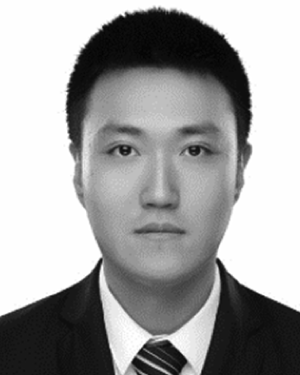 Shuonan DONG合作论文数1
 Randy K. Smith合作论文数1
 Charles Duhadway合作论文数Stanford University1Jesse Butterfield合作论文数Department of Computer Science, Brown University1
 David Kivilcim Hale合作论文数University of Alabama1
 Nicholas A. Kraft合作论文数Fathom1Joanne E. Hale合作论文数Management Information Systems1Halit Bener Suay合作论文数Worcester Polytechnic Institute1
 Daniel H. Grollman合作论文数Department of Computer Science;Brown University;Department of Computer Science, Brown University1




