Ranking and recommendation systems are the foundation for numerous online experiences, ranging from search results to personalized content delivery. These systems have evolved into complex, multilayered architectures that leverage vast datasets and often incorporate thousands of predictive models. The maintenance and enhancement of these models is a labor intensive process that requires extensive feature engineering. This approach not only exacerbates technical debt but also hampers innovation in extending these systems to emerging problem domains. In this report, we present our research to address these challenges by utilizing a large foundation model with a textual interface for ranking and recommendation tasks. We illustrate several key advantages of our approach: (1) a single model can manage multiple predictive tasks involved in ranking and recommendation, (2) decoder models with textual interface due to their comprehension of reasoning capabilities, can generalize to new recommendation surfaces and out-of-domain problems, and (3) by employing natural language interfaces for task definitions and verbalizing member behaviors and their social connections, we eliminate the need for feature engineering and the maintenance of complex directed acyclic graphs of model dependencies. We introduce our research pre-production model, 360Brew V1.0, a 150B parameter, decoder-only model that has been trained and fine-tuned on LinkedIn's data and tasks. This model is capable of solving over 30 predictive tasks across various segments of the LinkedIn platform, achieving performance levels comparable to or exceeding those of current production systems based on offline metrics, without task-specific fine-tuning. Notably, each of these tasks is conventionally addressed by dedicated models that have been developed and maintained over multiple years by teams of a similar or larger size than our own.
One of the most well-established applications of machine learning is in deciding what content to show website visitors. When observation data comes from high-velocity, user-generated data streams, machine learning methods perform a balancing act between model complexity, training time, and computational costs. Furthermore, when model freshness is critical, the training of models becomes time-constrained. Parallelized batch offline training, although horizontally scalable, is often not time-considerate or cost-effective. In this paper, we propose Lambda Learner, a new framework for training models by incremental updates in response to mini-batches from data streams. We show that the resulting model of our framework closely estimates a periodically updated model trained on offline data and outperforms it when model updates are time-sensitive. We provide theoretical proof that the incremental learning updates improve the loss-function over a stale batch model. We present a large-scale deployment on the sponsored content platform for a large social network, serving hundreds of millions of users across different channels (e.g., desktop, mobile). We address challenges and complexities from both algorithms and infrastructure perspectives, illustrate the system details for computation, storage, stream processing training data, and open-source the system.
Attention Model has now become an important concept in neural networks that has been researched within diverse application domains. This survey provides a structured and comprehensive overview of the developments in modeling attention. In particular, we propose a taxonomy that groups existing techniques into coherent categories. We review salient neural architectures in which attention has been incorporated and discuss applications in which modeling attention has shown a significant impact. We also describe how attention has been used to improve the interpretability of neural networks. Finally, we discuss some future research directions in attention. We hope this survey will provide a succinct introduction to attention models and guide practitioners while developing approaches for their applications.
We present the evolution of a large-scale content recommendation platform for LinkedIn Learning, serving 645M+ LinkedIn users across several different channels (e.g., desktop, mobile). We address challenges and complexities from both algorithms and infrastructure perspectives. We describe the progression from unsupervised models that exploit member similarity with course content, to supervised learning models leveraging member interactions with courses, and finally to hyper-personalized mixed-effects models with several million coefficients. For all the experiments, we include metric lifts achieved via online A/B tests and illustrate the trade-offs between computation and storage requirements.
Talent search and recommendation systems at LinkedIn strive to match the potential candidates to the hiring needs of a recruiter or a hiring manager expressed in terms of a search query or a job posting. Recent work in this domain has mainly focused on linear models, which do not take complex relationships between features into account, as well as ensemble tree models, which introduce non-linearity but are still insufficient for exploring all the potential feature interactions, and strictly separate feature generation from modeling. In this paper, we present the results of our application of deep and representation learning models on LinkedIn Recruiter. Our key contributions include: (i) Learning semantic representations of sparse entities within the talent search domain, such as recruiter ids, candidate ids, and skill entity ids, for which we utilize neural network models that take advantage of LinkedIn Economic Graph, and (ii) Deep models for learning recruiter engagement and candidate response in talent search applications. We also explore learning to rank approaches applied to deep models, and show the benefits for the talent search use case. Finally, we present offline and online evaluation results for LinkedIn talent search and recommendation systems, and discuss potential challenges along the path to a fully deep model architecture. The challenges and approaches discussed generalize to any multi-faceted search engine.
In this paper, we present an architecture executing a complex machine learning model such as a neural network capturing semantic similarity between a query and a document; and deploy to a real-world production system serving 500M+users. We present the challenges that arise in a real-world system and how we solve them. We demonstrate that our architecture provides competitive modeling capability without any significant performance impact to the system in terms of latency. Our modular solution and insights can be used by other real-world search systems to realize and productionize recent gains in neural networks.
Super-resolution methods form high-resolution images from low-resolution images. In this paper, we develop a new Bayesian nonparametric model for super-resolution. Our method uses a beta-Bernoulli process to learn a set of recurring visual patterns, called dictionary elements, from the data. Because it is nonparametric, the number of elements found is also determined from the data. We test the results on both benchmark and natural images, comparing with several other models from the research literature. We perform large-scale human evaluation experiments to assess the visual quality of the results. In a first implementation, we use Gibbs sampling to approximate the posterior. However, this algorithm is not feasible for large-scale data. To circumvent this, we then develop an online variational Bayes (VB) algorithm. This algorithm finds high quality dictionaries in a fraction of the time needed by the Gibbs sampler.
Unsupervised multilayered ("deep") models are considered for imagery. The model is represented using a hierarchical convolutional factor-analysis construction, with sparse factor loadings and scores. The computation of layer-dependent model parameters is implemented within a Bayesian setting, employing a Gibbs sampler and variational Bayesian (VB) analysis that explicitly exploit the convolutional nature of the expansion. To address large-scale and streaming data, an online version of VB is also developed. The number of dictionary elements at each layer is inferred from the data, based on a beta-Bernoulli implementation of the Indian buffet process. Example results are presented for several image-processing applications, with comparisons to related models in the literature.
In this paper, computer-based techniques for stylistic analysis of paintings are applied to the five panels of the 14th century Peruzzi Altarpiece by Giotto di Bondone. Features are extracted by combining a dual-tree complex wavelet transform with a hidden Markov tree (HMT) model. Hierarchical clustering is used to identify stylistic keywords in image patches, and keyword frequencies are calculated for sub-images that each contains many patches. A generative hierarchical Bayesian model learns stylistic patterns of keywords; these patterns are then used to characterize the styles of the sub-images; this in turn, permits to discriminate between paintings. Results suggest that such unsupervised probabilistic topic models can be useful to distill characteristic elements of style.
In this thesis, we shall derive, in a variety of settings, and for different applications, efficient posterior inference algorithms handling large data sets, and use side information to derive superior inference techniques. We demonstrate the efficiency and accuracy of those models and algorithms in the different applications, on both real and synthetic data sets. We evaluate the quality of the results, with both quantitative and human evaluation experiments. In the first part of the thesis the general framework is that of sparsity: we assume the data have a sparse representation; the application on which we focus is image super-resolution, in which one seeks to "up-scale images", i.e. "reconstruct" finer detail in an image than given in the data. Image super-resolution has been tackled successfully via sparse coding but not, so far, by Bayesian nonparametric methods (BNM). In other contexts, BNMs were shown to be powerful because they infer parameters that otherwise have to be assigned a priori. We build here the tools enabling such a BNM for the super-resolution of images. We start with building a sparse nonparametric factor analysis model for image super-resolution, more precisely, a model with a beta-Bernoulli process to learn the number of dictionary elements from the data. We test the results on both benchmark and natural images, comparing with the models in the literature. Then, we perform large-scale human evaluation experiments to explicitly assess the visual quality of the results. In a first implementation, we use Gibbs sampling, operating on the data in batch mode, and assess its performance. However, for large-scale data, such a Gibbs sampling approach is typically not feasible. To circumvent this, we develop an online variational Bayes (VB) algorithm that can deal with larger-scale data in a fraction of the time needed by traditional inference. In the second part of the thesis we consider data sets with rich side information. We study 2 different frameworks that have such side information: relational information and group information. To handle relational information, we build a relational factor analysis (rFA) model which incorporates this into the dictionary learning. We show that the use of relational information (e.g. spatial location), helps learning higher quality dictionaries and improves the recommendation systems in a social network and the image analysis algorithms (e.g. image inpainting). To handle group information, we propose a multi-task learning framework for image super-resolution problem using a hierarchical beta-process as a prior to dictionary assignments. In this model, we study grouped data and we build a model incorporating the group information. We show that by incorporating group information in this way the algorithm avoids erroneous selection of dictionary elements. Finally, in the third part of the thesis, we study latent sequential information between observations. We use this information to build a novel dynamic programming algorithm for sequential models. Hidden Markov models (HMMs) and conditional random fields (CRFs) are two popular techniques for modeling sequential data. Inference algorithms designed over CRFs and HMMs allow estimation of the state sequence, given the observations. In several applications, the end goal is not the estimation of the state sequence, but rather the estimation of the value of some function of the state sequence. In such scenarios, estimating the state sequence by conventional inference techniques, followed by computing the functional mapping from this estimate, is not necessarily optimal; it may be more efficient to directly infer the final outcome from the observations. In particular, we consider the specific instantiation of the problem where the goal is to find the state trajectories without exact transition points; we derive a novel polynomial time inference algorithm that outperforms vanilla inference techniques. We show that this particular problem arises commonly in many disparate applications and present the results for experiments on three different applications: (1) Toy robot tracking; (2) Single stroke character recognition; (3) Handwritten word recognition. (Abstract shortened by UMI.)
Hidden Markov models (HMMs) and conditional random fields (CRFs) are two popular techniques for modeling sequential data. Inference algorithms designed over CRFs and HMMs allow estimation of the state sequence given the observations. In several applications, estimation of the state sequence is not the end goal; instead the goal is to compute some function of it. In such scenarios, estimating the state sequence by conventional inference techniques, followed by computing the functional mapping from the estimate is not necessarily optimal. A more formal approach is to directly infer the final outcome from the observations. In particular, we consider the specific instantiation of the problem where the goal is to find the state trajectories without exact transition points and derive a novel polynomial time inference algorithm that outperforms vanilla inference techniques. We show that this particular problem arises commonly in many disparate applications and present experiments on three of them: (1) Toy robot tracking; (2) Single stroke character recognition; (3) Handwritten word recognition.
A convolutional factor-analysis model is developed, with the number of filters (factors) inferred via the beta process (BP) and hierarchical BP, for single-task and multi-task learning, respectively. The computation of the model parameters is implemented within a Bayesian setting, employing Gibbs sampling; we explicitly exploit the convolutional nature of the expansion to accelerate computations. The model is used in a multi-level ("deep") analysis of general data, with specific results presented for image-processing data sets, e.g., classification.
Wavelet transforms and machine learning tools can be used to assist art experts in the stylistic analysis of paintings. A dual-tree complex wavelet transform, Hidden Markov Tree modeling and Random Forest classifiers are used here for a stylistic analysis of Vincent van Gogh's paintings with results on two stylometry challenges that concern “dating, resp. extracting distinguishing features”.
Cooperative vehicle systems (CVS) can provide intelligent transportation systems services such as probe vehicle information and hazard warnings by exchanging data among suitably equipped vehicles as they travel. The sensitivity of the performance of CVS to the market penetration of suitably equipped vehicles is explained by using Monte Carlo analyses and simulations of wireless message propagation. The CVS functions are implemented by using wireless vehicle-vehicle data communications, which can be successful only when other equipped vehicles exist within wireless range to receive the messages and relay them to further vehicles. These relays may be accomplished by direct wireless transmission to nearby vehicles, but they may also be facilitated by transport relay, by which vehicles traveling in the opposite direction carry the messages and rebroadcast them to the vehicles that they pass. The effectiveness of both direct and transport relay mechanisms as a function of wireless communication range, market penetration, and traffic density and their influence on the speed of message propagation is shown. The direct relay is most effective with a high density of equipped vehicles, but when the density of equipped vehicles is low, the relays become much more dependent on the slower transport relay. When the market penetration is low early in the development of CVS, the most promising use cases are likely to be those that do not require rapid message propagation.
 Rohan Ramanath合作论文数LinkedIn4
 Ingrid Daubechies合作论文数Department of Mathematics, Trinity College of Arts & Sciences, Duke University;Department of Electrical and Computer Engineering, Pratt School of Engineering, Duke University4
 David M. Blei合作论文数Department of Statistics, Columbia University;Department of Computer Science, Columbia University3
 Lawrence Carin合作论文数Agency for Science, Technology and Research3
 Oncel Tuzel合作论文数AI Research Group, Apple3
 Kirill Talanine合作论文数LinkedIn Corporation2Jeffrey D. Gee合作论文数LinkedIn Corporation2Deepak Kumar合作论文数LinkedIn Corp, Sunnyvale, CA 94085 USA2
 Eugene Brevdo合作论文数Google DeepMind;Google Brain2Sneha Chaudhari合作论文数LinkedIn Corporation Sunnyvale2
 Bo Chen合作论文数DJI2
 David Dunson合作论文数Department of Statistical Science, Trinity College of Arts & Sciences, Duke University2
 Bo Hu (胡博)合作论文数School of Computer Science, Beijing University of Posts and Telecommunications;State Key Laboratory of Networking and Switching Technology, Beijing University of Posts and Telecommunications2
 Guillermo Sapiro合作论文数Department of Electrical and Computer Engineering, Duke University2
 Sina Jafarpour合作论文数Department of Computer Science, Princeton University2Konstantin Salomatin合作论文数2Shannon M. Hughes合作论文数Department of Electrical, Computer, and Energy Engineering, University of Colorado at Boulder2Vignesh Kothapalli合作论文数1Luke Simon合作论文数1Varun Mithal合作论文数1David Steel合作论文数1Mahesh Joshi合作论文数1Vladislav Tcheprasov合作论文数1
 Yu Wang合作论文数Big Data and Social Computing Lab, Computer Science Department, College of Engineering, University of Illinois at Chicago1
 Aman Gupta合作论文数1
 William Brown合作论文数1Sara Smoot合作论文数LinkedIn Corporation1Onkar Dalal合作论文数LinkedIn Corporation1
 Hakan Inan合作论文数Schnitzer Group, Department of Electrical Engineering, Stanford University;Facebook1Raja Sengupta合作论文数Department of Civil and Environmental Engineering, University of California, Berkeley1
 Sahin Cem Geyik合作论文数Meta1
 Qingquan Song (宋清全)合作论文数OpenAI1
 Ozcaglar Cagri合作论文数Computer Science Department, Rensselaer Polytechnic Institute Troy1
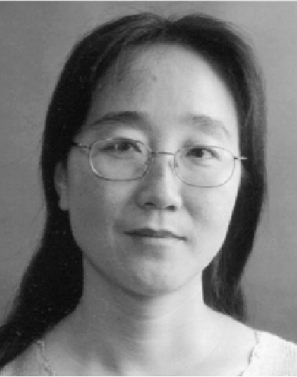 Xiaoling Zhai合作论文数1Tong Wu (吴彤)合作论文数College of Science, Northwest A&F University1Q. Guo合作论文数1
 Steven E. Shladover合作论文数Institute of Transportation Studies, University of California, Berkeley1
 Shivani Rao合作论文数Purdue University1
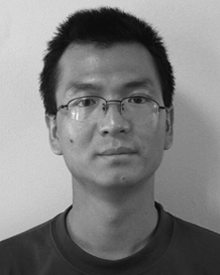 Xianren Wu合作论文数1
 Mustafa Ergen合作论文数Department of Elektronik ve Haberlesme Muhendisligi, Istanbul Technical University;Ambeent Inc.1
 Mingyuan Zhou合作论文数Department of Statistics and Data Sciences, College of Natural Sciences, The University of Texas at Austin;Department of Computer Science, College of Natural Sciences, The University of Texas at Austin;Microsoft AI1
 Hamed Firooz合作论文数Meta AI;LinkedIn1Shan Zhou (周珊)合作论文数School of Environmental Technology, Zhejiang Forestry University1
 Maziar Sanjabi合作论文数Meta AI;Facebook AI1Joel Vanderwerf合作论文数1
 Krishnaram Kenthapadi合作论文数Oracle1
 Robert Calderbank合作论文数Pierre R. Lamond Department of Electrical & Computer Engineering, Pratt School of Engineering, Duke University;Trinity College of Arts & Sciences, Duke University1Andrei Brasoveanu合作论文数1Bénédicte Bougler合作论文数1




