Portfolio management is a challenging task due to the uncertainty and volatility in financial markets, making precise asset allocation and return maximization difficult. This paper presents a novel deep reinforcement learning (DRL) approach enhanced with fuzzy trend indicators to improve portfolio decision-making. The model was developed using a DRL framework, where a convolutional neural network (CNN)-based policy network learns to optimize asset allocations through interactions with the market. Fuzzy trend indicators are incorporated as additional input features, enabling the model to better capture market uncertainties and ambiguous trends. By providing a more flexible representation of market conditions, fuzzy trend indicators allow the model to dynamically adjust portfolio allocations in response to changing trends, leading to more precise asset allocation decisions and enhanced portfolio performance. The proposed model was trained and evaluated on historical stock data from the Brazilian stock market, covering the period from 2011 to 2020. The dataset includes daily high, low, and closing prices, ensuring a strong foundation for model training and validation. Experimental results show that the fuzzy-enhanced model outperforms some state-of-the-art strategies in terms of both returns and adaptability to volatile market conditions.
The present study aims to overcome some defects of the K-nearest neighbor (K-NN) rule. Two important data preprocessing methods to elevate the K-NN rule are prototype selection (PS) and prototype generation (PG) techniques. Often the advantage of these techniques is investigated separately. In this paper, using the gravitational search algorithm (GSA), two hybrid schemes have been proposed in which PG and PS problems have been considered together. To evaluate the classification performance of these hybrid models, we have performed a comparative experimental study including a comparison between our proposals and some approaches previously studied in the literature using several benchmark datasets. The experimental results demonstrate that our hybrid approaches outperform most of the competitive methods.
In the last decades, many efforts have been made to solve multimodal optimization problems using Particle Swarm Optimization (PSO). To produce good results, these PSO algorithms need to specify some niching parameters to define the local neighborhood. In this paper, our motivation is to propose the novel neighborhood structures that remove undesirable niching parameters without sacrificing performance. Hence, this paper has two main contributions. First, two novel parameter-free neighborhood structures named Topological Nearest-Better (TNB) neighborhood and Distance-based Nearest-Better (DNB) neighborhood are proposed in the topological space and decision space, respectively. Second, two proposed neighborhoods are combined with Fuzzy PSO (FPSO) and two novel niching algorithms, called TNBFPSO and DNB-FPSO, are proposed for solving multimodal optimization problems. It should be noted that we use a zero-order fuzzy system to balance between exploration and exploitation in the proposed algorithms. To evaluate the performance of proposed algorithms, we performed a detailed empirical evaluation on the several standard multimodal benchmark functions. Our results show that DNB-FPSO statistically outperforms the other compared multimodal optimization algorithms.
This paper proposes a totally multiplier-less approximate reconstruction cosine modulated filter bank. The prototype filter is designed to obtain a computationally efficient, sharp transition width, finite impulse response (FIR) filter using the frequency response masking (FRM) approach combined with the canonic signed digit (CSD) representation of the coefficients. Meta-heuristic algorithms are deployed to optimize the performance of the filter bank. The algorithms are modified to suit the optimization problem, in which the objective function is non linear and the search space consists of integers
Cattle supply an important source of nutrition for humans in the world. CpG islands (CGIs) are very important and useful, as they carry functionally relevant epigenetic loci for whole genome studies. As a matter of fact, there have been no formal analyses of CGIs at the DNA sequence level in cattle genomes and therefore this study was carried out to fill the gap. We used hidden markov model algorithm to detect CGIs. The total number of predicted CGIs for cattle was 90668. The number of detected CGIs and CGI densities downwardly varied across chromosomes. Chromosome 25 had the largest number of CGIs (4556) and the highest CGI density (106.20 CGIs/Mb). A significant positive correlation observed among CGI densities with guanine-cytosine (GC) content, Obs(CpG)/Exp(CpG), recombination rate and gene density. When the size of chromosomes increased, the CGI densities decreased and a trend of higher CGI densities in the telomeric regions observed. This feature may be the reason of a positive correlation between CGI density and recombination rate. To detect information on CGI density differences between cattle and other vertebrate genomes, CGI density was also scanned in eleven vertebrate genomes. The CGI densities varied greatly among genomes. These discoveries may contribute to a better understanding of epigenomic role of CGIs and their molecular evolution in the cattle.
Software Performance Engineering (SPE) in the early life cycle of software development (software modeling) is very useful and cost-effective but does not guide the software architect through how to improve the design. Computing the least response time by controlling utilization and cost is a constrained optimization problem. This paper presents a constrained optimization method based on Gravitational Search Algorithm (GSA) for exploring the software design space automatically and proposes the best configuration in terms of performance evaluation. Presented method is compared with constrained PSO which is one of famous optimization algorithms. Obtained results confirm the efficiency of proposed method.
Among numerous inpainting methods that have been proposed, convolutional based methods are rapid and simple with respect to others. However, the major flaw of these methods is that sharp edges are not inpainted properly, and usually smoothed. In this paper, a new fast convolutional inpainting method is proposed for color images that is edgepreserving and could estimate the missing parts of an image effectively. In the proposed algorithm, the convolutional mask coefficients are calculated according to the gradient information at each pixel in three layers of color image. Experimental results confirm the simplicity and effectiveness of our method with respect to some other recent methods.
This paper presents a novel steganographic algorithm based on the spatial domain: Least Significant Bits (LSB). This approach improves the LSB matching method proposed by Mielikaien while Mielikaien's method utilizes a binary function to reduce the number of changed pixel values. In proposed method, a two-score system is proposed to assess the performance of different orders for LSB matching. Afterward a quantum gravitational search algorithm is employed to search for an optimal solution among all the permutation orders. By employing the proposed method, the distortion of the stego image could be reduced while the probability of detection is decreased. The experimental results show that the proposed method achieves better performance than Mielikainen's pair-wise LSB matching method in less distortion (means higher visual quality) and more preservation against steganalysis.
In recent years, researchers has proposed (t, n)-threshold image secret sharing and hiding schemes with authentication. The secret image is shared and hided into typical cover images to form the stego images so that to be transmitted securely. Unfortunately, there is a common week point that each stego image should be extended to 4/t times of the secret image. Recently, a (t, n)-threshold image secret sharing and hiding scheme with authentication is presented that the size expansion of the stego images reduced to 3.5/t. We propose an Improved (t, n)-threshold scheme that the size of each stego image is reduced to 3/t times of the secret image and the visual quality of stego image remains high. Moreover, the authentication property is enhanced based on Chinese Remainder Theorem (CRT). Eventually, the experimental results reveal that proposed scheme is obviously better than the other schemes.
Quantum-behaved Gravitational Search Algorithm (QGSA), a novel variant of GSA, is a global convergent algorithm whose search strategy makes it own stronger global search ability than classical GSA over unimodal problems. Like some other evolutionary optimization technique, premature convergence in the QGSA is also. In this paper, we propose a new kind of potential well evaluation, with a center which is weighted average of all Kbests based on their masses and distances. As results shown it helps the agent to escape the sub-optima more easily. The improved QGSA is evaluated on some benchmark function and results are reported.
In this paper, a new algorithm for edge detection based on fuzzy concept is suggested. The proposed approach defines dynamic membership functions for different groups of pixels in a 3 by 3 neighborhood of the central pixel. Then, fuzzy distance and alpha-cut theory are applied to detect the edge map by following a simple heuristic thresholding rule to produce a thin edge image. A large number of experiments are employed to confirm the robustness of the proposed algorithm. In the experiments different cases such as normal images, images corrupted by Gaussian noise, and uneven lightening images are involved. The results obtained are compared with some famous algorithms such as Canny and Sobel operators, a competitive fuzzy edge detector, and a statistical based edge detector. The visual and quantitative comparisons show the effectiveness of the proposed algorithm even for those images that were corrupted by strong noise.
In this paper a new image inpainting scheme using bilateral filters is proposed. Since in the digital image inpainting pixels' values in a damaged region are unknown and are needed in calculation of weights according to the range filter of bilateral filters, in the proposed scheme we substitute the difference between two gray level values in the range filter by multiplication of two vectors: direction between two pixels and gradient direction of known pixel in the neighborhood of damaged pixels. The algorithm is iterative, fast and simple to implement. In addition, to achieve a better performance, the number of iterations is adaptively determined according to the region type (structural or textural) using the local variance. To evaluate the performance of the proposed method, several comparative experiments are performed. Experimental results confirm the effectiveness of the proposed algorithm.
In this paper an improved Harmony Search (HS) is applied to solve the Economic Dispatch (ED) problem with nonconvex cost functions. The proposed approach modifies the improvement of Novel Global Harmony Search (NGHS) reported in the literature where the resulting approach is known as NGHS-II. The practical ED problem have nonconvex cost functions with equality and inequality constraints that makes the problem of finding the global optimum difficult using any optimization approaches. In this paper, the NGHS-II is deal with the equality and inequality constraints in the ED problem. To validate the results obtained by proposed NGHS-II, NGHS and other improved version of harmony search (IHS) are applied for comparison. Also, the results obtained by the NGHS-II are compared with the previous approaches reported in the literature. The results show that the proposed NGHS-II produces better solutions for all study systems.
This paper presents a new and effective image indexing technique that extracts features from JPEG compressed images. Using vector quantization techniques (VQ) and a codebook generated using a K -means clustering algorithm, the proposed technique is able to create an effective histogram from DCT coefficients, which are the major components of JPEG. The proposed method only needs to do partial decoding, therefore it can accelerate the work of indexing images. Experimental results show that its retrieval performance is higher compared with those of other methods from pixel and compressed domains. All experiments confirm the effectiveness and efficiency of the proposed method.
In practice, obtaining the global optimum for the economic dis- patch (ED) problem with ramp rate limits and prohibited operating zones is presents diculties. This paper presents a new and ecient method for solving the economic dispatch problem with non-smooth cost functions using a Fuzzy Adaptive Genetic Algorithm (FAGA). The proposed algorithm deals with the issue of controlling the exploration and exploitation capabilities of a heuristic search algorithm in which the real version of Genetic Algorithm (RGA) is equipped with a Fuzzy Logic Controller (FLC) which can eciently explore and exploit optimum solutions. To validate the results obtained by the proposed FAGA, it is compared with a Real Genetic Algorithm (RGA). Moreover, the results obtained by FAGA and RGA are also compared with those obtained by other approaches reported in the literature. It was observed that the FAGA outperforms the other methods in solving the power system economic load dispatch problem in terms of quality, as well as convergence and success rates.
The rock engineering classification system is based on six parameters defined by Bieniawski [5], who employed parallel sets of linguistic and numerical criteria that were acknowledged to influence the behaviour of rock masses and the stability of rock structures. Consequently, experts frequently relate rock joints and discontinuities as well as ground water conditions in linguistic terms, with rough calculations. Recently, intelligence system approaches such as artificial neural network (ANN) and neuro-fuzzy methods have been used successfully for time series modelling. Using neuro-fuzzy approaches, which enable the information that is stored in trained networks to be expressed in the form of a fuzzy rule base, would help to overcome this issue. This paper presents the results of a study of the application of neuro-fuzzy methods to predict rock mass rating. We note that the proposed weights technique was applied in this process. We show that neuro-fuzzy methods give better predictions than conventional modelling approaches.
Water quality diagrams are comprised of quality classes defined by crisp sets, and as a consequence the boundaries between classes have an inherent imprecision. In this study, the concentration values of electrical conductivity (EC) and sodium adsorption ratio (SAR) in United States Salinity Laboratory diagram (USSL) are combined together through an adaptive network-based fuzzy inference system (ANFIS) to generate a new method that can be used instead of the USSL-diagram. The results showed that water quality classification based on the proposed method is more precise in comparison with the USSL-diagram classification, and it is a promising alternative to traditional approach. It has been observed that the ANFIS model with 96% accuracy has much better predicting capability than the Mamdani fuzzy inference system (MFIS). The results indicated that the ANFIS modeling decreases error effects in hydro-chemical experiments and it also significantly decreases computation time for the irrigation water quality evaluation.
This paper deals with estimation of electricity demand of Iran based on economic indicators using Particle Swarm Optimization (PSO) Algorithm. The estimation is based on Gross Domestic Product (GDP), population, number of customers and average price electricity by developing two different estimation models: a linear model and a non-linear model. The proposed models are obtained based upon available actual data of 21years; since 1980–2000. Then the models obtained are used to estimate the electricity demand of the target years; for a period of time e.g. 2001–2006 and the results obtained are compared with the actual demand during this period. Furthermore, to validate the results obtained by PSO, genetic algorithm (GA) is applied to solve the problem. The results show that the PSO is a useful optimization tool for solving the problem using two developed models and can be used as an alternative solution to estimate the future electricity demand.
 Saeid Saryazdi合作论文数Department of Electrical Engineering, Shahid Bahonar University of Kerman4
 Malihe M. Farsangi合作论文数Department of Electrical Engineering, Shahid Bahonar University of Kerman4
 S.M. Mazloumzadeh合作论文数3
 M. Ghaderi-Zefrehei合作论文数2
 m soleimanpourmoghadam合作论文数2
 Mohammad Reza Mohammadabadi合作论文数Department of Animal Sciences, Shahid Bahonar University2
 Barazandeh Arsalan合作论文数Department of Animal Science, Jiroft University2
 Mohsen Shamsi合作论文数Department of Agricultural Machinery, Shahid Bahonar University of Kerman2
 Mehdi Nasri合作论文数Islamic Azad University, Khomeinishahr Branch2n alavi合作论文数1V. Nozari合作论文数1Song, J.合作论文数1amir ehsan feili monfared合作论文数1maryam mahyabadi合作论文数1Mahin Schaffie合作论文数Department of Petroleum Engineering, Shahid Bahonar University of Kerman1Hadi Noori合作论文数1
 Mina Mirhosseini合作论文数Department of Computer Science, Higher Education Complex of Bam, Bam, Iran1
 M. Baneshi合作论文数1
 Mohamad Koohi-Moghadam合作论文数Faculty of Dentistry, The University of Hong Kong1
 Reza Askari合作论文数Faculty of New Sciences and Technologies, University of Tehran1
 Nekooei, K.合作论文数Kerman Univ.;c;Kerman Univ.1
 Amoozegar, M.合作论文数Sch. of Comput. Eng., Iran Univ. of Sci. & Technol.;c;Sch. of Comput. Eng., Iran Univ. of Sci. & Technol.1
 Ghotbi Ravandi Elnaz合作论文数1
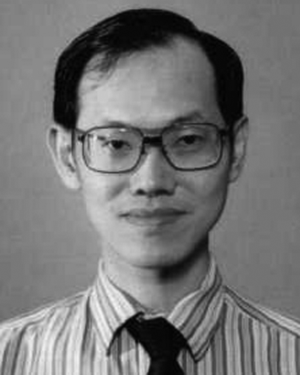 Yong Ching Lim合作论文数School of Electrical and Electronic Engineering, Nanyang Technological University1
 Mashaallah Mashinchi合作论文数Department of Statistics, Shahid Bahonar University of Kerman1Mehdi Neyestani合作论文数1
 Aida Mustapha合作论文数University Putra Malaysia1
 Hossein Jalalifar合作论文数Shahid Bahonar University of Kerman Kerman1P. Poursistani合作论文数1
 Masoud Saeed合作论文数Department of Electrical Engineering, Shahid Bahonar University of Kerman1Dongning Li合作论文数1
 Ehsanollah Kabir合作论文数Faculty Member , School of Cognitive Sciences1
 Amir Rajabi Behjat合作论文数Faculty of Computer Science and Information Technology, Universiti Putra Malaysia1
 Mohammad-Ali Nikouei Mahani合作论文数1M. H. Amjadi合作论文数1
 Vali Derhami合作论文数Department of Electrical and Computer Engineering, Yazd University1
 Esmat Rashedi合作论文数Department of Electrical Engineering, Shahid Bahonar University of Kerman1
 A.A. Sahebi合作论文数Department of Mining Engineering, Shahid Bahonar University of Kerman1
 Mohammad Bagher Dowlatshahi合作论文数Department of Computer Science, Shahid Bahonar University of Kerman1




