Large language models are undergoing a transition from model technology to system technology. Engineering challenges like cache reuse, context capacity, agent scheduling, and permission control resemble classical computer systems problems. This raises a question: if we treat the LLM as a CPU, KV cache as processor cache, context window as main memory, and agent framework as an operating system, can decades of computer architecture wisdom guide next generation model native systems? This paper pursues this analogy as a visionary survey. We map computer architecture concepts onto the emerging model native stack, survey literature across LLM as OS, memory management, agent frameworks, tool protocols, multi agent coordination, cognitive architectures, and safety governance, finding that each addresses a different layer without a unifying model. We propose the Intelligent Computing Architecture (ICA): six functional layers with interface contracts and design axioms. We resolve the tension over whether the LLM resembles a CPU or OS via a dual plane architecture a probabilistic execution plane (what can be computed) and a deterministic control plane (what should be computed), with every layer passing through as a graded crossover. We propose three Amdahl style design heuristics Semantic Locality, Context Budget, and Agent Speedup as organizing back of envelope models, illustrate their parameter ranges with published data, and identify predictive validation as the principal open task. We articulate analogy boundaries, note differences between silicon and model era architectures, and propose a research roadmap. This is a conceptual and survey contribution with no new experimental results.
Agent performance increasingly depends on harness engineering, yet harness design is usually buried in controller code and runtime-specific conventions, making it hard to transfer, compare, and study as a scientific object. We ask whether the high-level control logic of an agent harness can instead be externalized as a portable executable artifact. We introduce Natural-Language Agent Harnesses (NLAHs), which express harness behavior in editable natural language, and Intelligent Harness Runtime (IHR), a shared runtime that executes these harnesses through explicit contracts, durable artifacts, and lightweight adapters. Across coding and computer-use benchmarks, we conduct controlled evaluations of operational viability, module ablation, and code-to-text harness migration.
The growing demand for automated writing assistance in diverse academic domains highlights the need for robust Chinese Grammatical Error Correction (CGEC) systems that can adapt across disciplines. However, existing CGEC research largely lacks dedicated benchmarks for multi-disciplinary academic writing, overlooking continual learning (CL) as a promising solution to handle domain-specific linguistic variation and prevent catastrophic forgetting. To fill this crucial gap, we introduce CL^2GEC, the first Continual Learning benchmark for Chinese Literature Grammatical Error Correction, designed to evaluate adaptive CGEC across multiple academic fields. Our benchmark includes 10,000 human-annotated sentences spanning 10 disciplines, each exhibiting distinct linguistic styles and error patterns. CL^2GEC focuses on evaluating grammatical error correction in a continual learning setting, simulating sequential exposure to diverse academic disciplines to reflect real-world editorial dynamics. We evaluate large language models under sequential tuning, parameter-efficient adaptation, and four representative CL algorithms, using both standard GEC metrics and continual learning metrics adapted to task-level variation. Experimental results reveal that regularization-based methods mitigate forgetting more effectively than replay-based or naive sequential approaches. Our benchmark provides a rigorous foundation for future research in adaptive grammatical error correction across diverse academic domains.
Hard negative mining has become the dominant strategy for training retrievers, yet it faces intrinsic limitations: negatives are bounded by corpus availability, selected by retriever score rather than diagnostic value, and increasingly contaminated by false positives as the retriever improves. LLM-based synthesis offers a principled alternative, where negatives that are unconstrained, targeted, and free from false positive risk. But we show that naively incorporating generated negatives into contrastive learning often degrades retrieval performance. We identify and formalize the root cause as a generative-discriminative gap: LLM generation optimizes for fluent, plausible text, while contrastive learning demands strategic violations of relevance at the decision boundary. Our analysis reveals two compounding failure modes: discriminative-agnostic generation, where the LLM lacks an explicit model of query information needs and defaults to generic or topic-drifted text that provides no contrastive signal; and source-dependent shortcuts, where distributional artifacts enable the model to distinguish negatives by origin rather than relevance, causing gradient drift that actively corrupts optimization. To close this gap, we propose CausalNeg consisting of two main modules: (1) CoT-guided counterfactual perturbation for data construction: decomposes why a document satisfies a query into explicit information requirements, then surgically violates individual requirements to construct negatives with controlled, interpretable hardness. (2) Query-view entropy maximization during training: disperses generated negatives across the similarity spectrum, minimizing the mutual information between source identity and similarity scores to suppress shortcut exploitation. We make our code publicly available at https://github.com/mzhangzhicheng/CausalNeg.
Generalized Few-Shot Intent Detection (GFSID) is a challenging and realistic task as it requires to categorize both seen and novel intents simultaneously. Previous methods rely on the episodic learning paradigm, which makes it hard to extend to a generalized setup. Furthermore, they ignore preserving learned knowledge. To address the dilemma, we propose to convert the GFSID task into the class incremental learning paradigm. Specifically, we propose a two-phase learning framework based on prompt learning, which sequentially learns the knowledge of different intents in various periods. To retain learned knowledge we introduce two knowledge preservation methods for distinct real-life scenarios. Extensive experiments and detailed analyses on two widely used datasets show that our framework based on the class incremental learning paradigm achieves promising performance.
Large Audio Language Models (LALMs) have garnered significant research interest. Despite being built upon text-based large language models (LLMs), LALMs frequently exhibit a degradation in knowledge and reasoning capabilities. We hypothesize that this limitation stems from the failure of current training paradigms to effectively bridge the acoustic-semantic gap within the feature representation space. To address this challenge, we propose CORD, a unified alignment framework that performs online cross-modal self-distillation. Specifically, it aligns audio-conditioned reasoning with its text-conditioned counterpart within a unified model. Leveraging the text modality as an internal teacher, CORD performs multi-granularity alignment throughout the audio rollout process. At the token level, it employs on-policy reverse KL divergence with importance-aware weighting to prioritize early and semantically critical tokens. At the sequence level, CORD introduces a judge-based global reward to optimize complete reasoning trajectories via Group Relative Policy Optimization (GRPO). Empirical results across multiple benchmarks demonstrate that CORD consistently enhances audio-conditioned reasoning and substantially bridges the audio-text performance gap with only 80k synthetic training samples, validating the efficacy and data efficiency of our on-policy, multi-level cross-modal alignment approach.
Large language model agents can solve increasingly complex tasks, but their behavior is still often governed by fixed prompts, manually designed rules, or external supervision. This makes adaptation costly when the environment changes. We formulate agent self-evolution as a structured policy learning problem and propose SEAF, a self-evolutionary framework that combines explicit knowledge updates with policy optimization. SEAF separates interaction into two stages: in-episode execution, where the agent uses retrieved experience and environment rules to choose actions, and post-episode evolution, where trajectories are distilled into structured knowledge and used to update the policy. The framework maintains two complementary knowledge stores: Environment Rules (ER), which capture causal constraints of the environment, and Strategy Memory (SM), which records successful heuristics and recurring failure patterns. To internalize these experiences, SEAF applies Group Relative Policy Optimization (GRPO) with weighted reward broadcasting, allowing sparse episode-level rewards to provide more informative step-level training signals. Experiments on logic games and the TravelPlanner benchmark show that SEAF improves both rule discovery and long-horizon planning, outperforming prompting baselines, automated agent methods, and vanilla GRPO on most evaluation metrics.
Omnimodal large language models (Omni-LLMs) integrate audio, video, and text, yet remain vulnerable to cross-modal hallucinations, where one modality improperly influences predictions about another. Existing training-free decoders modulate modality influence through perturbation or relevance weighting, but do not assess predictive compatibility within the joint audio-visual branch. Because joint-branch discrepancies may indicate either harmful interference or useful complementarity, reliable intervention requires assessing both discrepancy magnitude and actionability. To this end, we propose Conflict-Aware Decoding (CAD), a training-free framework comprising Potential Conflict Magnitude Estimation (PCME) and Conflict Actionability Assessment (CAA). PCME quantifies potential conflict using audio-video disagreement and the deviation of the joint prediction from a relevance-weighted unimodal reference. CAA then applies Dempster-Shafer reliability discounting to task-space answer relations, using query relevance and answer decisiveness to determine whether intervention is warranted. When an actionable conflict is identified, CAD selectively reallocates decoding weight from the joint branch to the unimodal branches. Experiments on CMM, AVHBench, WorldSense, and VideoMME show that CAD consistently outperforms the base decoder and competitive training-free methods across multiple audio-visual backbones. On Qwen2.5-Omni-7B, CAD improves overall accuracy by 14.1 and 8.0 percentage points on CMM and AVHBench, respectively, without model retraining.
Personalized dialogue agents require continuous long-term memory to maintain coherent interactions across multiple sessions. However, deploying these capabilities on consumer-grade hardware (e.g., 8 GB VRAM edge devices) introduces severe memory and compute bottlenecks. Existing systems typically rely on isotropic cosine similarity for retrieval and heuristic rules for context compression. These approaches lack a unified theoretical foundation, frequently suffering from the hubness problem in high-dimensional retrieval and syntactic fragmentation during compression. To overcome these limitations, we propose CoreMem, a resource-efficient edge-cloud memory architecture fundamentally unified by information geometry. First, Riemannian retrieval replaces cosine matching with a locally adaptive Fisher-Rao metric, effectively penalizing hub memories via Mahalanobis distance with O(Ndr) Woodbury acceleration for real-time search. Second, Fisher-guided discrete token distillation (FDTD) introduces a hierarchical sentence-to-token compression mechanism. It derives sensitivity scores from Fisher information traces, providing a principled compression-KL tradeoff augmented with explicit structural syntax protection. Evaluated on the LOCOMO and LongMemEval-S benchmarks, CoreMem achieves strong accuracy improvements, yielding substantial gains in Open-domain (+4.51 pp) and Temporal (+4.17 pp) reasoning. Extensive profiling confirms that CoreMem operates seamlessly within a strict 8 GB VRAM budget, successfully bridging the gap between resource-constrained edge devices and the demand for theoretically grounded, lifelong memory agents.
A reliable executable environment is the foundation for ensuring that large language models solve software engineering tasks. Due to the complex and tedious construction process, large-scale configuration is relatively inefficient. However, most methods always overlook fine-grained analysis of the actions performed by the agent, making it difficult to handle complex errors and resulting in configuration failures. To address this bottleneck, we propose EvoConfig, an efficient environment configuration framework that optimizes multi-agent collaboration to build correct runtime environments. EvoConfig features an expert diagnosis module for fine-grained post-execution analysis, and a self-evolving mechanism that lets expert agents self-feedback and dynamically adjust error-fixing priorities in real time. Empirically, EvoConfig matches the previous state-of-the-art Repo2Run on Repo2Run's 420 repositories, while delivering clear gains on harder cases: on the more challenging Envbench, EvoConfig achieves a 78.1
Real repository issues routinely include visual evidence such as screenshots, error dialogs, rendered UI states, and logs, yet repository-level issue localization is evaluated mostly as a text-only task. Existing multimodal SE benchmarks evaluate end-to-end repair, entangling localization with patch synthesis and obscuring whether visual input helped, hurt, or was ignored. We introduce MM-IssueLoc, a controlled benchmark and evaluation protocol for repository-level localization with visual evidence. MM-IssueLoc contains 652 issue-PR instances across 23 languages, with annotations for 7 image categories and 4 relevance levels. It provides file-level and function-level gold labels, paired text-only and with-image evaluation, and VCE-based diagnostics that convert images into structured textual evidence. We evaluate LLM-based and retrieval-based systems, including MM-IssueLoc-VL-Emb as a controlled multimodal retriever. Results show that existing systems remain far from reliable multimodal repository localization: the strongest agent reaches 38.96 file Acc@5 and 22.45 function Acc@10, while the strongest retriever reaches 33.86 function Acc@10. Cross-benchmark comparisons show that high localization scores on text-dominant SWE benchmarks do not transfer cleanly to multimodal issue localization. MM-IssueLoc turns visual evidence into an explicit evaluation variable, enabling future work to test whether systems improve by using visual evidence for localization, rather than by relying on text-only cues or downstream patch-generation effects.
Chinese sentence paraphrase generation is important for model pre-training and semantic understanding. Existing methods—such as beam search, back-translation, and large language models (LLMs) often produce redundant structures, repeated words, or inconsistent semantics, especially due to Chinese’s flexible syntax. We identify three main challenges: (1) conventional metrics (e.g., BLEU, ROUGE) poorly align with paraphrase quality; (2) high-quality Chinese paraphrase corpora are scarce; and (3) paraphrase models can generate repetitive or over-edited outputs. To address these, we propose a comprehensive framework: (a) SPScore-zh, a composite metric evaluating syntactic diversity, synonym replacement, and semantic consistency, achieving Spearman 0.726 with human judgment; (b) CSPC-auto, a 6.85M-pair automatically generated corpus filtered by SPScore-zh, and CSPC-core, a high-quality expert-annotated dataset; (c) a three-stage curriculum learning strategy with rule-based token replacement for controllable generation. Experiments show our framework improves paraphrase quality and model robustness significantly.
Neural sequence models, despite their proficiency in generating highly fluent sentences, have also exhibited a tendency to hallucinate, introducing additional content that lacks grounding in the input data, as evidenced by recent investigations. This variety of fluent yet erroneous outputs poses a significant challenge, as it is difficult for users to discern the veracity of the presented content and identify inaccuracies. Several methods have been proposed to address this challenge. However, they sometimes detect the synonym of the true token in the generation as hallucination. To alleviate the above problem, we propose a novel architecture, i.e., Synonym Knowledge Graph Enhanced Language Model (SKGELM). We construct and prune a synonym knowledge graph according to the source sentence, which can help the subsequently graph attention network and classifier detect hallucination. Empirical results on SUMMAC benchmark and multi-domain Chinese–English translation benchmark show that our method achieves state-of-the-art performance and improves the best baseline significantly.
Measuring scientific paper innovation is both important and challenging. Existing content-based methods often overlook the full-paper context, fail to capture the full scope of innovation, and lack generalization. We propose HSPIM, a hierarchical and training-free framework based on large language models (LLMs). It introduces a Paper-to-Sections-to-QAs decomposition to assess innovation. We segment the text by section titles and use zero-shot LLM prompting to implement section classification, question-answering (QA) augmentation, and weighted innovation scoring. The generated QA pair focuses on section-level innovation and serves as additional context to improve the LLM scoring. For each chunk, the LLM outputs a novelty score and a confidence score. We use confidence scores as weights to aggregate novelty scores into a paper-level innovation score. To further improve performance, we propose a two-layer question structure consisting of common and section-specific questions, and apply a genetic algorithm to optimize the question-prompt combinations. Furthermore, under the fine-grained structure of innovation, we extend HSPIM to an HSPIM + that generates novelty, contribution, and feasibility scores with respective confidence scores. Comprehensive experiments on scientific conference paper datasets show that HSPIM outperforms baseline methods in effectiveness, generalization, and interpretability.
Large Language Models (LLMs) demonstrate exceptional capability across diverse tasks. However, their deployment in long-context scenarios is hindered by two challenges: computational inefficiency and redundant information. We propose RAM (Read As HuMan), a context compression framework that adopts an adaptive hybrid reading strategy, to address these challenges. Inspired by human reading behavior (i.e., close reading important content while skimming less relevant content), RAM partitions the context into segments and encodes them with the input query in parallel. High-relevance segments are fully retained (close reading), while low-relevance ones are query-guided compressed into compact summary vectors (skimming). Both explicit textual segments and implicit summary vectors are concatenated and fed into decoder to achieve both superior performance and natural language format interpretability. To refine the decision boundary between close reading and skimming, we further introduce a contrastive learning objective based on positive and negative query–segment pairs. Experiments demonstrate that RAM outperforms existing baselines on multiple question answering and summarization benchmarks across two backbones, while delivering up to a 12x end-to-end speedup on long inputs (average length 16K; maximum length 32K).
In open-world scenarios with massive and evolving tool repositories, tool-augmented large language models rely on a retriever to surface relevant tools for a given query. Because such repositories often contain many tools that implement the same functionality, a single query can often be resolved by several distinct but functionally equivalent tool combinations, making the natural query-to-tool mapping inherently one-to-many. However, existing tool retrieval benchmarks annotate each query with a single relevant tool combination, collapsing this one-to-many mapping into a rigid one-to-one annotation and causing valid retrieved tools to be misjudged as failures. To address this, we propose ToolEX (Tool Equivalent eXpansion), a framework that automatically discovers and annotates the tool combinations functionally equivalent to the labeled ones. Applied to the 7,360-query Tool-DE benchmark, ToolEX finds that 67.9
Current Large Language Models have achieved Olympiad-level logic, yet Vision-Language Models paradoxically falter on elementary spatial tasks like block counting. This capability mismatch reveals a critical "spatial intelligence gap," where models fail to construct coherent 3D mental representations from 2D observations. We uncover this gap via diagnostic analyses showing the bottleneck is a missing view-consistent spatial interface rather than insufficient visual features or weak reasoning. To bridge this, we introduce , a framework that grounds spatial reasoning in Orthographic Views. Drawing on engineering cognition, we propose a "Simulate-and-Reason" mechanism that decomposes complex scenes into canonical orthographic projections to resolve geometric ambiguities. By aligning egocentric perceptions with these allocentric references, our method facilitates explicit mental rotation and reconstruction. Empirical results on spatial reasoning benchmarks demonstrate that our method significantly outperforms existing baselines, with consistent gains on occlusion-heavy counting and view-consistent spatial reasoning. The framework also improves the stability and consistency of spatial descriptions, offering a scalable path toward stronger spatial intelligence in multimodal systems.
Large Language Models suffer from slow autoregressive inference. While self-speculative decoding accelerates this process its efficiency is hampered by static configurations like fixed exit layers and speculation lengths. We reframe this optimization as a Markov Decision Process and propose LEDE, a framework that uses offline reinforcement learning. LEDE learns a policy to dynamically select the optimal exit layer and speculation length based on the local context of the generated sequence at each step, balancing computational cost and draft quality. Comprehensive evaluations on Llama-2 and Llama-3 models show LEDE achieves up to a 2.0×∼2.7× speedup over autoregressive decoding and and provides an additional 17% speedup over the static speculative baselines.
Multimodal large language models (MLLMs) perform strongly on natural images, yet their ability to understand discrete visual symbols remains unclear. We present a multi-domain benchmark spanning language, culture, mathematics, physics and chemistry, organized into three cognitive levels: perception and recognition, combination and reasoning, and association and critical thinking. Across leading MLLMs, we observe a consistent cognitive mismatch. Models frequently underperform on elementary symbol recognition while appearing relatively competent on more complex reasoning tasks. This recognition-reasoning inversion indicates that current systems often compensate with linguistic priors, template retrieval or procedural reasoning instead of robust visual grounding. The pattern is especially clear for sparse, low-redundancy symbols such as handwritten characters, formula graphs, circuit diagrams and chemical structures. These results show that symbolic understanding remains a major bottleneck for multimodal intelligence and motivate training and evaluation schemes that prioritize grounded perception in discrete semantic spaces.
Large Language Models (LLMs) are undergoing a fundamental transformation from conversational generators into integrated AI systems capable of reasoning, action, memory, and self-improvement. We conceptualize this transition as a shift from Chatbot to Digital Colleague: from conversational answers to persistent work. We organize this transition along two tightly coupled dimensions. First, at the cognitive core level, LLMs are advancing from Chatbot-era "fast thinking" systems driven by next-token prediction toward Thinking LLMs that leverage inference-time computation, Chain-of-Thought reasoning, reflection, process supervision, and reinforcement learning to support more deliberate and reliable cognition. Second, at the tool-augmented task execution level, LLMs are progressing from tool-calling Agents that invoke external resources in an ad hoc manner toward OpenClaw-style workstation systems (OpenClaw) equipped with persistent Workspaces, skills, verification loops, and governance. The "Workspace + Skill" paradigm makes episodic tool use colleague-like via state persistence, reusable procedures, task closure, and experience reuse. We examine data construction shifts from instruction-response pairs to State-Action-Observation trajectories and evaluation from static benchmarks to sandboxed, auditable, self-evolving AI ecosystems.
 Yinghui Li (李映辉)合作论文数Tencent Youtu Lab, Tencent69
 Yangning Li合作论文数Tsinghua University56
 Ying Shen (沈颖)合作论文数School of Intelligent Systems Engineering, Sun Yat-sen University42
 Yong Jiang (江勇)合作论文数Tsinghua-Southampton Web Science Laboratory, Tsinghua Shenzhen International Graduate School34
 Hong-Gee Kim合作论文数Graduate School Department of Dental Science, Seoul National University;Biomedical Knowledge Engineering Laboratory, School of Dentistry, Seoul National University34
 Shu-Tao Xia (夏树涛)合作论文数Tsinghua Shenzhen International Graduate School, Tsinghua University21
 Ning Ding (丁宁)合作论文数Department of Electronic Engineering, Tsinghua University20
 Ben Y. Zhao合作论文数SAND Lab, University of Chicago;Department of Computer Science, University of Chicago19
 Shirong Ma合作论文数DeepSeek AI17
 Zhiyuan Liu (刘知远)合作论文数Department of Computer Science and Technology, Tsinghua University17
 Wei Wang (王维)合作论文数Medical College, Shanghai Jiaotong University15
 Kai Ouyang合作论文数Tsinghua University14
 Philip S. Yu (俞士綸)合作论文数Department of Computer Science, College of Engineering, University of Illinois Chicago;Big Data and Social Computing Lab, University of Illinois Chicago14
 Qingyu Zhou合作论文数TikTok14Pengjun Xie (谢朋峻)合作论文数Alibaba Group13
 Wenhao Jiang (姜文浩)合作论文数Guangming Laboratory12
 Xi Xiao (肖喜)合作论文数Tsinghua Shenzhen Intemational University Graduate School12
 Jinyuan Chen (陈金媛)合作论文数12
 Arun Kumar合作论文数11Rui Zhang (张瑞)合作论文数11
 Shulin Huang合作论文数10Ziran Li合作论文数10Yulin Chen (陈雨琳)合作论文数Shenzhen International Graduate School, Tsinghua University10
 Congzhi Zhao (赵丛枝)合作论文数10Xiaobin Wang合作论文数9
 Tianyu Yu (余天予)合作论文数Shenzhen International Graduate School, Tsinghua University9Haojing Huang合作论文数9
 Maosong Sun (孙茂松)合作论文数Department of Computer Science and Technology, Tsinghua University9
 Xiangjin Xie合作论文数Tsinghua University8Xianghong Xu合作论文数8
 Yaliang Li合作论文数Tongyi Lab, Alibaba Group8
 Juanzi Li (李涓子)合作论文数Department of Computer Science and Technology, Tsinghua University8
 Lili Cao合作论文数Google8Zibo Lin合作论文数Department of Computer Science and Technology, Tsinghua University8
 Xiaohan Zhao合作论文数Tsinghua National Laboratory for Information Science & Technology, Tsinghua University8J. Ye合作论文数7
 Liuyin Wang合作论文数Tsinghua University7
 Dong Wang合作论文数7
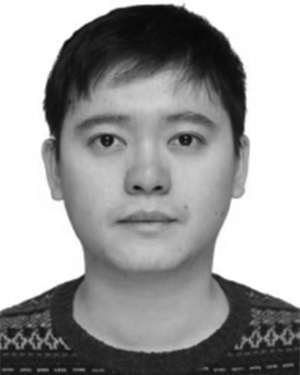 Rui Xie合作论文数7
 Wei Wu (武威)合作论文数Ant Group7
 Yunbo Cao (曹云波)合作论文数NLP Center, Tencent Cloud Xiaowei, Tencent7
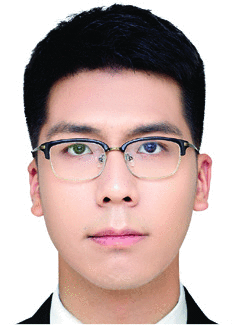 Li Mingchao合作论文数6Dongxiao Huang合作论文数6Zuotong Xie合作论文数6Rongyi Sun合作论文数Tsinghua Shenzhen International Graduate School, Tsinghua University6Xingyu Lu合作论文数Department of Computer Science and Technology, Tsinghua University;Tsinghua Shenzhen International Graduate School, Tsinghua University6
 Ruiyang (Ree) Liu合作论文数Style3D6
 Min Yang (杨敏)合作论文数Shenzhen Key Laboratory for High-Performance Data Mining, Shenzhen Institute of Advanced Technology, Chinese Academy of Sciences;University of Chinese Academy of Sciences;Large Language Models Center, Faculty of Computer Science and Artificial Intelligence, Shenzhen University of Advanced Technology6




