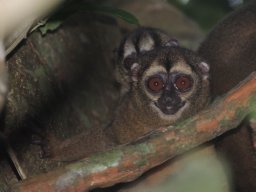
The Aotus lemurinus complex comprises three-night monkey species: Aotus griseimembra, A. lemurinus, and Aotus zonalis, whose distributions have historically been described as allopatric. In this study we applied ecological niche modeling (ENM) to evaluate this long-held hypothesis by comparing their climatic niches and estimate their potential geographic distributions. We assessed regions of potential distribution overlap to determine whether species distributions agree with allopatric, sympatric or parapatric patterns. Further, we quantified pairwise climatic niche similarity test to analyze niche conservatism patterns in this complex. Our results revealed potential regions of sympatry and parapatric contact identified in the inter-Andean valleys of Colombia and along the Colombia -Panama border, spanning elevations above and below 1,000 m. We found a phylogenetic niche conservatism within the complex. Thus A. griseimembra and A. lemurinus, most related species, showed the moderate higher climatic niche similarity, than the other pairwise comparissons. Overall, these findings challenge the allopatric distribution model and underscore a more dynamic ecological and biogeographic structure within the A. lemurinus complex, highlighting the importance of considering transitional zones and historical processes when interpreting their distributional patterns.
The Andean fox, Lycalopex culpaeus, is a generalist canid widely distributed along the Andes, though morphology and ecological information from its northern range remains limited. We report new data on the anatomy and diet of a specimen from southwestern Colombia of which we examined the stomach and intestines. The stomach is simple, rounded and expanded at the cardia and fundus region. Stomach contents consisted mainly of remains of small rodents, similar to prey items observed in other regions. This study provides the first detailed description of gastrointestinal anatomy in the Andean fox in the northern Andes.
Over the past two decades, molecular data have revealed a complex evolutionary history for the Neotropical felid genus Leopardus. A particularly problematic subset has been the L. tigrinus complex, which has been demonstrated to comprise more than one species. Recent molecular data indicated that it is not even monophyletic, comprising distinct Leopardus lineages with a similar morphology, which likely underlies the assumption that they formed a single species. To further investigate its composition and evolutionary history, we generated mtDNA data from multiple individuals sampled in Andean regions of Colombia and Peru. The Colombian samples formed a well-supported clade that was the sister-group of the Costa Rican lineage. Remarkably, the Peruvian L. tigrinus samples formed a different clade, placed at a distinct location within the Leopardus phylogeny, as a sister-group to (L. pardalis + L. wiedii). This unexpected result extends the inference of non-monophyly of the L. tigrinus complex, and raises the possibility that additional taxonomic entities may be contained in this genus.
Este trabajo presenta la caracterización taxonómica y geográfica de 2068 registros depositados en la Colección de Aves del Museo de Historia Natural de la Universidad de Caldas (MHN-UCa-A). Del total, 1946 registros se encuentran identificados a nivel de especie, 57 a nivel de subespecie y 35 hasta género. El material examinado corresponde principalmente a ejemplares completos preparados como montajes de exhibición y pieles de referencia, así como a plumas, huevos, nidos y, en menor proporción, especímenes completos en alcohol. Los registros provienen de siete países, con un predominio de especímenes recolectados en Colombia. A escala nacional, la representación regional se concentra en la región Andina, seguida por el Pacífico y el Caribe. En conjunto, la colección documenta registros de 19 de los 32 departamentos del país, siendo Caldas el de mayor número de ejemplares depositados.
Genomic resources remain scarce for many ecologically important tropical species. Here, we present genome sequences for two Neotropical weasel species of the genus Neogale : N. frenata , a species widely distributed in Colombia, and the enigmatic N. felipei , which is endemic to Colombia and Ecuador and remains poorly known.
The Andean region of Colombia hosts a high number of endemic amphibian species due to the complex topography of the three main cordilleras and the associated mountain massifs. Located in the Central Andes, the Department of Caldas spans the eastern slopes of the Cordillera Occidental, both slopes of the Cordillera Central, and the middle sections of the Cauca and Magdalena inter-Andean valleys. We compiled and analyzed the amphibian richness and distribution data across Caldas’ political and natural subdivisions using information from biological collections, scientific literature, and recent field work. We reported 135 species distributed in 48 genera, 18 families, and three orders (Anura, Caudata, and Gymnophiona), of which 22 species have their type locality within Caldas. Despite the department’s high amphibian diversity across its 7,888 km² area, information gaps remain after almost 100 years of research: one of the 27 municipalities lacks data entirely, several are underrepresented, and there are few records and uneven sampling in the western part of Caldas. To fill these distribution and knowledge gaps, we highlight as survey priority areas the Cauca Valley Dry and Montane Forests ecoregions on the eastern slope of Cordillera Occidental.
Within Trypanosoma, some species are of public health concern, such as Trypanosoma cruzi which is the causative agent of Chagas disease, also known as American trypanosomiasis. This disease is endemic in 17 countries across the Americas and primarily affects mammals, including humans. In certain countries such as Colombia, there are still gaps in understanding the associations between Trypanosoma and mammals. In this context, this study aimed to consolidate the current state of knowledge regarding the association between Trypanosoma and mammals, while providing both morphological and molecular data on trypanosomes circulating in wild mammals in two departments of Colombia—Arauca and Caldas—located in the Orinoquia and Andes regions, respectively. To compile historical records of natural infections involving Trypanosoma species in wild and exotic mammals (introduced rats and mice) in Colombia, a literature review using the PRISMA method was conducted. To complement this, morphological and molecular detection and analysis were performed on samples from 109 wild mammals, including blood smears, organ impressions, and amplification of fragments of the mini-exon, Cytb, ITS, SSUrRNA, and gGAPDH genes. Additionally, a morphometric analysis of blood trypomastigotes was conducted. The review yielded 40 scientific articles that reported the presence of eight Trypanosoma species in wild and exotic mammals in Colombia, with the highest prevalence observed in bats and rodents. The analysis of samples from Arauca (n = 64) and Caldas (n = 45) revealed a Trypanosoma sp. prevalence of 37.6% (n = 41). These findings provide a comprehensive overview of the current knowledge on Trypanosoma and its association with mammals in Colombia. Furthermore, the results highlight the presence of Trypanosoma in different wild hosts in the Andes and Orinoquia regions, underscoring the need for enhanced research on wildlife within a One Health framework.
Cryptic species are genetically distinct but morphologically similar lineages, frequently found in geographically complex regions where mountains and rivers serve as isolating barriers. In American primates, such as night monkeys (Aotus), cryptic speciation has been proposed but remains poorly understood due to limited sampling. In northwestern South America, members of the Aotus lemurinus complex (A. griseimembra, A. lemurinus, and A. zonalis) have been assumed to occupy distinct elevations, although no clear geographic boundaries have been identified. To clarify their evolutionary relationships, we integrated mitochondrial DNA data from 93 sites, ecological niche modeling, and analyses of hair length variation. Phylogenetic analyses recovered four major clades—one cis-Andean and three trans-Andean—showing strong geographic structure largely associated with the Magdalena River. Riverine barriers, rather than elevation, appear to have played a primary role in lineage divergence. Ecological niche modeling revealed potential distributions on opposite riversides across a broad elevational gradient, with a narrow zone of potential sympatry in the lower section of the Magdalena River. Niche similarity tests indicated no significant ecological divergence between clades. Hair length increased with elevation in wild populations inhabiting the Colombian Andes, on opposite sides of the Magdalena River, suggesting convergent morphological responses to highland ecosystems. These findings challenge previous taxonomic hypotheses that separated A. griseimembra and A. lemurinus by elevation and instead emphasize the role of riverine isolation—particularly along the upper and middle sections of the Magdalena River—in shaping the diversification of Aotus in northwestern South America.
The accelerated loss of biodiversity is one of the major concerns for conservation actions. In Colombia, much of the urban and cultivated areas are concentrated in the Andean region, a global biodiversity hotspot that retains less than 15
The phenology of trees in tropical forests shapes the temporal distribution of resources such as fruits and leaves. In montane forests (> 1000 m altitude), tree diversity and primary productivity tend to decline with elevation, correlating with lower temperatures and resulting in low food availability for herbivorous and frugivorous consumers. In such environments, wild animals often rely on adaptive food choice strategies to cope when preferred resources are scarce, shifting to less preferred but more available items. This research examines the feeding strategy of red howler monkeys (Alouatta seniculus) inhabiting a montane forest in the Colombian Andes (2,500–3,000 m asl) by analyzing their food intake (grams of dry weight) and their response to resource availability and food species aggregation over an annual cycle. We recorded 1,277 h of continuous focal animal sampling of two howler groups and monitored 28 phenological plots within their home range. Fruit availability varied throughout the year, with asynchronous fruiting patterns observed both within and between species, while leaves remained available all year-round. Montane howlers maintained a predominantly folivorous diet; however, only the daily intake of young leaves and ripe fruits was significantly explained by their availability. Overall, total daily food intake increased with ripe fruit and flower availability but decreased with that of unripe fruits, even though did not explain ripe fruit consumption. In contrast, the aggregation of food species had no effect on daily food intake. Although availability varied among items, montane howler monkeys adjusted their consumption patterns to specific resources availability (e.g., increasing intake of ripe fruits and young leaves during periods of higher availability), within the context of their primarily folivorous feeding strategy.
The middle Cauca River basin is an inter-Andean region located in Colombia and is part of one of the world's biodiversity hotspots. However, this region, historically and continuously impacted by human activities, lacks detailed information about the mammal species it harbours. We compiled a mammal species checklist in one of the region's forests and explored zoogeographic affinities through fieldwork, literature reviews, and the analysis of specimens deposited in the biological collections. This forest, known as the Bosque San Francisco, is a sub-Andean ecosystem with characteristics of both dry and montane forests, representing a potential refuge for biodiversity. We recorded 55 mammal species encompassing 48 genera, 24 families, and 8 orders, representing 9.94 % of Colombia's mammal species. Four species (Leopardus pardinoides, Leopardus wiedii, Lontra annectens, and Aotus griseimembra) are classified as Near Threatened or Vulnerable. Chiroptera (24 species) was the most diverse order followed by Carnivora (10 species) and Rodentia (eight species). All recorded species exhibit broad latitudinal range and are not restricted to a specific ecoregion, however, the species similarity analysis indicates that elevation is key to explain diversity patterns. Thus, determining the mechanisms that structure and sustain biodiversity in these ecosystems requires further research efforts.
The Andean Fox, Lycalopex culpaeus (Molina, 1782), is one of the largest endemic canids in South America. The northernmost part of its distribution lies in the Andes of southwestern Colombia, where it is known only from few localities. We present noteworthy records in southwestern Colombia, including one individual from the southern buffer area of Purac & eacute; National Park, a second individual found as roadkill on the Pan-American Highway, both in the Department of Cauca, and two additional records from the Colombian Massif. The Purac & eacute; record extents the distribution of this species by 74 km northward from previously verified localities.
 Fredy Arvey Rivera Paez合作论文数53
 Paula Andrea Ossa Lopez合作论文数Facultad de Ciencias Exactas y Naturales, Universidad de Caldas41
 Darwin M. Morales-Martínez合作论文数Grp Conservac & Manejo Vida Silvestre, Univ Nacl Colombia22
 Alexandra Cardona-Giraldo合作论文数20
 Elkin A. Noguera-Urbano合作论文数Inst Invest Recursos Biol Alexander Von Humboldt20
 Andres F Suarez Castro合作论文数Inst Invest Recurs Biol Alexander Von Humboldt19
 Miguel E. Rodríguez-Posada合作论文数Departamento de Biología;Universidad Nacional de Colombia;Departamento de Biología, Universidad Nacional de Colombia18
 Perez Weimar A.合作论文数17Héctor Fabio Arias-Monsalve合作论文数17Gustavo Adolfo Pisso-Florez合作论文数16Jose Jaime Henao Osorio合作论文数16
 Erika mayerly Ospina Perez合作论文数14
 Daniela Velásquez-Guarín合作论文数Grp Invest GEBIOME, Univ Caldas14
 Hugo Mantilla合作论文数14
 Ingrith Yuliany Mejía-Fontecha合作论文数Facultad de Ciencias Exactas y Naturales, Universidad de Caldas13ofelia mejiaegas合作论文数12
 Maria M. Torres-Martinez合作论文数Lab Biodiversidade Conservacao & Ecol Anim Silves, Univ Fed Parana12
 Sergio Solari合作论文数11
 Julian Andres Rojas合作论文数UNISARC),, Corporación Universitaria Santa Rosa de Cabal10
 Sebastián O. Montilla合作论文数Dept Ciencias Biol, Univ Los Andes9Sofía Terán-Sánchez合作论文数8
 Gabriel Castano-villa合作论文数8
 Julio J Chacon Pacheco合作论文数Lab Ecol Func, Pontificia Univ Javeriana8
 Diego J. Lizcano合作论文数Laboratorio de Ecología Vegetal;Departamento de Ciencias Biológicas;Universidad de los Andes;Laboratorio de Ecología Vegetal, Universidad de los Andes8
 Paúl M. Velazco合作论文数Division of Mammals;Field Museum of Natural History;Division of Mammals|Field Museum of Natural History7Javier Colmenares合作论文数6
 Sebastian Vasquez Palacios合作论文数University of Quindío6
 David Marin-C合作论文数6
 Jose F. Gonzalez-Maya合作论文数6Andrés Fernando Tamayo-Zuluaga合作论文数5Alberto Moncayo-Fernández合作论文数5Johnathan Alvarez-Londoño合作论文数5
 Lorys Yorelys Mancilla Agrono合作论文数5nestor roncancio duque合作论文数Sede Palmira, Univ Nacl Colombia5
 Carlos J. Agámez-López合作论文数Programa Biol, Univ Cordoba5
 Juan E. Uribe合作论文数gInvertebrate Zoology Department, Smithsonian Institution5
 Bruce D. Patterson合作论文数Negaunee Integrative Research Center, Field Museum of Natural History;University of Chicago;Museum of Texas Tech University5
 Fernando Passos合作论文数Conservation and Ecology of Wild Animals Laboratory, Universidade Federal do Paraná Biodiversity5fernando ayerbequinones合作论文数4
 Sebastian Cuadrado-Rios合作论文数4Luis Santiago Caicedo-Martínez合作论文数4marcela ortegarincon合作论文数4
 Estefani T. Martinez-Sanchez合作论文数4
 Javier Racero-Casarrubia合作论文数4
 Daniela Martínez-Medina合作论文数Grp Invest Territoriales Uso & Conservat LA Biodi, Fdn Reserva Nat Palmita4
 Alvaro Botero-Botero合作论文数life insurance corporation of india4
 Juan C. Cepeda-Duque合作论文数University of Los Andes4
 Federico Mosquera Guerra合作论文数Universidad Nacional de Colombia4
 Alvaro Adolfo Faccini-Martinez合作论文数4




