5G New Radio (NR) has been a great success story since its introduction. It offers high reliability, low communication latency, flexibility, and efficiency that further enable 5G networks to be used for mission critical applications. Currently, there are specialized networks serving industry verticals that would benefit from the NR properties. Key use cases include communications for critical infrastructure such as railways, public safety, and smart energy and infrastructure. These networks often use dedicated spectrum allocations that are narrower than the original minimum operating bandwidth of NR. In this paper, we describe how new flexibility is being introduced into the NR design to allow operation with bandwidths between about 3 and 5 MHz. As a use case study, we focus on railway communications, and study the co-existence of the Global System for Mobile Communications–Railway (GSM-R) and Future Railway Mobile Communication System (FRMCS) based on NR during the decade-long migration period. We discuss the changes required for the NR control channels and signaling and study the effect of the changes on the system performance.
The evolution of 5th generation (5G) cellular technology has introduced several enhancements and provides better performance compared to previous generations. To understand the real capabilities, the importance of the empirical studies is significant to also understand the possible limitations. This is very important especially from the service and use case point of view. Several test sites exist around the globe for introducing, testing, and evaluating new features, use cases, and performance in restricted and secure environments alongside the commercial operators. Test sites equipped with the standard technology are the perfect places for performing deep analysis of the latest wireless and cellular technologies in real operating environments. The testing sites provide valuable information with sophisticated quality of service (QoS) indicators when the 5G vertical use cases are evaluated using the actual devices in the carrier grade network. In addition, the Wi-Fi standards are constantly evolving toward higher bit rates and reduced latency, and their usage in 5G dedicated verticals can even improve performance, especially when lower coverage is sufficient. This work presents the detailed comparative measurements between Wi-Fi 6 and 5G New Radio (NR) performance in indoor facilities and extensive results carried out in 5G and beyond test site located in Finland. The results gathered from the extensive test sets indicate that the Wi-Fi 6 can outperform the 5G in the indoor environment in terms of throughput and latency when distance and coverage do not increase enormously. In addition, the usage of wireless technologies allows improved uplink performance, which is usually more limited in cellular networks. The gained results of our measurements provide valuable information for designing, developing, and implementing the requirements for the next-generation wireless applications.
Industry 4.0 is forming the manufacturing industry towards more agile and networked operations enriched by exploitation of new technology. Manufacturing is also one of the key verticals defined by the 5G Infrastructure Public Private Partnership (5G PPP) aimed at digital transformation in industrial communication. In this paper, we will present the current status of the VTT’s (VTT Technical Research Centre of Finland Ltd) Industry X Smart Manufacturing Testbed, which enables Finnish industrial companies to test and experiment new production methods and technologies in an industrial-like environment. The testbed utilizes technologies varying from robotics to 5G and beyond connectivity, and from international data spaces (IDS) to extended forms of reality (AR, VR, MR) and digital twins. The testbed is built in a hierarchical manner. Inter-connected factory level testbeds comprise of factory process level processes that are grouped into use case families. These processes include several proofs of concept demonstrators, which utilize different technologies available in the testbed. In this paper, three recent proof-of-cencepts (PoC) are briefly presented to illustrate the next-generation manufacturing possibilities using the latest communication technologies available.
5G enables the use of different types of services over the same physical infrastructure through the concepts and technologies of virtualization, softwarization, network slicing and cloud computing. Mobile Virtual Network Operators (MVNOs), using these concepts, provide an opportunity to share the same physical infrastructure among multiple operators. Each MVNO can have own distinct operating and support systems. However, the technologies used to enable such an environment have their own explicit security challenges and solutions. The integrated environment built upon these novel concepts and technologies, thus, will have complex security implications and requirements to be satisfied. In this vain, this article provides an overview of the security challenges and potential solutions for MVNOs.
This paper presents a proposal for dynamic spectrum management concept from a pan-European research operator perspective. Dynamic spectrum management is one of the key enablers for the 5G and beyond communications systems. Regulatory concepts for sharing the spectrum have been developed, and they have been adopted for implementation in the standardization. The prevailing methods are currently Licensed Shared Access (LSA) in the European Union (EU) and Citizens Broadband Radio Service (CBRS) in the United States (US). In the EU, however, the final decisions of the spectrum usage are done by the national regulatory authorities, and therefore it is seen that harmonized spectrum usage is not going to happen at European level in the near future. In this paper, we describe the approach taken in EuWireless to gain access to the spectrum resources dynamically for the research use. In the proposal, the information about the spectrum resources across the Europe are stored the central Spectrum Repository (SR). The local instances of EuW Spectrum Manager (SM), operating under the licences and regulations in different areas, handle the communication with the MNOs via standardized procedures such as LSA or CBRS.
The most recent evolutionary steps in the development of mobile communication network architectures have introduced the concepts of virtualisation and slicing also into the Radio Access Network (RAN) part of the overall infrastructure. This trend has made RANs more flexible than ever before, facilitating resource sharing concepts which go far beyond the traditional infrastructure and RAN sharing schemes between commercial Mobile Network Operators (MNO). This paper introduces the EuWireless concept for a pan-European mobile network operator for research and presents its vision for RAN slicing and network resource sharing between the infrastructures of the EuWireless operator, commercial MNOs and research organisations around Europe. The EuWireless approach is to offer virtual large-scale testbeds, i.e., EuWireless experimentation slices, to European mobile network researchers by combining the experimental technologies from the local small-scale research testbeds with the commercial MNO resources such as licensed spectrum. The combined resources are configured and managed through the distributed EuWireless architecture based on inter-connected local installations, so-called Points of Presences (PoP).
5G is enabling different services over the same physical infrastructure through the concepts and technologies of virtualization, softwarization, slicing and cloud computing. Virtual Mobile Networks (VMNs), using these concepts, provide an opportunity to share the same physical infrastructure among multiple operators. Each VMN Operator (VMNO) can have own distinct operating and support systems. However, the technologies used to enable VMNs have their own explicit security challenges and solutions. The integrated environment built upon virtualization, softwarization, and cloudification, thus, will have complex security requirements and implications. In this vain, this article provides an overview of the security challenges and potential solutions for VMNs.
This paper introduces the VTT LSA Research Laboratory (VLRL) which is a testbed for dynamic spectrum sharing developed by VTT. The VLRL is a part of VTT’s 5G test network located in Oulu, Finland. Main components of the VLRL are the Licensed Shared Access (LSA) system and Base Station Controller (BSC). LSA system controls the secondary use of the spectrum band owned by another Mobile Network Operator (MNO) and BSC is a software entity that takes care of the actual base station configuration when the LSA system requires channel occupation or evacuation. The VLRL has been developed over several years in several projects. This paper presents latest incarnation of the environment as it is used in the EuWireless (EuW) project, which aims to develop a platform enabling researchers to perform experiments in a realistic way by combining resources from research networks and commercial MNOs infrastructures. Dynamic spectrum sharing plays an important role in the EuW concept and the VLRL can be used to study and do experiments with the technology.
The current scenario has shown that, with the conventional spectrum access approach, the radio spectrum allocated to primary (licensed) users is hugely underutilized. While many spectrum methods have been proposed to utilize spectrum efficient manner, the spectrum access opportunistic way is happen to the most practical approach to attain near-optimal spectrum utilization by permitting secondary (unlicensed) users to sense and access available spectrum opportunistically. In this paper, we present decision making scheme in cognitive radio based on Interval type-2 fuzzy logic system. Here, classical type-1 and Interval type-2 fuzzy logic system has been compared in terms of possibility of spectrum access by the secondary user with effective and seamless communication between cognitive radio and primary user. The proposed fuzzy inference system has three input parameters such as spectrum utilization efficiency, degree of mobility and distance to primary user of cognitive radio, along with output parameter as the possibility of accessing the spectrum for secondary user based on linguistic knowledge of 27 rules. This paper mainly deals with design of decision making scheme using Interval type-2 fuzzy logic for minimizing the effect of uncertainty produced by the measurement
Energy and spectral efficiencies are key metrics to assess the performance of networks and compare different configurations or techniques. There are many ways to define those metrics, and the performance indicators used in their calculation can also be measured in different ways. Using an LTE-A network, we measure different performance indicators and the metrics' outputs are compared. Modifying the transmitted output power, the bandwidth, and the number of base stations, different network configurations are also compared. As expected, the measurements show that increasing the bandwidth increases the throughput more than it increases the energy consumption. Results clearly show that using inappropriate indicators can be misleading. The power indicator should include all energy consumed and the throughput should be dependent on the traffic, taking into account the idle time of the network, if any. There is a need to include more performance indicators into the metrics, especially those related to quality of service.
This paper investigates the trade-off between throughput and energy consumption in heterogeneous networks with dual connectivity and backhaul delay. The problem of traffic splitting between the main eNB and secondary eNBs is formulated as a multi-objective optimization problem. Based on some observations, assumptions, and subsequent simplifications, two algorithms are devised. One targets throughput optimization (TO) by transmission delay minimization. The other one does energy savings (ES) by not transmitting on the main eNB depending on the delay allowance defined in the QoS criterion of the transmitted data. The main eNB is in control of the data transfer to the secondary eNB. Simulations show that the TO algorithm performs slightly better than an earlier published algorithm in which the secondary eNBs are in control of the data transfer from the main eNB. The ES algorithm does save energy at the expense of a larger transmission delay.
The D2D-Relay mechanism, which integrates device-to- device (D2D) communications and relay technology, is promising in system performance improvement. This paper focuses on studying what kind of benefits the D2D-Relay mechanism could bring into a wireless communication system during the uplink transmission. To comprehensively analyze the system performance, we use a metric, which consists of the spectral efficiency (SE) and the energy efficiency (EE), as an indicator. With this criteria in mind, we theoretically describe the influence from users' preferences to the SE and the EE in detail. Noting that user pairing is an important part of this mechanism, we evaluate the performance of the D2D- Relay mechanism with three typical pairing algorithms based on different criteria. The simulation results conform to our derivations and reveal the performance gain brought by applying the D2D-Relay mechanism. In addition, with different configurations of the number of the users and their preferences to the SE and the EE, the most appropriate algorithm is suggested for the practical application.
Atmospheric ducts are horizontal layers that occur under certain weather conditions in the lower atmosphere. Radio signals guided in atmospheric ducts tend to experience less attenuation and spread much farther, i.e, hundreds of kilometers. In a large-scale deployed TD-LTE (Time Division Long Term Evolution) network, atmospheric ducts cause faraway downlink wireless signals to propagate beyond the designed protection distance and interfere with local uplink signals, thus resulting in a large outage probability. In this paper, we analyze the characteristics of ADI atmospheric duct interference (Atmospheric Duct Interference) by the use of real network-side big data from the current operated TD-LTE network owned by China Mobile. The analysis results yield the time varying and directional characteristics of ADI. In addition, we proposed an SVM (Support Vector Machine)-classifier based spacial prediction method of ADI by machine learning over combination of real network-side big data and real meteorological data. Furthermore, an implementation of ADMM (Alternating Direction Methods of Multipliers) framework is proposed to implement a distributed SVM prediction scheme, which reduces data exchange among different regions/cities, maintains similar prediction accuracy and is thus of a more practical use to operators.
5G systems research is getting close to the stage that practical implementations need to be tested in real scenarios. However, the technical requirements for 5G as very stringent and no general purpose equipment exists for testing 5G radio performance in reality yet. One future direction is, however, quite obvious: small cell deployments will play a major role in 5G systems. This paper discusses an initiative started in Oulu, Finland early 2015 to investigate this matter in practice. A special emphasis is put to test novel small cell enabled operator business models.
We consider full-duplex multi-hop forwarding in a Beyond 4G local area network. In the network, there is a high density of self-backhauling relay nodes that simultaneously act as access points towards the users, in addition to few nodes with wired backhaul. The access is framed and synchronized along the multi-hop flow, and the nodes apply time division duplexing. Interference cancelation as well as power optimization is performed within the multihop route. Simulations are carried out in a local area network consisting of multiple multi-floor buildings. The propagation channel is modelled using static pathloss, log-normal distributed random variable, or static pathloss with Rayleigh fading. The simulation results indicate that full-duplex relaying improves the network performance over half-duplex relaying, if self-interference channel attenuation is kept over 80 dB. The means of achieving tolerable self-interference levels in full-duplexing relays via physical design of the relay, and analog and digital interference cancellation are discussed.
In parallel with ongoing standardization of third generation partnership project (3GPP) Long Term Evolution - Advanced (LTE-A), also referred as 4G, the discussion on next generation beyond 4G (B4G) radio access technologies is already active. Purpose of B4G system, expected to be available in 2020, is to cope with the exponential increase of mobile data traffic. In this paper we analyze the feasibility of LTE-A and wireless local area network (WLAN) physical frames against B4G requirements and discuss how the B4G environment, radio channel properties and evolved component technology affect the design of the physical layer frame. We analyze the B4G physical subframe numerology including aspects such as time division duplex (TDD) switching time and cyclic prefix (CP) duration. The proposed numerology allows to design a B4G-optimized TDD physical subframe structure which further enables reaching the very tight physical layer round trip time (RTT) requirements.
We consider multi-hop forwarding in a Beyond 4G local area network, where in addition to nodes with wired backhaul, there is a high density of self-backhauling relay nodes acting simultaneously as access points towards users. The nodes apply Time Division Duplexing, access is framed and synchronized along a multi-hop flow, and there is a corresponding reuse factor for active hops along a multihop route. Interference cancelation, as well as power and resource optimization, is performed within along a route. Simulations are performed in a local area network consisting of multiple multi-floor buildings. Multi-hop self-backhauling is found to significantly improve the coverage of high data rates in the system.
The purpose of a Beyond 4G (B4G) radio access technology, is to cope with the expected exponential increase of mobile data traffic in local area (LA). The requirements related to physical layer control signaling latencies and to hybrid ARQ (HARQ) round trip time (RTT) are in the order of ~1ms. In this paper, we propose a flexible orthogonal frequency division multiplexing (OFDM) based time division duplex (TDD) physical subframe structure optimized for B4G LA environment. We show that the proposed optimizations allow very frequent link direction switching, thus reaching the tight B4G HARQ RTT requirement and significant control signaling latency reductions compared to existing LTE-Advanced and WiMAX technologies.
Future telecommunication systems need to support a discovery function, enabling all network nodes to discover each other directly over the air. In addition to discovery in traditional access point-to-user equipment (AP2UE) links, there is a need to support also other link types, such as device-to-device (D2D) communication and wireless backhauling. In this paper, we provide a design for discovery patterns and groups of patterns applicable to half-duplex time division duplexing (TDD) nodes operating in a frame based system. The proposed scheme allows an easy design of discovery patterns, which can be used for comprehensive bi-directional communication where all nodes are able to listen to each other. Proposed approach provides also an upper limit for the discovery time with an assumption that discovery signal is received correctly at the receiving node. We also support network topologies containing network elements of different hierarchies which require mono-directional discovery function among network nodes, e.g. from higher towards lower hierarchy levels.
 Jarno Pinola合作论文数VTT Technical Research Centre of Finland10
 Esa Tiirola合作论文数Nokia Networks7
 Eeva Lähetkangas合作论文数6
 Kari Pajukoski合作论文数6
 Kostas Pentikousis合作论文数Detecon International GmbH6
 Marcos D. Katz合作论文数VTT Technical Research Centre of Finland5
 Atso Hekkala合作论文数VTT Technical Research Centre of Finland5Tuomas Nissilä合作论文数4
 Jyrki Huusko合作论文数ICT/Network Technologies, VTT Technical Research Center4
 Esa Piri合作论文数VTT Technical Research Centre of Finland4Sandrine Boumard合作论文数4
 Honglin Hu (胡宏林)合作论文数Shanghai Advanceo Research Institute, Chinese Academy of Sciences3
 Mika Lasanen合作论文数3Marja Matinmikko合作论文数vtt technical research centre of finland3
 Jukka Makela合作论文数VTT Technical Research Centre of Finland3Mika Hoppari合作论文数3
 Miia Mustonen合作论文数3heli sarvanko合作论文数2
 Seppo Rantala合作论文数2Maria Safianowska合作论文数2Ijaz Ahmad合作论文数2
 Olav Tirkkonen合作论文数Department of Communications and Networking, School of Electrical Engineering, Aalto University2
 Aarne Mämmelä合作论文数2
 Mikko Uitto合作论文数2
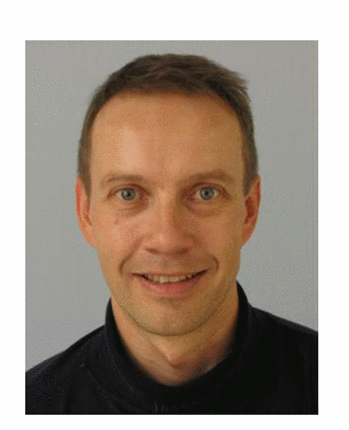 Tapio Rauma合作论文数2
 Adam Flizikowski合作论文数University of Technology and Life Sciences2
 Gilberto Berardinelli合作论文数Department of Electronic Systems, Aalborg University2Paola Cardamone合作论文数2
 Bernhard Raaf合作论文数NSN Research - Radio Systems, Nokia Siemens Networks2
 Mikko Hiivala合作论文数2
 Yevgeni Koucheryavy合作论文数1Valentin Polo合作论文数1
 Preben Mogensen合作论文数Department of Electronic Systems, The Technical Faculty of IT and Design, Aalborg University;Nokia Bell Labs1sami hakola合作论文数1kari juhani hooli合作论文数1Qutaiba Razouqi合作论文数1Kari Horneman合作论文数1Matti Weissenfelt合作论文数1
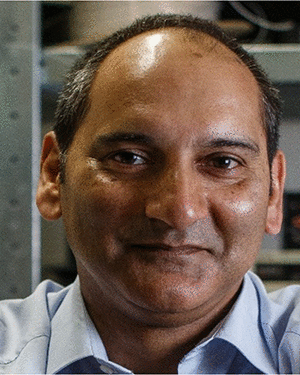 Nathan Joseph Gomes合作论文数1
 Zsombor Kiss合作论文数1
 Suvidha Mhatre合作论文数1mahesh v lakhekar合作论文数1
 Barbara Valera-Muros合作论文数1
 Tianheng Xu (徐天衡)合作论文数Shanghai Advanced Research Institute, Chinese Academy of Sciences;University of Chinese Academy of Sciences1
 Stefan Walter合作论文数1
 Hui Xu (徐辉)合作论文数1
 s l kotgire合作论文数1
 Matthew Baker合作论文数1
 aaron byman合作论文数1




