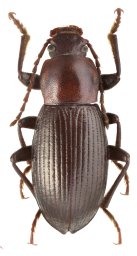
The present state of the invasive population of Odocnemis aurichalcea (Adams, 1817) (Coleoptera: Tenebrionidae) in North Caucasus is studied. This species is widespread in Transcaucasia and has entered Nalchik and Nartkala towns (North Caucasus, Kabardino-Balkaria, Russia) possibly during urban greening where it is mentioned in these localities since at least the middle of the 20th century. Nothing was known about the status of this invasive population for 54 years. A rich population of this species was discovered in the outskirts of Nalchik in a natural beech forest in 2022. The species is naturalized in the North Caucasus, but inhabits only a very narrow, isolated range in this region. Diurnal activity, the response of adults to high temperature and humidity, habitat and trophic associations, and current distribution of the species in the North Caucasus are assessed. Taxocenes of tenebrionids from the tribe Helopini, including O. aurichalcea, were described. We establish that imagoes of the species occupy a narrower ecological niche in the invasive range under natural conditions, than in the native range, inhabiting exclusively beeches and feeding on algae of the genus Desmococcus F. Brand, 1925 (Chlorophyta: Trebouxiophyceae).
Although the complex evolutionary history of lichen-forming fungi has gained considerable attention, particularly regarding the long-debated role of these organisms in shaping early terrestrial ecosystems, the evolution of lichenivory and its potential impact on the diversification of lichenophages have been largely neglected. With > 800 described species worldwide and a broad geographical distribution, the tribe Helopini (Coleoptera: Tenebrionidae) represents a diverse, yet poorly studied, group of predominantly lichenophagous beetles. Using a dataset of 52 ingroup taxa and five gene fragments, a first phylogenetic hypothesis of the tribe was generated, which was subsequently used for reconstructing the ancestral state of the trophic and habitat associations of the beetles and for estimating a time frame of diversification. Our phylogenetic reconstruction sheds light on the higher-level systematics of the tribe, supporting the current subtribal division of the group while also providing a framework for understanding the intergeneric relationships within subtribes. The results also indicate an Early Cretaceous origin of the tribe, highlighting the close association between Helopini and lichen-forming fungi since the emergence of the group. Nevertheless, at least seven independent switches from lichenophagy to alternative feeding habits have occurred since the middle Eocene, which can be linked temporally to transitions from forests to open habitats.
Years of research of the subtribe Blaptina made it possible to clarify relations between some species and propose changes in supraspecific structure of this subtribe. Blaps scabiosa Baudi di Selve, 1874 is designated as a type species of Caraboblaps Bauer, 1921, the new synonymy is proposed: Blaps Fabricius, 1775 = Caraboblaps Bauer, 1921, syn. n. Blaps nitens nitens Laporte, 1840 is designated as a type species of Periblaps Bauer, 1921, Blaps ominosa Ménétriés, 1832 is designated as a type species of Holoblaps Bauer, 1921; type species of Periblaps and Holoblaps are transferred here to genus Lithoblaps, as a result the following new synonymy is proposed: Lithoblaps Motschulsky, 1860 = Periblaps Bauer, 1921, syn. n. = Holoblaps Bauer, 1921, syn. n. The similarity of the structure of the aedeagus of Ablapsis compressipes Reitter, 1887 and some species of the subgenus Prosoblapsia Skopin et Kaszab, 1978 (genus Blaps Fabricius, 1775) gives a base to transfer the taxon Ablapsis Reitter, 1887 into the genus Blaps as a separate subgenus (Ablapsis stat. resurr.). Blaps tentyrioides Seidlitz, 1893 (= Blaps socia Seidlitz, 1893) is designated as a type species of the subgenus Protoblaps Bauer, 1921. As the genera Protoblaps Bauer, 1921 and Genoblaps Bauer, 1921 have one type species and the aedeagal structure of type species of Ablapsis, Protoblaps and Prosoblapsia is similar, the new synonymy is proposed: Ablapsis Reitter, 1887 = Protoblaps Bauer, 1921 syn. n. = Genoblaps Bauer, 1921 syn. n. = Prosoblapsia Skopin et Kaszab, 1978, syn. n. Analysis of imaginal and larval structures of the species here united in the taxon Lithoblaps Motschulsky, 1860 and other members of Blaps showed that differences between these two groups are comparable with those between other genera of the subtribe and, therefore, the former taxon is here regarded as a distinct genus Lithoblaps gen. resurr. Thus, 100 species and subspecies (marked as comb. n. or comb. resurr.) are transferred from Blaps to Lithoblaps. The additional new combination is established: Dila platythorax (Gemminger, 1870), comb. n. (from Blaps). The key to genera and the catalogue of the subtribe Blaptina are given.
A taxonomic review of tenebrionid platyopoid genera of the subfamily Pimeliinae from Eastern Europe, Central Asia, Afghanistan, Iran and Pakistan is given. This group of taxa was known before 1994 as the tribe Platyopini Motschulsky, 1849, which is now interpreted as a junior synonym of Pimeliini Latreille, 1802. The group is different from other Pimeliini in having dorso-lateral eyes, located above the level of the genae, and it includes the following ultrapsammophilic genera at least from Central and Southern Asia: Apatopsis Semenov, 1891, Habrochiton Semenov-Tjan-Shansky, 1907, Habrobates Semenov, 1903 [= Kawiria Schuster, 1935 syn. nov.], Dietomorpha Reymond, 1938, Przewalskia Semenov, 1893, Mantichorula Reitter, 1889, Platyope Fischer von Waldheim, 1820 [= Homopsis Semenov, 1893 syn. nov.], Earophanta Semenov, 1903. These genera are distributed in almost all large deserts of Palaearctic Asia: Karakum, Kyzylkum, Muyunkum, Taklamakan, Gobi, Registan, Dasht-e-Kawir, Dasht-e-Lut, as well as in other arid and semi-arid sandy landscapes from European Russia to the south of Eastern Siberia. The group of platyopoid genera is polyphyletic. We propose at least two monophyletic branches: the Habrobates genus group (the first four genera mentioned above), which represents the subtribe Habrobatina Nabozhenko & S. Chigray subtrib. nov. and the Platyope genus group (latter four genera) within the nominotypical subtribe. A new species is described from Pakistan (Balochistan): Dietomorpha gonzalesi S. Chigray & Nabozhenko sp. nov. Platyope granulata Fischer von Waldheim, 1820 is recorded for Kazakhstan for the first time. The following synonymy is resurrected: Apatopsis grombczewskii Semenov, 1890 = Apatopsis conradti Semenov, 1890, syn. resurr. Two new combinations resulting from the synonymy of genera are given: Habrobates gabrieli Schuster, 1935 comb. nov. (from Kawiria), Platyope grumi Semenov, 1893 comb. nov. (from Homopsis). Lectotypes are designated for the following taxa: Apatopsis grombczewskii (Semenov, 1891), Apatopsis conradti Semenov, 1891, Habrochiton vernus Semenov-Tjan-Shansky, 1907, Habrobates vernalis Semenov, 1903, Kawiria gabrieli Schuster, 1935, Platyope dilatata Reitter, 1887; Mantichorula semenowi Reitter, 1889, Mantichorula grandis Semenov, 1893, Homopsis grumi Semenov, 1893, Platyope serrata Semenov, 1893, Platyope planidorsis Reitter, 1889, Platyope tomentosa Semenov, 1893. Additional information for type specimens studied by the authors is given for Habrochiton primaeveris Semenov-Tjan-Shansky, 1907 (holotype), Habrobates vejisovi Kelejnikova, 1977, Platyope ordossica Semenov-Tjan-Shansky, 1907 (holotype), Earophanta autumnalis Semenov, 1903 (holotype, junior synonym of E. planidorsis Reitter, 1889), Earophanta loudoni Semenov, 1903 (holotype, junior synonym of Earophanta pilosissima Reitter, 1895), Earophanta pubescens Skopin, 1960 (holotype, paratypes), Earophanta beludzhistana Bogatchev, 1957 (holotype).
Aim. To reveal mutual relations between species of the genus Nalassus in taxocenes and the division of ecological niches during cohabitation.Material and Methods. Observations and collection of adult beetles and food objects were carried out in 2020–2022 in Dagestan, North Ossetia, Kabardino‐Balkaria, Karachay‐Cherkessia, Krasnodar Region (Russia) and Abkhazia. The nutrition of beetles was observed directly in nature at night with headlamps, and in some cases in laboratory conditions using the test cafeteria method. The number of beetles per area was counted on 100 × 4 m transects. The number, sexual structure and diurnal activity (feeding, copulation) were observed with the pause of 15 to 25 minutes. We measured temperature (the range from −4 to +40°C) and humidity (the range from 0 to 100%) by loggers every 7 minutes.Results. New localities for seven known species of Nalassus are presented. The new species N. (Caucasonotus) ritsanus M. Nabozhenko, sp. n. is described from environs of Ritsa Lake in Abkhazia and it is compared with other Abkhazian representatives of the subgenus Caucasonotus. We revealed or added information about trophic relations for eight species of the genus; lichenophagy is typical for the majority of species; phytophagy and saprophagy were registered for Nalassus for the first time; algophagy was fixed for two species. The number, sex structure in micropopulations and ranges of air temperature and humidity during the period of imagoes activity were analyzed.Conclusion. The most important and perhaps the only strategy for reducing competition in the cohabitation of Nalassus in the Caucasus is a trophic specialization. An occupation of open landscapes by Caucasian Nalassus did not play a role in the subgeneric differentiation, but was partially accompanied by a transition from lichenophagy to phytophagy and saprophagy.
A brief well-illustrated review of the tenebrionid genus Nalassus Mulsant, 1854 from the Greater Caucasus is presented. A new species, N. (Caucasonotus) negrobovi Nabozhenko, sp. n. is described from the alpine zone of Abkhazia. This species is similar to N. dombaicus (Nabozhenko, 2000), N. adriani (Reitter, 1922) and N. alanicus (Nabozhenko, 2000), but differs in the structure of eyes, antennae, pronotum and elytral interstriae. The following new synonyms are proposed after examination of a series of beetles and type specimens: Nalassus dissonus Nabozhenko, 2001 = Nalassus lutshniki Nabozhenko, 2001, syn. n.; Nalassus colchicus madlenae Nabozhenko, 2013 = Nalassus kartvelius Nabozhenko, 2013, syn. n.; Helops cambyses Seidlitz, 1895 = Cylindronotus ahngeri Medvedev, 1998, syn. n. Keys to species from the Greater Caucasus on males and females are given. New data on bionomics, landscape and habitat distribution and trophic relations are given. Interesting patterns are observed at the level of ecological groups: forest species feed mainly on corticolous foliose lichens from the family Physciaceae Zahlbr., while alpine Nalassus use saxicolous foliose lichens from the family Parmeliaceae Zenker; steppe species feed on terricolous foliose lichens at least from the family Cladoniaceae Zenker.
A new species is described from the Central part of the North Caucasus (Russia): Blaps caucasica M. Nabozhenko et I. Chigray sp. n. This taxon was interpreted earlier as B. scabriuscula subalpina Mntris, 1832, but both our morphological and molecular genetic analyses showed that it is in fact a separate new species. The following new synonymies are proposed: Blaps verrucosa Adams, 1817 = Blaps scabriuscula Mntris, 1832 syn. n., = Blaps montana Motschulsky, 1839 syn. n.; Blaps lethifera Marsham, 1802 = Blaps pterotapha Mntris, 1832 syn. n. The rank of one species is reinstated: Blaps subalpina Mntris, 1832 stat. resurr. The name Blaps sinuatocollis Solier, 1848 was unambiguously proposed for an infrasubspecific entity and must be excluded from zoological nomenclature. A phylogenetic hypothesis was reconstructed using mitochondrial Cytochrome c oxidase subunit I (COI) sequences for some closely related taxa from the North Caucasus and Ciscaucasia: B. caucasica sp. n., B. lethifera, B. subalpina and B. verrucosa. The resulting tree supports the assignment of two specimens from the Lower Don area (Rostov Region of Russia), earlier interpreted as B. scabriuscula subalpina, to B. lethifera. All known Blaps from Russia and Eastern Europe (countries of the former USSR) are illustrated, and keys on males and females are provided. The status of an invasive species Blaps aff. oblonga Kraatz, 1883 from South Siberia is discussed.
A single species of the genus Odocnemis Allard, 1876 occurs in Cyprus and it is considered endemic to the island: O. intrusicollis (Seidlitz, 1895). The species was known only by the original description of one female (holotype) from the type locality “Cyprus”. We found two populations of this darkling beetle across the Troodos mountain range, at higher and lower altitudes. The two populations differ in the structures of the prothorax and have slightly different male genitalia. Additionally, the two populations are isolated geographically, have different trophic associations and inhabit different types of forest. These differences may suggest early stages of differentiation into separate taxa. Odocnemis intrusicollis can be included in the separate intrusicollis species-group, similar to some groups from south Anatolia.
A taxonomic review of the tenebrionid genus Psammocryptus Kraatz, 1865 (Co-leoptera: Tenebrionidae: Pimeliinae: Tentyriini) is given. Species of this genus are distributed in the south of Russia (Caspian depression), Transcaucasia, Kazakhstan and Central Asia, Afghanistan and Pakistan, occurring in areas with salty soil, often in tugay forests of river basins. Two new species and one new subspecies are described: P. bogatchevi Nabozhenko, Chigray & Bekchanov, sp. nov. (Kazakhstan: Syrdarya basin, Kyzylkum desert; Uzbekistan: Amudarya lower reaches and delta, Syrdarya basin, Kyzylkum desert); P. kompantsevae Nabozhenko & Chigray, sp. nov. (Uzbekistan and Tajikistan: Amudarya, upper river basin); P. bayeri vachshianus Nabozhenko & Chigray, subsp. nov. (Tajikistan: Vakhsh River valley). The nominotypical subspecies P. bayeri bayeri Koch, 1943 occurs in Turkmenistan (Tejen valley and Amudarya valley middle river course) and Tajikistan (a new record for the country: Kafirnigan River valley). Psammocryptus minutus (Tauscher, 1812) is recorded for Armenia for the first time, but the population from Yerevan has become extinct due to urbanization. The following synonymy is restituted: Psammocryptus minutus (Tauscher, 1812) = P. bergi Kuzin 1934, syn. restit.
We present the life history and trophic relations of the lichenophagous darkling beetle _Helops glabriventris glabriventris Reitter, 1885 (Coleoptera: Tenebrionidae: Helopini), which is widespread in Cyprus. Adults of II. glabriventris feed primarily on Pseudevernia furfuracea (L.) Zopf (Parmeliaceae), which is the most widespread fruticose corticolo us lichen in Cypriot forests of Pinus brutia Tenore, Cedrus brevifolia (Hook. f.) Meilde and Pinus nigra J.F. Arnold and Anatolian forests of Piltus brutia. Additionally, they can feed on the crustose corticolous lichen Ilypocenomyce scalaris (Ach.) M. Choisy (Lecidea.ceae) as an alternative trophic source. We described and illustrated the last instar larva of this species, collected in the rotten wood of Pinus nigra. Fossorial adaptations of larvae are discussed and compared with other representatives of the tribe Helopini.
The taxonomic history, composition, morphology, distribution, and bionomics of the genus Dila Fischer von Waldheim, 1844 are discussed. The following new generic synonymy is established: Dila Fischer von Waldheim, 1844 = Caenoblaps König, 1906, syn.n. As a result, four species are transferred from Caenoblaps to the genus Dila: Dila difformis (König, 1906), comb.n., Dila nitida (Schuster, 1920), comb.n., Dila baeckmanni (Schuster, 1928), comb.n., Dila kulzeri (Schuster, 1928), comb.n. A new synonymy is established: Blaps kulzeri Pierre, 1964 = Caenoblaps kulzeriana Pierre, 1964, syn.n. A taxonomic review of the eight known Caucasian, Turkish and Iranian species is given. Lectotypes of Caenoblaps nitida and Caenoblaps difformis are designated. Three new species are described: Dila hakkarica sp.n. and Dila svetlanae sp.n. from the Hakkary Province of Turkey and Dila crenatopunctata sp.n. from West Azerbaijan Province of Iran. The position of the genus Dila within the tribe Blaptini and subtribal classification are discussed.
A new species of darkling beetles, Blaps ernesti sp. n., is described from the Southeast Caspian region (Turkmenistan, Iran). Allard was the first to describe this species in 1882, but he misidentified it as “Blaps variolaris Gemminger, 1870”, the junior synonym of Blaps rugosa Gebler, 1825, which is distributed in Russian Eastern Siberia, China and Mongolia. Seidlitz in 1893 and subsequent authors interpreted the Irano-Turkmen species as Blaps variolaris with the authorship of Allard, which is contrary to Article 49 of the International Code of Zoological Nomenclature. The new species is morphologically similar to Blaps mortisaga Linnaeus, 1758 but differs in the very coarse and dense punctation of its pronotum and elytra, in contrast to fine and sparse pronotal punctation and smooth elytra in the latter species. The basal duct of the spermatheca, between the vagina and reservoirs of the spermatheca of B. mortisaga, is short relative to the long accessory gland, reservoirs of the spermatheca are thin and elongated, the 1st reservoir is widened at the apex and 1.5 times longer than the 2nd reservoir. The basal duct of the spermatheca in Blaps ernesti sp. n. is very long relative to the short accessory gland, reservoirs of spermatheca are fusiform in the apical half, the 1st reservoir is slightly longer than the 2nd one. The new species is externally similar to Blaps dehaani Baudi di Selve, 1875 by punctation of pronotum and elytra, but differs in the larger body (18–28 mm vs 15–20 mm), very long male mucro and the hair tuft between abdominal ventrites 1 and 2
The new monotypic subgenus Stenolassus subgen. nov. of the genus Stenohelops Reitter, 1922 is described for Stenohelops klebsi (Nabozhenko, Perkovsky et Chernei, 2016) comb. nov. (Coleoptera: Tenebrionidae), which was previously described within the genus Nalassus Mulsant, 1856. This species is transferred to Stenohelops Reitter, 1922 based on the structure of the male aedeagus, abdominal ventrite 5, and the protarsi. A key to the subgenera of the genus Stenohelops is provided. The problematic species Isomira (Mucheimira) avula Seidlitz, 1896 is redescribed and its taxonomic placement addressed. A new species, Isomira (Isomira) hoffeinsorum sp. nov. is also described from Baltic amber. This new species possesses a mixture of characters associated with Mucheimira and Isomira, which can be a result of incomplete diversification of the genus Isomira during the Eocene.
A taxonomic review of the 32 species and subspecies of the genus Blaps Fabricius, 1775 from Central and South Kazakhstan is given. Two new species are described: Blaps skopini sp. n. and Blaps fouquei sp. n. The first species is most similar to Blaps granulata Gebler, 1825, B. granulipennis Skopin, 1966 and B. tsharynensis Skopin, 1961 but differs from these lastly mentioned species in the longer caudal extension of the elytra (mucro), shape and punctation of pronotum, structure of the male parameres and female genital tubes. Blaps fouquei sp. n. is most similar to B. seriata Fischer von Waldheim, 1820, and differs in the longer antennae, elytra flattened along suture, structure of the male parameres and female genital tubes. Blaps turcomanorum Seidlitz, 1893 is recorded for Kazakhstan for the first time. A key to all species known from the area under consideration is presented. Lectotypes of B. gigantea Motschulsky, 1845 and B. confusa Menetries, 1832 are designated. The most species are illustrated for the first time.
The tenebrionid species Blaps scabiosa (tribe Blaptini) is redescribed and illustrated. This species was twice described under the same name by Baudi di Selve in 1874 from Tashkent (now Uzbekistan) and by Faust in 1875 from Tash (Iran, Semnan Province). In 1876 Faust synonymized his species with Baudi’s species. Nabozhenko interpreted these taxa as two distinct species and gave a new name B. neoscabiosa Nabozhenko, 2008 to the Iranian B. scabiosa Faust, 1875 to eliminate homonymy. This species has never been found in Tien Shan and occurs only in Eastern Alborz Mountains. The type locality “Tashk.” (Tashkent) should be corrected to “Tash” (Iran, Semnan). After examination of the type specimens we have established that the Baudi’s and Faust’s taxa are conspecific, and the following synonymy is proposed: Blaps scabiosa Baudi di Selve, 1874 = B. scabiosa Faust, 1875, syn. resurr. = B. neoscabiosa Nabozhenko, 2008, syn. n. The lectotype of Blaps scabiosa Faust, 1875 is designated.
A new genus and species Medvedevia glebi gen. et sp. n. of the tribe Blaptini is described from eastern Nuristan, Afghanistan. The new genus belongs to the subtribe Blaptina. It is closely related to the genus Blaps Fabricius, 1775, which is evidenced by its body shape, structure of tarsomeres, and presence of the mucron. Medvedevia gen. n. differs from all Blaptini in the following characters: very wide mentum concealing the base of the labium and maxillae; not beaded pronotum; very wide processes of the mesoventrite and of abdominal ventrite 1; unusual structure of the aedeagus (basal piece is weakly C-curved, parameres are deeply cleft). New synonymy is established: subtribe Blaptina Leach, 1815 = Dilina Ren in Ren et al., 2016, syn. n.
Three new species of comb-clawed beetles of the tribe Alleculini (Tenebrionidae: Alleculinae) are decribed. Gonodera baygushevae Nabozhenko et I. Chigray, sp. n. (Eocene Baltic amber) is similar to extant Gonodera rufoaenea Reitter, 1900 by very finely and sparsely punctated elytral intertriae, but differs in the small size of body (6.6 mm, while other species of Gonodera Mulsant, 1856 have a minimal length of 8 mm), elongate punctation of head, subequal width of elytral and pronotal bases and six teeth on both clavae (other Gonodera have seven teeth). Gonodera kasatkini Nabozhenko, sp. n. (extant, Lebanon) belongs to the species-group with subequal antennomeres 3 and 4 of male and differs from all other species of this group in the absence of basal impression on pronotal disc and strongly depressed 5th elytral interstria at base. Mycetochara (s. str.) abdurakhmanovi Nabozhenko, sp. n. (extant, Lebanon) differs from all Western Palaearctic Mycetochara s. str. in the combination of red protorax with black elytra, large longitudinal oval impression in the middle of anterior half of pronotum and 10 long lanceolate spines on apical lobe of aedeagus. New distributional data for Isomira (s. str.) antennalis Reitter, 1884 (the first record for Lebanon), Mycetochara (Ernocharis) ruficollis Baudi di Selve, 1877 and Hymenalia ehdenica Novák, 2017 are given
A taxonomic review of the genus Prosodes Eschscholtz, 1829 of Iran is given. Two new species from the subgenus Meropersina Reitter, 1909 are described, both from West Azerbaijan Province: P. kasatkini sp. n. and P. shokhini sp. n. Three new synonymies are proposed: Prosodes (Dilopersina) mithras Reitter, 1904 = Prosodes (Dilopersina) chorassanica G. Medvedev, 1996, syn. n., Prosodes (Dilopersina) neopersis Semenov, 1910 = Prosodes (Dilopersina) exilis Medvedev, 1996, syn. n., Prosodes (Meropersina) cordicollis Allard, 1883 = P. cordicollis v. vermicularis Reitter, 1909, syn. n. Lectotypes are designated for Prosodes calcarata Reitter, 1893, Prosodes cordicollis v. vermicularis Reitter, 1909, Prosodes dentimana Reitter, 1909, Prosodes jakowlewi Reitter, 1909, Prosodes jakowlewi Semenov, 1894, Prosodes laticauda Reitter, 1896, Prosodes mithras Reitter, 1904, Prosodes vermiculosa Reitter, 1909, and Prosodes consanguinea Allard, 1885. The Iranian species Prosodes neopersis Semenov, 1910 is resurrected from the synonymy of Prosodes vestita Allard, 1880 and recorded from Turkmenistan for the first time. Prosodes vestita Allard, 1880 is raised to species level. The distribution of Prosodes kraatzi Reitter, 1893 is corrected: this species is known only from Eastern Afghanistan (not from Iran). Morphology of the two closely related subgenera, Dilopersina Reitter, 1909 and Meropersina Reitter, 1909 is discussed. A key to 17 Iranian species of the genus Prosodes is given (Prosodes kraatzi with doubtful Iranian occurrence is also added).
A new species of darkling beetles Blaps caspica sp. n. from Western Kazakhstan Kulaly Island (Tyuleniy Archipelago, Caspian Sea) is described. This new taxon belongs to the 6th group of the 2nd section according to Seidlitz's classification and is most similar to Blaps kadyrbekovi G. Medvedev, 2004, B. lethifera Marsham, 1802 and B. parvicollis Zoubkoff, 1829. Blaps caspica sp. n. differs from B. kadyrbekovi by the presence of a hair tuft between male abdominal ventrites 1 and 2, from B. parvicollis by having narrow acute short spurs on the mesotibiae, the structure of the gastral spicula, ovipositor and female genital tubes, from B. lethifera by the slender elliptic body, punctated (not granulated) epipleura and the structure of the female genital tubes. Images, an identification key and local distribution are given for ten Western Kazakhstan species of the genus Blaps Fabricius, 1775.
 Maxim Nabozhenko合作论文数19
 Ludmila V. Gagarina合作论文数5
 Anna Papadopoulou合作论文数Department of Zoology!, The University of Michigan;Email: unknown.;Department of Zoology!, The University of Michigan4Konstantinos Ntatsopoulos合作论文数3
 Г. М. Абдурахманов合作论文数Institute for Ecology and Sustainable Development, Dagestan State University3
 Bekir Keskin合作论文数3Svetlana Nabozhenko合作论文数2Loudmila Jelinscaia Lagou合作论文数2
 E. V. Abakumov合作论文数1A. A. Kovalev合作论文数1л в гагарина合作论文数1Norbek Kh. Bekchanov合作论文数1
 Andrey M. Shapovalov合作论文数1
 Svetlana Chigray合作论文数1Roberto Poggi合作论文数1Ottó Merkl合作论文数Zool Dept, Hungarian Nat Hist Museum1
 Nursen Alpagut KESKIN合作论文数Biology Department, Ege University1
 Alexander G. Kirejtshuk合作论文数Inst Zool, Russian Acad Sci1
 Andris Bukejs合作论文数1




