Submolecular resolution scanning tunnelling microscopy and qPlus atomic force microscopy reveal that, close to thermal equilibrium, bi-isonicotinic acid (4,4'-COOH-2,2'-bpy) assembles into extended molecular rows on both Au(111) and Ag(100) surfaces, driven primarily by the formation of OH center dot center dot center dot N hydrogen bonds. Both the intermolecular separation and inter-row spacing for Au(111) and Ag(100) are identical within experimental uncertainty, highlighting that the assembly of bi-isonicotinic acid networks on both metal surfaces is predominantly driven by intermolecular hydrogen-bonding and that the potential energy variation due to the substrate has relatively little influence. Nonetheless, the surface plays a key role in molecular organisation: symmetry-breaking induces prochiral behaviour, which drives the molecular enantiomers to form a racemic mixture of rows of different handedness. We adapt a tiling model previously introduced to model the formation of 2D networks of tetracarboxylic derivatives [Blunt et al. Science 322, 1077 (2008)] to the bi-isonicotinic acid system, providing key insights into the growth kinetics and attaining good agreement with the molecular morphologies observed in experiment.
A water molecule encapsulated inside a C60 fullerene cage behaves almost like an asymmetric top rotor, as would be expected of an isolated water molecule. However, inelastic neutron scattering (INS) experiments show evidence of interactions between the water molecule and its environment [Goh et al., Phys. Chem. Chem. Phys., 2014, 16, 21330]. In particular, a resolved splitting of the 101 rotational level into a singlet and a doublet indicates that the water molecule experiences an environment of lower symmetry than the icosahedral symmetry of a C60 cage. Recent calculations have shown that the splitting can be explained in terms of electrostatic quadrupolar interactions between the water molecule and the electron clouds of nearest-neighbour C60 molecules, which results in an effective environment of S6 symmetry [Felker et al., Phys. Chem. Chem. Phys., 2017, 19, 31274 and Bačić et al., Faraday Discussions, 2018, 212, 547-567]. We use symmetry arguments to obtain a simple algebraic expression, expressed in terms of a linear combination of products of translational and rotational basis functions, that describes the effect on a water molecule of any potential of S6 symmetry. We show that we can reproduce the results of the electrostatic interaction model up to ≈12 meV in terms of two unknown parameters only. The resulting potential is in a form that can readily be used in future calculations, without needing to use density functional theory (DFT) for example. Adjusting parameters in our potential would help identify whether other symmetry-lowering interactions are also present if experimental results that resolve splittings in higher-energy rotational levels are obtained in the future. As another application of our model, we show that the results of DFT calculations of the variation in energy as a water molecule moves inside the cage of an isolated C60 molecule, where the water molecule experiences an environment of icosahedral symmetry, can also be reproduced using our model.
Feed use of antioxidants is critical in protecting animals from oxidative stress. Due to consumer resistance to synthetic antioxidants, there is growing interest of using alternative natural substance in animal feed industry. The current study aimed to evaluate the antioxidant properties of peppermint oil, spearmint oil, and scotch oil using in vitro tests and cell culture models. The general antioxidant capacity of mint oils was first evaluated through four chemical-based assays including DPPH (2,2-diphenyl-1-picrylhydrazyl) radical scavenging assay (DPPH), Trolox equivalent antioxidant capacity assay (TEAC), reducing power assay, and ferric reducing antioxidant power assay (FRAP) with the tested doses from 0 to 500 mg/mL for each mint oil. The effectiveness of mint oils in mitigating lipid peroxidation was subsequently analyzed at various doses (from 0 to 2000 µg/mL) using freshly harvested liver tissue from pigs. In addition, IPEC-J2, a porcine jejunum epithelial cell line, was employed as in vitro model to determine the effect of mint oils on intestinal oxidative damage of animals. IPEC-J2 cells were cultured with each mint oil (0, 5, 10, 25, 50, 100, and 200 µg/mL) to test cell viability and cellular antioxidant activity (CAA). The optimal dose (25 µg/mL) was chosen to perform intracellular antioxidant assay by analyzing the production of glutathione disulfide and total glutathione by H2O2 stimulated IPEC-J2 cells. All data were analyzed by PROC MIXED of SAS. CONTRAST statements were performed to assess linear or quadratic effects of mint oils given at various doses. Chemical-based assays indicated that all mint oils had antioxidant activity, while peppermint oil exhibited (P < 0.05) the lowest half maximal effective concentration in DPPH and TEAC assays and the highest reducing capacity in FRAP and reducing power assays. Lipid peroxidation was inhibited (linear, P < 0.001) by all mint oils in a dose-dependent manner, and the lowest lipid peroxidation was observed at 1,000 µg/mL of all mint oils. High dose of mint oils (200 µg/mL) caused cell death. The maximal CAA was observed at 5 µg/mL for peppermint oil, and 100 µg/mL for spearmint oil and scotch oil. The addition of 25 µg/mL of spearmint oil or scotch oil increased (P < 0.05) the production of glutathione from H2O2-treated IPEC-J2 cells suggesting a mechanism of enhancing endogenous antioxidant defense. In conclusion, all three mint oils have in vitro antioxidant effects with a greater response observed in peppermint oil. More research is warranted to evaluate the antioxidant capacity of 3 mint oils in vivo.
Endohedral fullerenes can be formed by encapsulating one or more atom or molecule inside the cavity of the fullerene molecule. When a light molecule is encapsulated, it will remain close to the centre of the fullerene molecule without any strong interactions with its environment. This allows the quantum-mechanical behaviour of the molecule to be probed almost as if it were a free molecule. However, energy levels deduced from inelastic neutron scattering (INS) and in infrared spectroscopy show some small splittings compared to the expected results for a free molecule. This indicates that the encapsulated molecule is not totally free from the effects of its environment. More specifically, the molecule must feel an environment that has a lower symmetry than that of an undistorted fullerene cage. We will review the evidence for symmetry-lowering in different types of endohedral fullerenes, and discuss whether the symmetry-lowering could be due to the Jahn-Teller (JT) effect. We will then present some results of a model for H2O@C60 which shows that the splittings seen in INS data could be explained in terms of JT distortions of the encapsulating fullerene cage. Nevertheless, the possibility that they could also be explained with a non-JT model can’t be ruled out.
Orientational ordering of C-60 molecules within monolayer and multilayer islands is a regularly observed phenomenon in scanning tunneling microscopy (STM) studies. Here we simulate the orientational ordering seen in STM images via a novel combination of Monte Carlo and Huckel theory methods and compare to experimental data. A measure of the repulsive interaction energy between two adjacent C-60 molecules is precalculated by estimating and processing the electron density distribution between them. Many combinations of molecular orientations are considered to encompass all the details of the molecular orbitals. Precalculated intermolecular interaction energies are inputted into a simulated C-60 island. Here, the center position of each molecule is fixed, but the molecules are allowed to rotate freely around their centers. A minimum in the total island free energy is sought by sequentially picking molecules at random and rotating them according to their neighbors. Results show significant correlation with experimentally observed features in both mono- and multilayered islands on a variety of different substrates.
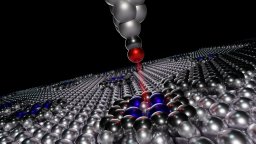
Scanning probe microscopy can now be used to map the properties of single molecules with intramolecular precision by functionalization of the apex of the scanning probe tip with a single atom or molecule. Here we report on the mapping of the three-dimensional potential between fullerene (C60) molecules in different relative orientations, with sub-Angstrom resolution, using dynamic force microscopy (DFM). We introduce a visualization method which is capable of directly imaging the variation in equilibrium binding energy of different molecular orientations. We model the interaction using both a simple approach based around analytical Lennard-Jones potentials, and with dispersion-force-corrected density functional theory (DFT), and show that the positional variation in the binding energy between the molecules is dominated by the onset of repulsive interactions. Our modelling suggests that variations in the dispersion interaction are masked by repulsive interactions even at displacements significantly larger than the equilibrium intermolecular separation.
Claims that dynamic force microscopy has the capability to resolve intermolecular bonds in real space continue to be vigorously debated. To date, studies have been restricted to planar molecular assemblies with small separations between neighboring molecules. Here we report the observation of intermolecular artifacts over much larger distances in 2D assemblies of C-60 molecules, with compelling evidence that in our case the tip apex is terminated by a C-60 molecule (rather than the CO termination typically exploited in ultrahigh resolution force microscopy). The complete absence of directional interactions such as hydrogen or halogen bonding, the nonplanar structure of C-60, and the fullerene termination of the tip apex in our case highlight that intermolecular artifacts are ubiquitous in dynamic force microscopy.
We investigate the combined effects of Jahn–Teller (JT) coupling and interactions with a surface substrate on fullerene anions C602- to C604-. JT coupling alone causes the C60 ions to instantaneously distort from the icosahedral symmetry of the neutral molecule to a lower symmetry, with the molecule moving dynamically between a set of equivalent distortions. When adsorbed on a surface, the number of equivalent minimum-energy distortions is reduced. The implications of this on observed scanning tunneling microscopy (STM) images will be discussed, and comparisons made with existing experimental data. We show that a consistent interpretation of the images from all of the charge states of C60 can only be obtained using a JT model in which the symmetry is further reduced by surface interactions. The comparison with experimental data also allows us to determine relationships between the quadratic Jahn–Teller coupling and surface interaction parameters.
Through the use of scanning tunnelling microscopy (STM), it is possible to directly observe the molecular orbitals associated with a particular molecule. For the charged ions of the C60 fullerene, the interpretation of these experimental images has an additional complication due to the inherent presence of the Jahn-Teller (JT) effect. In this work, the influence of the JT effect on STM images is examined. We also include interactions between the molecule and both the surface substrate on which it rests, and, when present within a monolayer, the nearest neighbours. Simple symmetry arguments are used to explain the effects of these external interactions on the energy of the different JT wells relating to molecular distortions of D3d, D5d, and D2h symmetry. We first investigate the C−60 monoanion, and then, through the construction of multi-electron states, move on to consider anions with higher charges. It is found that for high symmetry orientations of the molecule on the surface, the wells that are degenerate in the absence of external interactions split into equal energy subgroups, with the grouping dependent on the orientation of the molecule. Hückel molecular orbital theory is then used to investigate the effect this has on STM images. We show that when dynamic JT effects are considered, the images are always formed from some linear combination of the squares of the individual single electron molecular orbitals that make up the lowest unoccupied molecular orbital of the neutral molecule.
Scanning probe microscopy lets us "see" atoms and molecules with unprecedented detail, particularly when the resolution is enhanced by functionalizing the tip of the microscope through deliberate adsorption of atomic or molecular species. However, interpreting the resultant images is often far from trivial as they contain features of both the tip and the sample. Here, a computationally simple theoretical approach is presented that allows the orientations of the tip and sample molecules to be determined from a single scanning tunneling microscopy (STM) image, which in turn reveals information on the bonding interaction between the molecules and the tip and surface. We use the approach to deconvolve the experimental STM images arising from the interaction between a C-60-functionalized tip and a C-60 molecule adsorbed on a Si(111)-(7 x 7) surface. The results provide experimental verification of the surface orientations postulated theoretically by Rurali et al.. [Phys. Rev. B 81, 075419 (2010)].
We will consider the role played by electron-vibration and electron-electron interactions, through Jahn-Teller (JT) and Coulomb interactions, respectively, in icosahedral systems in which triplet electronic states are coupled to hg -type vibrations. Starting from the electronic terms that arise from consideration of Coulomb interactions, we introduce JT couplings both within the terms and between nondegenerate terms. We show how the symmetry of the JT distortion can change when extra electrons are added, and give the conditions under which JT distortions can be suppressed entirely when the Coulomb interactions are sufficiently large. The relevance of our results to anions of the fullerene molecule C60 are briefly discussed, and existing experimental measurements are used to estimate values for the quadratic JT coupling constants for these anions.
Using scanning tunnelling microscopy (STM), it is possible to observe detailed structure of the molecular orbitals (MOs) of fullerene anions C−60. However, understanding the experimental observations is not straightforward because of the inherent presence of Jahn–Teller (JT) interactions, which (in general) split the MOs in one of a number of equivalent ways. Tunnelling between equivalent distortions means that any observed STM image will be a superposition of images arising from the individual configurations. Interactions with the surface substrate must also be taken into account. We will show how simple ideas involving a symmetry analysis and Hückel molecular orbital theory can be used to understand observed STM images without need for the more usual but more complicated density functional calculations. In particular, we will show that when the fullerene ion is adsorbed with a pentagon, hexagon or double-bond facing the surface, STM images involving the lowest unoccupied molecular orbital (LUMO) can be reproduced by adding together just two images of squares of components of the LUMO, in ratios that depend on the strength of the JT effect and the surface interaction. It should always be possible to find qualitative matches to observed images involving any of these orientations by simply looking at images of the components, without doing any detailed calculations. A comparison with published images indicates that the JT effect in the C−60 ion favours D3d distortions.
The molecular orbitals of fullerene molecules on surface substrates can be imaged experimentally using scanning tunnelling microscopy (STM). The observed images are influenced by interactions with the substrate. In addition, for fullerene ions, splitting of the orbitals by the Jahn-Teller (JT) effect also affects the observed images. In this work, we consider the effect of both static and dynamic JT interactions on the images that are expected to be obtained from the fullerene anion C-60(-), taking into account interactions with the substrate. Our method is to use Huckel molecular orbital (HMO) theory, which is very simple and quick to implement on a desktop computer. Although our approach is not as rigorous as using density functional theory (DFT), the predicted STM images are almost indistinguishable from published DFT images. Furthermore, it readily allows us to explore different situations, such as different adsorption geometries. Our results are also compared with experimental and simulated STM images in the literature.
The fullerene trianion, C-60(3-), and the compounds associated with it are known to have properties that differ significantly from the other fullerene ions. For example, compounds of the form A(3)C(60) (where A is an alkali metal) which contain this ion, are known to be superconductors up to around 40K, whereas the alkali metal fullerenes containing C-60(2-) and C-60(4-) are found to be insulators, properties often attributed to the Jahn-Teller effect. In spite of this, little work has been undertaken analysing the Jahn-Teller effect in the trianion. In this work, the symmetry reduction caused by this effect is investigated by introducing quadratic terms into the Hamiltonian to model the Jahn-Teller interaction. It is found that, unlike the previously investigated ions of C-60, an electronic degeneracy remains if the molecular distortion were to be described by either the D-3d or D-5d point groups. Thus, a further reduction in symmetry is expected, and it is found that the distorted molecule is actually described by either the C-2h or D-2h group. A distortion of C-2h symmetry in a fullerene molecule has previously undergone little analysis, and so it is this that is then investigated by considering a set of distortional axes relating to the minimum energy wells formed under a quadratic interaction.
We show that the precise orientation of a C(60) molecule which terminates the tip of a scanning probe microscope can be determined with atomic precision from submolecular contrast images of the fullerene cage. A comparison of experimental scanning tunneling microscopy data with images simulated using computationally inexpensive Hückel theory provides a robust method of identifying molecular rotation and tilt at the end of the probe microscope tip. Noncontact atomic force microscopy resolves the atoms of the C(60) cage closest to the surface for a range of molecular orientations at tip-sample separations where the molecule-substrate interaction potential is weakly attractive. Measurements of the C(60)-C(60) pair potential acquired using a fullerene-terminated tip are in excellent agreement with theoretical predictions based on a pairwise summation of the van der Waals interactions between C atoms in each cage, i.e., the Girifalco potential [L. Girifalco, J. Phys. Chem. 95, 5370 (1991)].
We have measured the thermal conductivity of the iron pnictide superconductor LaFePO down to temperatures as low as T=60mK and in magnetic fields up to 5 T. The data shows a large residual contribution that is linear in temperature, consistent with the presence of low energy electronic quasiparticles. We interpret the magnitude of the linear term, as well as the field and temperature dependence of thermal transport in several pairing scenarios. The presence of an unusual supralinear temperature dependence of the electronic thermal conductivity in zero magnetic field, and a high scattering rate with minimal Tc suppression argues for a sign-changing nodal s+/- state.
Fullerene molecules adsorbed on surfaces often show macroscopic average distortions. As charged ions C 60 n− are known to be Jahn-Teller (JT) active, it is suggested that these distortions could be a manifestation of cooperative JT effects (CJTE) due to interactions between neighbouring fullerene ions. In order to understand the distortion properties it is necessary to take correlations between different distortions into account. However, this can’t easily be done in the mean field approximation usually used to describe the CJTE. We therefore propose an alternative procedure to describe 2D mesoscopic islands of C60 ions in which a pseudo vector spin \(\vec S\) is evoked to represent degenerate JT-distorted states when the quadratic JT coupling is considered. This approach is analogous to methods used for 2D magnetic systems. We then use the differential operator technique in effective field theory within the Ising approach. We include the effects of weak surface interactions and dynamic motion between equivalent distortions via terms equivalent to anisotropy and a transverse fieldin magnetism respectively. For distortions to D 5d symmetry, we determine single site correlations as a function of temperature, the macroscopic average distortion describing a structural phase transition, and the isothermal response function. Phase diagrams arepresented for relevant cases of the system parameters.
 Collette Arens Bates合作论文数113Ian D. Hands合作论文数29Colin A. Bates合作论文数29v z polinger合作论文数23ym liu合作论文数16b s monozon合作论文数11W.A. Diery合作论文数Faculty of Science, King AbdulAziz University11Pw Barmby合作论文数10
 Andrew J Lakin合作论文数10P J Kirk合作论文数8A Vasson合作论文数8
 Philip Moriarty合作论文数School of Physics & Astronomy, University of Nottingham8Michel Abou Ghantous合作论文数Department of Physics, Texas A and M University at Qatar8
 Elie Albert Moujaes合作论文数Department of Physics, American University of Beirut8To Klaassen合作论文数7C P Moate合作论文数6mark r eccles合作论文数6Q. C. Qiu合作论文数6
 Sweetman Adam合作论文数School of Physics and Astronomy, University of Nottingham6M.J. Pye合作论文数5Patricia B. Oliete合作论文数5M. Darcha合作论文数5A. Vasson合作论文数5Jm Chamberlain合作论文数4s jamila合作论文数4yimin liu合作论文数4
 Chiutu Cristina合作论文数4W. Ulrici合作论文数4
 Andrew Stannard合作论文数School of Physics & Astronomy;University of Nottingham;University Park;University of Nottingham, University Park4Faten Al-Hazmi合作论文数School of Physics and Astronomy, University of Nottingham4Huanming Li合作论文数4Samuel P. Jarvis合作论文数3S. M. Rough合作论文数3e p pearl合作论文数3r t grimes合作论文数3shatrugan sookhun合作论文数3haifa s alqannas合作论文数3Cjgm Langerak合作论文数3
 Mohammad Abdur Rashid合作论文数3rui huang合作论文数3
 Lev Kantorovich合作论文数Department of Physics, Faculty of Natural, Mathematical & Engineering Sciences, King’s College London3
 David L. Andrews合作论文数Centre for Photonics and Quantum Science, School of Chemistry, Faculty of Science, University of East Anglia3
 Stephen Meech合作论文数School of Chemistry, Pharmacy and Pharmacology, University of East Anglia3A. Erramli合作论文数3L.D. Hallam合作论文数3M. El-Metoui合作论文数3Samuel Paul Jarvis合作论文数2m b stanaway合作论文数2j leymarie合作论文数2




