Developing electronic platforms during education disruptions, particularly during the COVID-19 pandemic, had become crucial to addressing educational gaps. Research has shown technology's significant contribution to improving teaching and learning methods in labs, whether theoretical or experimental. This study creates an e-laboratory platform for managing university-level physics-chemistry practical work. The aim is to measure the platform's impact on students' experimental learning and identify integration and usage constraints. Our methodology was both quantitative and qualitative, conducted in a public institution. Two hundred forty students from two departments completed the questionnaire, and 25 teachers participated in semi-structured interviews. Findings revealed that e-laboratory simulations facilitated comparing theoretical solutions with actual lab practices and achieved goals in terms of communication pace, pre-lab content exchange (video conferences), post-lab experiment records, and evaluation sessions providing feedback for student progress tracking. However, insufficient computer equipment, technical problems during experiment setup, and momentary video conference issues hindered effective communication. This study guides researchers in enhancing adult education program efficiency. Considering online learning's adaptability and cost-effectiveness, improving learning effectiveness can justify continued use of online teaching beyond the pandemic by universities. Hence, electronic laboratories and the exploration of their integration transcend the realm of university scholars; they stand as a reservoir of potentiality for the perpetual advancement of professionals across diverse domains, affording a continuum of erudition throughout one's lifetime.
Context: Nowadays, e-Learning has become essential for the continuing education of health professionals, especially in developing countries. Its introduction in health care settings guarantees better opportunities for disseminating knowledge and skills. Objective: This study aimed to measure the effects of online training “E-learning” on the learning outcomes of nurses in two hospitals in the Casablanca-Settat region with the course “Health planning” as a training theme. Methods: This study is an experimental type, including an experimental group that benefited from online training (B, n 2 = 30) and a Control group that benefited from face-to-face training (A, n 1 = 30). We used a questionnaire to evaluate the nurses' knowledge (general and procedural) in pre and post-training and a questionnaire to evaluate the nurses' satisfaction with using e-learning in continuing education. Results: The results show a positive effect of online training on nurses' learning through an increase in knowledge (general and procedural) after comparing the average score in pre and post-training (The p-value is less than 0.05). Also, high satisfaction with the content covered, the methodology used in the e-Learning, and the quality of the platform. Conclusion: These results should encourage and motivate those responsible for continuing education to adopt online training as a complementary and promising solution to ensure flexible and continuous continuing education sessions for healthcare personnel.
—This work deals with the importance of experimental practice in the teaching of physical sciences. By practice, we rarely mean practical work carried out in the laboratory. We examined the relationship between students' knowledge of physical science and how practice may or may not help them understand chemical and/or physical concepts. What emerges from a survey distributed to our students is that they are very favorable of the use of the practice. The problem posed in this work consists in identifying the impact of experiments on the acquisition of knowledge and in responding to the problems of learning through experience in the short and medium term. The analysis of the answers allowed us to conclude that the experiment in class, by the teacher, helps to understand the physical and chemical phenomena and can be done before or after the study of the theory. The length and difficulty of practical work sometimes worry students, trying to follow the protocol step by step. This fact underscores the importance of clarity of purpose, through which students can be guided toward questioning what is expected of them, such as knowing how their knowledge has increased.
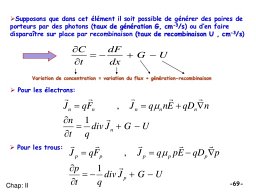
This work is based on the development of a theoretical model describing the drift and diffusion transport of photogenerated charge carriers and the impact of space charge on this transport in relation to the different physical phenomena characterizing the photovoltaic conversion in an inorganic silicon-based cell. In a second step, we used a numerical solution of the transport differential equations based on the Runge-Kutta algorithm in the framework of the finite difference method, This led us to an electrical model of the photovoltaic cell and of the photo-generated currents by RLC circuit equipped with a diode modeling the direction of electron and hole transport and allowed us to study the relations between the optical and electrical properties of the cell, as well as the influence of the different concentrations of impurities used for the n-type and p-type doping of the silicon on the properties of absorption of the light photons, the spectral response as well as the conductivity, the open-circuit potential and the short-circuit current.
The introduction of the competency-based approach (CBA) in 2000 at Moroccan schools led to the establishment of a new pedagogy (integration pedagogy) and the revision of the evaluation system while favoring the use of the formative function of evaluation. However, on the ground, this change does not make it possible to diagnose the pupils' difficulties and then help them remedy them. Our study describes Moroccan teachers' current formative evaluation practices of life and earth sciences (LES) as they implement them in their daily classroom practices and consequently. It is needed to identify the gap between the real and the prescribed, that is to say, between the practices described and those targeted by the orientations and official directives, which are based on the competency-based approach, which puts the learner at the heart of the act of learning. In November 2019, we conducted an anonymous questionnaire for 115 LES teachers working in several Moroccan high schools. The results show that the formative assessment practices of most teachers do not follow the guidelines described and recommended by the curriculum, ranging from the planning and preparation of these assessments to the real and active involvement of learners. The teaching approach adopted by the ministry (CBA) remains marginal in classrooms because of its complexity and requirements, which remain far removed from the concrete conditions of its implementation.
Objectives: The objectives of this study are to raise awareness among future radiology technicians regarding risk management in medical imaging and to measure their satisfaction with their participation in simulation sessions focused on the management of emergencies in radiology. Method: A prospective research-action study was conducted at the simulation center of the Institut Supérieur des Professions Infirmières et Techniques de Santé of Agadir, with radiology technician students enrolled in the 5th semester.A simulation workshop applied to the theme "Risk management in radiology related to an immediate hypersensitivity reaction to iodinated contrast products (ICP) used in CT" was organized over three days.Results: Sixteen radiology students participated in the three simulation scenarios. The evaluation of the technical skills of the participants in this simulation workshop revealed an insufficient mastery of these emergencies. Indeed, during the first simulation session concerning the management of an immediate hypersensitivity reaction to iodinated contrast products in second-grade CT, the average score for the session was 06.39/20 (3.25-9). In addition, the mean score for the second simulation session applied to cardiac arrest management was 06.03/20 (2.25- 8.75).Regarding the error room scenario, (50%) of the participants were satisfied with the relevance of the errors implemented in this simulation session, (37.5%) very satisfied, and (75%) judged the simulation as an effective approach to risk management.Conclusion: Teaching by simulation applied to the management of medical imaging emergencies proves to be a relevant pedagogical method for building a base of skills for future radiology professionals.
In this paper, we discuss the prediction of future solar cell photo-current generated by the machine learning algorithm. For the selection of prediction methods, we compared and explored different prediction methods. Precision, MSE and MAE were used as models due to its adaptable and probabilistic methodology on model selection. This study uses machine learning algorithms as a research method that develops models for predicting solar cell photo-current. We create an electric current prediction model. In view of the models of machine learning algorithms for example, linear regression, Lasso regression, K Nearest Neighbors, decision tree and random forest, watch their order precision execution. In this point, we recommend a solar cell photocurrent prediction model for better information based on resistance assessment. These reviews show that the linear regression algorithm, given the precision, reliably outperforms alternative models in performing the solar cell photo-current prediction Iph
This study aims to measure the degree of use of smartphones in learning by Moroccan students, Using some techniques of artificial intelligence. This is an exploratory descriptive study in which a sample of the student population of The Ben Msick Faculty of Sciences and the Higher Normal School of CasablancaMorocco was subjected to a questionnaire during the 20192020 academic year. the results were favorable, the results of this study show an average rate of use of smartphones for learning purposes by these students. They also show no statistically significant differences in this respect regarding the three variables treated, namely: sex, institution, and level of education. since students often use their smartphones for educational purposes, they will use artificial intelligence-assisted applications on their university campus.
Following the new global Coronavirus pandemic (COVID-19), Morocco has turned towards the use of "Distance Teaching -Learning" as an inevitable solution to ensure the continuity of learning and for the safety of the various educational actors.We followed a descriptive, analytical and exploratory method, through a qualitativequantitative approach.This situation has revealed the existence of hidden digital differences that hinder equal opportunities for all learners in equitable access to digital resources, which is reproduced in the school field, and calls into question the quality of this "Distance -Teaching".Not to mention the psychological impact of isolation and the fear of contagion.The objective of our work is to pinpoint the difficulties, failures and successes of this change in school, through the integration of digital tools in teaching, and their effects on teachers and learners.
The teaching-learning process has recognized a technological innovation that provides intuitive pedagogical tools for exploring new teaching strategies based on intelligent learning and computer-based virtual experiments in general science and specifically chemistry. The aim of this article is to study the educational value of interactive learning methods based on new computer and communication technologies, while applying a numerical simulation solution to the teaching of chemical experiments. Our work is based on the implementation of a computer application modeling the syntheses, structures and properties of crystallographic materials, in order to identify and study different crystalline structures proposed in theoretical courses, using a standardized set of 3D calculation and transformation functions at different angles based on mathematical calculations.To evaluate the integration of this simulation software and study its pedagogical impact on the students, the research turned to a sample of second-year students enrolled in the chemistry department of the Ben M'sik Faculty of Sciences whose the objective is to do a comparative study between the practical works of crystallography using classical methods and after numerical simulation using our computer application, in order to identify the didactic factors influencing the cognitive engagement of the learners.
The work presented in this paper aims at applying a new complementary computer methodology to the teaching of chemical science including the use of a virtual environment laboratory that has an alternative value for the simulation of practical experiments in chemistry. This study is based on two axes, the first deals with the implementation of a laboratory for simulation that helps to carry out various practical work of chemistry. The second axis aims to demonstrate the pedagogical impact of the use of virtual learning environments on the teaching-learning process in the university curriculum. To study the necessity and the feasibility of this technological tool we took as a case study the exploitation of the periodic table in the descriptive chemistry and the practical works of chemical kinetics. In this article we used a strategic methodology to meet the validation constraints of our computer tool thenwe conducted a qualitative study on a sample of students from the Physical Chemistry of Materials Laboratory at the Ben M'sik Faculty of Science to identify the didactical factors influencing the progress of the practical work using our computer solution.
Technological innovation in science provides complementary tools for exploring new teaching strategies within a pedagogical framework that promotes interaction between the teacher and the learner. This work is based on the implementation of a computer application modeling crystallographic material structures, in order to identify and study the different crystalline structures and their characteristics, based on the techniques of three-dimensional modeling covering the OpenGL library and the Euler rotation matrices, and developed by the C # programming language. The analysis and design of this study ranging from the study of the existing, the identification of the problematic, modeling and development, and finally the validation tests. Our research is aimed at second-year chemistry students at Ben M’sik Faculty of Science, Hassan II University of Casablanca, Morocco. We wish to conduct a comparative study between classical methods and after numerical simulation, in order to identify didactic factors influencing the cognitive engagement of learners. The results were good, 89.20% of students in the first group who worked on manipulations using the simulation application scored above 15/20, and 90.22% scored above 15.20./20 for the second group after completion of the manipulations according to the two modalities (traditional and computer). Teachers mentioned that the results have been favorable and support the recommended educational objectives for effective integration of this computer system, which seems to be effective for students who have tried to interact with the practical work to understand the phenomenon of crystallography by a virtual simulation on computer.
According to Western countries, dyslexia suffer from a high proportion of 3% to 6% of school-aged children, and the prevalence rate is higher among boys than girls, which is an indication of an increase among men with dyslexia. The percentage of people with dyslexia varies from one language to another, the percentage being higher in China because of the difficulties of the Chinese language and the reliance on images and symbolic forms. Through a methodology based on new technologies in a pedagogical framework, and we were able to study various statistics, and it seems it is weaker in Japan where language is easier and more compared to dyslexia between England and Germany. Among children of the same age, gender, and level of education (grade 2), the percentage in England ranged from 40% to 60%, compared to 17% in Germany, and decreased progressively with the school scale, reaching 8% because of the ease of German compared to English. For Arab societies, there are currently no statistics available in Arab countries show the number of people with dyslexia among children or adults.
 Said Belaaouad合作论文数11Malika Tridane合作论文数9
 Said Benmokhtar合作论文数7
 Soufiane Zerraf合作论文数Lab Phys Chem Mat, Hassan II Univ Casablanca5Siham Zain合作论文数2Oussama Dardary合作论文数Dept Sci, ENS Meknes, Moulay Ismail Univ2
 Mohammed Azza合作论文数Lab Phys Chem MAt, Hassan II Univ Casablanca2Zineb Azar合作论文数1
 El Hadi Chahid合作论文数1Khadija El Kababi合作论文数1
 Legrouri Khadija合作论文数1Hafsa Janah合作论文数1Amina Lhbibani合作论文数1Jaouad Muftisada合作论文数1Mohamed El Wafiq合作论文数1M. Moutaabbid合作论文数1
 Adnane Aouidate合作论文数MCNSL, Moulay Ismail Univ1Lotfi S合作论文数école normale supérieure, université Hassan-II-Ain-Choc1
 M. Salah合作论文数Laboratoire de Catalyse;Synthese et Environnement;Facultedes Sciences et Techniques1
 Khouya El Hassane合作论文数1
 Ahmed Hamdani合作论文数1
 Abdessamad Tridane合作论文数Department of Applied Sciences and Mathematics, Arizona State University1
 Mohammed El Mahi Chbihi合作论文数1




