Crop type classification with satellite imageries is widely applied to support sustainable agricultural practices and for continuous crop monitoring [1], [2], [3]. In this work, we present a study for the classification of winter crops on a nationwide perspective for Uruguay. We have analyzed Uruguay’s three most widely extended winter crops: wheat, barley, and rapeseed. We have trained a classifier based on XGBoost that uses temporal series built from Sentinel-2 image data. For training, we used the information from previous years and reported the results the following year. To our knowledge, this is the first work that proposes a clear and systematic way to classify winter crops in Uruguay based on historical data without needing samples of the actual year. We have obtained high precision and recall values for rapeseed and results comparable with other regions’ work for wheat and barley.
This study evaluates the recently proposed Document Attention Network (DAN) for extracting key-value information from Uruguayan birth certificates, handwritten in Spanish. We investigate two annotation strategies for automatically transcribing handwritten documents, fine-tuning DAN with minimal training data and annotation effort. Experiments were conducted on two datasets containing the same images (201 scans of birth certificates written by more than 15 different writers) but with different annotation methods. Our findings indicate that normalized annotation is more effective for fields that can be standardized, such as dates and places of birth, whereas diplomatic annotation performs much better for fields containing names and surnames, which can not be standardized.
Comprobar la identidad de las personas sigue siendo un reto para los países de América Latina y el Caribe (ALC). El Modelo de Madurez de los Sistemas de Identificación es una herramienta impulsada por el Banco Interamericano de Desarrollo (BID) con el objetivo de comprender los aspectos clave para evaluar la madurez de sus sistemas de identificación. Para ello, el modelo se basa en un análisis exhaustivo de los sistemas de identificación más avanzados a nivel global para encontrar los elementos más relevantes al grado de desarrollo de un sistema de identificación. El modelo se estructura en torno a 6 dimensiones y 16 indicadores que abarcan tanto los aspectos relacionados con la definición de directrices, regulación y planificación del sistema, como aquellos vinculados a la ejecución de los procedimientos del ciclo de vida de la gestión de la identidad, es decir, registro, emisión, uso y actualización. En definitiva, este modelo busca ser una guía práctica para la región, al proporcionar una ruta estratégica clara para la modernización de los sistemas de identificación, permitir una evaluación precisa del nivel de Desarrollo en las áreas más importantes que los caracterizan y proponer los pasos a alcanzar para mejorar estos sistemas.
In this work, we present a study for the classification of summer crops on a nationwide perspective. Using both optical and radar satellite images, we implement a time-series classification algorithm using XGBoost. Two datasets with farm-level information were used: one with ground truth obtained directly from farmers' production and the other with declared crops obtained at the government level. The crops analyzed were corn, soybean, sorghum, and pastures. When trained and validated with ground truth, the classifier yields a F1-Score performance of 99% for soybean, and values higher than 80% for corn and sorghum. Predictions performed with this model on the dataset of declared crops lead to F1-Score values of 54, 97, and 50%, for corn, soybean, and sorghum, respectively. These low values for corn and sorghum indicate the presence of mislabeled data in that dataset, which in turns may suggest issues with the declarations provided by the farmers.
Fusion is a key component in many biometric systems: it is one of the most widely used techniques to improve their accuracy. Each time we need to combine the output of systems that use different biometric traits, or different samples of the same biometric trait, or even different algorithms, we need to define a fusion strategy. Independently of the fusion method used, there is always a decision step, in which it is decided if the traits being compared correspond to the same individual or not. In this work, we present a statistical decision criterion based on the a-contrario framework, which has already proven to be useful in biometric applications. The proposed method and its theoretical background is described in detail, and its application to biometric fusion is illustrated with simulated and real data.
In this work, we evaluate the use of fingerprints to identify people from a very young age. Although it is well known that fingerprints are stable all along life, and even before born fingerprint patterns are fully developed, automatic identification (or comparison) systems are developed generally for adult fingerprints. Our interest is not only to study the feasibility of using child fingerprints...
Wavelet compression schemes (such as JPEG2000) lead to very specific visual artifacts due to the quantization of noisy wavelet coefficients. They have highly spatialy-correlated structure that makes it difficult to be removed with standard denoising algorithms. In this work, we propose a joint denoising and decompression method that combines a data-fitting term which takes into account the quantization process and an implicit prior contained in a stateof-the-art denoising CNN.
JPEG and Wavelet compression artifacts leading to Gibbs effects and loss of texture are well known and many restoration solutions exist in the literature. So is denoising, which has occupied the image processing community for decades. However, when a noisy image is compressed, the noisy wavelet coefficients can be assigned to the “wrong” quantization interval, generating artifacts that can have dramatic consequences in products derived from satellite image pairs such as sub-pixel stereo vision and digital terrain elevation models. Despite the fact that the importance of such artifacts in very high resolution satellite imaging has recently been recognized, this restoration problem has been rarely addressed in the literature. In this work we present a thorough probabilistic analysis of the wavelet outliers phenomenon, and conclude that their probabilistic nature is characterized by a single parameter related to the ratio q/σ of the compression rate and the instrumental noise. This analysis provides the conditional probability for a Bayesian MAP estimator, whereas a patch-based local Gaussian prior model is learnt from the corrupted image iteratively, like in state-of-the-art patch-based denoising algorithms, albeit with the additional difficulty of dealing with non-Gaussian noise during the learning process. The resulting joint denoising and decompression algorithm is experimentally evaluated under realistic conditions. The results show its ability to simultaneously denoise, decompress and remove wavelet outliers better than the available alternatives, both from a quantitative and a qualitative point of view. As expected, the advantage of our method is more evident for large values of q/σ.
It is widely known that biometric systems based on adults fingerprints have reached an outstanding performance when compared against other biometric traits. This explains their extensive use by governmental agencies in charge of citizen identification. Nevertheless, the performance is highly degraded when fingerprints of newborns or toddlers are used. In this work, we analyze the performance of existing solutions (both at sensor and matching level) using 45000 infants fingerprints taken from an on-production civilian database. We also propose a solution by zooming the input fingerprints with an interpolation factor based on ridges distances. The developed solution shows improvements in both fingerprint quality (NFIQ 2.0) as well as recognition performance.
Data degradation by radio frequency interferences (RFI) is one of the major challenges that SMOS and other interferometers radiometers missions have to face. Although a great number of the illegal emitters were turned off since the mission was launched, not all of the sources were completely removed. Moreover, the data obtained previously is already corrupted by these RFI. Thus, the recovery of brightness temperature from corrupted data by image restoration techniques is of major interest. In this work we propose a variational approach to recover a super-resolved, denoised brightness temperature map based on two spatial components: an image u that models the brightness temperature and an image o modeling the RFI. The approach is totally new to our knowledge, in the sense that it is directly and exclusively based on the visibilities (L1a data), and thus can also be considered as an alternative to other brightness temperature recovery methods.
All biometric systems have two major functions: the identification of a given template on a biometric database and the verification that two templates correspond to the same subject. Although in both operations the response confidence of the system is of great importance, in the verification process it becomes crucial. Indeed we want to determine, with a very low error, whether two templates correspond to the same subject or not. Most of the work devoted to biometrics are related to other stages of the process: the preprocessing, feature extraction or even the definition of robust metrics to compare them. Nevertheless, few works exist on the criteria used to the acceptance of a matching between two templates. In this work we focus on this decision criterion: we introduce a novel strategy based on the a contrario framework. We show several advantages of using this framework in the context of biometrics: it is automatically adapted to the data, it allows us to control the performance of the system in advance and can be used directly in the matching stage not requiring a prior training stage. In order to show the framework on a practical situation, we implement a face recognition system. We perform several experiments to validate this novel strategy using different databases, both private and public. Also the robustness of this technique is evaluated using different features and metrics. The results show that the proposed approach outperforms classic methods, with a consistent theory behind it, that can be naturally adapted to any biometric system.
In this work we focus in the reliability estimation of biometric systems output. We explain why this is a very important problem when deploying a biometric system and face it using a statistical approach. In particular, we present a solution based in the a- contrario approach widely used in the image processing field. We show how this strategy could be adapted and its key advantages with respect to other state-of-the-art reliability measures. A comprehensive set of experiments is used to validate the approach, using different fingerprints databases, matching systems, and comparing the performance with other state-of-the-art confidence measure strategies.
In this work we focused in the matching stage of a face recognition system. These systems are used to identify an unknown person or to validate a claimed identity. In the face recognition field it is very common to innovate in the extracted features of a face and use a simple threshold on the distance between samples in order to perform the validation of a claimed identity. In this work we present a novel strategy based in the a-contrario framework in order to improve the matching stage. This approach results in a validation threshold that is automatically adapted to the data and allows to predict the performance of the system in advance. We perform several experiments in order to validate this novel strategy using different databases and show its advantages over using a simple threshold over the distances.
Face recognition systems (FRS) have been widely studied and the performances reported are very high in the standard databases used for comparison. In this work we present a FRS that achieves state of the art results in these databases and show its performance's variation when tested in a field trial using a citizen identification database. To accomplish this, a set of experiments are proposed. These include increasing the size of the database, using subsets that include a time difference of one to ten years between the query samples and those enrolled in the system and finally using different subsets of the same database. Discussion on these experiments and conclusions are presented.
Estimates of soil moisture and surface salinity are of significant importance to improve meteorological and climate prediction. The SMOS mission monitor these quantities, by measuring the brightness temperature by means of L-band aperture synthesis interferometry. Despite the L-band being reserved for Earth and space exploration, SMOS images reveal large number of strong outliers, produced by illegal antennas emitting in this band. In this work we propose a variational approach to recover a super-resolved, denoised brightness temperature map. The measurements are modeled as the superposition of three super-resolved components in the spatial domain: the target brightness temperature map u, an image o modeling the outliers, and Gaussian noise n. This decomposition allows to isolate each of its constituent parts, thanks to a sparsity operator that acts on o, and a bounded variation prior on u that extrapolates its spectrum promoting a non-oscillating behavior. The proposed model is interesting in itself, as it is general enough to be applied to other restoration problems. Experiments on real and synthetic data confirm the suitability of the proposed approach.
Neuronavigation is the application of image guidance to neurosurgery where the position of a surgical tool can be displayed on a preoperative image. Although this technique has been used worldwide in the last ten years, it was never applied in Uruguay due to its cost. In an ongoing project, the Engineering Faculty (Universidad de la República), the Hospital de Clínicas (Medicine Faculty - Universidad de la República) and the Regional Hospital of Tacuarembó are doing the first experimental trials in neuronavigation. In this project, a prototype based on optical tracking equipment and the open source software IGSTK (Image Guided Surgery Toolkit) is under development and testing.
The benefits of photogrammetry from low baseline stereo pairs have been increasingly demonstrated in recent years by engineers at the French Space Agency (CNES) and their collaborators, thanks to new advances in image restoration and computer vision. Such an emerging technology requires new tools for generating test data, evaluating and visualizing results. This article discusses the mathematical, numerical and computational problems involved in simulating such low baseline stereo pairs with sufficient accuracy, as well as in the inverse scenario, where the disparity map computed from a low-baseline stereo pair has to be expanded to generate a large baseline stereo pair that makes visual evaluation of the result by photogrametric experts easier. The trade-offs that have to be made in order to obtain accurate results on very large images, with tight constraints on computer resources are also discussed.
In this work we propose a new automatic methodology for computing accurate digital elevation models (DEMs) in urban environments from low baseline stereo pairs that shall be available in the future from a new kind of earth observation satellite. This setting makes both views of the scene very similar, thus avoiding occlusions and illumination changes, which are the main disadvantages of the commonly accepted wide-baseline configuration. There still remain two crucial technological challenges: (i) precisely estimating DEMs with strong discontinuities and (ii) providing a statistically proven result, automatically. The first one is solved here by a piecewise affine representation that is well adapted to man-made landscapes, whereas the application of computational Gestalt theory introduces reliability and automation. In fact this theory allows us to reduce the number of parameters to be adjusted, and to control the number of false detections. This leads to the selection of a suitable segmentation into affine regions (whenever possible) by a novel and completely automatic perceptual grouping method. It also allows us to discriminate e. g. vegetation-dominated regions, where such an affine model does not apply and a more classical correlation technique should be preferred. In addition we propose here an extension of the classical "quantized" Gestalt theory to continuous measurements, thus combining its reliability with the precision of variational robust estimation and fine interpolation methods that are necessary in the low baseline case. Such an extension is very general and will be useful for many other applications as well.
 D. Di Martino合作论文数Laboratory of Molecular Biology, Raggruppamento Carabinieri Investigazioni Scientifiche (RaCIS), Messina, Italy8
 Alicia Fernández合作论文数7
 Federico Lecumberry合作论文数Instituto de Ingeniería Eléctrica, Universidad de la República6
 Andrés Almansa合作论文数Télécom ParisTech - LTCI CNRS6
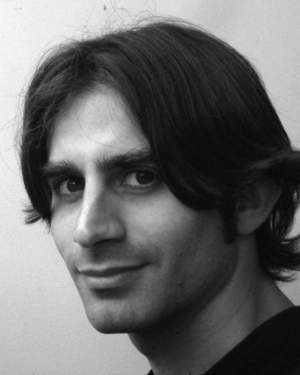 Rafael Grompone von Gioi合作论文数Ecole Normale Superieure4
 B. Rouge合作论文数3
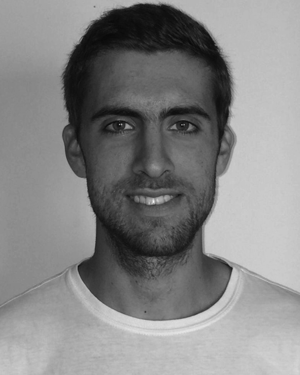 Guillermo Garella合作论文数3
 Carbajal Guillermo合作论文数3
 Pablo Musé合作论文数Universidad de la República3P. Muse合作论文数2Adrián Cal合作论文数2
 Francesco Franzoni合作论文数2Vanina Camacho合作论文数2
 Mario Gonzalez Olmedo合作论文数Universidad Autónoma de San Luis Potos;(UASLP) Engineering Department, 78290, San Luis Potosi, Mexico;c;Engineering Department, Universidad Autónoma de San Luis Potosí (UASLP)2Sylvain Durand合作论文数2
 Gabriele Facciolo合作论文数Ecole Normale Superieure Paris-Saclay2Ramiro Lima合作论文数1
 Marina Gardella合作论文数Univ Paris Cite, Univ Paris Saclay1
 Solène Tarride合作论文数1Antoine Tadros合作论文数1
 Álvaro Gómez合作论文数1
 Jérémy Anger合作论文数CMLA ENS Cachan, CNRS Université Paris1Villar Alvaro合作论文数1Vazquez Luis合作论文数1Pereyra Gabriela合作论文数1
 Christopher Kermorvant合作论文数1Sebastian Berchesi合作论文数1Gabriel Lema合作论文数1
 Jean-Michel Morel合作论文数City University of Hong Kong1
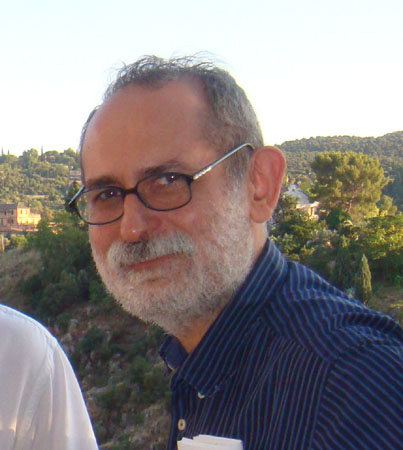 Vicent Caselles合作论文数Departament de Tecnologies de la Informació i les Comunicacions, Universitat Pompeu Fabra1
 Laura Igual合作论文数Department of Mathematics and Computer Science, Universitat de Barcelona1Luis Garrido合作论文数Departament de Tecnologia
Passeig Circumval·lacio 81
Laura Igual合作论文数Department of Mathematics and Computer Science, Universitat de Barcelona1Luis Garrido合作论文数Departament de Tecnologia
Passeig Circumval·lacio 81 Ali Khazaal合作论文数1




