source in a filament plane and in the plane perpendicular to the filament was measured for different conditions of focalization of the laser beam.In a second step, parameters affecting the efficiency of the opto-acoustic conversion were investigated.In order to get better laser propagation conditions in water the laser wavelength was changed from 800nm to 400nm.This was achieved by using a KDP crystal (second harmonic generation).The influence of optical pulse duration and total laser pulse energy on the level of the received acoustical signals were successively investigated.In this experiment three hydrophones were used, covering all together the frequency band [0-15 MHz].Finally, some tests of sound source generation in a saline solution (35 g/l NaCl) were made in order to predict what would be the source level in a real sea experiment.
Acoustic signals generated by filamentation of ultrashort terawatt laser pulses in water are characterized experimentally. Measurements reveal a strong influence of input pulse duration on the shape and intensity of the acoustic wave. Numerical simulations of the laser pulse nonlinear propagation and the subsequent water hydrodynamics and acoustic wave generation show that the strong acoustic emission is related to the mechanism of superfilamention in water. The elongated shape of the plasma volume where energy is deposited drives the far-field profile of the acoustic signal, which takes the form of a radially directed pressure wave with a single oscillation and a very broad spectrum.
In this work the non-linear opto-acoustic problem which consists in generating an acoustic signal in water from an intense ultra short laser pulse has been studied. The acoustic source obtained could be related to the phenomenon of filamentation which produces a contraction of the initial beam accompanied by the formation of plasma. Relatively recent work has shown that lasers of this type could be used to produce remote acoustic sources with interesting applications to underwater acoustics. The spectrum of the sound source obtained was investigated and its directivity pattern in both planes (plane of the filament and plane perpendicular to the filament) was measured. The sound level of the source as a function of energy, duration, and wavelength of the laser pulse was also measured.
Results of laboratory-scale measurements of long-range across-slope pulse propagation in three-dimensional wedge-shaped oceanic waveguides with a sandy bottom are reviewed. The experimental data considered were collected during two laboratory-scale experimental campaigns that were led in 2006 and 2007 (after a required calibration phase) in the large indoor shallow-water tank of the LMA-CNRS laboratory in Marseille. Operational frequencies and water depths were chosen to produce a reduced number of propagating modes so as to facilitate the analysis of the received signals. The experimental data contain strong 3-D effects like mode shadow zones and multiple mode arrivals, all consistent with well-known three-dimensional effects described in the literature. The data are compared with numerical solutions obtained using a fully three-dimensional parabolic equation based model. Comparisons are performed in both time domain (received signals at distinct ranges and depths) and frequency domain (TL-versus-range curves at distinct depths for several discrete frequencies). In both cases, the experimental data are in good agreement with the numerical predictions.
Acoustic signals generated in water by terawatt (TW) laser pulses undergoing filamentation are studied. The acoustic signal has a very broad spectrum, spanning from 0.1 to 10 MHz and is confined in the plane perpendicular to the laser direction. Such a source appears to be promising for the development of remote laser based acoustic applications.
The authors focus on the effects of phenomena, such as linear internal waves, that are responsible for fluctuations of the depth-dependent sound speed profile and, hence, induce distortions of the resulting acoustic pressure field and degradation of the associated sonar performances. The main goal of this study is to develop a scaled experiment configuration able to provide some results representative of this kind of distortions. To do so, a theoretical study of the phenomenon has first been carried out: we obtained an expression for the standard parabolic equation applied to the Fourier transform of the moments of order 2 and 4 in 3D medium. Various simulation programs were developed and used for the following purposes: validating or discarding some relationships given by Flatte through his classical dimensionless analysis (ΛΦ plane); tracing rays through an acoustic lens featuring a plane face and a randomly rough face and propagating an acoustic wave through the same object in order to anticipate for the shape of the distorted pressure field, including diffraction effects. We were able both theoretically and experimentally to induce acoustic scattering that mimics, at reduced scale and frequencies around 2MHz, the correlation properties and the corresponding array performance that would be observed at sea, after propagation through a linear internal wave field, or reflection on a rough sea surface.
Cet article presente un procede d'inversion geoacoustique passif a partir de signaux representatifs de vocalises de mammiferes marins et d'un unique hydrophone en milieux petits fonds. Notre methode utilise au mieux la propagation en multitrajets des vocalises et leur signature temps-frequence pour extraire un observable permettant d'estimer par inversion les proprietes du fond marin. Il s'applique aux vocalises presentant au moins trois trajets resolus (direct, fond, surface) ce qui implique une portee d'environ 300 m autour de l'hydrophone pour des hauteurs d'eau de 100 m. A partir d'outils temps frequence, chaque emission est localisee et permet d'estimer le couple (rasance, coefficient de reflexion) lui correspondant. Le cumul d'un ensemble d'emissions permet de mesurer une courbe du coefficient de reflexion en fonction des angles de rasance. Cette donnee alimente un algorithme d'inversion geoacoustique mis en oeuvre a travers un algorithme genetique. Dans cet article, nous detaillons la theorie de la methode et nous etudions ses performances. Nous demontrons la validite de la methode sur des signaux generiques reels emis par une source controlee dans le Golfe du Lion (rampes de frequences de 1 kHz a 2 kHz de duree 10 ms). Ces donnees permettent de valider la methode sur des signaux aux caracteristiques tres proches de celles de vocalises de mysticetes (baleines a bosse par exemple). Le cas des sifflements de delphinides (ex : dauphins communs), plus hauts en frequence, est egalement aborde.
This paper presents a geoacoustic inversion scheme relying on the inversion of signal close to marine mammals vocalizations on a single hydrophone in shallow waters. Our method makes best use of the multipath propagation of vocal calls and of their time-frequency signature to extract an observable used by the inversion algorithm to estimate sea bottom features. This method requires vocalizations with at least three resolved paths (direct, first bottom reflected and first surface reflected paths), which implies a 300 meter range around the hydrophone for 100 meter water depth. Using time-frequency tools, each emitted call is localized and processed to provide its corresponding couple (grazing angle, reflexion coefficient). Through the processing of several vocalizations, we get a curve of the reflexion coefficient according to grazing angles. This curve feeds a geoacoustic inversion algorithm run with a genetic algorithm. In this paper; we describe both the theory and performances of our method. We demonstrate its validity on generic real signals emitted through a controlled acoustic source in the Gulf of Lion (10 ms duration chirps with [1 kHz-2 kHz] bandwidth). An application on delphinids higher frequency calls is also mentioned but the inversion step for those signals will need further functions to assess and correct the directivity losses.
The paper describes the theory and implementation issues of modeling of the backscattered field from a thin air-filled spherical elastic shell immersed in water close to the seabed or to the air/water interface. Computational results obtained for the full multiple scattering solution are compared with the model utilizing the single-scatter approximation in a wide-frequency range 0 < k 0 a ≤ 55. In this frequency range for a thin air-filled spherical shell the main elastic contribution to scattering is due to the lowest-order compressional wave which is the generalization of the Lamb symmetric wave of a flat plate and due to the subsonic mode of the first antisymmetric Lamb wave. Strong resonance peaks produced by these waves in the backscattered form functions have been identified in numerical modeling. It has been shown that when the object is close to the interface in addition to geometrical reflections between the shell and the interface, strong interactions due to these resonances can be observed.
In March 1960, the sounds from 300-lb explosive charges deployed off Perth, Australia were recorded at Bermuda, the antipode to Perth (AGU 1960, Bryan et al. 1963, Shockley et al. 1982). The test verified the suggestion by Ewing and Worzel (1948) that acoustic propagation in the ocean over antipodal distances was possible. Under a careful and controlled scientific plan, three surplus depth charges were deployed from an Australian oceanographic research vessel, the HMAS Diamantina, at 5-min. intervals. The shot locations were determined by celestial navigation under ideal conditions, giving a uncertainty in position of about 1 nm. This positioning uncertainty corresponds to a travel time uncertainty of about 1 s. Time keeping was done manually using a chronometer deck watch, most likely the ship’s navigation clock, with an uncertainty of about 1 s. The experiment was coordinated with the Bermuda SOFAR station, which recorded the arrival pulses. The travel times of the pulses were about 3 hr., 43 min. The recorded arrivals at Bermuda consisted of a broad pulse of about 20 s width (half maximum) with peak intensity about 15 dB above noise, followed by a second weaker pulse of comparable width about 30 s later. The acoustic paths traveled by the sound are refracted geodesics (Munk et al. 1988, Heaney et al. 1991, Jensen et al. 1994, Munk et al. 1995). A key question concerning this experiment has been to determine the precise acoustic paths followed by the acoustic pulses (Figure 1).
The scattering strength of isotropic and anisotropic rough surfaces was experimentally and theoretically investigated for high frequencies about 500 kHz. Emphasis was placed on studying the response from three two-dimensional rough surfaces which roughness was either isotropic (characterized by a Gaussian distribution) or anisotropic (characterized by a modified-sine surface). Theoretical predictions rely on the first-order small slope approximation either including a Gaussian structure function or a quasi-periodic structure function. The combination of true data and theoretical results indicates the importance of taking into account the anisotropy of a surface in a scattering prediction process. It is shown that the scattering strength varies a lot depending on the propagation plane. In the longitudinal direction of ripples, scattering strength is mostly in the specular direction, whereas in the transversal direction of the ripples, the scattering strength is spread in a very different way related to the particular features of the ripples, with several maxima and minima independent of the specular direction. Contrary to the isotropic surface, the scattering strength from an anisotropic rough surface is modified from one propagation plane to another, which explains why the entire rough surface should be taken into account without any simplification as it is often seen when dealing with scattering models. Compared to such a surface, positions of the emitter and of the receiver are naturally significant when measuring scattering strength.
The development of low-frequency sonar systems, using, for instance, a network of autonomous systems in unmanned vehicles, provides a practical means for bistatic measurements (i.e., when the source and receiver are widely separated) allowing for multiple viewpoints of the target of interest. Time-frequency analysis, in particular, Wigner-Ville analysis, takes advantage of the evolution time dependent aspect of the echo spectrum to differentiate a man-made target, such as an elastic spherical shell, from a natural object of the similar shape. A key energetic feature of fluid-loaded and thin spherical shell is the coincidence pattern, also referred to as the mid-frequency enhancement (MFE), that results from antisymmetric Lamb-waves propagating around the circumference of the shell. This article investigates numerically the bistatic variations of the MFE with respect to the monostatic configuration using the Wigner-Ville analysis. The observed time-frequency shifts of the MFE are modeled using a previously derived quantitative ray theory by Zhang et al. [J. Acoust. Soc. Am. 91, 1862-1874 (1993)] for spherical shell's scattering. Additionally, the advantage of an optimal array beamformer, based on joint time delays and frequency shifts is illustrated for enhancing the detection of the MFE recorded across a bistatic receiver array when compared to a conventional time-delay beamformer.
Sound propagation in water-saturated glass beads was studied under controlled laboratory conditions over a frequency range from 200 to 900 kHz for sound-speed measurements and from 200 to 800 kHz for attenuation measurements. The influence of the grain size on both p-wave speed and attenuation was studied using three kinds of glass beads. A strong negative dispersion of the sound speed over the whole frequency range studied was observed with the three different populations of beads used in this experiment (mean grain size: 272 μm, 520 μm, and 1.33 mm). In addition, it was found that not only does the attenuation increase nonlinearly with frequency, but it also depends on the size of the beads. These results are consistent with earlier measurements performed by other researchers over the same frequency range with glass beads of about the same sizes. In this paper, we also discuss the results of the measurement (over a wide frequency range: 200 kHz-1.5 MHz) of the reflection coefficient of a thick slab of glass beads whose surface was smoothed, as well as the correlation between the behavior of this reflection coefficient and the negative dispersion of the sound speed. For this experiment, five populations of beads (91 μm, 272 μm, 520 μm, 133 mm, and 2.98 mm) were used.
The objective of this work was to study the scattering strength depending on the receiver and sound source positions compared to an anisotropic surface. Roughness scattering by an anisotropic rough surface was studied under controlled laboratory conditions at a frequency of 500kHz. Two kinds of anisotropic rough surfaces were used, both with a height of 3mm, but one with a wavelength of 2.5cm the other of 5cm. The measurements have shown strong scattering behaviors depending on the direction of the propagation plane on the rough surface. In the smoother direction, scattering strength was observed around the specular direction, whereas for the rougher direction, the scattering strength showed maxima and minima at specific scattered angles. These angular positions were closely related to the shape of the surface as well as to the relationship between dimensions and the acoustic frequency. The experimental results were compared with simulations performed using the small slope approximation of first order and an appropriate roughness correlation function. This comparison showed good agreement between experimental data and simulations in terms of roughness scattering behavior.
This paper investigates the forward modeling of chirp-sonar data for the quantitative characterization of marine subbottom sediment between 1 and 10 kHz. The forward modeling, based on a transfer function approach, included impacts of layering or impedance mismatch, attenuation, roughness, and transitional layers, i.e., continuous impedance variations. The presented approach provided the best compromise between the number of available geoacoustic parameters from chirp-sonar data and the subbottom modeling accuracy. The forward model was tested on deep-sea chirp-sonar data acquired at a central frequency of 3.5 kHz. Comparisons between synthetic and experimental seismograms showed good agreement for the first 15 m of buried layers. Performance of the inversion using this forward model was also examined through sensitivity analysis. The results suggested that estimations of layer thickness, impedance, and transitional layer thickness were robust, whereas roughness and attenuation estimations were subject to wavelength and layer thickness conditions
In this study, comparisons are made between two imaging techniques in the context of the Multistatic Synthetic Aperture Sonar (SAS): the Matched Filtering method and a reconstruction method based on the Kirchhoff Approximation (KA). The Matched Filtering Algorithm (MFA) is the classical method used for image formation purposes in synthetic aperture systems. In this method the field diffracted by the target is approached by the "point scatterers" model. One of the first objective of this work is to develop a more complex and more realistic model than the well known "point scatterers" model. In addition, the aim is to get not only the shape and the size of target but also some quantitative information about its physical properties. Thus, a forward model based on the KA is proposed to get a more realistic description of the scattered field and a reconstruction method has been obtained through the use of a 2-D Fourier transform of this forward model. The algorithm hence obtained is named: "Imaging Reconstruction Algorithm in the Kirchhoff Approximation" (IRAKA). In this paper the IRAKA is compared to the MFA in order to check its capability to reconstruct target shape.Images of 2-D targets of circular and elliptic cross-sections are reconstructed with the MFA and with the IRAKA from both numerical data and tank experimental data. These imaging methods are compared in terms of quality of the shape reconstruction and in terms of their robustness to noise in a given multistatic configuration. Both algorithms are also used to reconstruct images of a 2-D target of circular cross-section in a multistatic forward looking SAS context. With a good Signal to Noise Ratio (SNR) we get better results with the IRAKA than with the MFA in terms of the quality of target shape reconstruction. In presence of additive white Gaussian circular noise, the MFA off course, gives better results than the IRAKA. Nevertheless, using a technique of stabilization of the deconvolution, it has been possible to improve the performances of the IRAKA even in presence of additive noise.
In this paper, laboratory scale measurements of long-range across-slope propagation of broadband pulses in a shallow-water wedge-shaped environment with a sandy bottom are reported. The scaled model was designed to study the three-dimensional (3D) acoustic field in the presence of only a few propagating modes. The recorded time series exhibit prominent 3D effects such as mode shadow zones and multiple mode arrivals. Inspection of the spectral content of the time signals gives evidence of intra-mode interference and frequency dependence of the mode cut-off range in the across-slope direction.
This study was performed in controlled laboratory conditions using several broadband transducers to cover a wide frequency range from 200 kHz to 3MHz. Various types of sediments were used: natural medium and coarse sand, and glass beads with corresponding mean sizes. Sound speed and attenuation were measured and compared with predictions of Biot theory. The theory failed to predict both high attenuation and negative dispersion of sound speed observed at very high frequencies (above 500 kHz for medium sands), which can be assumed an effect of strong grain scattering. All the measurements were performed at different times to ensure the repeatability of the results. A comparison of results obtained for natural sands with those for artificial sediment (glass beads) of the same mean size, allowed observing the influence of the grain shape on the reflected and backscattered signals. Also, the influence of the transducer directivity diagram on the sediment reflectivity was observed. This effect is discussed and shown to be essential in the case of strong incoherent scattering observed for coarse sediments. Finally, the time-frequency contents of the reflected signal were analyzed. It was found to be very sensitive to the granular structure of the sediment. [Work supported by CNRS and ONR.]
Monostatic Synthetic Aperture Sonar (SAS) are high resolution systems for target imaging which are now of common use in the underwater acoustics domain. The objective of this work was to analyse what kind of information should be obtained from a multistatic SAS system. This idea has been applied in radar but very few works exist in the underwater acoustics domain. The applications could be detection and identification of buried mines or mines lying on the seabed and divers detection for harbour protection. These applications deal with the problem of target detection and identification near a rough surface. To show what can be obtained with a multistatic SAS processing, we have performed an experiment with a circular cylinder of 1 cm diameter lying on a rough interface made of sand grains of 1 mm diameter. Measurements were performed in a tank with both a multistatic and a monostatic SAS systems. The signal used to insonified the target area was a short impulse with a 2 MHz central frequency which corresponds to a ka about 40. Images of the cylinder in presence of clutter have been reconstructed with the matched filtering algorithm from monostatic and multistatic acquisitions and have been compared.
 Régine Guillermin合作论文数CNRS, UPR 7051, Lab Mecan & Acoust, F-13402 Marseille 20, France14
 FréDéRic Sturm合作论文数6
 Manell Zakharia合作论文数France. N. Diner: IFREMER Centre de Brest6
 Jean Sageloli合作论文数5j sageloli合作论文数5Fattaccioli, D.合作论文数5
 Alexios Korakas合作论文数5
 Anatoliy N. Ivakin合作论文数5
 Patrick Sanchez合作论文数IRISA/INRIA IRISA5
 Didier Ferrand合作论文数4
 Aurelien Houard合作论文数Lab Opt Appl, CNRS4Jérôme Carbonnel合作论文数4
 Amélie Jarnac合作论文数4Andre Mysyrowicz合作论文数Laboratoire d’Optique Appliquée, CNRS4C. Gazanhes合作论文数4
 Yohann Brelet合作论文数Ecole Polytechnique de l'Universite de Nantes4Yvesbernard André合作论文数4
 Yann Stéphan合作论文数4
 Cedric Gervaise合作论文数Institut de Recherche Chorus4
 Gaetano Canepa合作论文数3
 Franck Daout合作论文数3
 Patrick Flandrin合作论文数Ecole Normale Superieure de Lyon3Caroline Hervé合作论文数3
 Panagiotis Papadakis合作论文数IMT Atlantique3Amelie Barazzutti合作论文数2
 Francoise Schmitt合作论文数2
 Leo Van Biesen合作论文数Universiteit Brussel;Department of Fundamental Electricity and Instrumentation2Florian Dadouchi合作论文数2
 Alessandra Tesei合作论文数Undersea Research Centre;Marine Physical Laboratory;Marine Physical Laboratory, Undersea Research Centre2
 Michael I Taroudakis合作论文数Institute of Applied and Computational, University of Crete2Virginie Jaud合作论文数2
 Abdellatif Bey Temsamani合作论文数2
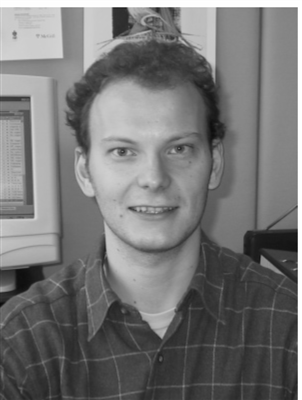 Steve Vandenplas合作论文数2
 Raymond J. Soukup合作论文数2
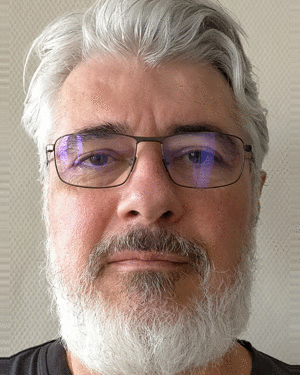 Paul Cristini合作论文数Chargé de recherche CNRS LMA Marseille2
 Gregory M. Fridman合作论文数2Natalie S. Grigorieva合作论文数2Jean Louis Rousselot合作论文数1j p herault合作论文数1François Magand合作论文数1kevin rudd合作论文数1edward l kunz合作论文数1
 michel legris合作论文数1Herbert Überall合作论文数1Anders Krogvig合作论文数1claire drevet合作论文数1
 Audun Oppedal Pedersen合作论文数Dept Phys & Technol, Univ Bergen1
 Gaultier Real合作论文数DGA Naval Systems, Toulon, France1
 Tron Vedul Tronstad合作论文数Digital Dept, SINTEF1




