针对传统波达角估计方法只适用于特定天线阵列,计算量过大和实时性差的问题,提出采用K近邻算法(KNN)对任意天线阵列实现高精度来波方向估计的方法.该方法提取来波信号的相位和幅度信息作为输入数据,利用K近邻算法构建来波方向估计模型,实现了高精度、实时化的来波方向估计.仿真实验结果表明,该方法能够实现高精度的来波方向估计,和干涉仪测向方法进行对比,证明该方法对频率估计误差和信号入射范围有更好的鲁棒性,进一步体现了该方法的优越性和可行性.
针对平方根容积卡尔曼滤波(SRCKF)算法精确性和实时性存在的不足,以固定单站无源定位系统为研究对象,提出基于改进SRCKF的固定单站无源定位算法.该算法对SRCKF算法时间更新环节进行线性简化,能避免计算容积点带来的加权近似误差,减少运算量提高效率;引入迭代思想,对量测更新环节进行迭代运算,充分利用量测信息,降低估计误差.仿真结果表明,该算法能有效提高滤波估计精度和运算时效.
针对传统交互多模型(IM M)算法转移概率矩阵固定不变,模型转换缓慢且滤波精度不高的问题,提出一种修正转移概率的IMM-SRCKF固定单站无源跟踪算法.该算法以固定单站对机动目标无源跟踪为研究对象,将平方根容积卡尔曼滤波(SRCKF)与IMM算法结合,对传统IMM算法中的模型转移概率进行实时修正,充分挖掘包含在当前量测中的模式信息,克服了转移概率先验信息失真的缺陷,提高了模型切换速度和滤波跟踪精度;同时SRCKF算法通过QR分解来避免复杂的矩阵求逆和分解运算,保持了协方差矩阵的对称性和半正定性,数值精度和稳定性更高.仿真分析验证了该算法在模型切换速度及滤波精度方面的优越性.
Outliers often appear in measurement noise of single observer passive location system, which has a negative effect on filtering accuracy and stability, and may even lead to filter divergence. Aiming at the effect of outliers, an anti-outliers square-root cubature Kalman filter algorithm is proposed based on Bayes theorem by using the normalized polluted normal model. In this method, the cubature rule is used to calculate the mean value and variance of the nonlinear function, the normalized contaminated normal model is used to deal with the measurement error, and the variance matrix of the measurement prediction residual is adjusted in real time according to the posterior probability of outliers. The simulation results in the fixed single observer passive location model show that the proposed algorithm is robust and can eliminate the adverse effects of discrete or continuous outliers in the measurement noise.
This paper presents a new method to estimate the direction of arrival by using k-nearest neighbor (KNN) algorithm. Extracting the phase and amplitude information of the incoming signal between the antenna array elements as the input of the model, using the k-nearest neighbor algorithm to build the direction estimation model, can get a higher estimation accuracy, at the same time, it has a better adaptability for the incoming signal with wide frequency range, different signal-to-noise ratio and large signal range, and has a certain application value. In this paper, the specific implementation steps of the algorithm are given, and the simulation results verify the superiority and feasibility of the method.
针对强非线性系统固定单站无源定位可观测性分析困难的问题,提出基于线性系统可观测理论的分析方法并进行了仿真验证.首先以目标角度、角速度和多普勒频率变化率为观测量,通过对观测方程的伪线性化处理,避免求解复杂的雅克比矩阵,而后对匀速、匀加速直线运动和匀转弯运动进行可观测分析,得出可观测条件,为进一步研究提供了理论前提.最后通过仿真实例检验了可观测性理论分析的正确性.
目前小样本条件下高分辨距离像雷达目标识别算法存在识别率较低、识别率稳定度较差等问题,对此,本文提出了基于数据增强和加权辅助分类生成对抗网络(Weighted Auxiliary Classifier Generative Adversarial Networks,WACGAN)的雷达目标识别算法.该算法首先根据雷达目标散射特性,通过时间镜像数据增强方法扩充数据集,然后将扩充数据集输入WACGAN,通过自动选择高质量的生成样本,使判别器在标签样本监督学习的基础上得到进一步优化,最后直接利用判别器实现对雷达目标的有效识别.仿真实验结果表明,本文算法在不增加识别时间的基础上,有效提高了小样本条件下对雷达目标的识别率和识别稳定度.
The fixed single station can realize the passive location of the moving target by measuring the angle, angular velocity and Doppler frequency change rate, but this method requires high angular velocity measurement accuracy. For this reason, a fixed mono-station passive detection and location method based on space-frequency domain information is proposed, which uses direction of arrival, phase difference rate-of-change, carrier frequency and Doppler frequency rate-of change to realize passive location of moving targets. The analysis and simulation show that this method avoids the high precision measurement of diagonal velocity, reduces the requirement of parameter measurement technology, and the ranging error is less affected by angle and frequency measurement error. It is greatly affected by the measurement error of phase difference rate-of-change and Doppler frequency rate-of-change.
The random matrix approach for extended object tracking (EOT) is appealing. This approach assumes that the measurements are linear in the kinematic state and measurement noise. In many practical applications, however, this linear condition cannot always be satisfied. First, this study derives a linearised measurement model. The model first employs a decorrelated unbiased technique to convert the non-linear measurements into Cartesian coordinates. Then, due to the property of the random matrix as the covariance of the extension noise, the model reformulates the likelihood function by calculating a product of two multivariate Gaussian distributions. The proposed linearised measurement model can be incorporated into existing random matrix approaches. Secondly, to describe a more complicated dynamics without the restriction of the existing random matrix framework, the authors propose a variational Bayesian (VB) approach for EOT. The VB approach minimises the Kullback–Leibler divergence between the true and approximate posterior density to obtain a convergent solution. The effectiveness of the proposed linearised model and the VB approach is illustrated by simulation results.
The traditional low‐resolution radar target recognition technology has the difficulty in improving the recognition rate and insufficient generalization because of using a tw o‐step recognition algorithm based on feature extraction and target classification .A low‐resolution radar target one‐step recognition algorithm based on strengthening condition generative adversarial netw ork (SCG A N )+ convolution neural netw ork (CN N ) is put forw ard .CN N is used in the algorithm to automatically obtain the sampling data deep essence characteristics to achieve the low‐resolution radar target one‐step recognition .In order to improve the recognition rate with limited training data ,CG A N theory is used to improve the coverage of sampling in feature space .M oreover ,an SCGAN model is proposed to generate samples w ith unmixed distribution by adding mixed punishment to the discriminator .CN N can better identify radar targets based on SCG A N .T he numerical simulations have demon‐strated the effectiveness of the low‐resolution radar target one‐step recognition algorithm and the recognition algorithm based SCGAN+CNN .
Numerical accuracy of the cubature Kalman filter (CKF) is crucially degraded by the accumulated round-off errors. As a systematic solution to reduce the influence of round-off errors, the square-root filters are appealing. This study proposes a square-root CKF based on the singular value decomposition (SVD) approach to enhance the robustness against round-off errors. In addition, motivated by the impact of matrix inversion operation on the positive definiteness and symmetry of the error covariance matrix and numerical conditioning, the authors derive a sequential square-root CKF. The sequential CKF avoids matrix inversion operation involved in the original CKF and directly propagates square factor in each cycle step. The variation is a valid way to better preserve the positive definiteness and symmetry and numerical stability. To evaluate the proposed approaches, four numerical experiments are simulated. The results illustrate the numerical robustness and stability of the proposed approaches.
The existing methods of low-resolution radar target recognition are based on feature extraction, which are difficult to improve the recognition rate and lack of generalization. In this paper, a direct target recognition algorithm for low-resolution radar based on focal loss is proposed. The algorithm using Convolutional Neural Network (CNN) automatically to obtain sample data deep essence characteristics, without feature extraction, realize the target recognition directly. In order to further improve the recognition effect under the condition of unbalanced samples, the focal loss function is used to calculate the error. By using focal loss, CNN can focus on the difficult samples in the training process to improve the ability to recognize difficult samples. Experimental results show that, the proposed direct target recognition algorithm for low-resolution radar based on focal loss than traditional based on weighted Support Vector Machine (WSVM) recognition algorithm of recognition rate increased by 7.95%, than CNN recognition algorithm based on cross-entropy loss function recognition rate increased by 5.17%. The experimental results fully demonstrated the effectiveness of the proposed algorithm and the superiority to traditional recognition method based on characteristic.
在扩展目标产生量测密度差异较大的情况下,传统的基于距离划分的多扩展目标高斯混合概率假设密度(ET-GM-PHD)滤波算法计算量大,跟踪效果不佳.针对这个问题,提出了一种改进的ET-GM-PHD滤波算法,该算法首先通过局部异常因子(LOF)检测对量测集进行杂波的滤除,然后采用共享最近邻(SNN)相似度为量测划分准则.SNN相似度体现了量测分布的局部信息,考虑了量测周围的量测信息,因此利用SNN相似度划分量测密度差别较大的量测集时,划分效果比较理想.提出的算法相较于传统算法,减少了运行时间,提升了跟踪的稳定性.
针对传统势概率假设密度(CPHD)滤波算法在杂波率未知的情况下跟踪效果不佳、计算量繁重的问题,提出了一种改进的杂波率未知环境下CPHD滤波算法.该算法首先针对杂波先验未知的情况,提出杂波率未知条件下的CPHD滤波算法,并针对CPHD滤波算法计算复杂的问题,引入最大似然自适应门限,利用进入门限中的量测进行更新步.实验结果表明,算法在降低计算时间的同时,保证了算法在杂波率未知环境下的跟踪性能.
针对不同扩展目标产生的量测密度差异较大时,多扩展目标高斯混合概率假设密度(ET-GM-PHD)量测集划分困难,计算量繁重的问题,提出了一种基于动态网格密度的SNN相似度的量测划分算法.首先利用动态网格技术对量测数据进行预处理,减小量测中的杂波干扰;而后采用共享最近邻(SNN)相似度对处理后的观测值进行量测划分.经过仿真结果分析,文中提出的算法相较于传统算法,减少了运行时间,提升了跟踪的稳定性.
针对雷达侦察过程中数据库标签样本不足导致目标识别率难以提高的问题,提出了基于生成对抗网络(GAN)的半监督低分辨雷达目标识别算法.该算法将现有的少量标签样本和接收到的大量无标签样本作为样本集,使用卷积神经网络(CNN)替代GAN的判别器部分,利用GAN强大的对抗生成能力,提高小标签样本条件下对低分辨雷达目标的分类识别能力.仿真实验结果表明,该算法较传统半监督雷达目标识别方法具有更短的识别时间和更好的识别效果,证明了算法的优越性.
Wi-Fi指纹定位易受周围环境的影响,稳定性差;行人航迹推算(pedestrian dead reckoning,PDR)定位需要待定位目标的初始位置,且容易产生累计误差.针对上述问题,提出了一种基于PDR反馈的Wi-Fi室内定位算法.该算法主要分为三个阶段:基于相关向量回归(relevance vector regression,RVR)的初始位置定位阶段、基于PDR定位的反馈阶段、基于K近邻(K-nearest neighbor,KNN)的指纹定位阶段.实验结果表明,提出的算法在定位精度和稳定性方面较其他的定位算法有明显的提高,并且该算法相对于Wi-Fi定位减小了时间复杂度,实时性较好.
This paper proposes an adaptive extended object tracking algorithm with unknown time-varying sensor error covariance in linear state-space models. The proposed algorithm employs Inverse Wishart distribution to describe the full covariance. To produce an analytical solution, the measurement likelihood function introduces a latent variable to obtain an augmented form. Then, the latent variable is involved into the estimated list of quantities. To hold a recursive estimation framework, the proposed algorithm selects variational Bayesian (VB) inference to approximate the joint posterior distribution of estimated quantities. The VB inference minimizes Kullback-Leibler divergence between the true and approximate posterior density to obtain a convergent solution. Simulation experiments with unknown covariance demonstrate the effectiveness of the proposed algorithm.
The traditional method for the recognition of low-resolution radar targets is based on artificial feature extraction, which requires the feature extraction of data first, which leads to the loss of other data information, and is not conducive to the generalization of recognition methods and improvement of recognition accuracy. Aiming at this problem, this paper proposes a one-dimensional convolution neural network low resolution radar target recognition method based on direct sampling data. In this method, the sampling data is taken as the network input data. By adjusting the weight and quantity of convolution kernel, the deep essential features are automatically obtained from the sampling data, and then the recognition of radar target is realized by softmax classifier. The simulation results show that this method can identify radar targets accurately and has 85% target recognition rate when SNR is -10dB.This paper provides a new solution for radar target recognition.
从认知雷达的角度出发,综合考虑跟踪模型和波形选择,提出一种能够适应目标运动状态急剧变化的波形自适应机动目标跟踪算法.首先,将匀速运动模型和当前统计模型作为交互式多模型(IMM)的模型集,并结合贝叶斯理论提出一种时变转移概率的自适应IMM算法.然后,结合量测误差椭圆与目标状态预测误差椭圆正交理论,研究了基于基带脉冲波形模糊函数旋转的波形库实现方法并给出了波形自适应选择跟踪算法的具体步骤.仿真实验表明,所提算法能够适应目标不同加速度机动,雷达系统跟踪性能得到了较大幅度提升.
 Jingqing Luo合作论文数23Kefan ZHU (朱克凡)合作论文数9Mingxing Fang合作论文数6XIANG Feihua (相飞华)合作论文数5XueMing Jin (靳学明)合作论文数5Kai Liu (刘凯)合作论文数5
 Zhifei Li合作论文数4Cong PENG (彭聪)合作论文数4Peng-cheng ZHANG (张鹏程)合作论文数3QingSong Zhou (周青松)合作论文数3JianYun Zhang (张剑云)合作论文数3
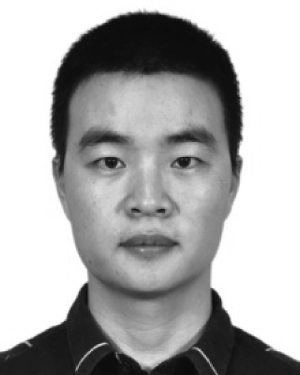 Xiang Liu合作论文数3
 Hui Kong合作论文数3
 Chengyou Yin (尹成友)合作论文数3YAN Kun-yu合作论文数2Xianghao Meng合作论文数2Yong-jing YANG (杨永晶)合作论文数2HuaiLin Ruan (阮怀林)合作论文数2XiWen Tang (唐希雯)合作论文数2LiWei Sun (孙立炜)合作论文数2Youjun Liu (刘有军)合作论文数2Pingchang Kuang (旷平昌)合作论文数2Cheng Zexin合作论文数1Yin Xuezhong合作论文数1Xiwen Tang合作论文数1Luo Jing-qing合作论文数1
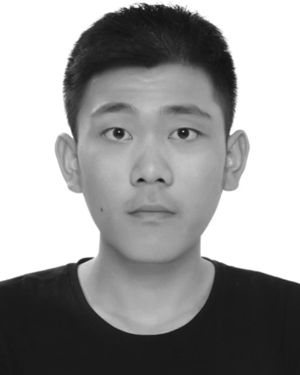 WANG Miao合作论文数1LI Jun-wu (李俊武)合作论文数1You-jun LIU (刘有军)合作论文数1
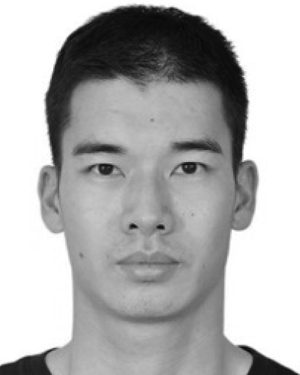 Mingyang Du合作论文数1Miao Wang合作论文数1Zhong Chen合作论文数1Ting Chen合作论文数1Xiaomei SONG (宋小梅)合作论文数1Jianguo Zhao (赵建国)合作论文数1ZHANG Peng-cheng (张鹏程)合作论文数1Jian-fei WU (吴建飞)合作论文数1Shijun WU (吴世俊)合作论文数1Bao LIU (刘宝)合作论文数1Xinghua Liu (刘兴华)合作论文数1YunXiang Mao (毛云祥)合作论文数1ShiLong Wu (吴世龙)合作论文数1DaPing Bi (毕大平)合作论文数1Fei Ye (叶菲)合作论文数1Lei Lei (雷磊)合作论文数1JianHua Fang (方建华)合作论文数1Kun Zhang (张坤)合作论文数1Yu Zhu (朱宇)合作论文数1Shuliang Wang (王树亮)合作论文数1




