Multifunction radar (MFR) working mode recognition in complex electromagnetic environments remains a challenging task, particularly in few-shot scenarios where only limited labeled data are available. To address this challenge, this paper proposes a multi-scale adaptive consistency network (MAC-Net) for robust few-shot working mode recognition. By jointly integrating multi-scale contextual feature modeling, adaptive metric learning, and prototype consistency regularization, the proposed method effectively mitigates interference-induced feature degradation, enhances representation robustness, and stabilizes class representations under limited supervision. Experiments under different mixed pulse corruption ratios show that MAC-Net achieves competitive performance under clean conditions and consistently superior robustness under corrupted conditions in both 5-way-1-shot and 5-way-5-shot settings.
Research on remote sensing image super-resolution (RSISR) based on deep neural network has made significant progress. However, complex network architectures and high computational costs conflict with the resource limitations of small edge devices. To alleviate this problem, in this article, we propose a multilevel variance feature modulation network (MVFMNet), which can effectively utilize both local and nonlocal information for better super-resolution reconstruction of remote sensing images. Specifically, we propose a local variance-aware spatial attention (LVSA) module, which employs adaptive max-pooling to extract nonlocal features and introduces local variance to represent local structure. Building upon LVSA, we design a multilevel variance feature modulation block (MVFMB) by integrating two LVSA branches with distinct downsampling scales, enabling adaptive selection of multiscale representative features. To further enhance the features modulated by MVFMB, we introduce a symmetric gated feed-forward network to fuse more local contextual information. Comparison experiments conducted on several benchmark datasets demonstrate that MVFMNet can achieve a better tradeoff between reconstruction accuracy and computational efficiency in remote sensing image SR (RSISR). The code of MVFMNet will be released at https://github.com/AHUT-MILAGroup/MVFMNet.
Automatic modulation classification (AMC) enables automated wireless spectrum anomaly detection, facilitating efficient spectrum enforcement. Deep neural networks (DNNs), characterized by multiple hidden layers with nonlinear activation functions that allow for learning higher level patterns hidden in the data, have proven effective in various tasks, including AMC. However, existing DNN-based approaches often struggle with generalization-their performance degrades significantly when deployed under unseen conditions, such as varying signal-to-noise ratios (SNRs) distinct from their training environments. To address this limitation, we propose CTLAE, a supervised deep learning framework that integrates an autoencoder architecture with contrastive learning. During training, CTLAE processes signal samples of the same modulation category but with diverse SNRs, explicitly guiding the model to discern noise-intensity discrepancies. In addition, the model is tasked with reconstructing segmented and heavily masked signal data, further enhancing its robustness to noise variations. Experiments on radar and communication signal datasets validate CTLAE's superiority: it achieves at least 5% higher overall test accuracy compared to state-of-the-art baselines, demonstrating significant improvements in generalization.
Significant progress has been made in remote sensing image super-resolution based on deep neural networks. However, existing methods typically suffer from parameter redundancy and high computational costs, making them difficult to deploy on resource-constrained edge devices. Moreover, the image reconstruction process often involves phenomena such as texture blurring and edge distortion, which degrade the restoration quality. To address these issues, we propose a lightweight dual-domain attention aggregation network (LDANet), aiming to achieve image super-resolution with both high efficiency and high quality. Specifically, LDANet is composed of multiple cascaded dual-domain attention-guided feature aggregation blocks (DAGBs). Within each DAGB, we propose the variance-aware spatial attention module, which enhances the extraction capability of non-local salient features through a dual-path mechanism that integrates parallel adaptive pooling and feature variance modulation strategies, thereby improving the discriminability of spatial features while effectively suppressing noise interference. To further optimize pixel-level detail expression, we propose the pixel-embedding channel attention module, which achieves cross-channel global context awareness by jointly modeling pixel-level spatial relationships and channel-wise self-attention, thereby enhancing texture fidelity and edge clarity. Moreover, asymmetric convolutional gated feed-forward network is introduced to enhance the feature aggregation and local context mixing capabilities within the DAGB. Comparative experiments demonstrate that LDANet achieves superior reconstruction performance on multiple datasets with smaller model sizes, exhibiting better potential for practical applications. The source code of LDANet will be released at https://github.com/AHUT-MILAGroup/LDANet .
The use of supervised deep neural network (DNN) for automatic modulation classification, offering an end-to-end diagram, has gained significant attention in military and civilian field, e.g., spectrum monitoring, specific emitter identification and cognitive radio. However, this approach suffers from issues such as generalization error and spurious correlations. In an effort to capture and extract more abstract and useful concepts that can enhance performance on downstream tasks, one of the promising representation learning methods, known as "contrastive learning", has achieved notable success in computer vision and natural language processing. This approach maximizes the similarities between different views of the same data example in the latent space to learn useful features. In this paper, we propose a contrastive-based objective for improving the transferability performance on the lower signal-to-noise ratios (SNR) dataset. Compared to the previous denoised-based methods used for classifying noisy signal data, we eliminate the constraints of pairwise input. This means that our model can leverage arbitrary combination of noisy and clean signal examples within same category. Additionally, the introduction of the noise level estimation enhances the robustness to the uncertain noise conditions. Simulation results on both the synthetic radar signal dataset and public communication signal dataset demonstrate that the proposed method exhibits minimal generalization error and showcases promising performance on signal data with different noise type.
Deep learning for fine-grained radar mode recognition faces a major bottleneck—its heavy reliance on expensively labeled data. To address this, we propose a novel semi-supervised framework that effectively leverages unlabeled data. Through an end-to-end, triple-branch framework that integrates a dual contrastive learning mechanism with tailored strategies for pulse distortions, our model achieves high accuracy with minimal labels. Experimental results on two challenging datasets demonstrate that the proposed framework boosts accuracy by 17% to 34% using only 10% of the labeled data, establishing a new state-of-the-art performance.
Most lightweight super-resolution networks are designed to improve performance by introducing an attention mechanism and to reduce model parameters by designing lightweight convolutional layers. However, the introduction of the attention mechanism often leads to an increase in the number of parameters. In addition, the lightweight convolutional layer has a limited receptive field and cannot effectively capture long-range dependencies. In this letter, we design a novel lightweight base module called partial attention convolution (PAConv) and develop three variants of PAConv with different receptive fields to collaboratively exploit non-local information. Based on PAConv, we further propose a lightweight super-resolution network called partial attention feature aggregation network (PAFAN). Specifically, we arrange the PAConv variants in a progressive iterative manner to form the attention progressive feature distillation block (APFDB), which aims to gradually optimize the distilled features. Furthermore, we construct a multi-level aggregation spatial attention (MASA) via a stacking of the PAConv variants to systematically coordinate multi-scale structural information. Extensive experiments conducted on benchmark datasets show that PAFAN achieves an optimal balance between reconstruction quality and computational efficiency. In particular, with only 123K parameters and 0.49G FLOPs, PAFAN can maintain a performance comparable to that of SOTA methods.
Pose is a fundamental attribute of 3-D point cloud shape, which profoundly impacts point cloud analysis tasks. However, it is very tricky to directly solve the pose attribute, since it is deeply coupled with geometry shape. To this end, the representation separation strategy has been proposed, where the global representation is modeled as a combination of the pose-related part representation and the geometry shape part representation. However, these methods still cannot model the representation of the pose attribute well. As a reply, we design a new pose decoder in this article, learning to disentangle the pose attribute by exploiting its complement, i.e., the geometry shape part representation. Specifically, a Siamese structure is introduced constituting of two shared branches, where two consistent point clouds with different pose attributes are input. The geometry shape part representation and the global representation are learned in each branch network to solve the pose-related part representation for disentangling the pose distribution. Then, we emphasize the completeness and no redundancy of geometry shape part representation by designing two constraints: 1) we recover the learned geometry shape part representation to a point cloud and enforce it to maintain the same geometry shape as the original input point cloud to guarantee all geometry shape information is retained and 2) we develop two geometry shape part representations embedded from two branches to be the same so as to filter the pose information out. These two constraints are incorporated into the unsupervised loss function to train our pose decoder. Our pose decoder can be integrated into different point cloud shape analysis methods. We evaluate our pose decoder in point cloud classification and part segmentation tasks to handle the pose diversity problem of the input point cloud, which significantly improves the robustness. Besides, the obtained respective poses of input point clouds can be used to register them naturally, making the unsupervised method achieving superior performance.
With the implementation of deep learning (DL) in signal recognition, the processing efficiency and accuracy of radar automatic modulation recognition (AMR) have been effectively improved. The success of DL usually depends on plentiful labeled training data, but, in actual electromagnetic environments, due to expensive annotation cost and noncooperative characteristics, there is often a scarcity of labeled samples and an abundance of unlabeled samples. Therefore, this article designs a contrastive semi-supervised learning (SSL) method that employs unlabeled samples with predicted pseudo-label to assist model training. First, the convolutional attention network is pretrained utilizing the contrastive learning method, and positive sample pairs are constructed by adding noise and rotation. Then, the pretrained backbone network and stochastically initialized classifier are fine-tuned with labeled samples. In order to avoid the influence of false negative sample pairs, the fine-tuned network is employed to predict unlabeled samples. The filtered samples with pseudo-label and real label samples constitute a new dataset through stratified sampling to balance the samples. Finally, the network is fine-tuned again using the mixed dataset. By comparing the proposed algorithm with existing supervised and semi-supervised methods on a simulation dataset, the algorithm can significantly improve the recognition performance under conditions of small sample size and low signal-to-noise ratio (SNR), verifying its superiority and robustness.
Deep neural network-based image classification models are vulnerable to adversarial examples, which are meticulously crafted to mislead the model by adding perturbations to clean images. Although adversarial training demonstrates outstanding performance in enhancing models robustness against adversarial examples, it often incurs the expense of accuracy. To address this problem, this article proposes a strategy to achieve a better tradeoff between accuracy and robustness, which mainly consists of symbol perturbations and examples mixing. First, we employ a symbol processing approach for randomly generated initial perturbations, which makes model identify the correct parameter attack direction faster during the training process. Second, we put forward a methodology that utilizes a mixture of different examples to generate more distinct adversarial features. Further, we utilize scaling conditions for tensor feature modulation, enabling the model to achieve both improved accuracy and robustness after learning more diverse adversarial features. Finally, we conduct extensive experiments to show the feasibility and effectiveness of the proposed methods.
Recently, the unmanned aerial vehicle (UAV) synthetic aperture radar (SAR) has become a highly sought-after topic for its wide applications in target recognition, detection, and tracking. However, SAR automatic target recognition (ATR) models based on deep neural networks (DNN) are suffering from adversarial examples. Generally, non-cooperators rarely disclose any SAR-ATR model information, making adversarial attacks challenging. To tackle this issue, we propose a novel attack method called Transferable Adversarial Network (TAN). It can craft highly transferable adversarial examples in real time and attack SAR-ATR models without any prior knowledge, which is of great significance for real-world black-box attacks. The proposed method improves the transferability via a two-player game, in which we simultaneously train two encoder–decoder models: a generator that crafts malicious samples through a one-step forward mapping from original data, and an attenuator that weakens the effectiveness of malicious samples by capturing the most harmful deformations. Particularly, compared to traditional iterative methods, the encoder–decoder model can one-step map original samples to adversarial examples, thus enabling real-time attacks. Experimental results indicate that our approach achieves state-of-the-art transferability with acceptable adversarial perturbations and minimum time costs compared to existing attack methods, making real-time black-box attacks without any prior knowledge a reality.
Reconnaissance unmanned aerial vehicles are specifically designed to estimate parameters and process intercepted signals for the purpose of identifying and locating radars. However, distinguishing quasi-simultaneous arrival signals (QSAS) has become increasingly challenging in complex electromagnetic environments. In order to address the problem, a framework for self-supervised deep representation learning is proposed. The framework consists of two phases: (1) pre-train an autoencoder. For learning the unlabeled QSAS representation, the ConvNeXt V2 is trained to extract features from masked time–frequency images and reconstruct the corresponding signal in both time and frequency domains; (2) transfer the learned knowledge. For downstream tasks, encoder layers are frozen, the linear layer is fine-tuned to classify QSAS under few-shot conditions. Experimental results demonstrate that the proposed algorithm can achieve an average recognition accuracy of over 81% with the signal-to-noise ratio in the range of −16∼16 dB. Compared to existing CNN-based and Transformer-based neural networks, the proposed algorithm shortens the time of testing by about 11× and improves accuracy by up to 21.95%.
Target recognition mainly focuses on three approaches: optical-image-based, echo-detection-based, and passive signal-analysis-based methods. Among them, the passive signal-based method is closely integrated with practical applications due to its strong environmental adaptability. Based on passive radar signal analysis, we design an “end-to-end” model that cascades a noise estimation network with a recognition network to identify working modes in noisy environments. The noise estimation network is implemented based on U-Net, which adopts a method of feature extraction and reconstruction to adaptively estimate the noise mapping level of the sample, which can help the recognition network to reduce noise interference. Focusing on the characteristics of radar signals, the recognition network is realized based on the multi-scale convolutional attention network (MSCANet). Firstly, deep group convolution is used to isolate the channel interaction in the shallow network. Then, through the multi-scale convolution module, the finer-grained features of the signal are extracted without increasing the complexity of the model. Finally, the self-attention mechanism is used to suppress the influence of low-correlation and negative-correlation channels and spaces. This method overcomes the problem of the conventional method being seriously disturbed by noise. We validated the proposed method in 81 kinds of noise environment, achieving an average accuracy of 94.65%. Additionally, we discussed the performance of six machine learning algorithms and four deep learning algorithms. Compared to these methods, the proposed MSCANet achieved an accuracy improvement of approximately 17%. Our method demonstrates better generalization and robustness.
Recent studies have proven that synthetic aperture radar (SAR) automatic target recognition (ATR) models based on deep neural networks (DNN) are vulnerable to adversarial examples. However, existing attacks easily fail in the case where adversarial perturbations cannot be fully fed to victim models. We call this situation perturbation offset. Moreover, since background clutter takes up most of the area in SAR images and has low relevance to recognition results, fooling models with global perturbations is quite inefficient. This paper proposes a semi-white-box attack network called Universal Local Adversarial Network (ULAN) to generate universal adversarial perturbations (UAP) for the target regions of SAR images. In the proposed method, we calculate the model's attention heatmaps through layer-wise relevance propagation (LRP), which is used to locate the target regions of SAR images that have high relevance to recognition results. In particular, we utilize a generator based on U-Net to learn the mapping from noise to UAPs and craft adversarial examples by adding the generated local perturbations to target regions. Experiments indicate that the proposed method effectively prevents perturbation offset and achieves comparable attack performance to conventional global UAPs by perturbing only a quarter or less of SAR image areas.
Understanding and analyzing radar work modes play a key role in electronic support measure system. Many classifiers, for example those based on convolutional neural network (CNN) and recurrent neural network (RNN), are available for recognizing radar work modes as well as emitter types from their waveform parameters. However, the performance of these methods may suffer significantly when confronting different types of signal degradation, e.g., measurement error, lost pulse and spurious pulse. To tackle this issue, we in this paper develop a Bayesian attention belief network (BABNet) based on Bayesian neural networks in which the probability distribution over weights can help to enhance the model robustness for corrupted data. In particular, we adopt pre-trained CNN as the Bayesian inference prior. This not only accelerates the convergence speed, but also avoids the training process getting stuck in bad local minima. Meanwhile, instead of using RNNs which are difficult to be implemented in parallel, the combination of padding operation and attention module in the proposed BABNet enables CNN, as the backbone, to process sequential data with variable length. Extensive experiments are conducted to demonstrate the recognition capability and robustness of the BABNet in different environments.
In recent years, the unmanned aerial vehicle (UAV) synthetic aperture radar (SAR) has become a highly sought-after topic for its wide applications in the field of target recognition, detection, and tracking. However, SAR automatic target recognition (ATR) models based on deep neural networks (DNN) are suffering from adversarial examples. Generally, non-cooperators rarely disclose any information about SAR-ATR models, making adversarial attacks challenging. In this situation, we propose Transferable Adversarial Network (TAN) to attack these models with highly transferable adversarial examples. The proposed method improves the transferability via a two-player game, in which we simultaneously train two encoder-decoder models: a generator that crafts malicious samples through a one-step forward mapping from original data, and an attenuator that weakens the effectiveness of malicious samples by capturing the most harmful deformations. In particular, compared to traditional iterative methods, our approach is able to one-step map original samples to adversarial examples, thus enabling real-time attacks. Experimental results indicate that the proposed approach achieves state-of-the-art transferability with acceptable adversarial perturbations and minimum time costs compared to existing attack methods, i.e., it excellently realizes real-time transferable adversarial attacks.
Deep learning with its rapid development and advancement has achieved unparalleled performance in many areas like computer vision as well as cognitive radio and signal recognition. However, the performance of most deep neural networks would suffer from degradation in the data mismatch scenario, e.g., the test dataset has a related but nonidentical distribution with the training dataset. Considering the noise corruption, a classifier’s accuracy might drop sharply when it is tested on a dataset with much lower signal-to-noise ratio compared to its training dataset. To address this dilemma, in this work, we propose an efficient denoising and classification network (DNCNet) for radar signals. The DNCNet consists of denoising and classification subnetworks. First, a radar signal detection and synthetic mechanism is designed to generate pairwise clean data and noisy data for the DNCNet to train its denoising subnetwork. Then, a two-phase training procedure is proposed to train the denoising subnetwork in the first phase and strengthen the mapping between the denoising results and perceptual representation in the second. Experiments on synthetic and benchmark datasets validate the excellent performance of the proposed DNCNet against state-of-the-art methods in terms of both signal restoration quality and classification accuracy.
Fixed-structure neural network lacks flexibility when tackling different classification tasks, prompting a growing interest in developing automated neural architecture search (NAS) methods. Approaches so far mainly consider the classification accuracy of the searching results for NAS, yet another important factor, the computation cost, is ignored. In this paper, a feasibility problem is modeled subject to specific constraints in terms of both the classification accuracy and computation cost, which can greatly enhance the flexibility against the fixed "balanced function" proposed in recent work in identifying radar signals in different electromagnetic environments. Moreover, to be able to traverse the infinite feasible region formed by the constraints, we propose a simple yet effective method based on the Gaussian process regression model by fine-tuning an initialized balanced function and leveraging a data distribution that meets the constraints. Experimental results demonstrate the superiority of the proposed NAS technique in designing comparably accurate network structures against manually-designed models, with less computation cost compared to conventional NAS algorithms.
This work is concerned with the distributed extended object tracking system over a realistic network, where all nodes are required to achieve consensus on both the extent and kinematics. To this end, we first exploit an aligned velocity model to establish a tight relation between the orientation and velocity vector. Then, we use the moment-matching method to give two separate models to match the information filter (IF) framework. Later, we resort to the two models to propose a centralized IF and extend it to the distributed scenario based on the embedded alternating direction method of multipliers (ADMM) technique. To keep an agreement between nodes, an optimization function is given, followed by a consensus-based constraint. Numerical simulation together with theoretical analysis verifies the convergence and consensus of the proposed filter.
Radar Maneuvering Targets Tracking (RMTT) in clutter is a quite challenging issue due to the errors in the models and the varying dynamics of the processes. Modern radar tracking system calls for the adaptive signal and data processing algorithm urgently to adapt the uncertainty of the environment. The mechanism of human cognition can help persons cope with the similar difficulties in visual tracking. Inspired by human cognition mechanism, a comprehensive method for RMTT is proposed. In the method, the model transition probability in Interacting Multiple Model (IMM) and the validation gate can be adjusted dynamically with target maneuver; the waveform in radar transmitter can vary with the perception of the environment. Experimental results in cluttered scenes show that the proposed algorithm is more accurate for perceiving the environment and targets, and the waveform selection algorithm is better than that with fixed waveform.
 DaPing Bi (毕大平)合作论文数18Shuliang Wang (王树亮)合作论文数9
 Zhihui Li合作论文数Natl Univ Def Technol, Coll Elect Engn, Hefei 230037, Peoples R China5
 Junpeng Shi合作论文数Natl Univ Def Technol, Coll Elect Countermeasure, Hefei 230037, Peoples R China5
 Jifei Pan (潘继飞)合作论文数国防科技大学电子对抗学院5
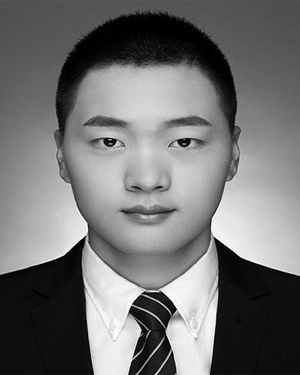 Zilong Wu合作论文数4
 Xiao Zheng (郑啸)合作论文数安徽工业大学计算机科学与技术学院3
 Xiaohao Cai合作论文数School of Electronics and Computer Science, Faculty of Engineering and Physical Sciences, University of Southampton3
 Wei Xue合作论文数2Bing Sun合作论文数2Jingwei Xiong合作论文数2
 Meng Du合作论文数2Bao LIU (刘宝)合作论文数2HuaiLin Ruan (阮怀林)合作论文数2Zhiyuan Zhang合作论文数College of Electronic Science and Technology, National University of Defense Technology2
 Ping Zhong (钟平)合作论文数College of Electronic Science and Engineering,National University of Defense Technology2Dongming Wu合作论文数1Wang Yuanbo合作论文数1Linqing Guo合作论文数1Aiqi Jing合作论文数1Shi Yan合作论文数1Xueyu Wei合作论文数1
 Fangling Zeng合作论文数1Xinsong Xu合作论文数1
 Hongyan Wang合作论文数1
 Zhifei Li合作论文数1JieGui Wang (王杰贵)合作论文数1FangZheng Liu (刘方正)合作论文数1
 Daping Bi (毕大平)合作论文数1




