In many schools, students are able to tailor their undergraduate engineering coursework to emphasize a particular specialty field. When organized by the university, such an emphasis within the context of a major is often called an academic "concentration." Universities with a smaller array of majors in specialty engineering disciplines can employ concentrations to foster student success in a given field and attract students who are already interested in such a specialty, if it is not available as a major. Concentrations can generally be offered with relatively low cost, because the specialty coursework often comprises electives already taught in the program. Using survey and graduation data from a small private engineering college in the Midwest, this paper examines the strength of concentrations' recruiting appeal against the cost to maintain them, the change in student interest over time, and the impact on post-graduation placement for students who complete the concentration.
NOTE: The first page of text has been automatically extracted and included below in lieu of an abstract Engineering Personified: An Application of the One Minute Engineer 1. Introduction In the typical freshman engineering curriculum, instructors often talk about works of engineering such as bridges and automobiles, but not of the engineers that designed them. Discussion focuses on the science and mathematics behind such works, but not on the ideas and events that motivated their designers. One of the unfortunate consequences of such omissions is a disconnect in the minds of many students between their perception of what they currently are and what they aspire to be professionally. At the First Year Engineering Workshop entitled “Dialogue II on Engineering Education: the Role of the First Year,” held in July 2007 at the University of Notre Dame, David Billington, Sr., made the argument for the need to humanize engineering. In his presentation, he opined that entering students relate more to historical examples than to abstract principles. Among the points raised were that students should study outstanding engineers because the human element of engineering is missing from their classes; that ideas and personalities are part of engineering; and that students are naturally attracted to the best works of a field of study. Moreover, the field of engineering has transformed American society into a technological powerhouse, and future engineers need to understand how this happened. Simply put, Billington makes the claim that engineering needs to be somehow personified in the classroom so that the contributions made by those in the past and present are made known to students, allowing them to envision the possible contributions that they can make as engineers in the future. 2. Background Previous ASEE Conferences have featured papers on the One Minute Engineer (OME), where students give short individual presentations on student-selected, engineering-related topics in areas such as devices, biographies, vocabulary, or current events. The OME is designed to be implemented with minimal sacrifice of class time, as only one to three short presentations are given each day. In a paper by Jaeger and Bilén1, the development of the OME as a pedagogical tool is discussed along with its use at their institutions. The OME was initially introduced at Northeastern University as the Demo Minute in the fall of 2003 and 2004 in an effort to help students improve their public speaking skills. Topics used for the Demo Minute included demonstration of a device, word of the day and newsworthy/current events. With positive response from students at Northeastern and interest from a faculty member at the Pennsylvania State University (Penn State), the OME was introduced in the spring of 2004 in an Introduction to Engineering Design course at Penn State. Changes from its development at Northeastern included the addition of a category, biography, and the use of a Likert-type survey to evaluate the effectiveness of the tool. At Penn State, 93% of students agreed or strongly agreed that they felt more aware of engineering issues following completion of the OME and more than 82% felt the OME was useful and interesting.
Juniors at Ohio Northern University are typically enrolled in three Mechanical Engineering courses during the fall quarter. These include ME 311, Process of Mechanical Design, ME 341, ManufacturingProcesses,andME371,NumericalMethods. Inthefallof2002,thedesign project for the ME 311 course was altered to integrate material from these three courses. Student teams designed a part in ME 311, optimized its design (minimizing the material used) in ME 371, and built the part using what they learned in ME 341. In addition, finished parts were tested using a tension test, and students redesigned the part based on the results of that test. It is hoped that these changes will allow students to see connections between various courses, and force students to consider manufacturability, cost, and available materials when creating and evaluating a design. A student survey, as well as the functionality of the finished design, will be used to assess this new approach.
Over the past two decades, significant work has been done to increase the opportunities for engineering students to develop an entrepreneurial mindset (EM). These have included curricular, cocurricular, and extracurricular activities on many campuses. This article describes efforts to build the EM comprehensively into the mechanical engineering curriculum at Ohio Northern University. While several frameworks have been proposed related to the EM, the work here is motivated by the Kern Entrepreneurial Engineering Network framework (KEEN). A core group of college faculty identified the institutional definitions of the KEEN student outcomes and identified courses for deployment of these outcomes to provide comprehensive, curriculum-wide exposure to the EM. This article discusses how the work was completed, incentive and reporting structures for onboarding faculty, the adopted strategies for program assessment of the EM outcomes, and efforts to ensure long-term sustainability of the curricular modifications. Observations, challenges, and unexpected benefits are discussed, as well as anticipated next steps for college-wide implementation.
Robotic vision is widely used to provide feedback for the calibration and operation of autonomous robots. In many situations, the automation of the robot requires tracking one or more points of interest on the robot or in its surroundings. In this work, we developed and tested a camera-based vision system that can detect multiple points of interest and discriminate them into up to three groups. This is achieved by exploring the Red, Green, and Blue color layers in a single video feed. The experimental results show the proposed system's ability to accurately locate and distinguish three points of interest mounted on an industrial robot.
Flipping the Design Class using “Off-the-shelf” Content: Can it work? The benefits and challenges of flipping classrooms have been demonstrated in many recent papers, including several presented in the Mechanical Engineering Division at ASEE Conference. This, combined with very negative reviews by students of the current textbook, convinced the author at a small private Midwest university (University X) to experiment with a partially-flipped classroom in the fall semester of 2013. In preparation for this, the author found a tremendous amount of already-developed video and text resources available online for no cost, and often very high quality. This led to the idea for this paper – can a flipped classroom be taught using only these types of resources? This is now being done for the third time at University X this academic year, in a senior-level design course. The online content includes popular videos (such as TED talks), how-to guides (either video or text), and reference materials or case studies. Initial student responses have been very positive, with some students noting they are actually enjoying an engineering class for the first time. Surveys regarding this approach, as well as student performance on common final exam questions, will be presented in the final paper. Preliminary findings indicate that in general this approach can work, but that there are certain content areas in which the available resources are very weak. A summary of resources used and student ratings of each will also be provided.
Nearly all Mechanical Engineering programs have a capstone design experience. In many curricula, there is a classroom component that complements the capstone course. This paper presents a novel approach to that "complementary" class one in which students are asked to complete two design projects concurrently with ongoing work on their capstone proj ect.Some context must be provided in order to understand the motivation for this approach. First, at a small private Midwest university, the capstone projects are two -semester projects. In addition, each student group works on a different project. Some of those projects are composed of only mechanical engineering students, but the majority of groups include students from another department.
Despite years of research in the area of robotics, the vast majority of industrial robots are still used in “teach-repeat” mode. This requires that the workpiece be in exactly the same position and orientation every time. In many high-volume robotics applications, this is not a problem, since the parts are likely to be fixtured anyway. However, in small to medium lot applications, this can be a significant limitation. The motivation for this project was a corporation who wanted to explore the use of visual control of a manipulator to allow for automated teaching of robot tasks for parts that are run in small lot sizes.
Occupancy grids are a very convenient tool for environment representation in robotics. This paper will detail a novel approach for computing occupancy grids from stereo vision and show its application to intelligent vehicles. In the proposed approach, occupancy is initially computed directly in the stereoscopic sensor's disparity space. The calculation formally accounts for the detection of obstacles and road pixels in disparity space, as well as partial occlusions in the scene. In the second stage, this disparity-space occupancy grid is transformed into a Cartesian space occupancy grid to be used by subsequent applications. This transformation includes spatial and temporal filtering. The proposed method is designed to easily be processed in parallel. Consequently, we chose to implement it on a graphics processing unit, which allows real-time processing for demanding applications. In this paper, we present this method, and we propose an application to the problem of perception in a road environment. Results are presented with real road data, qualitatively comparing this approach with other methods.
This chapter describes detection and tracking of moving objects (DATMO) for purposes of autonomous driving. DATMO provides awareness of road scene participants, which is important in order to make safe driving decisions and abide by the rules of the road. Three main classes of DATMO approaches are identified and discussed. First is the traditional approach, which includes data segmentation, data association, and filtering using primarily Kalman filters. Recent work within this class of approaches has focused on pattern recognition techniques. The second class is the model-based approach, which performs inference directly on the sensor data without segmentation and association steps. This approach utilizes geometric object models and relies on non-parametric filters for inference. Finally, the third class is the grid-based approach, which starts by constructing a low level grid representation of the dynamic environment. The resulting representation is immediately useful for determining free navigable space within the dynamic environment. Grid construction can be followed by segmentation, association, and filtering steps to provide object level representation of the scene. The chapter introduces main concepts, reviews relevant sensor technologies, and provides extensive references to recent work in the field. The chapter also provides a taxonomy of DATMO applications based on road scene environment and outlines requirements for each application.
 Michael Seelinger合作论文数Yoder Software, Inc., YSI14
 Mathias Perrollaz合作论文数INRIA Grenoble11
 Christian Laugier合作论文数LIG Laboratory9
 edwin r elston合作论文数7Lee F. Holeva合作论文数7
 david mikesell合作论文数Mechanical Engineering, Ohio Northern University6
 John K. Estell合作论文数Ohio Northern University6Yong Mao合作论文数5Amaury Nègre合作论文数GIPSA-LabGIPSA5
 Eric T. Baumgartner合作论文数Jet Propulsion Laboratory;California Institute of Technology;Jet Propulsion Laboratory, California Institute of Technology5
 Anne Spalanzani合作论文数Pierre-Mendès-France University;INRIA4
 Igor E. Paromtchik合作论文数The Institute of Physical and Chemical Research (RIKEN), Wako, Saitama Japan Japan4eric l jensen合作论文数3Juliet K. Hurtig合作论文数3Michael Rider合作论文数3
 Steven B. Skaar合作论文数3David Sawyers合作论文数3thiago bellardi合作论文数2Laurie Laird合作论文数2
 A. Cristofaro合作论文数2alejandro dizan vasquez govea合作论文数2
 Olivier Aycard合作论文数ε-motion, GRAVIR-UJF-INRIA-INP Grenoble2
 Agostino Martinelli合作论文数INRIA Rhone Alpes2
 Alessandro Renzaglia合作论文数Rome U. & INFN, Rome2Milomir M Stanisic合作论文数Department of Aerospace and Mechanical Engineering, University of Notre Dame2
 Beverly K. Jaeger合作论文数Virtual Environments Laboratory;Snell Engineering Center;Northeastern University;Snell Engineering Center, Northeastern University2
 Christopher Tay合作论文数2
 Sami Khorbotly合作论文数Ohio Northern University2
 Qadeer Baig合作论文数2
 James P. Schmiedeler合作论文数2
 Stéphanie Lefevre合作论文数Mercedes Benz R&D center in California2Eric Baumgartner合作论文数1Trung-Dung Vu合作论文数1Richard Whalen合作论文数1Susan Freeman合作论文数1Blake Hylton合作论文数1
 James Hylton合作论文数1
 Jeffrey West合作论文数H Lee Moffitt Canc Ctr & Res Inst, Integrated Math Oncol, Tampa, FL 33612 USA1
 Firas Hassan合作论文数Dept. of Electr. & Comput. Eng. & Comput. Sci., Ohio Northern Univ.;c;Dept. of Electr. & Comput. Eng. & Comput. Sci., Ohio Northern Univ.1
 Sarah E. Zappe合作论文数1Dennis a Guenther合作论文数1
 Urbano Nunes合作论文数Institute of Systems and Robotics,Department of Electrical and Computer Engineering,University of Coimbra1
 Pierre Bessiere合作论文数Grenoble Université1
 Rudolph Triebel合作论文数Department of Perception and Cognition, Institute of Robotics and Mechatronics, German Aerospace Center;Institute of Engineering Thermodynamics, German Aerospace Center;Karlsruhe Institute of Technology1
 Emilio J. González-Galván合作论文数Centro de Investigación y Estudios de Posgrado, Universidad Autónoma de San Luis Potosí1
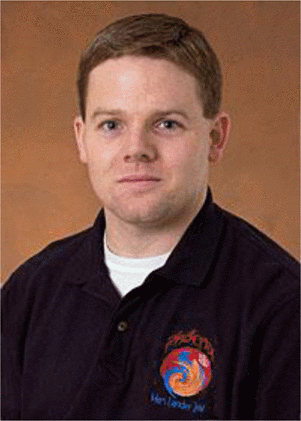 Matthew Robinson合作论文数Jet Propulsion Laboratory, Pasadena, USA 911091
 Sebastian Thrun合作论文数Stanford University;Kitty Hawk Corporation;Udacity1
 F.K. Mak合作论文数1
 Jorge D. Rios合作论文数1




