The controller setting is a simple task if the process parameters are known. If the process model is not known then the modern approach is the adaptive method. The paper shows that the complex problem of the adaptive iterative methods for simultaneous identification and control how can be handled.
The paper discusses some interesting mainly philosophical paradigms of the modelling and control areas, which are still partly unsolved and/or only partially studied.
A new approach is proposed to improve the robustness of simple PID controls. This scheme widens the critical medium frequency domain and increases the achievable bandwidth using adaptive-iterative method. Recently not only the optimality but the robustness is also important for the industry.
All existing basic regulator design methods are summarized in this paper and compared concerning their usability and formal algebraic formulations. It is systematically proved that the best usable method is the YOULA-parameterization based regulator design introduced by the authors.
All existing basic regulator design methods are summarized in this paper and compared concerning their usability and formal algebraic formulations. First the regulators based on state-feedback is discussed. These regulators mostly use pole placement, sometimes with full pole cancellation. The other versions are based on characteristic polynomial design, which is a feedback regulator design method. Another class of the regulators are based on the Youla-parameterization, which is sometimes called Q-parameterization. Then it is shortly summarized how a Youla regulator is computed. Finally it is systematically proved that the best usable method is the Youla-parameterization based regulator design introduced by the authors.
System view, understanding systems and how they are controlled, is an important discipline in engineering education. Nowadays considering the ever-increasing knowledge, the explosion of information, the available visual technics and software tools, and the requirement for online distance education, there is a need to revisit the content and the teaching methodology of the basic control course. Here we present our experience in renewing the basic control course. The topics of the course are given. The lectures are available electronically and can be used also in online teaching. The main ideas are explained on two levels: hopefully in an understandable way for everyone and precisely, using mathematical tools. In the lectures, some parts of the multilevel e-book, SYSBOOK, are referred, which has been developed to present the main principles on different levels, for everyone, for the students, and partly for researchers. Besides static teaching materials, some interactive demonstrations can also be used in the lectures contributing to the enjoyment of the learning process. During computer laboratory exercises using MATLAB/SIMULINK software, the students apply the analysis and synthesis methods discussed in the lectures. In the content of the control course, a new feature is the emphasis of the YOULA parameterization method for controller design showing that other methods can be considered as its special cases. Nowadays in education a new teaching-learning paradigm is Open Content Development (OCD) which means active participation of the teachers and students creating an up-to-date teaching material. Utilizing the experiences of these pilot efforts, the SYSBOOK platform has been connected to the OCD model providing the possibility for the students to develop their own control case studies. Besides it is also important to execute real-time experiments in laboratory work or using distant laboratories.
It is shown that the Smith predictor is a subclass of the Youla-parameterization based generic two-degree-of-freedom controllers. Comparing the algorithms, the application of the new approach is suggested.
The optimization of simple two-degree-of-freedom control systems is very easy with new parameterizations such as Youla and Keviczky-Bányász. The comparison of their model-based versions is important at the practical applications.
The optimization of simple two-degree-of-freedom control systems is very easy with the new parameterizations, as Youla, Keviczky-Banyasz, etc. The comparison of their model-based versions is important at the practical applications.
It is shown that the Smith predictor is a subclass of the Youla parameterization based generic two-degree of freedom controllers. Comparing the algorithms the application of the new approach is suggested.
System view, understanding systems and how they are controlled is an important discipline in engineering education. Nowadays considering the ever increasing knowledge, the explosion of information available at the internet, the available visual technics and software tools there is a need to revisit the content and the teaching methodology of the first control course. The IFAC Technical Committee on Control Education (9.4) is circulating a pilot survey addressing these questions. Here we present our experience related to renewing the control course. The topics of the course are given. The main ideas are explained on two levels: hopefully in an understandable way for everyone, and precisely, using mathematical tools. In the lectures some parts of the multilevel e-book, Sysbook are referred, which has been elaborated to present the main principles governing systems and control on different levels. Besides static teaching materials interactive demonstrations developed for Sysbook are also used in the lectures which enhance the effectiveness and also enjoyment of the learning process. At the last part of each lecture the students are active solving problems related to the topic of the lecture. They are motivated by the obtained extra evaluation points. Then the solutions of the problems are discussed. Computer laboratory exercises using MATLAB/SIMULINK software contribute to understanding and applying the analysis and synthesis methods discussed in the lectures. The course is supported by the recently published Springer books: Keviczky et al.: Control Engineering and Control Engineering: MATLAB Exercises. In the content of the control course a new feature is the emphasis of the YOULA parameterization method for controller design already in the first control course and showing that other controller design methods can be considered as its special cases. Nowadays in education a new teaching – learning paradigm is Open Content Development (OCD) which means active participation of the teachers and students creating an up-to-date teaching material. This project runs at the Department of Technical Education at the Budapest University of Technology and Economics since 2015 supported by the Hungarian Academy of Sciences. In the frame of vocational teacher training programs several so-called micro-contents have been developed. Utilizing the experiences of these pilot efforts the Sysbook platform has been connected to the OCD model. In a special surface Sysbook provides several case studies for systems and their control (e.g. driving, energy production and distribution, oil refinery, systems and control in the living organism, etc.). Teachers and students studying systems and control can elaborate new case studies in their areas of interest which means active application of the learned topics. After evaluation these projects can be uploaded in the student area of Sysbook. Summarizing: in the methodology of teaching a basic control course the motivation of the students can be increased by active participation in the learning process, including interactive demonstration of the principles, solving exercises at the end of the lectures and getting immediate feedback, solving analysis and synthesis problems in the computer laboratories, and developing their own case studies for Sysbook. It should be also emphasized that the examples of systems and their control should be chosen mainly from the area of the specialization of the students (electrical or software engineering, chemical engineering, biology, economics, etc.). Also it is important to provide real-time experiments in laboratory work or using distant laboratories. IFAC Repository would be also of great help reaching useful resources.
The optimality in a generic two-degree of freedom control system can be decomposed into three major steps, because the control error has three major parts: design-, realizability- and modeling-loss. The second term can be made zero for inverse stable processes only. This decomposition opens new ways for practical optimization of two-degree-of-freedom (TDOF) systems and helps the construction of new algorithms for robust identification and control. It is more reasonable to teach the optimization of control systems using these components.
Polynomial design is an important method of regulator design. The main idea is that the transfer function of the closed loop control system is prescribed as the aim of the control, then the regulator is calculated using the knowledge about the process. The controller design is executed by solving a Diophantine equation. The method can be applied in case of sampled data control as well. Control of unstable processes and processes with dead time can also be realized.
If a system is characterized by its state equation, it is straightforward to design a controller based on this system representation. The control signal is created by feeding back the state variables of the system through constant gains. These state feedback vector can be calculated to ensure the prescribed location of the poles of the control system. If the state variables are not measurable, they have to be estimated and then state feedback is realized from the estimated state variables. Properties of control systems with state feedback are discussed.
In a sampled-data control circuit the regulator can be designed in the frequency domain taking into account that by sampling and applying a zero order hold the system behaves as if additional dead-time had occurred in the system. Discrete PID controllers considering this effect are designed with pole cancellation technique.
In practice the most frequently used controllers are PID controllers which use proportional, integrating and differentiating effects in the control algorithm. Design of these controllers is shown through examples.
 Csilla Banyasz合作论文数71Cs. Bányász合作论文数57Jeno Hetthessy合作论文数Department of Automation and Applied Informatics, Budapest University of Technology and Economics37
 Ruth Bars合作论文数Bayer CropScience34
 Jozsef Bokor合作论文数Department of Control for Transportation and Vehicle Systems, Budapest University of Technology and Economics;Hungarian Academy of Sciences25M. Hilger合作论文数22J. Kolostori合作论文数19
 Robert Haber合作论文数13
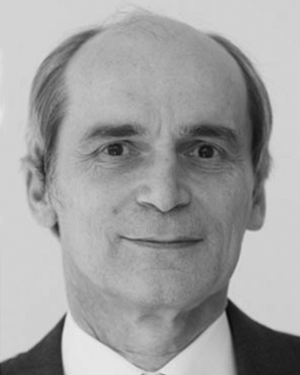 István Vajk合作论文数Department of Automation and Applied Informatics, Budapest University of Technology and Economics13Andras Edelmayer合作论文数9F Csaki合作论文数5Tibor Kovács合作论文数Department of Neurology, Semmelweis University5
 Péter Gáspár合作论文数4
 David Sik合作论文数3Miklos Vajta合作论文数3
 Tibor Vámos合作论文数Computer and Automation Research Institute, Hungarian Academy of Sciences;Budapest Technical University3
 Alexandros Soumelidis合作论文数3Ferenc Szigeti合作论文数3S. J. Suomi合作论文数2z csaszar合作论文数2
 Andras Benedek合作论文数Mora Ferenc Museum2Nagy Istvan合作论文数2K. S. P. Kumar合作论文数2
 Sandor Veres合作论文数Department of Automatic Control and Systems Engineering, The University of Sheffield;SysBrain Ltd2N. Czeiner合作论文数2
 Balazs Kulcsar合作论文数Department of Signals and Systems, Chalmers University of Technology2m habermayer合作论文数2
 Tamas Bartha合作论文数Computer and Automation Research Institute, Hungarian Academy of Sciences2
 Istvan Szaszi合作论文数2A Karpati合作论文数1A. Turi合作论文数1R. Haber合作论文数1
 Karmen Kovacs合作论文数Dept Expt Zool & Neurobiol, Univ Pecs1
 Zoltan Szabo合作论文数Department of Mathematics, Princeton University1A. Fehér合作论文数1
 Laszlo T. Koczy合作论文数Dept Telecommun & Media Informat, Budapest Univ Technol & Econ1
 Peter Foldesi合作论文数Department of Logistics and Forwarding, Széchenyi István University1
 Andras Barta合作论文数Department of Automation and Applied Informatics, Budapest University of Technology and Economics1E.I. Varga合作论文数1Zs. Csáki合作论文数1
 Heinz Unbehauen合作论文数Department of Automation and Process Automation, University of Bochum1




