In human-robot dialogue systems, streaming automatic speech recognition (ASR) services (e.g., Google ASR) are often utilized, with the microphone positioned close to the robot's loudspeaker. Under these conditions, both the robot's and the user's utterances are captured, resulting in frequent failures to detect user speech. This study analyzes voice activity detection (VAD) errors by comparing results from such streaming ASR to those from standalone VAD models. Experiments conducted on three distinct dialogue datasets showed that streaming ASR tends to ignore user utterances immediately following system utterances. We discuss the underlying causes of these VAD errors and provide recommendations for improving VAD performance in human-robot dialogue.
This paper addresses the issue of the significant labor required to test interview dialogue systems. While interview dialogue systems are expected to be useful in various scenarios, like other dialogue systems, testing them with human users requires significant effort and cost. Therefore, testing with user simulators can be beneficial. Since most conventional user simulators have been primarily designed for training task-oriented dialogue systems, little attention has been paid to the personas of the simulated users. During development, testing interview dialogue systems requires simulating a wide range of user behaviors, but manually creating a large number of personas is labor-intensive. We propose a method that automatically generates personas for user simulators using a large language model. Furthermore, by assigning personality traits related to communication styles when generating personas, we aim to increase the diversity of communication styles in the user simulator. Experimental results show that the proposed method enables the user simulator to generate utterances with greater variation.
Character end-to-end ASR (C-ASR) models fail to recognize the spelling of words that are absent from paired data (audio and text). This orthographic dependency on the paired data can be resolved by using a cascade of syllable ASR (S-ASR) and syllable-to-character translation (SCT) models once the pronunciations of the text are given as syllabograms in model training. However, this method's performance suffers from errors that propagate from each model. We propose a probabilistic integration of the two models and robust training of the SCT model. The former provides a global score for better estimations based on S-ASR and SCT models during the blockwise beam search. The latter introduces a pronunciation error generator using a mask token to increase robustness against SASR errors. Experimental results using real Japanese dialogue corpora showed that our model outperformed the naive cascading with no probability, C-ASR, and other open models. We also showed that the integration of recognition results from C-ASR and S-ASR with SCT outperformed each isolated model.
This paper proposes a methodology for identifying evaluation items for practical dialogue systems. Traditionally, user satisfaction and user experiences have been the primary metrics for evaluating dialogue systems. However, there are various other evaluation items to consider when developing and operating practical dialogue systems, and such evaluation items are expected to lead to new research topics. So far, there has been no methodology for identifying these evaluation items. We propose identifying evaluation items based on business-dialogue system alignment models, which are applications of business-IT alignment models used in the development and operation of practical IT systems. We also present a generic model that facilitates the construction of a business-dialogue system alignment model for each dialogue system.
We aim to develop a library for classifying affirmative and negative user responses, intended for integration into a dialogue system development toolkit. Such a library is expected to highly perform even with minimal annotated target domain data, addressing the practical challenge of preparing large datasets for each target domain. This short paper compares several approaches under conditions where little or no annotated data is available in the target domain. One approach involves fine-tuning a pre-trained BERT model, while the other utilizes a GPT API for zero-shot or few-shot learning. Since these approaches differ in execution speed, development effort, and execution costs, in addition to performance, the results serve as a basis for discussing an appropriate configuration suited to specific requirements. Additionally, we have released the training data and the fine-tuned BERT model for Japanese affirmative/negative classification.
The automatic recognition of user rapport at the dialogue level for multimodal dialogue systems (MDSs) is a critical component of effective dialogue system management. Both the dialogue systems and their evaluations need to be based on user expressions. Numerous studies have demonstrated that user personalities and demographic data such as age and gender significantly affect user expression. Neglecting users’ personalities and demographic data will result in less accurate user expression and rapport recognition. To the best of our knowledge, no existing studies have considered the effects of users’ personalities and demographic data on the automatic recognition of user rapport in MDSs. To analyze the influence of users’ personalities and demographic data on dialogue level user rapport recognition, we first used a Hazummi dataset which is an online dataset containing users’ personal information (personality, age, and gender information). Based on this dataset, we analyzed the relationship between user rapport in dialogue systems and users’ traits, finding that gender and age significantly influence the recognition of user rapport. These factors could potentially introduce biases into the model. To mitigate the impact of users’ traits, we introduced an adversarial-based model. Experimental results showed a significant improvement in user rapport recognition compared to models that do not account for users’ traits. To validate our multimodal modeling approach, we compared it to human perception and instruction-based Large Language Models (LLMs). The results showed that our model outperforms that of human and instruction-based LLM models.
This paper proposes to refer to the field of software engineering related to the life cycle of dialogue systems as Dialogue Systems Engineering, and surveys this field while also discussing its future directions. With the advancement of large language models, the core technologies underlying dialogue systems have significantly progressed. As a result, dialogue system technology is now expected to be applied to solving various societal issues and in business contexts. To achieve this, it is important to build, operate, and continuously improve dialogue systems correctly and efficiently. Accordingly, in addition to applying existing software engineering knowledge, it is becoming increasingly important to evolve software engineering tailored specifically to dialogue systems. In this paper, we enumerate the knowledge areas of dialogue systems engineering based on those of software engineering, as defined in the Software Engineering Body of Knowledge (SWEBOK) Version 4.0, and survey each area. Based on this survey, we identify unexplored topics in each area and discuss the future direction of dialogue systems engineering.
One essential function of dialogue systems is the ability to ask questions and acquire necessary information from the user through dialogue. To avoid degrading user engagement through repetitive questioning, the number of such questions should be kept low. In this study, we cast knowledge acquisition through dialogue as stream-based active learning, exemplified by the segmentation of user utterances containing novel words. In stream-based active learning, data instances are presented sequentially, and the system selects an action for each instance based on an acquisition function that determines whether to request the correct labels from the oracle (in this case, the user). To improve the efficiency of training the acquisition function via reinforcement learning, we introduce two extensions: (1) a new action that performs semi-supervised learning, and (2) a state representation that takes the remaining budget into account. Our simulation-based experiments suggested that these two extensions have the potential to improve word segmentation performance with fewer questions for the user.
AbstractSpeech technology has made significant advances with the introduction of deep learning and large datasets, enabling automatic speech recognition and synthesis at a practical level. Dialogue systems and conversational AI have also achieved dramatic advances based on the development of large language models. However, the application of these technologies to humanoid robots remains challenging because such robots must operate in real time and in the real world. This chapter reviews the current status and challenges of spoken dialogue technology for communicative robots and virtual agents. Additionally, we present a novel framework for the semi-autonomous cybernetic avatars investigated in this study.
When individuals communicate, they use different vocabularies, speaking speeds, facial expressions, and gestural languages, depending on those with whom they are speaking. This study focuses on the age of the speaker as a factor that affects the style of communication. We collected a multimodal dialogue corpus with various speaker ages. We used travel as the topic, as it interests people of all ages, and we set up a task based on a tourism consultation between an operator and a customer at a travel agency. This article presents the details of the dialogue task, collection procedures and annotations, and analysis of the characteristics of the dialogues and facial expressions, focusing on the age of the speakers. The results of the analysis suggest that the adult speakers have more independent opinions, the older speakers express their opinions more frequently than other age groups, and those in the operator role smile more frequently at minors.
Multimodal sentiment analysis (MSA) is critical in developing empathetic and adaptive multimodal dialogue systems or conversational agents that can naturally interact with users by recognizing sentiment and engagement. Addressing the challenges of collecting labeled data for MSA in human-agent interaction (HAI), this study introduces an innovative approach that combines active learning and multitask learning. Our efficient sentiment recognition model leverages active learning to select informative data for learning models, significantly reducing the labor-intensive data labeling process. Furthermore, we employ multitask learning to improve annotation (label) quality by evaluating alignment with true labels and interannotator agreement, thus enhancing the reliability of sentiment annotations. We evaluate the proposed multitask and active learning methods via a human-agent multimodal dialogue dataset that includes various types of sentiment annotations, which are publicly available. The experimental results demonstrate that by learning to predict the agreement score, multitask learning becomes better than singletask learning at capturing the uncertainties in the data. This study lays the groundwork for incremental learning strategies in MSA, aiming to adaptively understand user sentiments in human-agent interactions.
 Hiroshi Gitchang Okuno (奥乃博)合作论文数Future Robotics Organization, Waseda University;Kyoto University;Amity University162
 Tetsuya Ogata (尾形哲也)合作论文数Department of Intermedia Art and Science, School of Fundamental Science and Engineering, Faculty of Science and Engineering, Waseda University147
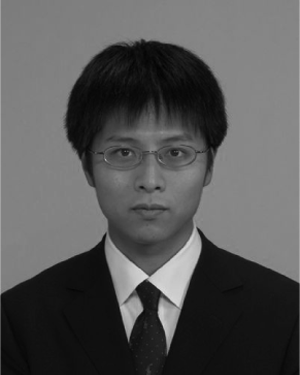 Ryu Takeda合作论文数Graduate School of Informatics, Kyoto University58
 Mikio Nakano (中野幹生)合作论文数C4A Research Institute, Inc.;Osaka University;Institutes of Innovation for Future Society, Nagoya University;Global Research Institute for Mobility in Society, Nagoya University40
 Kazuhiro Nakadai (中臺一博)合作论文数Department of Systems and Control Engineering, School of Engineering, Tokyo Institute of Technology39
 Toru Takahashi合作论文数30
 Masataka Goto (後藤真孝)合作论文数National Institute of Advanced Industrial Science and Technology27
 Tatsuya Kawahara (河源逹也)合作论文数Graduate School of Informatics, Kyoto University23
 Shogo Okada合作论文数Tokyo Institute of Technology16
 Jun Tani (谷淳)合作论文数Cognitive Neurorobotics Research Unit, Okinawa Institute of Science and Technology, Graduate University;認知脳ロボティクス研究ユニット14
 Katsutoshi Itoyama合作论文数13
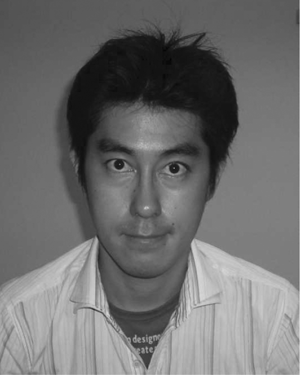 Shun'Ichi Yamamoto合作论文数13Satoshi Sato合作论文数Department of Aplied Chemistry and Biotechnology,
Graduate School of Engineering, Chiba University11
Shun'Ichi Yamamoto合作论文数13Satoshi Sato合作论文数Department of Aplied Chemistry and Biotechnology,
Graduate School of Engineering, Chiba University11 Tetsuro Kitahara合作论文数Graduate School of Informatics, Kyoto University11
 Hiroshi Tsujino合作论文数Honda Research Institute Japan Co. Ltd.11
 Shun Nishide合作论文数11
 Kazuyoshi Yoshii (吉井和佳)合作论文数Department of Intelligence Science and Technology, Graduate School of Informatics, Kyoto University;Center for Advanced Intelligence Project, RIKEN10Hisashi Kanda合作论文数10Kotaro Funakoshi合作论文数Honda Research Institute Japan Co., Ltd.9
 Jean-Marc Valin合作论文数Google9
 Shun Shiramatsu合作论文数Nagoya Institute of Technology9
 Takuma Otsuka (大塚琢馬)合作论文数Innovative Communication Laboratory;NTT Communication Science Laboratories8Hyun-Don Kim合作论文数8Yuichiro Fukubayashi合作论文数Graduate School of Informatics;Kyoto University7
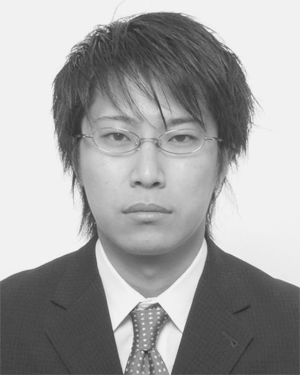 Hiromasa Fujihara合作论文数National Institute of Advanced Industrial Science and Technology (AIST),7Satoshi Ikeda合作论文数6Takaaki Sugiyama合作论文数6Ryunosuke Yokoya合作论文数Graduate School of Informatics, Kyoto University6Hokuto Munakata合作论文数5
 Shun Katada合作论文数Japan Advanced Institute of Science and Technology5
 Teruhisa Misu合作论文数Honda Research Institute USA, Inc.5Masaki Katsumaru合作论文数5Kyoko Matsuyama合作论文数5Kohei Ono合作论文数4Masamitsu Murase合作论文数4
 Naoyuki Kanda合作论文数Meta4
 Yoji Kiyota合作论文数Academic Center for Computing and Media Studies, Kyoto University4Hideki Kozima合作论文数Department of Spatial Design and Information Systems
School of Project Design
Miyagi University4
Yoji Kiyota合作论文数Academic Center for Computing and Media Studies, Kyoto University4Hideki Kozima合作论文数Department of Spatial Design and Information Systems
School of Project Design
Miyagi University4 Koiti Hasida合作论文数4tsugumi otsuka合作论文数3Yuki Hirano合作论文数3Sixia Li合作论文数Japan Advanced Institute of Science and Technology, Japan3
 Zhaojie Luo (罗兆杰)合作论文数Osaka University3
 Sadao Kurohashi合作论文数National Institute of Informatics;Department of Intelligence Science and Technology, Graduate School of Informatics, Kyoto University3
 Ryuichiro Higashinaka (東中竜一郎)合作论文数NTT Communication Science Laboratories;Graduate School of Informatics, Nagoya University3
 Shinichi Ueno合作论文数3Kentaro Yamada合作论文数3
 Takeshi Mizumoto合作论文数Graduate School of Informatics, Kyoto University3




