We present results of measurements of aerosol physical properties conducted on board of r/v Oceania during two cruises to the Spitsbergen region in 2014 (AREX 2014) and 2015 (AREX 2015). Measurements of aerosol size distribution, aerosol scattering coefficient and black carbon concentrations were made in two different Spitsbergen fjords: Hornsund and Kongsfjorden. The aerosol size distribution was measured in the size range from 0.09 μm to 47 μm using two aerosol size distribution spectrometers and a standard condensation particle counter. For the scattering coefficient an integrating nephelometer was used. Black carbon concentration was measured by an aethalometer. Temporal variabilities in physical properties of aerosol observed during the AREX 2014 and AREX 2015 campaigns were much higher than the differences between both fjords. The basic factors influencing aerosol conditions were advection and local generation of marine aerosol. In 2015 an episode of smoke advection was observed in both fjords causing an increase in the mean black carbon concentration from 7–12 ng m−3 to about 60 ng m−3, and an aerosol scattering coefficient at 550 nm from 2–4 Mm−1 to 12–17 Mm−1. Moreover, under certain conditions statistically significant gradients in aerosol optical properties were observed along the fjord axis reflecting an impact of mountains surrounding the fjords.
This paper presents the results of Aerosol Optical Depth (AOD) studies which took place in Ny-Ålesund in the spring of 2014 during the iAREA campaign. The measurements were taken using Microtops II hand-held sunphotometers along the Kongsfjorden, on a path leading from the research village to the fjord opening. Local breeze circulation was observed during the measurement campaign which resulted in an evident increase of AOD along the measurement profile towards the open sea. Using the observed AOD, changes over the open sea have been calculated and the location of the breeze front has been determined.
A recent study has shown increased warming in the fjords of west Spitsbergen. Their location is critical, as they are situated along the main northward pathway of Atlantic Water (AW) which is a great source of heat to the Arctic Ocean and the fjords. In the light of ongoing warming, we aim to discuss differences between the fjords under northward transformation of oceanic waters. We compared summer hydrographic conditions in two fjords located in two opposite ends of west Spistbergen: Hornsund in the south and Kongsfjorden in the north. The study is based on high resolution CTD measurements collected during Arctic cruises between 2001 and 2015. The emphasis was put not only on differences in water temperature, salinity and water masses but also the freshwater content (FWC), AW transport and heat delivery to the fjords. In general, the water in Kongsfjorden is on average 1°C warmer and its salinity is higher by 0.5 compared to Hornsund. It is also characterized by two times greater transport of AW and heat delivery to the fjord. On the other hand, Hornsund reveals two times higher FWC. Both fjords undergo a gradual warming due to an increased presence of Atlantic origin waters. The ongoing warming is accompanied by an increase in variability of temperature and salinity dependent on the domination of the Sørkapp Current (SC) or the West Spitsbergen Current (WSC) on the West Spitsbergen Shelf (WSS). Nonetheless, Hornsund remains more Arctic-type fjord compared to Kongsfjorden, due to stronger blocking by SC.
This paper presents the results of a comparison of basic meteorological parameters in two Arctic fjords situated on the west coast of Spitsbergen, the main island of the Svalbard archipelago. Air temperature, wind speed and direction, humidity and cloud cover from the period 2005 to 2016 are described and compared with previous (from 1975) analyses of meteorological conditions in the investigated region. Such a choice of dates coincides with the time the GAME project measurements were carried out. The main goal of this study was to compare meteorological conditions in two fjords: Hornsund and Kongsfjorden, during the time of rapid climate changes. The results are collated with research results available in literature from previous years. We discovered that in the investigated period the climate of the Hornsund region is more oceanic than in Kongsfjorden. The stable level of the difference in climate elements is manifested and is evident mainly through greater amplitudes in air temperatures in Kongsfjorden, and in stronger winds in Hornsund.
The purpose of the work was to determine how atmospheric and oceanic processes (the North Atlantic Oscillation (NAO) and the Arctic Ocean Oscillation (AOO)) influence hydrography and zooplankton on the West Spitsbergen Shelf (WSS), and the impacts of the processes on chick meals of zooplanktivorous little auks Alle alle. There were distinct Atlantic and Arctic oceanographic domains on the shelf resulting from the presence of the West Spitsbergen Current and the Sorkapp Current, which contain different proportions of Calanus finmarchicus and C. glacialis. The abundance of warm- and cold- water species varied as a result of an interplay between processes in the atmosphere and ocean. In the Arctic domain, on which the study focused, the NAO impacted oceanography, zooplankton, and consequently little auk chick meals, with time- lags of 4- 7 years. The diet of little auk chicks was more energy- rich when C. glacialis stage 5 in the Arctic community were more easily available. To date, the changes in zooplankton abundance on the WSS have not posed a threat to the ability of little auks to feed their chicks lipid- rich Arctic copepods.
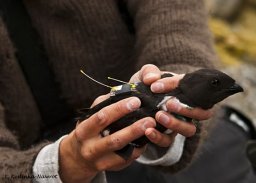
In conditions of deteriorating food availability, seabirds may maximize their breeding success by increasing reproductive effort, which compromises body condition, stress level, survival, and future reproductive success. We studied a small planktivorous alcid, the little auk Alle alle, in 2 breeding colonies in west Spitsbergen, Norway (Hornsund and Magdalenefjorden) with contrast- ing oceanographic conditions (Arctic and Atlantic environments, respectively). We hypothesized that the chick diet composition and parental foraging effort differs between these colonies, which results in intercolony variation in body mass and stress level of both adults and chicks. We found dif- ferences in sea temperature and salinity (both lower in Hornsund) and the abundance of Atlantic copepod Calanus finmarchicus (3.6 times less abundant in Hornsund) between foraging areas. Birds from both colonies foraged selectively on Calanus glacialis CV. Composition, total biomass and energy content of food loads were similar in both colonies, though food delivered to nestlings in Mag- dalenefjorden was more diverse. The frequency of feeds was also similar in both colonies. Parent lit- tle auks in Magdalenefjorden, however, performed longer foraging trips than in Hornsund (medians 183 vs. 124 min). Longer foraging trips suggest that these birds traveled longer distances to find abundant prey at the marginal sea ice zone and/or spent more time foraging close to the colony but in poorer foraging areas. Despite increased parental efforts in Magdalenefjorden, body mass and stress levels of adults and chicks were similar in both colonies. This suggests that little auks from northwest Spitsbergen did not reach a threshold requiring prioritization of self-maintenance over chick provisioning.
Composition and abundance of zooplankton were studied simultaneously with feeding ecology of planktivorous Little Auks (Alle alle) in two different sea shelf areas of West Spitsbergen, Norway, in summer 2007. Zooplankton was collected adjacent to bird colonies in Magdalenefjorden (influenced by Atlantic West Spitsbergen Current) and Hornsund (dominated by the Arctic Sørkapp Current). In spite of different hydrological situations, the abundance of prey preferred by Little Auks, Arctic Calanus glacialis copepodids stage V, among zooplankton was similar in both localities. However, there was much more of Atlantic Calanus finmarchicus on the shelf outside Magdalenefjorden compared to Hornsund, resulting in different abundance ratios of Arctic to Atlantic copepods in the two areas (1:14 and 1:1, respectively). Even greater differences between the two areas occurred in the ratio of C. glacialis CV to other zooplankters, amounting to 1:40 in Magdalenefjorden and 1:6 in Hornsund. In both Little Auk colonies food brought by parents to their chicks contained mainly C. glacialis CV, albeit the proportion of this copepod in meals was significantly higher in Hornsund. Meals delivered to Little Auk chicks in Hornsund had also higher zooplankton numbers, biomass and energy content. In Magdalenefjorden, on the other hand, a higher number of feedings and longer duration of foraging trips were recorded. These differences became more apparent with increasing energy requirements of the fast growing nestlings. This was probably a consequence of lower relative abundance of the Little Auks’ preferred prey in the sea adjacent to Magdalenefjorden colony. It seems that searching for the preferred food items, such as C. glacialis, among abundant but less favored C. finmarchicus, may require more time and energy demanding foraging behavior. As a consequence, foraging effort of the Little Auk parents from Magdalenefjorden was higher, and feeding efficiency lower, than those of birds from Hornsund. Increasing influx of warm Atlantic waters that bring boreal zooplankton to the Arctic Seas may have negative impacts on Little Auks’ time and energy budgets and eventually on their breeding success and range of breeding distribution.
Distribution maps of CDOM and algal pigments, both in superficial and deep waters, have been obtained operating a portable dual laser spectrofluorometer and a lidar fluorosensor equipments for the first time during two polish AREX oceanographic campaigns in 2006 and 2007 summertime in the Svalbard area. The different hydrological regimes strongly affected the biological factors in the waters around the Svalbard Islands as monitored during the campaigns with strong regional differentiations between the two years. The occurrence of large phytoplanktonic blooms and patches have been observed in the western area of the Spitsbergen Island coastline due to the nutrient release from pack ice and/or iceberg melting with values of more than 10 μg/l in both campaigns. Different CDOM fractions have been monitored with the remote and local instruments and inverse proportionality with salinity is confirmed along the water column. Phycobilin pigments, as phycoerythrin and phycocyanin accessory algal pigments, have been monitored in the northern area as well as tyrosine and tryptophan protein-like fluorescence distribution. The double filtration, performed with the dual laser spectrofluorometer, allows to retrieve the small fluorescence contribution due to NADPH and carotenoids pigments in the blue fluorescence emission. Successively, the large spectroscopic data base has been critically analyzed with a robust statistic instrument, thus identifying different marine provinces and retrieve distinctive CDOM fractions.
 P. Makuch合作论文数4Tomasz Petelski合作论文数4
 Piotr Markuszewski合作论文数Institute of Oceanology, Polish Academy of Sciences3Anna Rozwadowska合作论文数3
 Lech Stempniewicz合作论文数Katedra Ekologii i Zoologii3
 Nina Karnovsky合作论文数3
 Katarzyna Wojczulanis-Jakubas合作论文数Department of Vertebrate Ecology and Zoology;University of Gdansk;Department of Vertebrate Ecology and Zoology, University of Gdansk3
 Waldemar Walczowski合作论文数3
 Slawomir Kwasniewski合作论文数Institute of Oceanology, Sopot, Poland3
 Marta Gluchowska合作论文数Institute of Oceanology, Polish Academy of Sciences (IO PAN),3
 Wojciech Walkusz合作论文数Institute of Oceanology, Polish Academy of Sciences Powstańców Warszawy3
 Dariusz Jakubas合作论文数Department of Vertebrate Ecology and Zoology;University of Gdansk;Department of Vertebrate Ecology and Zoology, University of Gdansk3Ilona Goszczko合作论文数2Agnieszka Promińska合作论文数1
 Igor G Okladnikov合作论文数1Paulina Pakszys合作论文数1Rafał Boehnke合作论文数Inst Oceanol, Polish Acad Sci1F. Colao合作论文数1
 luca fiorani合作论文数Italian Natl Agcy New Technol Energy & Sustainabl, Frascati Res Ctr1
 Maria Sighicelli合作论文数Technical Unit Sustainable Development and Agro-Industrial Innovation, Italian National Agency for New Technologies, Energy and Sustainable Economic Development (ENEA),1Di Cicco Annalisa合作论文数1
 Jan Marcin Węsławski合作论文数Department of Ecology, The Institute of Oceanology, Polish Academy of Sciences1
 Violetta Drozdowska合作论文数Institute of Oceanology;Physics Department, Marine1
 Piotr Wieczorek合作论文数Institute of Computer Science, University of Wroclaw1
 Katarzyna Blachowiak-Samolyk合作论文数Institute of Oceanology Powstancow, Polish Academy of Sciences1Jan Piechura合作论文数1Tymon Zielinski合作论文数Institute of Oceanology;Polish Academy of Sciences;Powstaców Warszawy;Institute of Oceanology, Polish Academy of Sciences|Powstaców Warszawy1Antonio Palucci合作论文数1
 Agnieszka Beszczynska-Moeller合作论文数1
 Violeta Lazic合作论文数1
 Dorota Kidawa合作论文数Department of Vertebrate Ecology and Zoology, University of Gdańsk1Ann Marie Aglionby Harding合作论文数1




