This paper proposes an innovative approach by leveraging uncrewed aerial vehicles (UAVs) as base stations (BSs) and a high-altitude platform station (HAPS) as the central processing unit (CPU) in an integrated sensing and communication (ISAC) system for 6G networks. We explore the challenges, applications, and advantages of ISAC systems in next-generation networks, highlighting the significance of optimizing position and power control. Our approach integrates HAPS and UAVs to enhance wireless coverage, particularly in remote areas. UAVs function as dual-purpose access points (APs), using their maneuverability and line-of-sight (LoS) aerial-to-ground (A2G) links to transmit combined communication and sensing signals. The scheme operates in two time slots: in the first slot, UAVs transmit dedicated signals to communication users (CUs) and potential targets. UAVs detect targets in specific ground locations and, after signal transmission, receive reflected signals from targets. In the second slot, UAVs relay these signals to HAPS, which performs beamforming to align signals for each CU from various UAVs. UAVs decode information from HAPS and adjust transmissions to maximize the efficiency of the beam pattern toward the desired targets. We formulate a multi-objective optimization problem with the goal of maximizing both the minimum signal-to-interference-plus-noise ratio (SINR) for CUs and the echo signal power from the targets. This is achieved by finding the optimal power allocation for CUs in each UAV, subject to constraints on the maximum total power in each UAV and the transmitted beam pattern gain. Simulation results demonstrate the effectiveness of this approach in enhancing network performance, resource allocation, fairness, and system optimization. By utilizing HAPS as the CPU, computational tasks are offloaded from UAVs, which conserves energy and further improves overall network performance.
Sparse linear arrays (SLAs) are becoming increasingly popular due to their superior performance in achieving higher degrees of freedom (DOFs) compared to uniform linear arrays. However, most SLA design methods are inflexible for different DOFs; therefore, they are not well suited to addressing the problem of designing the desired virtual array configuration. In this article, we propose two methods for designing SLAs based on the coordinate descent algorithm with a maximum block improvement selection rule. These methods achieve the desired DOF and minimize the number of required sensors while considering the mutual coupling effects between array elements. The first method focuses on optimizing the array for minimal sensor usage, while the second method further enhances performance by reducing mutual coupling. In addition, we address the virtual array design problem in multiple-input multiple-output radar systems. The proposed methods are applied to achieve desired configurations in both 2-D planes and filled linear arrays. The results confirm that the proposed methods offer improved suppression of mutual coupling and leakage when compared to state-of-the-art approaches. Furthermore, the simulation results demonstrate that the desired virtual arrays can be reliably constructed in various scenarios.
This paper introduces a novel high altitude platform station (HAPS)-based integrated sensing and communication (ISAC) system, referred to as HAPS-ISAC, designed to enhance the capabilities of future 6G networks by simultaneously optimizing communication and sensing functions. HAPS operates as a super-macro base station in the stratosphere, utilizing advanced beamforming techniques within a multiple-input multiple-output (MIMO) architecture, supplemented by multiple-input single-output (MISO) configurations, effectively enabling the system to serve ground communication users (CUs) while conducting high-resolution sensing of potential targets. A Rician channel model is employed to capture both line-of-sight (LoS) and non-line-of-sight (NLoS) conditions. The performance of the system is optimized through a non-convex optimization problem that maximizes the minimum beampattern gain towards desired sensing angles while ensuring that the signal-to-interference-plus-noise ratio (SINR) requirements for CUs are satisfied, all under the power constraints of the HAPS. Compared to the traditional terrestrial and UAV-based ISAC systems, HAPS-ISAC delivers sustained and reliable service over extensive areas, leading to significantly improved overall performance. Simulation results show that HAPS-ISAC significantly improves SINR, resource allocation, sensing accuracy, and fairness, outperforming existing technologies. This establishes HAPS-ISAC as a key enabler for 6G networks and advances intelligent infrastructures like IoT and smart cities.
This paper presents a high-altitude platform station (HAPS)-enabled integrated sensing and communication (ISAC) system designed for sixth-generation (6G) networks. Positioned in the stratosphere, HAPS serves as a super-macro base station, leveraging advanced beamforming techniques to enable communication and sensing simultaneously. This research addresses the need for equitable service distribution in 6G networks by focusing on fairness within the HAPS-ISAC system. It tackles a non-convex optimization problem that balances sensing beampattern gain and signal-to-interference-plus-noise ratio (SINR) requirements among communication users (CUs) using a max-min fairness approach while adhering to power constraints. The proposed HAPS-ISAC framework ensures efficient resource allocation, reliable coverage, and improved sensing accuracy. Simulation results validate the potential of HAPS-ISAC as a pivotal enabler for 6G networks and integrated communication-sensing systems.
This article presents a method for designing transmit beampattern in 4-D imaging automotive multiple-input-multiple-output (MIMO) radars, employing the distance between the designed and desired beampatterns as the design metric. Utilizing the l(p)-norm criteria, we consider a broader range of p values, specifically for p >= 2 and 0 < p <= 1, to enhance the optimization framework. The optimization problem formulated under these criteria is efficiently solved using the block successive upper bound minimization (BSUM) technique for discrete and continuous phase constraints. Our analysis verifies the convergence of the objective function and confirms the solution's convergence, thereby establishing a new stopping criterion for this optimization process. Furthermore, we demonstrate that our proposed method outperforms the commonly used omnidirectional beampattern across various automotive scenarios, highlighting its superior adaptability and utility in multiple applications. In addition, our methods demonstrate good performance and computational efficiency, making them suitable for real-time 4-D imaging automotive BSUM radar applications.
Phase-modulated continuous-wave (PMCW) radar is an emerging technology in various civilian applications. Due to the high bandwidth of the PMCW signal, it needs high-speed analog-to-digital converters (ADCs). High-resolution ADCs supporting this high bandwidth are expensive, have a big size on the chip, and consume high power, which are significant challenges for radar. A solution to deal with the aforementioned challenges is to use low-resolution, or in the most extreme case, one-bit ADCs. In this article, we aim at designing the transmit code and the receive filter for the PMCW radar in the presence of one-bit ADC at the receiver side. To this end, we introduce the mean integrated sidelobe level metric, called MISL. MISL generalizes the well-known ISL metric for nonideal ADC usage at the receiver side and takes the effect of noise and target backscattering coefficient into account. For mathematical tractability, we employ the maximum likelihood estimation of the target backscattering coefficient. This leads to casting an optimization problem that does not need knowledge about noise and target characteristics. We utilize the cyclic optimization procedure to optimize the transmit code and the receive filter. The filter design subproblem admits a closed-form solution, whereas we obtain a solution to transmit code design subproblem via the coordinate descent framework. Numerical examples illustrate the superior performance of the proposed method compared to benchmarks that design sequences assuming ideal ADC at the receiver.
Two-dimensional beampattern shaping in 4D-imaging MIMO radars is a promising approach to enhance spatial sensing. However, spectrally dense environments that require the suppression of specific frequency bands introduce challenges to beampattern optimization. In this paper, we propose a method to match the designed beampattern closely with a desired beampattern under the unimodularity constraint while suppressing the spectral response in the undesired frequency bands. We employ the generalized l(p)-norm for beampattern shaping to minimize interference from undesired directions. The resulting optimization problem is non-convex, multi-variable, and NP-hard, highlighting the importance of determining a practical and effective solution strategy. To address this, we decompose the problem into two independent sub-problems, each solved using an evolutionary algorithm. This methodology enables the achievement of high-performance solutions in beampattern shaping while satisfying spectral constraints, demonstrating the potential for improvements in radar system performance.
Compressive Sensing (CS) theory has been used for Synthetic Aperture Radar (SAR) imaging due to the sparsity feature of SAR images. Therefore, some well-known CS algorithms like Orthogonal Matching Pur -suit (OMP) and Regularized OMP (ROMP) methods have been employed for SAR image formation with a very small number of samples. On the other hand, it has been shown that the SAR signal is consistent with the definition of block sparsity. Hence, compressive sensing methods employing block structure, known as Block Compressive Sensing (BCS), are presented and used for SAR image formation to achieve more accuracy with a smaller number of samples. In this paper, first, a new BCS-based algorithm, namely, Block Norm Regularized Orthogonal Matching Pursuit (BNROMP), is introduced which can be used in all BCS applications. Then, this novel method is used for SAR image formation to achieve more accuracy and excellent resolution with a small number of samples. The simulation results for the synthesized data, as well as real data, show that by using the novel BNROMP method, we could form SAR images with higher quality, as compared to those for the standard image formation algorithms and other CS-SAR or BCS-SAR methods. (c) 2023 Elsevier B.V. All rights reserved.
In synthetic aperture radar (SAR) signal processing, the images of the moving targets are displaced and unfocused due to their unknown motion parameters. Therefore, different methods have been suggested for ground-moving target indication (GMTI) and ground-moving target imaging to detect the moving targets and estimate their motion parameters. In this article, noting the linear frequency modulation of the SAR-transmitted signal, we propose a method that employs the fractional Fourier transform (FrFT) as a tool for signal detection and signal parameter estimation. Specifically, for the detection of the SAR echo signal, the generalized likelihood ratio test (GLRT) is derived by means of the FrFT. The proposed detector is further modified to possess the constant false alarm rate (CFAR) property. The performance of the proposed method and its effectiveness in SAR imaging for moving targets are evaluated through simulations and examples.
Compared to the traditional monostatic MIMO radar which uses uniform linear arrays (ULAs) for transmitting and receiving signals, sparse linear arrays (SLAs) monostatic MIMO radars can achieve greater Degrees Of Freedom (DOF) and a higher resolution. The optimal placement of sensors in both transmit and receive arrays to attain the maximum DOF is, however, a basic problem in the collocated monostatic MIMO radar. Optimum solution of such a problem is restricted to an exhaustive computer search. Some popular arrays such as nested and coprime arrays have been previously proposed as alternative solutions that can achieve a good DOF, but they do not necessarily lead to the maximum one. In this paper at first, we formulate the optimal placement of sensors in the collocated monostatic MIMO radar to improve the sum coarray as well as the difference coarray of the sum coarray. After that, we present a mathematical framework to achieve the optimal solution for both problems. Finally, we demonstrate that the proposed method yields the optimal MR-MIMO array while demanding much less computational complexity as compared with the computer search.
Sparse linear arrays (SLAs) provide a high number of degrees of freedom (DOF) and reduce the mutual coupling effect between sensors of the array. Many design methods for SLAs have been proposed in the last two decades but most of the existing SLA design methods fail to achieve minimum number of sensors for a desired DOF. In this paper, a design method is proposed which utilizes the branch and bound (B&B) optimization algorithm to give a SLA with the desired DOF and minimum number of physical sensors. The proposed SLA design method is obtained by generalizing the minimum sensor array (MSA) design method which is recently proposed in the literature. This generalized method provides the same DOF as the MSA method but with a smaller number of physical sensors. In addition, a version of this design method is proposed which provides more robustness against mutual coupling effect between the sensors of the array. Simulation results demonstrate the superiority of the performance of the SLAs obtained with the proposed method over the arrays obtained with the MSA method and also over the other existing SLAs.
Compared to the uniform linear array (ULA), the sparse linear array (SLA) has many advantages such as a greater degrees of freedom (DOF), a higher resolution, and robustness against mutual coupling. The optimal placement of elements to achieve the maximum DOF in SLA has been an old problem in array signal processing. Finding the optimum placement is limited to an exhaustive computer search as yet. Therefore, some familiar SLAs (such as `nested' and `coprime' arrays) have been suggested to improve DOF although none of them necessarily can achieve the maximum DOF with a certain number of sensors. In this paper, first we have proposed a novel hole-free SLA that yields the minimum number of sensors (MSA) for the desired DOF. The optimization problem associated with such an array is a nonlinear binary optimization problem. Then, the problem is transformed into a binary linear programming (BLP) problem which could be solved exactly. Using the proposed method, a fast and efficient solution to the minimum redundancy array(MRA) is found. Finally, the simulation results show that the proposed array has a higher DOF compared to the other competitive methods for a given number of sensors, which is the maximum possible DOF. This can lead to a better target resolution and DOA estimation.
We propose a compressive pulse-Doppler radar that works through one-bit quantization of the received noisy signal by comparing it with a time-varying reference level. Considering the sparsity of the targets in the range-Doppler domain, we solve the problem by sparse recovery methods in both the absence and presence of clutter. The proposed method leads to an optimization problem that can be tackled by a convex approximation. Numerical examples confirm the effectiveness of the proposed method.
In this paper, we consider the problem of transmit signal and receive filter design for a phase modulated continuous wave (PMCW) monostatic single-input single-output (SISO) radar system when low-resolution analog-to-digital-convertor (ADC) is used at the receiver. By applying Bussgang decomposition model, the effect of low-resolution ADC is considered in the model, and two cases of colored and white noise are investigated. In the white noise case, it is concluded that the matched filter (MF) is the best filter maximizing the signal-to-interference-plus-noise-ratio (SINR) of the receive filter output. In the presence of colored noise, we propose a cyclic design procedure for maximizing the output SINR. Numerical examples illustrate the superiority of the proposed method in comparison with the well-known m- sequence probing signal with matched or designed receive filter. The effect of different parameters is also verified.
This chapter is framed in the mentioned context with the goal of providing a comprehensive study on the design of unimodular (in particular binary) sequences possessing good aperiodic autocorrelation properties for radar systems. To this end, a new technically sound procedure aimed at designing continuous/discrete phase sequences with good aperiodic autocorrelation function (in terms of PSL and ISL) is introduced in this chapter. Specifically, resorting to the Pareto framework, the weighted sum of PSL and ISL is considered as an objective function to optimize under the phase -only constraint on the probing waveform. Hence, an iterative procedure based on the coordinate descent (CD) method is introduced to deal with the resulting non -deterministic polynomial -time hardness (NP -hard) optimization problem. Each iteration of the devised method requires the solution of a nonconvex min -max problem. It is handled either through a novel bisection or a fast Fourier transform (FFT)-based method, respectively, for the continuous and the discrete phase constraint. Several numerical examples will illustrate the performance enhancement (especially in the highly important binary case) of the devised algorithm.
Frequency modulated continuous wave (FMCW) radar-based ranging systems provide the ability to achieve high precision in ranging targets. The FMCW radar estimates the range of the target by sending a frequency modulated signal and estimating the frequency of the signal returned from the target. Ranging multiple targets in FMCW radar is equivalent to estimating the frequencies of multiple sinusoids buried in noise. In this article, an algorithm based on chirp z-transform (CZT) is presented for high precision ranging in multi-target scenarios with FMCW radar. The accuracy and the efficiency of the proposed estimation algorithm is evaluated theoretically and through simulations.
One of the important parameters in Synthetic Aperture Radars (SARs) is image resolution which is defined in two dimensions, azimuth and range. Two techniques named pulse compression and Range Cell Migration Correction (RCMC) help us to achieve high resolutions. Generally, the transmitted pulse in SAR is a Linear Frequency Modulation (LFM) which is typically compressed by matched filter. As Fractional Fourier Transform (FrFT) is able to eliminate the quadratic phase term, compressing the LFM signal by FrFT has been introduced in literature. Since the Range Cell Migration (RCM) is a quadratic term, it can also be corrected by FrFT, a fact not considered earlier. In this paper, a novel algorithm is proposed where in addition to pulse compression, the RCM is corrected by the FrFT. The simulation results are presented to show the advantages of the proposed algorithm compared to the conventional Range-Doppler Algorithm (RDA) according to Integrated Side-lobe Ratio (ISLR), Peak to Side-lobe Ratio (PSLR) and Impulse Response Width (IRW) criteria.
In this paper, we aim at designing sets of binary sequences with good aperiodic/periodic auto- and cross-correlation functions for multiple-input multiple-output (MIMO) radar systems. We show that such a set of sequences can be obtained by minimizing a weighted sum of peak sidelobe level (PSL) and integrated sidelobe level (ISL) with the binary element constraint at the design stage. The sets of designed sequences are neighboring the lower bound on ISL and have a better PSL than the best-known structured sets of binary sequences. To formulate the problem, we introduce a Pareto-objective of weighted auto- and cross-correlation functions by establishing a multi-objective NP-hard constrained optimization problem. Then, by using the block coordinate descent framework, we propose an efficient monotonic algorithm based on fast Fourier transform, to minimize the multi-dimensional objective function. Numerical results illustrate the superior performance of the proposed algorithm in comparison with the state-of-the-art methods.
In this paper, we aim at designing a set of binary sequences with good aperiodic auto-and cross-correlation properties for Multiple-Input-Multiple-Output (MIMO) radar systems. We show such a set of sequences can be obtained by minimizing the Integrated Side Lobe (ISL) with the binary requirement imposed as a design constraint. By using the block coordinate descent (BCD) framework, we propose an efficient monotonic algorithm based on Fast Fourier Transform (FFT), to minimize the objective function which is non-convex and NP-hard in general. Simulation results illustrate that the ISL of designed binary set of sequences is the neighborhood of the Welch bound, indicating its superior performance.
 Mohammad Mahdi Naghsh合作论文数ECE Department, Isfahan University of Technology24
 Mohammad Alaee-Kerahroodi合作论文数8
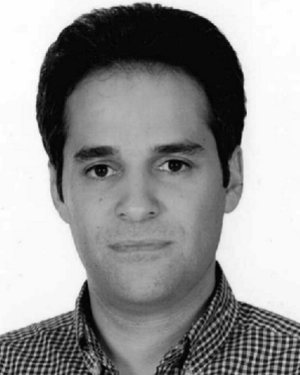 Sayed Jalal Zahabi合作论文数Department of Electrical Engineering, Yazd University7
 Petre Stoica合作论文数Information Technology Department, Division of Systems and Control, Uppsala University7
 Mojtaba Soltanalian合作论文数Department of Electrical and Computer Engineering, College of Engineering, University of Illinois at Chicago6
 Antonio De Maio合作论文数Dipartimento di Ingegneria Elettrica e delle Tecnologie dell’Informazione, Università degli Studi di Napoli Federico II5
 Nafiseh Janatian合作论文数5
 Augusto Aubry合作论文数Dipartimento di Ingegneria Elettrica e delle Tecnologie dell’Informazione, Università degli Studi di Napoli Federico II5
 Sumei Sun合作论文数Institute for Infocomm Research, A*STAR4
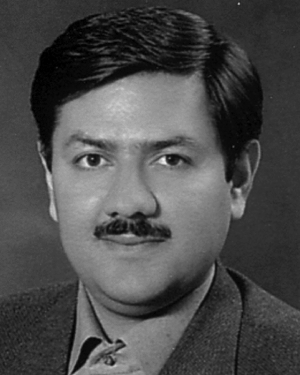 Abbas Sheikhi合作论文数Department of Electrical and Electronic Engineering, Shiraz University4
 Mohammad Ebrahimi合作论文数3
 Jian Li (李荐)合作论文数Spectral Analysis Laboratory, Department of Electrical & Computer Engineering, University of Florida3
 Halim Yanikomeroglu合作论文数Department of Systems and Computer Engineering, Carleton University;Non-Terrestrial Networks Lab, Carleton University3
 Mohammad Javad Omidi合作论文数Department of Electrical and Computer Engineering, Isfahan University of Technology3
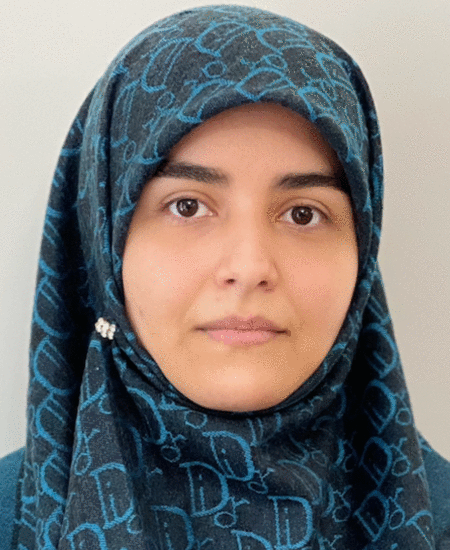 Foozie Foroozmehr合作论文数2
 Jalal Khamse-Ashari合作论文数Carleton Univ, Dept Syst & Comp Engn, Ottawa, ON, Canada2
 Azra Abtahi合作论文数Isfahan Univ Technol, ECE Dept, Esfahan, Iran2
 Nayebi, M.M.合作论文数Dept Elect Engn, Sharif Univ Technol2
 Björn Ottersten合作论文数Interdisciplinary Centre for Security, Reliability and Trust, University of Luxembourg;Department of Signal Processing, School of Electrical Engineering, Royal Institute of Technology2
 Bhavani Shankar Mysore Rama Rao合作论文数Interdisciplinary Centre for Security, Reliability and Trust, University of Luxembourg2
 Mohammad Dakhilalian合作论文数Cryptography & System Security Research Laboratory, Isfahan University of Technology2
 Saeed Sadri合作论文数Isfahan University of Technology2
 Shahram ShahbazPanahi合作论文数Department of Electrical, Computer and Software Engineering, Faculty of Engineering and Applied Science, University of Ontario Institute of Technology2
 Ehsan Yazdian合作论文数Department of Electrical and Computer Engineering, Isfahan University of Technology2
 Foroogh S Tabataba合作论文数Dept .;Sharif University of Technology;Sharif University of Technology2
 Hassan Halabian合作论文数2
 Ehsan Haj Mirza Alian合作论文数2
 Farokh Marvasti合作论文数Multimedia and Signal Processing Lab, Sharif University of Technology2
 Ioannis Lambadaris合作论文数University of Maryland2
 Mojtaba Soltamalian合作论文数1peyman kazemi合作论文数1M. Alaee合作论文数1
 Ehsan Raei合作论文数University of Luxembourg1Arash Mirzaei合作论文数Fac Informat Technol, Monash Univ1
 Mohamad Farzan Sabahi合作论文数Univ Isfahan, Dept Elect Engn, Esfahan, Iran1
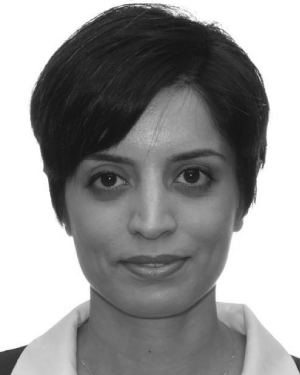 Talaei, F.合作论文数1
 Oliver Lang合作论文数1
 Mahmood Karimi合作论文数School of Electrical and Computer Engineering, Shiraz University1
 Reinhard Feger合作论文数Christian Doppler Laboratory for Integrated Radar Sensors, Johannes Kepler University1
 Mohammadali Khosravifard合作论文数Dept Elect & Comp Engn, Isfahan Univ Technol1
 Hamid Mala合作论文数Cryptography and System Security Research Laboratory, Isfahan University of Technology1
 Hamid Mirmohammad Sadeghi合作论文数School of Pharmacy and Pharmaceutical Sciences, University of Isfahan1
 Guan Yong Liang合作论文数Energy Research Institute, Nanyang Technological University;School of Electrical & Electronic Engineering, Nanyang Technological University1
 Mohammad Zamani合作论文数Shiraz University1
 T. Aaron Gulliver合作论文数Department of Electrical & Computer Engineering, Faculty of Engineering and Computer Science, University of Victoria1
 Vincent Rijmen合作论文数Department of Electrical Engineering, KU Leuven;Faculty of Engineering Science, KU Leuven;Division Computer Security and Industrial Cryptography, KU Leuven1Hossein Alavi合作论文数1




