We present and analyze a method for reducing the computational complexity of the Back-Projection image reconstruction algorithm in the framework of forward-looking synthetic aperture radar. The proposed approach leverages a radar network and a processing architecture combining decimated Back-Projection and the Sequential Spatial Masking algorithm. Simulation results show that the proposed approach enables extreme slow-time decimation, which significantly reduces the complexity without sacrificing the field of view.
Two sparse multiple-input multiple-output (MIMO) radar configurations are compared against a conventional dense MIMO radar to investigate low-complexity, super-resolution direction-of-arrival (DOA) estimation from a single snapshot. Both sparse configurations divide the virtual array (VA) into two uniformly spaced subarrays with a coprime relationship between them. The first is the well-known coprime array in which the inter-element spacings of the two subarrays are coprimes. The second is the VEXPA configuration, where both subarrays share the same inter-element spacing and a coprime parameter defines the relative shift between them. The analysis highlights the spatial resolution gains of sparse configurations over dense arrays while revealing limitations from the de-aliasing mechanism and reduced degrees of freedom (DOFs) inherent to the subarray partitioning.
This work addresses the problem of autofocusing for forward-looking MIMO synthetic aperture radar (FL-MIMO-SAR) images. To this end, we first present and analyze the detailed geometry and signal model of the FL-MIMO-SAR autofocusing problem. Then, we propose and test a comprehensive pipeline for FL-MIMO-SAR autofocusing with automatic radar motion parameters estimation and compensation. The approach leverages a combination of three SAR image quality indicators (IQIs) to assess the performance of the autofocusing process, which is compatible with both time-domain and frequency-domain image reconstruction algorithms. Moreover, the computational complexity of the optimization problem is reduced by employing a guided backprojection (GBP) algorithm. Furthermore, we compare the three IQIs with respect to their sensitivity to different types of positioning errors. The performance of the proposed solution is quantitatively evaluated using different simulated scenarios and controlled experimental data from an anechoic chamber. Finally, we test the applicability of the proposed solution using real data from automotive scenarios. The results show that the proposed pipeline is capable of handling phase-only as well as range-cell-migration defocusing models.
In this paper, an algorithm for enabling fast near-field multiple-input multiple-output synthetic aperture radar (MIMO-SAR) imaging is proposed and analyzed. The drastic reduction in the near-field MIMO-SAR scanning time is made possible by introducing high sparsity in the synthetic aperture. In addition, the proposed algorithm addresses the problem of high sidelobe levels, which results from random under-sampling. It is shown that the proposed approach significantly reduces the scanning time without sacrificing resolution. Moreover, the proposed approach manages to attenuate the sidelobe level significantly, which improves the dynamic range of the MIMO-SAR images.
This work presents and analyzes a method for reducing the computational complexity of the Back-Projection image reconstruction algorithm in the framework of forward-looking multiple-input multiple-output synthetic aperture radar. A combination of the decimated Back-Projection and the Sequential Spatial Masking algorithms is proposed. Simulation results show that the proposed approach manages to significantly reduce the complexity of the Back-Projection without sacrificing the resolution or the field of view.
In Frequency Modulated Continuous Waveform (FMCW) radar systems, the phase noise from the Phase-Locked Loop (PLL) can increase the noise floor in the Range-Doppler map. The adverse effects of phase noise on close targets can be mitigated if the transmitter (Tx) and receiver (Rx) employ the same chirp, a phenomenon known as the range correlation effect. In the context of a multi-static radar network, sharing the chirp between distant radars becomes challenging. Each radar generates its own chirp, leading to uncorrelated phase noise. Consequently, the system performance cannot benefit from the range correlation effect. Previous studies show that selecting a suitable code sequence for a Phase Modulated Continuous Waveform (PMCW) radar can reduce the impact of uncorrelated phase noise in the range dimension. In this paper, we demonstrate how to leverage this property to exploit both the mono- and multi-static signals of each radar in the network without having to share any signal at the carrier frequency. The paper introduces a detailed signal model for PMCW radar networks, analyzing both correlated and uncorrelated phase noise effects in the Doppler dimension. Additionally, a solution for compensating uncorrelated phase noise in Doppler is presented and supported by numerical results.
We propose and analyze an image reconstruction algorithm for high angular resolution with a forward-looking multiple-input multiple-output synthetic aperture radar (FL-MIMO-SAR). This algorithm achieves significant attenuation levels of the sidelobes (SL) and ghosts such as grating lobes (GL) and Doppler left-right ambiguity (DLRA). Aspects such as SAR image reconstruction, high SLs in SAR images, the formation of GLs, DLRA, and the overlapping between DLRA ghosts and nearby GLs are investigated. In addition, different imaging scenarios are simulated using a frequency-modulated continuous wave (FMCW) radar simulator and validated with real measurements using different time-division multiplexing MIMO FMCW radars. The simulation and experimental results show that the proposed algorithm manages to significantly enhance the SAR image by attenuating the SLs and canceling ghosts and ambiguities. Furthermore, the proposed algorithm results in true targets with narrower response patterns, which improves the detectability of targets in the SAR image.
This paper presents a high-resolution automotive multi-input multi-output (MIMO) radar with sparse arrays using beamspace matrix completion. Sparse arrays, while offering a larger aperture than uniform arrays with an equivalent number of antenna elements, suffer from higher sidelobe levels due to missing elements (holes). To address this issue, an array interpolation technique employing low-rank matrix completion through a Hankel matrix formation has been proposed. However, the computational demands of this approach make it imprac-tical for low-cost automotive radar sensors. To overcome this challenge, we propose a subarray-based beamspace approach, reducing the dimensions of the Hankel matrix for efficient matrix completion in sparse arrays within automotive MIMO radar systems. Numerical simulations validate the effectiveness of our approach, focusing on a one-dimensional sparse linear array (SLA) and assessing various performance metrics.
Orthogonal frequency division multiplexing (OFDM) radars are impacted by the power amplifier (PA) non-linearity, due to the high peak-to-power-average ratio of the radar waveform, as in OFDM communication systems. In the state-of-the-art, solutions using digital pre-distortion (DPD) and symbol-based equalization have been proposed to try to mitigate the impact of PA distortions. However, the effect of PA non-linearity on range sidelobes was not detailed, especially when guard bands (GBs) are included in OFDM subcarriers. In this paper, we provide a detailed analytical signal model of the PA non-linearity impact on OFDM radar considering GBs. A method to combine constant amplitude zero autocorrelation code with DPD is validated by simulations.
Recent advancements in radar technology have led to increased interest in radar networks, which promise enhanced angular resolution and robust measurements. However, designing radar transceivers for such networks requires careful consideration of hardware nonidealities. This paper considers distortion terms due to circuit nonlinearities and the impact of uncorrelated phase noise (PN). We present a comprehensive analysis of the link budget for Frequency Modulated Continuous Wave (FMCW) transceivers in radar networks, taking nonlinearities into account. We also show the impact of uncorrelated PN on the multistatic responses.
Integrated frequency-modulated continuous-wave (FMCW) radars are used in target range and velocity sensing applications [1] . In these systems, the output frequency is linearly modulated over time, typically referred to as an FMCW chirp. The key component in the integrated FMCW radar sensor is the FMCW chirp synthesizer. Most often the chirp synthesizer is implemented by using a frequency-modulated phase-locked loop (PLL).
We address the problem of power amplifier (PA) non-linearity in OFDM radars. The usual metric to minimize the impact of PA non-linearities is the peak-to-average power ratio (PAPR). However, minimizing the PAPR without considering the effect of guard bands and analog lowpass filtering results in severe underestimation of the actual PAPR in continuous time. We propose an algorithm that takes guard bands and analog filtering into account in the PAPR minimization. Simulation is used to show that linear PAPR smaller than 1.3 (1.14dB) is achieved with our algorithm and that the peak sidelobe level in the range profile are reduced well below -50dB.
Synthetic aperture radar (SAR) techniques are commonly used in spaceborne and airborne side-looking radar imaging applications, where the relatively high platform speeds enable the formation of very long synthetic apertures, which provide images with high angular resolution. However, the recent development of new autonomous ground vehicles, with relatively slow speeds, calls for new SAR imaging methods to obtain high angular resolution images. In this paper, the concept of forward-looking multiple-input multiple-output SAR (FL-MIMO-SAR) is analyzed and applied for short-range millimeter-wave radar forward-looking imaging in autonomous mobile robots (AMRs). Moreover, if the antenna inter-element spacing in the MIMO array is small, the FL-MIMO-SAR imaging system will provide low or no angular resolution refinement at the radar boresight region, i.e., Doppler beam sharpening (DBS) ineffective region. To solve that, the combination of FL-MIMO-SAR and sparse MIMO arrays with large inter-element spacing (FL-sparseMIMO-SAR) is proposed. Aspects such as the signal model, image reconstruction, complexity reduction, and the left-right ambiguity for FL-MIMO-SAR imaging systems are addressed. In addition, different imaging scenarios for AMRs are simulated using a frequency-modulated continuous wave radar simulator. Simulation results are validated with real measurements. It is shown that the proposed combination of FL-MIMO-SAR and MIMO arrays with large inter-element spacing manages to significantly suppress the grating lobes, which come from the sparsity in the antenna array. Moreover, the proposed FL-sparseMIMO-SAR helps to relax the requirements on the synthetic aperture length and solves the DBS-blind region problem, thanks to the larger real sparse MIMO array and the grating lobes suppression with the FL-SAR processing. Finally, the results show high potential for radar imaging systems, with FL-sparseMIMO-SAR capabilities, to be employed in the applications of AMRs towards smart factories and warehouses.
In this paper, the three-dimensional (3-D) imaging problem of monostatic forward-looking synthetic aperture radar (FL-SAR) is analyzed. A 3-D guided-and-decimated back-projection (3-D GDBP) algorithm is proposed for reducing the computational complexity of 3-D FL-SAR image reconstruction. This is done by combining range and Doppler processing together with decimation along the slow-time samples and backprojection along the fast-time samples. In addition, the geometry and frequency-modulated continuous wave (FMCW) signal model for the 3-D FL-SAR problem are presented. Finally, the performance of the proposed method is tested and compared against the 3-D decimated backprojection algorithm.
This paper proposes a solution to reduce the range sidelobes and ghost targets in PMCW radars by improving the Zadoff sequences with the help of a progressive phase rotation. First, we show that the proposed code sequences, named $\pi /K$ -Zadoff, are robust to IQ imbalance, DC offset and baseband third order non-linear distortions. We provide the criteria to select the values of $K$ which minimize the range sidelobes produced by those non-idealities. Then, we show how to attenuate the remaining range sidelobes due to other transceiver analog front-end non-idealities by changing the transmitter code sequence every slow time repetition. This technique will be adapted to the specific case of Zadoff sequences to preserve two of their properties: the robustness to Doppler frequency shift and power amplifier non-linearity. The resulting PMCW radar is able to achieve low sidelobes even in presence of front-end non-idealities and moving targets. We demonstrate the effectiveness of our methods by simulation with a realistic automotive scenario.
This paper presents a highly integrated and compact 140 GHz MIMO FMCW radar prototype with 10 GHz bandwidth. The radar is based on a custom-designed CMOS chipset with on-chip antennas. Together with COTS FPGA and processor, the prototype is packaged in a 10x10x5 cm 3 housing that allows testing and experimenting without laboratory equipment. The paper describes the chipset and its performances, the signal processing architecture and implementation, the mechanical and thermal design of the housing. Measurement results with the prototype are provided, demonstrating the radar resolution performance and the 2D angle measurement capabilities.
This paper is about the use and performance of mismatched filters (MMFs) in PMCW radars. We review and motivate their use and show how MMFs can be designed to provide excellent sidelobe levels and Doppler tolerance. Numerical simulations demonstrate sidelobe level reductions of up to 50 dB when compared to matched filtering (MF). However, a drawback is the loss in maximum range which introduces a major design trade-off to be considered. Furthermore, other methods such as fast-time Doppler compensation (FTDC) are competitive, but break down outside the unambiguous Doppler zone.
Phase noise can severely degrade the radar performances by producing strong sidelobes which may mask small targets. Reducing those sidelobes by improving the radar analog front-end severely increases the system complexity. Another approach consists in developing waveforms more robust to phase noise. Even if the phase noise phenomenon is well known, it has been intensively investigated only in Frequency Modulated Continuous Wave (FMCW) radars, not so much in Phase Modulated Continuous Wave (PMCW) radars. In this paper, we will provide a detailed analysis of the impact of phase noise on FMCW radars and on different code sequences for PMCW radars. This analysis will be used to compare the impact of phase noise on different waveforms. Both range profile and Doppler profile will be investigated. We will show that radar waveforms can be designed to provide low sidelobes in presence of phase noise. Our model will be validated by simulation.
We tackle the detrimental impact of Doppler shifts on Golay complementary sequences (GCS) and mutually orthogonal complementary sets (MOCS). These sequences sets are attractive for binary PMCW MIMO radars since they can offer, under ideal circumstances, exactly zero range sidelobes and perfect orthogonality between simultaneously transmitting antennas for MIMO schemes. However, their use is precluded with moving targets because the phase rotations due to Doppler significantly degrade the range profiles and destroy the orthogo-nality. We first describe how GCS and MOCS can be arranged in a PMCW MIMO radar frame and then introduce a low-complexity method to mitigate the degradations due to Doppler. Our method does not require any knowledge about the targets and achieves very low sidelobes and near-ideal orthogonality over the full unambiguous Doppler interval. Using an automotive scenario at 79GHz, we show by simulation that our scheme achieves sidelobe levels and orthogonality leakages below -80dB with respect to the target level.
Binary sequences with good periodic autocorrelation properties are essential for phase-modulated continuous-wave radars. Except for a few well-known sequence families with optimal sidelobes, the search for long binary sequences with low sidelobes is difficult because of the very large search space. We propose a search algorithm, valid for any length, that leads to near-optimal sequences in reasonable search time. The sequences that we generate have lower peak sidelobes than state-of-the-art sequences. This enables to create large sequence sets supporting waveform diversity. We provide search results for all lengths smaller than 200 and for some lengths up to 10000.
 André Bourdoux合作论文数Interuniversity Microelectronics Centre29
 François Horlin合作论文数Université Libre de Bruxelles8
 Adnan Albaba合作论文数6
 Hichem Sahli合作论文数Department of Electronics and Informatics, Faculty of Applied Sciences, Vrije Universiteit Brussel6
 Serge Massar合作论文数Laboratoire d'Information Quantique, Département de Physique, Faculté des Sciences, Universite Libre de Bruxelles5
 Eddy De Greef合作论文数3
 Hasan Can Yildirim合作论文数OPERA-WCG, Université Catholique de Louvain2
 Ruoyu Feng合作论文数IMEC2
 Adham Sakhnini合作论文数ESAT KU Leuven, Imec Leuven, Leuven, Belgium2
 Sofie Pollin合作论文数IMEC;Electrical Engineering, KU Leuven2
 Thibault Deleu合作论文数2
 Miguel Glassee合作论文数2
 Claude Desset合作论文数Imec2
 Marco Mercuri合作论文数1
 Thomas Gielen合作论文数1
 Laurent Storrer合作论文数OPERA-WCG, Université Libre de Bruxelles1
 Maxim Rykunov合作论文数1
 Anirudh Kankuppe合作论文数imec, Leuven, Belgium1
 Yuliang Sun合作论文数HELLA GmbH & Co KGaA, Lippstadt, Germany1
 Ivan D. Castro合作论文数IMEC1
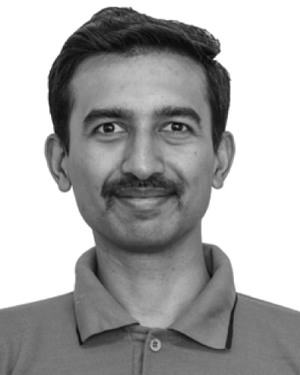 Pratap Tumkur Renukaswamy合作论文数1
 S. Hamed Javadi合作论文数Electr. Eng. Dept., Ferdowsi Univ. of Mashhad;c;Electr. Eng. Dept., Ferdowsi Univ. of Mashhad1
 F. Goldfarb合作论文数1
 Nereo Markulić合作论文数Imec1
 Quentin Vinckier合作论文数1
 Jan Craninckx合作论文数Interuniversity Micro-Electronic Centre1
 Felice Crupi合作论文数a;Dipartimento di Fisica della Materia e Tecnologie Fisiche Avanzate and INFM;a; Dipartimento di Fisica della Materia e Tecnologie Fisiche Avanzate and INFM1
 Pietro Russo合作论文数Institute for Polymers, Composites and Biomaterials, National Research Council1
 Karthick Nagaraj Parashar合作论文数1
 Aliakbar A. Gorji合作论文数Amirkabir University of Technology1
 François Duport合作论文数1
 Philippe De Doncker合作论文数Université libre de Bruxelles1
 Tim Verbelen合作论文数VERSES AI Research Lab1
 Tom Torfs合作论文数IMEC1Arianna Smerieri合作论文数Sleep Disorders Center, University of Parma1
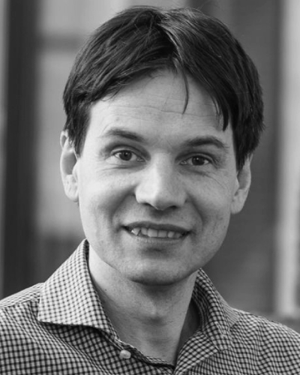 Kristof Vaesen合作论文数RFCDM-SSET, IMEC1
 Ilja Ocket合作论文数1




